• Our new ticketing site is now live! Using either this or the original site (both powered by TrainSplit) helps support the running of the forum with every ticket purchase! Find out more and ask any questions/give us feedback in this thread!

L&Y Goods Yard Entrance Circa 1890

Status
Not open for further replies.

Andy873

Established Member
Joined
23 Mar 2017
Messages
1,424
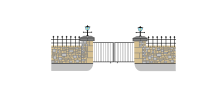
I've spent the last couple of days drawing an L&Y branch line goods yard entrance (attached).

Now I know the entrance posts had gas lights, and thanks to Google Earth's street view I was able to confirm the walls either side of the posts had metal railings (except the actual design of them), but where would the notice board with the opening hours be? on the wooden gate?

Could someone remind me please of what would be the general opening hours (Monday - Saturday) of a goods yard back around 1890?

Do we have any example of goods yard opening hour boards?

Finally, what do you think of my impression of the goods yard entrance?

Thanks.
 

Attachments

  • Goods Yard Entrance GH.png
    Goods Yard Entrance GH.png
    14.3 KB · Views: 21
Sponsor Post - registered members do not see these adverts; click here to register, or click here to log in
R

RailUK Forums

Gloster

Veteran Member
Joined
4 Sep 2020
Messages
13,055
Location
Up the creek
A few general comments. A goods yard entrance was a mundane matter and I doubt that the boundaries were marked by anything except a fence ending in a couple of solid gateposts, possibly a bit more substantial if they had gas lights on them. Of course, there were occasions when there were more elaborate arrangements to please councils or some local nobs, but mostly the attitude was that it was only a goods yard and they were likely to get rough treatment, so cheap repair was a factor.

Opening times could be anything from 06.00, 07.00 or 08.00 to 18.00 or later; Saturdays could have an early afternoon closure. By agreement some traders might be able to load or unload outside the official hours, which were related to the staffing hours.

The notice board would most likely be just behind and raised up above the fence, and to one side or other of it, possibly facing the main direction of arriving road traffic. If it was on the gate it would be less obvious as they were often left open during opening hours or all round the clock.

To a certain extent the railway knew that it could not prevent pilferage, although it made reasonable attempts to prevent it. However, it did clearly delineate its boundaries, so that if you were inside them you would need to explain yourself.
 

Pigeon

Member
Joined
8 Apr 2015
Messages
1,123
Your picture reminds me a bit of photos I have seen on janfordsworld of some of the entrances to the older parts of the Liverpool docks area; although those are somewhat grander, I find the general style reminiscent. I agree that most goods yards would be unlikely to be that impressive. I've encountered quite a few old photos of the frontage of the Midland goods depot at St Pancras, no less, while researching rumours of westward extensions to the Widened Lines to see how true they were (not, really), and even that wasn't noticeably grand.

I reckon your best bet is to hunt around the internet for old photos of some actual L&Y goods yard entrances and see what they looked like. Might be a bit of a pain, but at least it's sort of possible. I would expect that searching directly for goods yard entrances would be largely fruitless, and that it would be more productive to search for things like more "famous" buildings etc. that were near a goods yard entrance, or of some event that took place in the same street - maybe a parade or something, maybe the upheaval of roadworks to install tram rails in the town when trams first came in (often well recorded in local history archives) - and see what you can see by peering at the background.
 

eldomtom2

On Moderation
Joined
6 Oct 2018
Messages
2,401
Now I know the entrance posts had gas lights, and thanks to Google Earth's street view I was able to confirm the walls either side of the posts had metal railings (except the actual design of them)
Are you talking about a specific goods yard entrance? This makes it sound like you are.
 

Andy873

Established Member
Joined
23 Mar 2017
Messages
1,424
A few general comments. A goods yard entrance was a mundane matter and I doubt that the boundaries were marked by anything except a fence ending in a couple of solid gateposts, possibly a bit more substantial if they had gas lights on them. Of course, there were occasions when there were more elaborate arrangements to please councils or some local nobs
As always some goods points made, thanks.

It does appear that the entrance to the yard was that little bit more elaborate, with regards to where the board with the opening times was, maybe it (or more than one) was secured to the metal railings? I say possibly more than one board as the yard entrance is actually on the corner of two roads, so maybe one on each side.

Are you talking about a specific goods yard entrance? This makes it sound like you are.
Yes I am, but thought a more general approach might yield some answers.

I reckon your best bet is to hunt around the internet for old photos of some actual L&Y goods yard entrances and see what they looked like. Might be a bit of a pain, but at least it's sort of possible. I would expect that searching directly for goods yard entrances would be largely fruitless, and that it would be more productive to search for things like more "famous" buildings etc. that were near a goods yard entrance, or of some event that took place in the same street - maybe a parade or something, maybe the upheaval of roadworks to install tram rails in the town when trams first came in (often well recorded in local history archives) - and see what you can see by peering at the background.
Thanks for the suggestions, some of them I've already tried though, I do have a few photos but all of them are from a distance and don't show the yard side / entrance. However I'll try your other suggestions!

I've contacted (today) English Heritage as they have entries for this station and the other two on the line, will let everyone know how I get on as I'm sure they must have more details on other stations too, perhaps one of interest to someone else.

To a certain extent the railway knew that it could not prevent pilferage, although it made reasonable attempts to prevent it. However, it did clearly delineate its boundaries, so that if you were inside them you would need to explain yourself.
Regarding the main gates themselves - I know during business hours they were left open... One poor boy had sneaked in hoping to catch birds, he set his "trap" under an empty coal wagon which was at the end of a rake of wagons. Later when he sneaked back to see if he had caught anything he was killed when the wagons were shunted.

At the inquest, his father (clearly upset) complained that the yard gates were always left open during the day, and that the yard had low walls. Maybe after this accident the railings were installed? or perhaps they were there from the start, who knows!

Regarding the metal railings - could they have been cut down during the second world war? I know many railings were cut then for the war effort...

 

Sir Felix Pole

Established Member
Joined
21 Oct 2012
Messages
2,221
Location
Wilmslow
The 'Britain from Above' site is very good for viewing railway installations for modelling purposes - it has a huge collection of aerial photographs taken across the country from the 1920s onwards. If you create an account, you can logon and zoom in to quite fine detail.

Here is the (LNWR) goods station at Heaton Norris, Stockport for example.

Heaton Norris
 

norbitonflyer

Established Member
Joined
24 Mar 2020
Messages
5,847
Location
SW London
The entrance might be more ornate if the goods yard had started life as a passenger station, such as Nine Elms, Bricklayers Arms or Bishopsgate in London.
 

Andy873

Established Member
Joined
23 Mar 2017
Messages
1,424
The 'Britain from Above' site is very good for viewing railway installations for modelling purposes - it has a huge collection of aerial photographs taken across the country from the 1920s onwards. If you create an account, you can logon and zoom in to quite fine detail.

Here is the (LNWR) goods station at Heaton Norris, Stockport for example.

Heaton Norris
Thanks for that idea but I've already tried it and there's no clear view of the goods yard, but still appreciated!

The entrance might be more ornate if the goods yard had started life as a passenger station, such as Nine Elms, Bricklayers Arms or Bishopsgate in London.
Thanks, unfortunately this station's yard was always a yard.

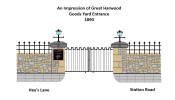
Attached is my final impression of the goods yard entrance 1890.

Thanks everyone!
 

Attachments

  • Goods Yard Entrance GH.png
    Goods Yard Entrance GH.png
    23.4 KB · Views: 11

Gloster

Veteran Member
Joined
4 Sep 2020
Messages
13,055
Location
Up the creek
Thanks for that idea but I've already tried it and there's no clear view of the goods yard, but still appreciated!


Thanks, unfortunately this station's yard was always a yard.

Attached is my final impression of the goods yard entrance 1890.

Thanks everyone!

The goods yard entrance is right at the bottom of the photo, on the left of the approach to the long road bridge. The long lane on the near side of the lines going from it towards the left hand edge of the photo was presumably the access for road vehicles. It is difficult to see, but there might be a notice on the fence to the right of the gates (or it might be a blemish on the negative). You can see that the entrance is just a basic fence and gates.

I am afraid that your impression looks much too elaborate to my eyes. There were occasions when the gates and fence boundary were ‘de luxe’, but this was only when it was necessary: the norm was simplicity.
 

Andy873

Established Member
Joined
23 Mar 2017
Messages
1,424
I am afraid that your impression looks much too elaborate to my eyes. There were occasions when the gates and fence boundary were ‘de luxe’, but this was only when it was necessary: the norm was simplicity.
Point taken!

Question - The yard side walls have rounded capping stones on top, these stones have one hole each in the middle. Now if there is a corresponding hole on the other side then could these holes have been used so they could be raised into position and not for railings at all?
 
Status
Not open for further replies.

Top