• Our new ticketing site is now live! Using either this or the original site (both powered by TrainSplit) helps support the running of the forum with every ticket purchase! Find out more and ask any questions/give us feedback in this thread!

Rail Freight Flows and News UK

Adrian Barr

Member
Joined
2 Jul 2020
Messages
776
Location
Doncaster
I've not seen any mention of them making use of rail again but surely given the expected volumes they can't leave it all to road transport?

The problem is that there is unlikely to be a point-to-point flow with enough volume over a sufficient distance to make rail transport viable. The incoming cardboard waste will be coming from all over the UK, and there are unlikely to be outgoing trainload volumes (of tissues?) to a single location.

Even when the paper mill was sending traffic by rail, the outgoing products were in wagonload quantities - although trainloads of timber were received: https://www.flickr.com/photos/lickeybanker/12232727483/
This shot from 1993 is interesting, indicating that both timber and paper traffic had survived the end of Speedlink: https://www.flickr.com/photos/penmorfas/50500985392/

Paul Shannon's "Rail Freight Since 1968" book on wagonload traffic mentions a two-way flow of paper in the EWS era between Shotton and Irvine, with newsprint going north for Scottish distribution and magazine paper coming south for English / Welsh distribution. The flow is mentioned in this 2004 shot by Adrian Nicholls of an Enterprise train at Barassie: https://www.flickr.com/photos/36034969@N08/4963602784/
Although that two-way flow ended, in 2008 UPM at Shotton were sending paper to the Howard Tenens (formerly Stora) warehouse at Ripple Lane. This is no doubt the traffic seen in this 2008 shot (which is actually quite a long train considering it was still a wagonload flow): https://www.flickr.com/photos/penmorfas/50221549772/
That must have been the last flow to or from Shotton paper mill, ending probably not long after that photo around 2009, along with most of the remaining wagonload network.

Paul Shannon's book also mentions paper flows from Caledonian Paper at Irvine (in the EWS era) to Antwerp (via the Channel Tunnel) and Purfleet. This 2003 shot of an Enterprise train mentions similar traffic: https://www.flickr.com/photos/36034969@N08/53265188606/
I think the last paper flow from Irvine was to Daventry.

It's a shame the various paper flows (including the Stora traffic) all ended, but then again overall volumes of paper production must have dropped a lot due to the internet. Ignoring the lack of track mentioned in the above post (!) I could imagine a flow from Shotton to somewhere like Daventry (plugging it into the supermarket distribution chain) but the distance is not huge and I'll be very surprised to see any rail traffic generated.
 
Sponsor Post - registered members do not see these adverts; click here to register, or click here to log in
R

RailUK Forums

Steveswan10

Member
Joined
11 Aug 2016
Messages
152
Location
Herefordshire
Hi I've noticed that the daily Margam/Llanwern to Dee Marsh has been getting longer the last couple of weeks. When I was a kid it used to be twice daily with around 15-20 wagons (the old open BAA/BBA wagons with the odd covered wagon in the consist) to the covered BYA's to the now much smaller IHA's which usually had between 20 and 25 wagons but the last couple of weeks there running at 27 (mixture of IHA's and BYA's), is there more of a need of steel up at Shotton and could we see the regular return of the second afternoon train? Any thoughts??
 

Gaz67

Member
Joined
21 Feb 2022
Messages
176
Hi I've noticed that the daily Margam/Llanwern to Dee Marsh has been getting longer the last couple of weeks. When I was a kid it used to be twice daily with around 15-20 wagons (the old open BAA/BBA wagons with the odd covered wagon in the consist) to the covered BYA's to the now much smaller IHA's which usually had between 20 and 25 wagons but the last couple of weeks there running at 27 (mixture of IHA's and BYA's), is there more of a need of steel up at Shotton and could we see the regular return of the second afternoon train? Any thoughts??
Shotton takes steel from the blast furnaces at Port Talbot and coats it (lot more to it obviously). With the closure of the blast furnaces this steel will be imported or possibly come from Scunthorpe for a bit. The trains may still come up from South Wales but theoretically if say the steel is imported from Holland then it may come through Immingham or Hull. Everything is up in the air now due to this crazy decision . I will leave it there for the sake of my blood pressure.
 

Adrian Barr

Member
Joined
2 Jul 2020
Messages
776
Location
Doncaster
Hi I've noticed that the daily Margam/Llanwern to Dee Marsh has been getting longer the last couple of weeks. When I was a kid it used to be twice daily with around 15-20 wagons (the old open BAA/BBA wagons with the odd covered wagon in the consist) to the covered BYA's to the now much smaller IHA's which usually had between 20 and 25 wagons but the last couple of weeks there running at 27 (mixture of IHA's and BYA's), is there more of a need of steel up at Shotton and could we see the regular return of the second afternoon train? Any thoughts??

There was a minor derailment on the internal rail system at Shotton recently that resulted in more empty wagons on site than normal (i.e. at least one train must have returned light engine instead of taking out empty wagons). The incoming 6M76 normally runs with 25 wagons as usual. There was a one-off second train on 13th September when 66092 brought in 25 wagons as 6M86, arriving around 7pm and returning as 6V80.
It's seen here crossing Cefn Mawr viaduct: https://www.flickr.com/photos/whosoever2/53993827288/

Photo of the exchange Sidings at Dee Marsh with 08823 and 66734, earlier this year before the switch from GBRF to DB haulage: https://www.flickr.com/photos/195339731@N04/53615256790/
Corus coil warehouse at Shotton with EWS-liveried 08593 back in 2006: https://www.flickr.com/photos/tunnyspics/4605963293/

Shotton takes steel from the blast furnaces at Port Talbot and coats it (lot more to it obviously).

The coils for Shotton are mainly loaded at Llanwern now. Although the train starts at Margam, like a lot of the other Tata services it can be used for other traffic between Margam and Llanwern. A Margam - Dee Marsh train might effectively be functioning as a Port Talbot - Llanwern service and a Llanwern - Shotton service, with the same loco taking different wagons from Llanwern. Shotton also sends out small volumes of finished steel coil traffic (less than 10 wagons per train) on some of the the otherwise empty trains going back to South Wales. Destinations are usually Round Oak, Llanwern or Newport Docks (forwarded on existing services from South Wales).

There's been a shift in traffic flows since the closure of Blast Furnace 5 at Port Talbot in early July. With Blast Furnace 4 reportedly shutting down on Monday (30th September) there will no doubt be further changes.

Port Talbot has still been sending out hot-rolled coil (usually in open wagons, although the Hartlepool flow also uses covered wagons for some reason) to the usual destinations of Trostre, Corby, Hartlepool and Llanwern. Trostre has been supplemented with coil arriving through Cardiff Docks. Corby has been getting trains from Tees (loaded at Middlesbrough Goods) in addition to Port Talbot. Hartlepool has also been getting coil from both Port Talbot and imports through the Port of Middlesbrough (loaded at Middlesbrough Goods). There seems to have been a reduction in the number of Margam - Llanwern trains, probably because as more coil is loaded at Llanwern, there is additional space on existing trains (e.g. Margam to Round Oak or Dee Marsh) to move inter-works traffic from Port Talbot to Llanwern.

Cold-rolled coil to Round Oak is now mainly loaded at Llanwern, but some has also been coming from Port Talbot. Middlesbrough Dawsons traffic (cold-rolled coils for delivery to Nissan) is similar, with most wagons loaded at Llanwern. Export traffic from South Wales through Hull and Immingham (with the Hull traffic detached at Rotherham and sent as a separate train) is less frequent but has run occasionally, again mostly loaded at Llanwern.

Despite increasing imports, Port Talbot has also been sending coils for export through Newport Docks. The wagons are quite often reloaded with import coils for Llanwern, and Llanwern in turn sends coils for export through Newport Docks! Without knowing the exact type of coils and what processing has been done to them, the multi-way flows are confusing, but I think a lot of it is basically interworks traffic between South Wales and Ijmuiden in the Netherlands, quite likely hot-rolled coil being imported and cold-rolled coil being exported. An interesting example was a wagon loaded at Port Talbot with coil for Llanwern, reloaded at Llanwern with export coil for Newport Docks, reloaded at Newport Docks with import coil for Llanwern, and then reloaded at Llanwern with coil for Round Oak! So coils to places like Round Oak and Shotton which have been loaded at Llanwern have probably been cold-rolled at Llanwern using hot-rolled-coil which has come either from Port Talbot or imported through Newport Docks. In turn, hot-rolled-coil from Port Talbot currently uses slab produced on site, but the slab has also been supplemented with imports through Cardiff and Newport Docks (and also Portbury - where slab trains should resume on monday - 30th Sep - running as 6Z50 / 6Z51).

With the closure of the blast furnaces this steel will be imported or possibly come from Scunthorpe for a bit. The trains may still come up from South Wales but theoretically if say the steel is imported from Holland then it may come through Immingham or Hull. Everything is up in the air now due to this crazy decision

Scunthorpe could theoretically supply Port Talbot with slab (as it has done in the past) but as British Steel and Tata are now completely different companies this in unlikely. From comments in interviews on the Tata UK YouTube channel - https://www.youtube.com/@TataSteelUK - the imported steel needed to replace that coming from the Port Talbot blast furnaces is mainly coming from the big Tata plant at Ijmuiden in Holland and from Tata plants in India, with a small amount from China. They mention that stocks of slab at Port Talbot have been built-up to help maintain the supply to the rolling mills after the blast furnace closure.

You mention Immingham: In addition to occasional export steel from South Wales through Immingham, Tata have run a couple of trains from Immingham to Wolverhampton in the same 6M99 path as the existing service, which is normally a completely separate coil flow for a different customer. There has also been a new flow from Llanwern to Wolverhampton Steel Terminal recently (6M59 loaded / 6V52 empties) - as seen here at Washwood Heath - https://www.flickr.com/photos/89144442@N05/54009371802/

It will be interesting to see how all this settles down in terms of rail flows, but for the moment the biggest transport effect of closing the blast furnaces has been the end of raw materials (coal / coke / iron ore) arriving by sea. The "tar tanks" to Middlesbrough Goods stopped a while ago (a by-product of the coke ovens), and the lime trains from Hardendale will not be required, but hopefully a lot of the other rail traffic will continue (in some cases from different sources) with the future potential for scrap traffic to the proposed arc furnace at Port Talbot. Edit: another traffic affected is the loading of slag at Port Talbot Grange Sidings, for use as aggregate, although I don't think any trains had run for a couple of months last time I looked.

======
Edited to include a link to this nice drone shot of some of the extensive sidings within Port Talbot steelworks: https://railphotoanthology.weebly.com/uploads/7/0/6/6/7066978/dji-0069ed_orig.jpg
The view is looking towards Margam Yard, which is barely visible in the distance. There are hot-rolled coil wagons in the sidings to the right, the container loading / unloading area in the centre for both the Hardendale lime and Middlesbrough Goods "tar tanks" traffic, with more sidings to the left. The hot rolling mill is out of shot to the left (accessed by some of the lines that cross the internal roadway), with the large building on the left part of the cold rolling mill which has a loading bay on the other side. The line to the slab yard runs on the other side of the small pond to the extreme right, with the line to Port Talbot Grange sidings (slag loading / coal and scrap unloading) out of view somewhere to the right of that.

For reference I'll link the thread I made a while back on the Port Talbot internal rail system:
https://www.railforums.co.uk/thread...reight-flows-and-internal-rail-system.257742/
 
Last edited:

Gaz67

Member
Joined
21 Feb 2022
Messages
176
Interesting read as ever Adrian. So to simplify this , large billets from the continent or far east go to the mill at Llanwern to be converted into coil, this coil then travels to Shotton for coating, is this correct?.
 

geordieblue

Member
Joined
11 Jan 2020
Messages
787
Location
Leeds
There was a minor derailment on the internal rail system at Shotton recently that resulted in more empty wagons on site than normal (i.e. at least one train must have returned light engine instead of taking out empty wagons). The incoming 6M76 normally runs with 25 wagons as usual. There was a one-off second train on 13th September when 66092 brought in 25 wagons as 6M86, arriving around 7pm and returning as 6V80.
It's seen here crossing Cefn Mawr viaduct: https://www.flickr.com/photos/whosoever2/53993827288/

Photo of the exchange Sidings at Dee Marsh with 08823 and 66734, earlier this year before the switch from GBRF to DB haulage: https://www.flickr.com/photos/195339731@N04/53615256790/
Corus coil warehouse at Shotton with EWS-liveried 08593 back in 2006: https://www.flickr.com/photos/tunnyspics/4605963293/


The coils for Shotton are mainly loaded at Llanwern now. Although the train starts at Margam, like a lot of the other Tata services it can be used for other traffic between Margam and Llanwern. A Margam - Dee Marsh train might effectively be functioning as a Port Talbot - Llanwern service and a Llanwern - Shotton service, with the same loco taking different wagons from Llanwern. Shotton also sends out small volumes of finished steel coil traffic (less than 10 wagons per train) on some of the the otherwise empty trains going back to South Wales. Destinations are usually Round Oak, Llanwern or Newport Docks (forwarded on existing services from South Wales).

There's been a shift in traffic flows since the closure of Blast Furnace 5 at Port Talbot in early July. With Blast Furnace 4 reportedly shutting down on Monday (30th September) there will no doubt be further changes.

Port Talbot has still been sending out hot-rolled coil (usually in open wagons, although the Hartlepool flow also uses covered wagons for some reason) to the usual destinations of Trostre, Corby, Hartlepool and Llanwern. Trostre has been supplemented with coil arriving through Cardiff Docks. Corby has been getting trains from Tees (loaded at Middlesbrough Goods) in addition to Port Talbot. Hartlepool has also been getting coil from both Port Talbot and imports through the Port of Middlesbrough (loaded at Middlesbrough Goods). There seems to have been a reduction in the number of Margam - Llanwern trains, probably because as more coil is loaded at Llanwern, there is additional space on existing trains (e.g. Margam to Round Oak or Dee Marsh) to move inter-works traffic from Port Talbot to Llanwern.

Cold-rolled coil to Round Oak is now mainly loaded at Llanwern, but some has also been coming from Port Talbot. Middlesbrough Dawsons traffic (cold-rolled coils for delivery to Nissan) is similar, with most wagons loaded at Llanwern. Export traffic from South Wales through Hull and Immingham (with the Hull traffic detached at Rotherham and sent as a separate train) is less frequent but has run occasionally, again mostly loaded at Llanwern.

Despite increasing imports, Port Talbot has also been sending coils for export through Newport Docks. The wagons are quite often reloaded with import coils for Llanwern, and Llanwern in turn sends coils for export through Newport Docks! Without knowing the exact type of coils and what processing has been done to them, the multi-way flows are confusing, but I think a lot of it is basically interworks traffic between South Wales and Ijmuiden in the Netherlands, quite likely hot-rolled coil being imported and cold-rolled coil being exported. An interesting example was a wagon loaded at Port Talbot with coil for Llanwern, reloaded at Llanwern with export coil for Newport Docks, reloaded at Newport Docks with import coil for Llanwern, and then reloaded at Llanwern with coil for Round Oak! So coils to places like Round Oak and Shotton which have been loaded at Llanwern have probably been cold-rolled at Llanwern using hot-rolled-coil which has come either from Port Talbot or imported through Newport Docks. In turn, hot-rolled-coil from Port Talbot currently uses slab produced on site, but the slab has also been supplemented with imports through Cardiff and Newport Docks (and also Portbury - where slab trains should resume on monday - 30th Sep - running as 6Z50 / 6Z51).


Scunthorpe could theoretically supply Port Talbot with slab (as it has done in the past) but as British Steel and Tata are now completely different companies this in unlikely. From comments in interviews on the Tata UK YouTube channel - https://www.youtube.com/@TataSteelUK - the imported steel needed to replace that coming from the Port Talbot blast furnaces is mainly coming from the big Tata plant at Ijmuiden in Holland and from Tata plants in India, with a small amount from China. They mention that stocks of slab at Port Talbot have been built-up to help maintain the supply to the rolling mills after the blast furnace closure.

You mention Immingham: In addition to occasional export steel from South Wales through Immingham, Tata have run a couple of trains from Immingham to Wolverhampton in the same 6M99 path as the existing service, which is normally a completely separate coil flow for a different customer. There has also been a new flow from Llanwern to Wolverhampton Steel Terminal recently (6M59 loaded / 6V52 empties) - as seen here at Washwood Heath - https://www.flickr.com/photos/89144442@N05/54009371802/

It will be interesting to see how all this settles down in terms of rail flows, but for the moment the biggest transport effect of closing the blast furnaces has been the end of raw materials (coal / coke / iron ore) arriving by sea. The "tar tanks" to Middlesbrough Goods stopped a while ago (a by-product of the coke ovens), and the lime trains from Hardendale will not be required, but hopefully a lot of the other rail traffic will continue (in some cases from different sources) with the future potential for scrap traffic to the proposed arc furnace at Port Talbot.
As usual what a great post, cheers.
 

Steveswan10

Member
Joined
11 Aug 2016
Messages
152
Location
Herefordshire
Good morning, with all the swapping round lately can anyone tell me which loco is on the 0849 Cardiff to Manchester 1W55 this morning as it is not showing up on rtt. Thank you

quite number of them being controlled by 4 different

There was a minor derailment on the internal rail system at Shotton recently that resulted in more empty wagons on site than normal (i.e. at least one train must have returned light engine instead of taking out empty wagons). The incoming 6M76 normally runs with 25 wagons as usual. There was a one-off second train on 13th September when 66092 brought in 25 wagons as 6M86, arriving around 7pm and returning as 6V80.
It's seen here crossing Cefn Mawr viaduct: https://www.flickr.com/photos/whosoever2/53993827288/
I'm pretty sure they have been running up with 27 wagons this week (I'm a signaller at Leominster) but I'll check Monday morning
 

Adrian Barr

Member
Joined
2 Jul 2020
Messages
776
Location
Doncaster
So to simplify this , large billets from the continent or far east go to the mill at Llanwern to be converted into coil, this coil then travels to Shotton for coating, is this correct?.

For the Llanwern - Shotton traffic, as I understand it, Llanwern are taking in hot-rolled coil (either from Port Talbot or imported through Newport Docks) for cold-rolling, with the cold-rolled coils then despatched to Shotton.

While on the topic of Shotton, this video is interesting:

Tata Steel Shotton Introduction


More generally on the current pattern of steel movements and different products:
Import steel heading by ship to South Wales is either in the form of slab (which has to go to Port Talbot for rolling, as the production line for rolling slab at Llanwern was mothballed years ago), or it can be in the form of steel coil (also known as strip or strip coil). Production at Llanwern is based around processing incoming coils (pickling / cold rolling / galvanising / cutting into sheets and so on). I think most of the coils coming into Llanwern would be hot-rolled; but some cold-rolled steel may also be arriving for further processing (both open and covered coil wagons are used from Port Talbot to Llanwern). An idea of operations at Llanwern is given by this Tata webpage - among other things they produce automotive steel (for body panels) and have a production line for the kind of galvanised steel barriers used at the side of roads.
https://www.tatasteeleurope.com/construction/sustainability/performance-at-our-sites/llanwern

For a general terminology of different types of steel see below - for example billet is a specific term not related to the production of steel coil / strip.
Some of this info is taken from the World Steel Association Glossary: https://worldsteel.org/about-steel/glossary/


General gallery of different types of steel products: https://www.wedowds.co.uk/about/gallery (N.B. the only steel moved by rail through Newport Docks is in the form of coil and slab, plus export tinplate from Trostre!)

Billet: A semi-finished steel product with a square cross-section up to 155mm x 155mm [produced at Cardiff Celsa]
Billets are used to make bars and rods (e.g. rebar / wire rod / merchant bar on site at Cardiff Celsa)
>Internal billet move for Celsa at Cardiff, with billets visible stacked 4 high and 8 wide. These will be made into wire rod at the Cardiff Rod Mill (Castle works): https://www.flickr.com/photos/chrisperkins/49828815301/

Bloom: A semi-finished steel product with a square cross-section greater than 155mm x 155mm [produced at Scunthorpe for making "long products" i.e. structural steel, beams, rails e.t.c. ]
>Blooms on FIA wagons at Skinningrove, used for making specialist products: https://www.flickr.com/photos/46120187@N08/52662003892/
https://britishsteel.co.uk/what-we-do/special-profiles/
>Blooms on BDA wagons heading for Skinningrove (loaded 7 wide, with 14 blooms per wagon in this case): https://www.flickr.com/photos/32859789@N02/52608776706/

Plate: A flat-rolled product from slabs or ingots of greater thickness than sheet or strip. [manufactured at Dalzell from slab, but the plate is not moved by rail]

Sections: Structural steel products for use in construction. Beams, columns, piles e.t.c https://britishsteel.co.uk/what-we-do/construction-steel/sections-product-range/
These are produced by British Steel at Scunthorpe and Lackenby (Teesside Beam Mill).
Not currently dispatched by rail but this is a good example of a wagon loaded with steel sections in 2008: https://www.flickr.com/photos/richardajones/6359383205/

Sheet: A flat-rolled product over 12 inches in width and of less thickness than plate [made from cutting strip - this kind of processing is done at Llanwern among other things, but sheets are not moved by rail]

Slab: A semi-finished steel product processed through a continuous caster and cut into various lengths. The slab has a rectangular cross section and is used as a starting material in the production process of flat products, i.e. hot rolled coils or plates. [produced at Port Talbot and Scunthorpe, also imported through Cardiff / Newport / Portbury docks for rolling into strip at Port Talbot]
>Chunky slabs seen loaded to BTA wagons, although larger slabs (in some cases weighing 25 tons) can only have 2 loaded to a BTA due to the weight: https://www.flickr.com/photos/nat37670/53126085150/
Tata slab traffic is now mostly loaded on BYAs converted from coil carriers (3 slabs per wagon is normal): https://www.flickr.com/photos/chrisperkins/53718127375/
The only Tata facility currently processing slab is Port Talbot, so all slab traffic from Newport Docks / Cardiff Docks / Portbury is heading to port Talbot for hot-rolling into strip (i.e "hot rolled coil").
There was a production line at Llanwern for rolling slabs, but this was mothballed years ago and production at Llanwern now involves processing coils from Port Talbot (or imported through Newport Docks).

Strip: Flat steel coil products, with widths of less than 600mm for hot rolled products and less than 500mm for cold-rolled products. The wider flat products are called wide strips.
>"Strip" is firstly hot-rolled from slab (hot-rolled coil) at Port Talbot (or imported). Locations using hot-rolled coil are Trostre tinplate works, Corby tube works, Hartlepool pipe works, and Llanwern.
Hot-rolled coil can then be pickled (surface scaling removed) and cold-rolled (reduced in thickness and turned into a product suitable for use in manufacturing, e.g. for car body panels or domestic appliances).
Hot-rolled coils are the big coils transported in open wagons, often while still hot (can sometimes be seen steaming in the rain!) while cold-rolled coils need to be transported in covered wagons for protection from rain.

Wire Rod: Coiled steel rod which has a number of end uses and applications, including tie wire, mesh, fencing, shelving, shopping carts, wire hangers and nails. A typical use of wire rod from Cardiff Celsa would be in the production of reinforcing mesh, where the wire is welded into a grid to strengthen poured concrete used on constructions projects. [despatched from Cardiff Celsa to Burton in VGA vans]



Last edited:

Gaz67

Member
Joined
21 Feb 2022
Messages
176
It's certainly a complex industry, at least traffic levels don't seem to be adversely affected so far, lime from Shap being the big loss. You mentioned above "proposed electric arc furnace", is the construction of this still not 100% guaranteed?
 

75A

Established Member
Joined
31 Mar 2021
Messages
2,043
Location
Ireland (ex Brighton 75A)
For the Llanwern - Shotton traffic, as I understand it, Llanwern are taking in hot-rolled coil (either from Port Talbot or imported through Newport Docks) for cold-rolling, with the cold-rolled coils then despatched to Shotton.

While on the topic of Shotton, this video is interesting:

Tata Steel Shotton Introduction

More generally on the current pattern of steel movements and different products:
Import steel heading by ship to South Wales is either in the form of slab (which has to go to Port Talbot for rolling, as the production line for rolling slab at Llanwern was mothballed years ago), or it can be in the form of steel coil (also known as strip or strip coil). Production at Llanwern is based around processing incoming coils (pickling / cold rolling / galvanising / cutting into sheets and so on). I think most of the coils coming into Llanwern would be hot-rolled; but some cold-rolled steel may also be arriving for further processing (both open and covered coil wagons are used from Port Talbot to Llanwern). An idea of operations at Llanwern is given by this Tata webpage - among other things they produce automotive steel (for body panels) and have a production line for the kind of galvanised steel barriers used at the side of roads.
https://www.tatasteeleurope.com/construction/sustainability/performance-at-our-sites/llanwern

For a general terminology of different types of steel see below - for example billet is a specific term not related to the production of steel coil / strip.
Some of this info is taken from the World Steel Association Glossary: https://worldsteel.org/about-steel/glossary/


General gallery of different types of steel products: https://www.wedowds.co.uk/about/gallery (N.B. the only steel moved by rail through Newport Docks is in the form of coil and slab, plus export tinplate from Trostre!)

Billet: A semi-finished steel product with a square cross-section up to 155mm x 155mm [produced at Cardiff Celsa]
Billets are used to make bars and rods (e.g. rebar / wire rod / merchant bar on site at Cardiff Celsa)
>Internal billet move for Celsa at Cardiff, with billets visible stacked 4 high and 8 wide. These will be made into wire rod at the Cardiff Rod Mill (Castle works): https://www.flickr.com/photos/chrisperkins/49828815301/

Bloom: A semi-finished steel product with a square cross-section greater than 155mm x 155mm [produced at Scunthorpe for making "long products" i.e. structural steel, beams, rails e.t.c. ]
>Blooms on FIA wagons at Skinningrove, used for making specialist products: https://www.flickr.com/photos/46120187@N08/52662003892/
https://britishsteel.co.uk/what-we-do/special-profiles/
>Blooms on BDA wagons heading for Skinningrove (loaded 7 wide, with 14 blooms per wagon in this case): https://www.flickr.com/photos/32859789@N02/52608776706/

Plate: A flat-rolled product from slabs or ingots of greater thickness than sheet or strip. [manufactured at Dalzell from slab, but the plate is not moved by rail]

Sections: Structural steel products for use in construction. Beams, columns, piles e.t.c https://britishsteel.co.uk/what-we-do/construction-steel/sections-product-range/
These are produced by British Steel at Scunthorpe and Lackenby (Teesside Beam Mill).
Not currently dispatched by rail but this is a good example of a wagon loaded with steel sections in 2008: https://www.flickr.com/photos/richardajones/6359383205/

Sheet: A flat-rolled product over 12 inches in width and of less thickness than plate [made from cutting strip - this kind of processing is done at Llanwern among other things, but sheets are not moved by rail]

Slab: A semi-finished steel product processed through a continuous caster and cut into various lengths. The slab has a rectangular cross section and is used as a starting material in the production process of flat products, i.e. hot rolled coils or plates. [produced at Port Talbot and Scunthorpe, also imported through Cardiff / Newport / Portbury docks for rolling into strip at Port Talbot]
>Chunky slabs seen loaded to BTA wagons, although larger slabs (in some cases weighing 25 tons) can only have 2 loaded to a BTA due to the weight: https://www.flickr.com/photos/nat37670/53126085150/
Tata slab traffic is now mostly loaded on BYAs converted from coil carriers (3 slabs per wagon is normal): https://www.flickr.com/photos/chrisperkins/53718127375/
The only Tata facility currently processing slab is Port Talbot, so all slab traffic from Newport Docks / Cardiff Docks / Portbury is heading to port Talbot for hot-rolling into strip (i.e "hot rolled coil").
There was a production line at Llanwern for rolling slabs, but this was mothballed years ago and production at Llanwern now involves processing coils from Port Talbot (or imported through Newport Docks).

Strip: Flat steel coil products, with widths of less than 600mm for hot rolled products and less than 500mm for cold-rolled products. The wider flat products are called wide strips.
>"Strip" is firstly hot-rolled from slab (hot-rolled coil) at Port Talbot (or imported). Locations using hot-rolled coil are Trostre tinplate works, Corby tube works, Hartlepool pipe works, and Llanwern.
Hot-rolled coil can then be pickled (surface scaling removed) and cold-rolled (reduced in thickness and turned into a product suitable for use in manufacturing, e.g. for car body panels or domestic appliances).
Hot-rolled coils are the big coils transported in open wagons, often while still hot (can sometimes be seen steaming in the rain!) while cold-rolled coils need to be transported in covered wagons for protection from rain.

Wire Rod: Coiled steel rod which has a number of end uses and applications, including tie wire, mesh, fencing, shelving, shopping carts, wire hangers and nails. A typical use of wire rod from Cardiff Celsa would be in the production of reinforcing mesh, where the wire is welded into a grid to strengthen poured concrete used on constructions projects. [despatched from Cardiff Celsa to Burton in VGA vans]


Now that's what I call informative, thank you.
 

geordieblue

Member
Joined
11 Jan 2020
Messages
787
Location
Leeds
It's certainly a complex industry, at least traffic levels don't seem to be adversely affected so far, lime from Shap being the big loss. You mentioned above "proposed electric arc furnace", is the construction of this still not 100% guaranteed?
I believe lime from Shap will continue to travel by rail, with a new export flow to Holland starting. Going out from Tees Dock IIRC.
 

Adrian Barr

Member
Joined
2 Jul 2020
Messages
776
Location
Doncaster
You mentioned above "proposed electric arc furnace", is the construction of this still not 100% guaranteed?

"Proposed" is maybe the wrong word to use; looking at the latest news on Port Talbot, the deal to build it has been finalised with the government earlier this month, so while nothing is 100% guaranteed, it should go ahead:
https://www.theguardian.com/busines...steel-industry-as-2500-jobs-go-at-port-talbot

It was announced earlier this year that the plans would go ahead, but I don't think everything had been agreed at that point:
https://www.tatasteeleurope.com/cor...f-the-art-electric-arc-furnace-in-port-talbot

I believe lime from Shap will continue to travel by rail, with a new export flow to Holland starting. Going out from Tees Dock IIRC.

That's good news.
 

geordieblue

Member
Joined
11 Jan 2020
Messages
787
Location
Leeds
Routed via the Tyne Valley?
Not sure. It seems there was a trial loading a couple of months ago with a JIA hopper attached to Ditton-Dollands Moor: https://www.flickr.com/photos/32865...aVnyp-2p8XWvg-2p8Y3Em-2p61k5s-2p3gEWp-2oZjd11

The comments on this Flickr post give a bit of extra info: https://www.flickr.com/photos/36034969@N08/53845795654/

And then a couple of weeks ago on WNXX someone suggested that it was becoming a permanent flow.

I don’t have any insider info so can’t claim that this is happening with any certainty but it would seem to make sense that the Hardendale site owners wish to keep it operational.
 

Gaz67

Member
Joined
21 Feb 2022
Messages
176
Not sure. It seems there was a trial loading a couple of months ago with a JIA hopper attached to Ditton-Dollands Moor: https://www.flickr.com/photos/32865...aVnyp-2p8XWvg-2p8Y3Em-2p61k5s-2p3gEWp-2oZjd11
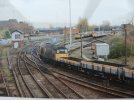
Fingers crossed for this, routed via Copy Pit would be good haha. That pic of the 66 at Arpley is depressing, I was looking at my old pics from 30 years ago recently, some of the last I took at that location , here is the same spot April 94, 15 odd locos stabled.
 

Attachments

  • 20240929_095018.jpg
    20240929_095018.jpg
    1.9 MB · Views: 84
  • 20240929_095030.jpg
    20240929_095030.jpg
    2.1 MB · Views: 82
Last edited:

ExRes

Established Member
Joined
16 Dec 2012
Messages
8,359
Location
Back in Sussex
Info picked up from RTT by an se gen contributor for 8th October so may or may not be an actual running by that time, a new DCR flow

Tuesday 8th 2142 6L16 Willesden DCR to Tilbury RCT, Wednesday 9th loaded 0617 6O56 to East Peckham Tip then 1427 6M99 back to Willesden DCR
 

JKF

Established Member
Joined
29 May 2019
Messages
1,298
Portbury steels are back on again, first run of 6Z50 today with an immaculate looking 66654. I think this traffic might continue in batches to meet imported steel slab flows as ships berth in the docks. I suspect this might also be some of the imported material to keep the rolling mills at Port Talbot going as mentioned by @Adrian Barr above.

Heavy haul 66 became the established traction on the previous workings after problems with a single standard 66 and a few subsequent days of double-heading.

Return loaded trip was 158 minutes late on departure, with arrival time of the inbound service not recorded (though was on time from Parson Street). Wonder if the inbound trip was delayed in the gorge, there are often fallen trees?

IMG_0064.jpeg

(image shows 66654 just visible through the bushes passing beneath the Clifton Suspension Bridge, taken from the bridge)
 

Oxfordblues

Member
Joined
22 Dec 2013
Messages
1,124
Last edited:

geordieblue

Member
Joined
11 Jan 2020
Messages
787
Location
Leeds
A "freight day for Tesco" according to Grocery Trader magazine as Tesco launch their tenth service: 4H43 08:44 Daventry DRS - Trafford Park Euro Terminal and 4B43 17:20 return. Outbound with supplies to stores throughout the North-West and inbound with groceries such as Heinz baked beans from Wigan and Kelloggs breakfast cereals from Trafford Park (back on rail a last): https://grocerytrader.co.uk/a-freight-day-for-tesco-rail-as-10th-rail-service-rolls-into-action/
I enjoyed the quotes from Maritime’s chairman - commenting on how the terminal is ‘uniquely placed’. Seems like a not-so-subtle clapback at some of the discussion this week
 

HST125Scorton

Member
Joined
4 Jun 2019
Messages
156
Location
Atherton
Starting today a new Tesco flow has begun between Daventry and Trafford Park.
In the hands of 88006 today.

4H43 0844 Daventry Drs (Tesco) to Trafford Park Euro Terminal
Returns as 4B43 1720 Trafford Park Euro Terminal to Daventry Drs (Tesco)
 

markymark2000

On Moderation
Joined
11 May 2015
Messages
5,104
Location
Great Britain
A "freight day for Tesco" according to Grocery Trader magazine as Tesco launch their tenth service: 4H43 08:44 Daventry DRS - Trafford Park Euro Terminal and 4B43 17:20 return. Outbound with supplies to stores throughout the North-West and inbound with groceries such as Heinz baked beans from Wigan and Kelloggs breakfast cereals from Trafford Park (back on rail a last): https://grocerytrader.co.uk/a-freight-day-for-tesco-rail-as-10th-rail-service-rolls-into-action/
The article says that the products are going to Widnes distribution centre.... If only there was a rail container terminal directly next to that terminal?! As well as Freightliner just up the road in Garston. What a waste of HGV driving hours when the train could run significantly closer to the distribution centre.
 

Oxfordblues

Member
Joined
22 Dec 2013
Messages
1,124
The article says that the products are going to Widnes distribution centre.... If only there was a rail container terminal directly next to that terminal?! As well as Freightliner just up the road in Garston. What a waste of HGV driving hours when the train could run significantly closer to the distribution centre.
Some of the boxes might be heading to Widnes, but I get the impression that most are destined for direct delivery to stores in the north-west.
 

Malaxa

Member
Joined
9 Mar 2022
Messages
167
Location
London
The first non-Tesco container service into Tilbury 2 was back in July 2022, when there was a short-lived DB service on the same route to Trafford Park, which abruptly ceased the following month!
The official opening of the "new" Tilbury2 - Trafford Park intermodal route was yesterday, September 30, made possible by Network Rail's Access Charge Discount Scheme - the press release is here:

Is this development connected with the simultaneously introduced Trafford Park - Daventry Tesco service?
 

Adrian Barr

Member
Joined
2 Jul 2020
Messages
776
Location
Doncaster
Is this development connected with the simultaneously introduced Trafford Park - Daventry Tesco service?

I'm not sure, but it's interesting that at the Trafford Park end of the DRS Daventry service, they are using the former Euroterminal now operated by Maritime, which is owned by DB. Maybe both services are taking advantage of the access charge discount scheme but are otherwise unconnected.

This news article from last year talks about Maritime taking over management of Tesco's rail operations: https://www.multimodal.org.uk/artic...jor-contract-to-manage-tescos-rail-operations
There are some interesting posts in the thread on Supermarket's use of railfreight, including a bit of news I'd missed that JG Russell bought the Coatbridge terminal from Freightliner in April, leading to the transfer of Tesco trains from Mossend Euroterminal to Coatbridge: https://www.freightliner.co.uk/news/freightliner-sells-coatbridge-terminal-to-john-g-russell/
Similarly, I think the Maritime involvement may be part of the reason for serving their Trafford Park terminal by rail, rather than using the Stobart-operated rail terminal at Widnes, with the article linked by OxfordBlues (post #1429) suggesting that some of the traffic previously routed via the Stobart-run Tesco distribution centre at Widnes is now being sent direct to store from Trafford Park.

=========
Back in posts #1406/1407 we were discussing the recent lack of aggregate trains from Tilbury 2. I'm not sure if there have been any since a few specials ran in April, such as this service to Paddington: https://www.flickr.com/photos/kl47576/53627883260/

However, yesterday (1st October) there was a 6L10 loaded train from Mountsorrel to Tilbury 2 (66603 with 10 JNAs) which returned empty as 6M92 back to Mountsorrel. The CMAT terminal was built for handling imported aggregate, but I suppose there's nothing to stop it receiving stone by rail for local distribution. I'm not sure if this was a one-off or the start of a new flow?
 

furnessvale

Established Member
Joined
14 Jul 2015
Messages
4,906
The article says that the products are going to Widnes distribution centre.... If only there was a rail container terminal directly next to that terminal?! As well as Freightliner just up the road in Garston. What a waste of HGV driving hours when the train could run significantly closer to the distribution centre.
Theoretically, the train could run from Daventry to Widnes, then empty stock to Trafford Park and return to Daventry loaded.

No doubt there are very good reasons why that is not viable.
 

Rail Quest

Member
Joined
8 Apr 2023
Messages
756
Location
Warrington
Theoretically, the train could run from Daventry to Widnes, then empty stock to Trafford Park and return to Daventry loaded.
I'd assume that Widnes to Trafford Park would be the biggest issue there. It would require at least one direction change. The easiest way I could imagine it doing that is running to Crewe BH, loco run around, then back up to Manchester
 

furnessvale

Established Member
Joined
14 Jul 2015
Messages
4,906
I'd assume that Widnes to Trafford Park would be the biggest issue there. It would require at least one direction change. The easiest way I could imagine it doing that is running to Crewe BH, loco run around, then back up to Manchester
Which is why I used the word theoretically and mentioned viability. Even then, the issue of 25-30 HGV skeletals having to return empty to widnes for the next train has not been addressed! :D
 

billh

Member
Joined
7 Jan 2015
Messages
320
A "freight day for Tesco" according to Grocery Trader magazine as Tesco launch their tenth service: 4H43 08:44 Daventry DRS - Trafford Park Euro Terminal and 4B43 17:20 return. Outbound with supplies to stores throughout the North-West and inbound with groceries such as Heinz baked beans from Wigan and Kelloggs breakfast cereals from Trafford Park (back on rail a last): https://grocerytrader.co.uk/a-freight-day-for-tesco-rail-as-10th-rail-service-rolls-into-action/
I thought Kelloggs were closing their Trafford Park factory soon? "Back on rail " may be only short term.
 

Top