Our new ticketing site is now live! Using either this or the original site (both powered by TrainSplit) helps support the running of the forum with every ticket purchase! Find out more and ask any questions/give us feedback in this thread!
Talk of infrastructure investment made me think of the number of times my train has sat outside Shrewsbury waiting for a platform. In theory the station is not that busy so is it something a few more points to enable parallel moves could fix?
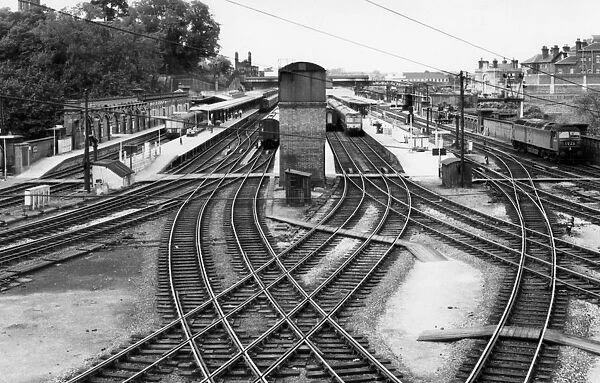
It'd need more than just a few sets of points. Cardiff-Manchester trains must use platform 4, Manchester-Cardiff trains can use 4 or 7. Obviously if they use 4 it conflicts with a train coming the other way (to Crewe or Wrexham), or reversing. If they use 7 the departure conflicts with anything coming into or out of the bays (I.e. Telford line trains). The junction layout is very constrained by the tight curves on 3 of the 4 lines leading out of Shrewsbury (to Crewe, Telford and Hereford).
Without demolishing the station and starting again it's difficult to see where the layout could be improved from a track layout view, although improved signalling would help a little bit.
Would it to a great extent though? You would gain at station stops marginally, but unless there are significant step changes in speed along the route,its not going to get a lot.
It'd need more than just a few sets of points. Cardiff-Manchester trains must use platform 4, Manchester-Cardiff trains can use 4 or 7. Obviously if they use 4 it conflicts with a train coming the other way (to Crewe or Wrexham), or reversing. If they use 7 the departure conflicts with anything coming into or out of the bays (I.e. Telford line trains). The junction layout is very constrained by the tight curves on 3 of the 4 lines leading out of Shrewsbury (to Crewe, Telford and Hereford).
Without demolishing the station and starting again it's difficult to see where the layout could be improved from a track layout view, although improved signalling would help a little bit.
Could Platform 4 (and/or 7) be split in half in any helpful way? The lines exist without platform faces to facilitate a split.
I assume 4 is the most useful for a split as the Manchester bound train can use the southern half then go around the southbound train from Wrexham if that is occupying the north half of the platform (or vice versa have the arrival from Wrexham run all the way to the south and the Manchester train use the centre line to reach the northern half of 4).
Another thought is whether you can split platform 1 (or whichever the remaining platform on that side is) so that trains can use the southern half and still make it across to Manchester? Alternatively by splitting platform 1, the arrival from Wrexham can arrive while there is a train waiting to go towards Wrexham using the other half of platform 1.
I don't know. My gut instinct is not because the lengths of the trains and the platforms aren't going to mean anything worthwhile is left over after the signals and points go in.
I assume 4 is the most useful for a split as the Manchester bound train can use the southern half then go around the southbound train from Wrexham if that is occupying the north half of the platform (or vice versa have the arrival from Wrexham run all the way to the south and the Manchester train use the centre line to reach the northern half of 4).
Another thought is whether you can split platform 1 (or whichever the remaining platform on that side is) so that trains can use the southern half and still make it across to Manchester?
Alternatively by splitting platform 1, the arrival from Wrexham can arrive while there is a train waiting to go towards Wrexham using the other half of platform 1.
I don't know. My gut instinct is not because the lengths of the trains and the platforms aren't going to mean anything worthwhile is left over after the signals and points go in.
I don't think you'd have any useful space left over from a Mk4 set.
I think this is might be the most feasible option but it really doesn't get you very much.
This just feels like a recipe for a massive delay repay bill.
Presumably, the use of any split platform would only be necessary under disruption, since most of the time it should be possible to schedule the Manchester bound train from 4 in a way that did not conflict with 4 being needed for the arrival from Wrexham. So a split platform 1 as a resilience measure is about the only workable change.
There would be another presumption that any fast Cardiff to Manchester would run with stock without a separate loco and DVT. Hence the length would be more akin to a 5 car 80x.
It is good to think about ways to remove obstacles to a fast service using the Marches though.
Another related question concerns Hereford. Would split platform(s) be useful there? My thinking on that is the stopping service can arrive and sit in Hereford for 10 minutes whilst the faster train arrives then departs. This is what Midland Mainline used to do when they added Turbostars to London St Pancras trains. Passengers from smaller stations north of Leicester could transfer to the HST and then the turbostar continued to pick up the local stops. A similar idea might help passengers at places like Abergavenny and Ludlow not feel like they had been completely left out by the new arrangements.
For clarity though. I think the best service on the Marches is provided by an hourly Manchester, an hourly Chester and maybe the Liverpool later, all of which pick up the main stops every hour (If a local is added in the south then Pontypool and Cwmbran become candidates to be skipped sometimes - Only Whitchurch and Nantwich really feature on my main stops list between Shrewsbury and Crewe)
Being Shropshire based I’d like to offer some observations / food for thought based on discussions with a fair number of local people. Most of those have in turn had discussions with others about both work and leisure trips along the Marches Line.
Many of the trains on the Marches line are overcrowded, two coach trains are often inadequate leading to many complaints, which are evident among local people even if such complaints don’t get as far as being more widely known about. The class 67 hauled sets are very much welcomed by local people for their general comfort, quite apart from having more accommodation.
People from Shrewsbury enjoy being able to reach the larger destinations of Manchester, Hereford and Cardiff without having to stop frequently. This suggests that a service which stops only at Crewe, Shrewsbury, Hereford and Newport could well attract additional passengers, over and above the numbers that already use this route. It’s really not comfortable for longer journeys when the trains stop every 10 minutes or so, with all of the movements and shuffling that takes place. Stopping only once every 45 minutes (or so) would improve comfort significantly.
To add to point 2, we should remember that the roads between these places are pretty dire for quick journeys. For example you’d be hard pressed to do Shrewsbury to Crewe by road in much under an hour, whereas even after the recent addition of some minutes to the present non-stop trains, they still take barely 30 minutes. Shrewsbury to Hereford is more like an hour and a half by road, whereas the non-stop trains were just half of that until the advent of every train stopping at Ludlow (which includes the additional discomfort of the sideways lean in the station due to it being on a curve). The point about all this is that the railways ought to be capitalising on this lack of incentive to make these journeys by road.
The converse to points 2 and 3 is that plenty of passengers also want to use the intermediate stations. My mother is now 88 and lives in Church Stretton, and I’m doing my best to persuade her that she should be making longer journeys these days by train rather than driving (which she still thinks she should be able to). She visits relatives in Lincoln and changes trains at Crewe (plus Nottingham or Newark), but all too often when she returns to Crewe she has to allow over an hour there, because the shorter connection is too tight, and trains from there to Church Stretton only run once every two hours. Of course there will be many other examples, the point is that there are many needs for trains stopping at the smaller stations too.
So the ideal is for faster trains in addition to the existing stopping trains, even if the faster trains only run perhaps two hourly. Naturally additional trains add pressure to the signalling especially where there are long sections as there are on this route, but perhaps the provision of shorter signalling blocks could be considered? I’d also offer the suggestion that in order to reduce pressure north of Crewe and south of Newport, some (but not all) of the stopping trains might only run from Crewe to Newport, given the relative abundance of trains onwards to Manchester and Cardiff.
There has been talk of providing a new Platform 8 at Shrewsbury, which would help greatly with capacity. Platform 3 is used regularly but it isn’t linked to Platforms 4-7, being the other side of the ticket barrier via a subway and numerous steps. A Platform 8 would similarly involve being the other side of the ticket barrier, and in one way would be even worse as a longer walking distance would be incurred, but then we ought to be talking about providing a bridge, and at least Platform 8 would be close to the station car park, which the rest of the station really isn’t!
A concern that hasn’t been mentioned when thinking about any possible upgrades of the service on the Marches Line is the level crossings. Of course road users would encounter additional delays, but the frequency of trains on this route isn’t all that great. However, the most congested crossing point by far, for road traffic, must be Harlescott Crossing, 2 miles north of Shrewsbury station. Here, the various planning authorities have allowed massive growth of retail and industrial units, not to mention housing, all within a mile or so of this crossing point, which all means that road traffic builds up very quickly as soon as the barriers are closed for a train, and at most times of day the road traffic then takes a good 5 minutes to clear. This might not sound much, but believe me it’s enough to create a lot of bad feeling towards the railways, by that majority of people who won’t use any form of transport except their cars. A couple of years ago I was invited to discuss this on Radio Shropshire and did so, when it became clear that a great many people believed that the railway should be shut because of the inconvenience it causes to road users. They were quite dismayed when I told them the railway was here many decades before the roads, and that road traffic is only tolerated at the permission of the railways. The point is, any extra trains would need serious thought, and believe me, it really wouldn’t be easy to provide a bridge for either the road or the railway at this location.
Okay, that’s enough for now. It’s all worth thinking about, but for my part I would like to see fast train services provided on the Marches Line, in addition to the present stopping trains, if we could find a way to do it.
I think you've very fundamentally misunderstood the reality of devolution, as is the case with a lot of your posts and their Cheshire-centric view.
Welsh Ministers want a high capacity and high frequency service to all stations between Cardiff Central and Abergavenny. They're in the driving seat so that's what's happening, whether it delivers good value for money or no.
Anyone asking ‘why faster’ is in denial about the growth it has repeatedly delivered all over the UK rail network. On the Marches that has contributed to the route growing from 5 trains per day each way to todays traffic level.
In a letter in October’s Modern Railways, Chris Gibbs welcomes the recent mk4 PSR improvements and says:
‘Regional Railways….delivered 90mph running for Class 158s in 1992 and made full use of it….13.33 Manchester to Cardiff…in 2h 58min which has yet to be matched…..’
He concludes with…
The Marches line continues to have great potential and I look forward to its future with interest.
Accelerating the Marches services could have no better endorsement.
And that speeding up has resulted in an average of 74 passenger journeys per day between Cardiff and Manchester, or to put it another way about 5 or 2 1/2 per train (depending on how the the 26895 annual journeys are calculated).
That’s considered a great success on the railway is it?
How about running Manchester-Cardiff via Birmingham every 2 hours, using the same path as the existing XC Manchester-Bristol (which also becomes 2-hourly).
On the Marches line there could be an hourly stopper to Crewe (maybe with ad-hoc extensions to Manchester), plus an hourly semi-fast to Liverpool/Holyhead.
How about running Manchester-Cardiff via Birmingham every 2 hours, using the same path as the existing XC Manchester-Bristol (which also becomes 2-hourly).
How about running Manchester-Cardiff via Birmingham every 2 hours, using the same path as the existing XC Manchester-Bristol (which also becomes 2-hourly).
On the Marches line there could be an hourly stopper to Crewe (maybe with ad-hoc extensions to Manchester), plus an hourly semi-fast to Liverpool/Holyhead.
The best timing between Manchester Piccadilly and Bristol Parkway is 2h 50m, and that's when the slots line up best at Birmingham New Street. The best timing between Cardiff Central and Bristol Parkway using a AC-powered train is 30m. Realistically, there is absolutely no chance of lining up Cardiff - Bristol, Bristol - Birmingham and Birmingham - Manchester all together perfectly, but if you did you could achieve 3h 20m.
And that speeding up has resulted in an average of 74 passenger journeys per day between Cardiff and Manchester, or to put it another way about 5 or 2 1/2 per train (depending on how the the 26895 annual journeys are calculated).
That’s considered a great success on the railway is it?
The best timing between Manchester Piccadilly and Bristol Parkway is 2h 50m, and that's when the slots line up best at Birmingham New Street. The best timing between Cardiff Central and Bristol Parkway using a AC-powered train is 30m. Realistically, there is absolutely no chance of lining up Cardiff - Bristol, Bristol - Birmingham and Birmingham - Manchester all together perfectly, but if you did you could achieve 3h 20m.
Presumably such alignment would be achieved by the proposal from @Bertie the bus to switch Manchester to Bristol Temple Meads to Manchester to Cardiff in alternate hours. My understanding is that messes up the diagrams as the Bristol unit spends almost an hour for turnaround in Bristol, but the Cardiff train would need more time to get to Cardiff and turn round.
I assume you could not send the Manchester to Bristol path via Gloucester as that would remove a connection from Manchester/Birmingham to Bristol (albeit that it is only Parkway and not Temple Meads in the hours where the train goes to Cardiff).
Lining slots up through Birmingham is a massive challenge, but probably not impossible.
(Although my thread was more about routes, a thought is splitting/joining at Cheltenham and sending the Cardiff portion via Gloucester)
I think you've very fundamentally misunderstood the reality of devolution, as is the case with a lot of your posts and their Cheshire-centric view.
Welsh Ministers want a high capacity and high frequency service to all stations between Cardiff Central and Abergavenny. They're in the driving seat so that's what's happening, whether it delivers good value for money or no.
You are under a misapprehension; I actually voted for Welsh devolution in 1997, but even with the enhanced powers subsequently granted, it is not full self-government. I support an enhanced Metro-like service from Cardiff to Abergavenny at least every 30 minutes calling at all current stations plus a re-opened Caerleon station, which it is within the powers of the Welsh government to promote. However, its implementation would be subject to agreement from Westminster, as other than the Valley lines north of Cardiff Queen Street, the Welsh government does not control rail infrastructure in Wales. Wales also does not have a direct responsibility for public transport for the population served by the North-and-West main line from Pontrilas northwards. In addition, it is not in control of overall finances in Wales, as it is merely a devolved part of the UK relying on the London-based UK government for its income, and subject to the financial fortunes of the UK. It is clear that the new Labour government wants to spend as little as it can get away with on rail developments, at least for now.
You are under a misapprehension; I actually voted for Welsh devolution in 1997, but even with the enhanced powers subsequently granted, it is not full self-government. I support an enhanced Metro-like service from Cardiff to Abergavenny at least every 30 minutes calling at all current stations plus a re-opened Caerleon station, which it is within the powers of the Welsh government to promote. However, its implementation would be subject to agreement from Westminster, as other than the Valley lines north of Cardiff Queen Street, the Welsh government does not control rail infrastructure in Wales. Wales also does not have a direct responsibility for public transport for the population served by the North-and-West main line from Pontrilas northwards. In addition, it is not in control of overall finances in Wales, as it is merely a devolved part of the UK relying on the London-based UK government for its income, and subject to the financial fortunes of the UK. It is clear that the new Labour government wants to spend as little as it can get away with on rail developments, at least for now.
Welsh Ministers have control over all TfW services that run within Wales though, even the ones over Network Rail's lines. Control is shared with the Secretary of State in London for all cross-border services, but it's fair to say the Welsh Ministers have more control of the TfW service even in England than the Secretary of State does. Realistically there is no room for cuts to stops south of Hereford. Indeed more stops are likely to be added in future, not cut. It doesn't need to be full self-government. There is a reason so many trains skip Leominster and none but one skip Abergavenny.
A concern that hasn’t been mentioned when thinking about any possible upgrades of the service on the Marches Line is the level crossings. Of course road users would encounter additional delays, but the frequency of trains on this route isn’t all that great. However, the most congested crossing point by far, for road traffic, must be Harlescott Crossing, 2 miles north of Shrewsbury station. Here, the various planning authorities have allowed massive growth of retail and industrial units, not to mention housing, all within a mile or so of this crossing point, which all means that road traffic builds up very quickly as soon as the barriers are closed for a train, and at most times of day the road traffic then takes a good 5 minutes to clear. This might not sound much, but believe me it’s enough to create a lot of bad feeling towards the railways, by that majority of people who won’t use any form of transport except their cars. A couple of years ago I was invited to discuss this on Radio Shropshire and did so, when it became clear that a great many people believed that the railway should be shut because of the inconvenience it causes to road users. They were quite dismayed when I told them the railway was here many decades before the roads, and that road traffic is only tolerated at the permission of the railways. The point is, any extra trains would need serious thought, and believe me, it really wouldn’t be easy to provide a bridge for either the road or the railway at this location.
Okay, that’s enough for now. It’s all worth thinking about, but for my part I would like to see fast train services provided on the Marches Line, in addition to the present stopping trains, if we could find a way to do it.
I suspect that the road was there before the railway. In the past proposals have been made to by-pass this stretch of the line entirely by building a new railway linking to the Wrexham line. This would eliminate the level crossing problem and simplify the track layout at the north end of Shrewsbury station, making all through platforms available for all trains and potentially speeding up the approach. It would, of course, be rather expensive!
Welsh Ministers have control over all TfW services that run within Wales though, even the ones over Network Rail's lines. Control is shared with the Secretary of State in London for all cross-border services, but it's fair to say the Welsh Ministers have more control of the TfW service even in England than the Secretary of State does. Realistically there is no room for cuts to stops south of Hereford. Indeed more stops are likely to be added in future, not cut. It doesn't need to be full self-government. There is a reason so many trains skip Leominster and none but one skip Abergavenny.
Your point about Welsh control of TfW services is understood, and your comment prompted me to do a quick comparison of the ORR passenger data at Abergavenny (AGV) and Leominster (LEO), which is interesting.
The two towns are very similar in population size (around 12,000), and if you look at the passenger statistics it’s actually Leominster which has the highest number of passengers to any single destination, at 78,400 per annum to Hereford. Abergavenny’s single highest trip generator is also Hereford, with only just over half as many passengers, at 40,900, but this is all logical since AGV is almost twice as far from Hereford as LEO is, and many of these trips will be accounted for by commuters, most of whom will only travel on one or two of the daily trains.
But after this, the attraction of LEO for rail passengers is a great deal less than AGV. The top 10 trip generators for each station discounting Hereford, gives 27,500 for LEO, but a far larger amount of 97,600 for AGV. Much of this is again logical, since the only medium sized towns north of LEO are Ludlow and Shrewsbury, which are far smaller than the places south of AGV at roughly comparable distances, ie Newport and Cardiff. Cwmbran also attracts a lot of passengers from AGV, and there is no comparable station near to LEO. London Paddington also attracts a good number from AGV, since it’s a good bit closer in time from London than is LEO.
So here are two conclusions. Firstly, you could say that it’s not all down to the control of Welsh Ministers, to a significant extent it’s due to the relative proximity of locations that people can and want to travel to by rail.
Secondly though, and quite significantly, Shrewsbury and Crewe each attract almost twice as many passengers from AGV than they do from LEO, which is somewhat surprising given that AGV and LEO are almost the same size towns, but that AGV is almost twice as far from Shrewsbury as LEO is. This last statistic lends a lot of weight to the argument that if services are provided, then people will use them!
Your point about Welsh control of TfW services is understood, and your comment prompted me to do a quick comparison of the ORR passenger data at Abergavenny (AGV) and Leominster (LEO), which is interesting.
The two towns are very similar in population size (around 12,000), and if you look at the passenger statistics it’s actually Leominster which has the highest number of passengers to any single destination, at 78,400 per annum to Hereford. Abergavenny’s single highest trip generator is also Hereford, with only just over half as many passengers, at 40,900, but this is all logical since AGV is almost twice as far from Hereford as LEO is, and many of these trips will be accounted for by commuters, most of whom will only travel on one or two of the daily trains.
But after this, the attraction of LEO for rail passengers is a great deal less than AGV. The top 10 trip generators for each station discounting Hereford, gives 27,500 for LEO, but a far larger amount of 97,600 for AGV. Much of this is again logical, since the only towns north of LEO are Ludlow and Shrewsbury, which are far smaller than the places south of AGV at roughly comparable distances, ie Newport and Cardiff. Cwmbran also attracts a lot of passengers from AGV, and there is no comparable station near to LEO, and London Paddington also attracts a good number from AGV, since it’s a good bit closer in time from London than is LEO.
So here are two conclusions. Firstly, you could say that it’s not all down to the control of Welsh Ministers, to a significant extent it’s due to the relative proximity of locations that people can and want to travel to by rail.
Secondly though, and quite significantly, Shrewsbury and Crewe each attract almost twice as many passengers from AGV than they do from LEO, which is somewhat surprising given that they are almost the same size towns, and that AGV is almost twice as far from Shrewsbury as LEO is. This last statistic lends a lot of weight to the argument that if services are provided, then people will use them!
Serve to show the value of not missing these stops.
I think Hereford attracts a lot of students, which would be true from both Abergavenny and Leominster. Certainly, I try to avoid trains that arrive/depart from Hereford at College times.
Well put it this way, my father in law told me many times about living near to Harlescott crossing, with his memories of it being fields all around, and just the odd house here and there. This was in the 1950s, 100 years AFTER the railway was in use. Even I remember there being very little in the way of industrial and retail premises there when I was at school in the 1970s, that's about when the growth all started, and it's been gradually growing ever since. The road was there, but for the first 100 years after the railway was built it was a very lightly used lane with a handful of vehicles a day, and even today its name is still "Harlescott Lane".
== Doublepost prevention - post automatically merged: ==
I suspect that the road was there before the railway. In the past proposals have been made to by-pass this stretch of the line entirely by building a new railway linking to the Wrexham line. This would eliminate the level crossing problem and simplify the track layout at the north end of Shrewsbury station, making all through platforms available for all trains and potentially speeding up the approach. It would, of course, be rather expensive!
I'd not heard of any proposals to by-pass this stretch of line, but at first thought it has some merit, not least for the reasons you've given. The biggest question would of course be how it could be funded, and if only our planners had their act together back in the 1970s there would have been huge opportunities to do so. With so many housing, retail and industrial developments within a mile of the crossing in the last 50 years, the entire cost might have been recoverable from these developments, or at least enough of a contribution to make Network Rail sit up and take notice about taking this further. What an opportunity missed
Aside from this, it would probably require about 4 miles of new railway (depending on the ambitions of the route), and looking at the local OS map there isn't a great deal in the way, ie no rivers, very few buildings, one fairly lightly trafficked A-class road, a handful of of lanes, and nothing too challenging for gradients. Interesting, but alas I can't see Network Rail rushing into it.
Unless of course the next opportunity is taken. Shrewsbury is supposedly getting its new Northwest Relief Road (NWRR) in the next couple of years, which will cross the Chester line just about where an alternative route towards Crewe might divert. As happens with almost all new roads, it's only a matter of time until new developers will see an opportunity for more development, which can exploit the new road access. Perhaps planning permissions could be given subject to contributions towards the new rail link. Maybe with new developments to relieve pressure on the Harlescott area, perhaps a Park and Rail station could be considered? Ah well, we can but wonder!
Well put it this way, my father in law told me many times about living near to Harlescott crossing, with his memories of it being fields all around, and just the odd house here and there. This was in the 1950s, 100 years AFTER the railway was in use. Even I remember there being very little in the way of industrial and retail premises there when I was at school in the 1970s, that's about when the growth all started, and it's been gradually growing ever since. The road was there, but for the first 100 years after the railway was built it was a very lightly used lane with a handful of vehicles a day, and even today its name is still "Harlescott Lane".
== Doublepost prevention - post automatically merged: ==
I'd not heard of any proposals to by-pass this stretch of line, but at first thought it has some merit, not least for the reasons you've given. The biggest question would of course be how it could be funded, and if only our planners had their act together back in the 1970s there would have been huge opportunities to do so. With so many housing, retail and industrial developments within a mile of the crossing in the last 50 years, the entire cost might have been recoverable from these developments, or at least enough of a contribution to make Network Rail sit up and take notice about taking this further. What an opportunity missed
Aside from this, it would probably require about 4 miles of new railway (depending on the ambitions of the route), and looking at the local OS map there isn't a great deal in the way, ie no rivers, very few buildings, one fairly lightly trafficked A-class road, a handful of of lanes, and nothing too challenging for gradients. Interesting, but alas I can't see Network Rail rushing into it.
Unless of course the next opportunity is taken. Shrewsbury is supposedly getting its new Northwest Relief Road (NWRR) in the next couple of years, which will cross the Chester line just about where an alternative route towards Crewe might divert. As happens with almost all new roads, it's only a matter of time until new developers will see an opportunity for more development, which can exploit the new road access. Perhaps planning permissions could be given subject to contributions towards the new rail link. Maybe with new developments to relieve pressure on the Harlescott area, perhaps a Park and Rail station could be considered? Ah well, we can but wonder!
Changing the signalling and inserting a new high-speed junction would be pretty darn disruptive and costly. It'd also be a mammoth process to get consent for the new line cutting across open country, even if the land were already secured commercially. The benefits would be pretty dubious as it'd be slightly further for trains to run too.
One reason may be that Abergavenny station acts as a railhead for a much wider area, including the Heads of the Valleys (especially Blaenau Gwent) and the Usk Valley (Brecon/Crickhowell), whereas Leominster does not. Towns formerly linked to Leominster by rail (Bromyard, Kington) no longer have regular bus services to it, just to Hereford. Abergavenny also has a major hospital (Nevill Hall), although its role has been partially downgraded following the opening of Grange University Hospital at the site of Llanfrechfa Grange Hospital on the eastern side of Cwmbran.
Here's a timetabling suggestion.
Premise - standardised times at Piccadilly, Crewe and Newport/Cardiff (ideally Shrewsbury too); alternating cl67 and 197 timings.
1. The 197 has time for 2 (?3) extra stops between Crewe and Newport so:
cl67 calls Shrewsbury and Hereford only, 197 calls Nantwich and Ludlow.
You can obviously decide to add one more stop to each - for example you could make Nantwich hourly and Whitchurch or Abergavenny 2-hourly - but the basic principle remains.
2. A second Marches service calls all stations Shrewsbury-Newport, coming from Holyhead or Liverpool via Chester alternately (to keep the Senedd happy the Holyhead could skip Gobowen and Ruabon - I'm assuming a 2-hourly Chester-Birmingham is required as well)
3. If TfW so wish, add a Cardiff Abergavenny stopper to give a half-hourly service at that end.
Here's a timetabling suggestion.
Premise - standardised times at Piccadilly, Crewe and Newport/Cardiff (ideally Shrewsbury too); alternating cl67 and 197 timings.
1. The 197 has time for 2 (?3) extra stops between Crewe and Newport so:
cl67 calls Shrewsbury and Hereford only, 197 calls Nantwich and Ludlow.
You can obviously decide to add one more stop to each - for example you could make Nantwich hourly and Whitchurch or Abergavenny 2-hourly - but the basic principle remains.
2. A second Marches service calls all stations Shrewsbury-Newport, coming from Holyhead or Liverpool via Chester alternately (to keep the Senedd happy the Holyhead could skip Gobowen and Ruabon - I'm assuming a 2-hourly Chester-Birmingham is required as well)
3. If TfW so wish, add a Cardiff Abergavenny stopper to give a half-hourly service at that end.
Nice to see someone taking an interest in this, and yes your suggestions are a good starting point, although I'd think a Liverpool-Cardiff train would probably be easier and faster to route via Crewe than Chester. The other thing to add to this route would be the stopper from Crewe to Shrewsbury, and as per my earlier comment, perhaps this could be extended all stations to Newport. There are plenty of onward trains to Cardiff from Newport, and if this train returned from there to Crewe, this would allow the number of trainsets (and staff) needed to be fewer than if it was to run through to Cardiff.
Just out of interest I've had a stab at producing a timetable, purely for fun and focussing only on the Crewe to Cardiff section (ie not taking into account much about conflicting situations). I've compiled this using the existing ATW weekday timetable, and adapting that to provide the following :
One fast train every two hours from Manchester to Cardiff, stopping only at Crewe (xx.10 past the even hours), Shrewsbury, Hereford and Newport. This train to be that which continues to West Wales, offering a faster and more comfortable journey. The Stockport and Wilmslow stops have tentatively been removed, but they could be retained.
This train to be followed at xx.20 from Crewe by a semi-fast Liverpool-Cardiff train, omitting stops at Wrenbury, Prees, Yorton, Church Stretton, Craven Arms and Pontypool, arriving into Cardiff 29 minutes after the above fast train.
At Shrewsbury, the train comes in from Holyhead and follows 15 minutes later, stopping at all stations except Leominster, which is served by other trains. This train serves Pontypool, although that could perhaps become a request stop.
An hour after the fast train, a semi fast train runs fast from Crewe (xx.10) to Shrewsbury, then to Cardiff omitting Church Stretton, Craven Arms and Pontypool.
Ten minutes later at xx.20, a train leaves Crewe stopping at all stations to Newport, where it arrives 10 minutes ahead of the next fast train.
This service pattern retains the same two-hourly level of service at Wrenbury, Prees and Yorton, while Nantwich, Whitchurch and Wem are upgraded to have an hourly service to Shrewsbury and south, and also to Crewe.
Shrewsbury to Newport has 5 trains every two hours instead of 3 at present, stations along the route have various improvements.
The whole point of the Cardiff-Liverpool service is to extend Halton Curve services and connect Liverpool directly with Wrexham. Routing via Crewe and Runcorn defeats the object of this rationale, or routing via Crewe and Chester requires a reversal at Chester.
It'd need more than just a few sets of points. Cardiff-Manchester trains must use platform 4, Manchester-Cardiff trains can use 4 or 7. Obviously if they use 4 it conflicts with a train coming the other way (to Crewe or Wrexham), or reversing. If they use 7 the departure conflicts with anything coming into or out of the bays (I.e. Telford line trains). The junction layout is very constrained by the tight curves on 3 of the 4 lines leading out of Shrewsbury (to Crewe, Telford and Hereford).
A general view of Shrewsbury station in Shropshire showing the platforms and track from the Castle Foregate end, and diesel locomotives at the station. Shrewsbury station opened in October 1848 and continues to be busy to this day. Our beautiful Wall Art and Photo Gifts include Framed Prints...
They have, but operations have also been rationalised quite a lot!
As it's currently set up, for any give route through the station, trains in both directions would be parallel. The bays having a single lead isn't really a problem as trains would be leaving within a couple of minutes of an arrival.
Obviously, for combinations of routes where trains must necessarily cross, it can't be parallel.
Shrewsbury is a prisoner of the geography the GWR has bestowed. The curvature at each end is extreme, and as I said before you'd need to flatten the station and start again to do anything meaningful.
Re: Shrewsbury ‘easy wins’ would it not make sense to connect platform 3 to the Crewe line (currently northbound trains can only depart towards Chester) so as to enable Manchester trains to use another platform when needed?
Obv wouldnt help with creating new parallel moves but would help mitigate any queuing south of the station if pl4 is occupied when a Manchester train arrives
Shrewsbury is a prisoner of the geography the GWR has bestowed. The curvature at each end is extreme, and as I said before you'd need to flatten the station and start again to do anything meaningful.
In fairness to the GWR, it's not obvious how any other layout would have been possible. The station sits directly over the River Severn so that dictates its position vertically, and it's at right angles to the river so any other alignment would have immediately meant a longer bridge. This is also constrained by the proximity of the Castle which was there a long time before the GWR, and the whole of the adjacent town centre is on various slopes which aren't exactly rail-friendly. Then we have the fact that four routes leave directly outside the station, two at each end, and re-aligning any of those would have presented a big further challenge.
So even if we ignored all of the surrounding buildings that arrived after the GWR, it's hard to see a better alignment taking everything else into account. Oh, and finally, the Hereford and Woverhampton routes approach from very different angles, but any attempt at merging those outside the station would have met with the Abbey, which again was there centuries before the GWR!
In fairness to the GWR, it's not obvious how any other layout would have been possible. The station sits directly over the River Severn so that dictates its position vertically, and it's at right angles to the river so any other alignment would have immediately meant a longer bridge. This is also constrained by the proximity of the Castle which was there a long time before the GWR, and the whole of the adjacent town centre is on various slopes which aren't exactly rail-friendly. Then we have the fact that four routes leave directly outside the station, two at each end, and re-aligning any of those would have presented a big further challenge.
So even if we ignored all of the surrounding buildings that arrived after the GWR, it's hard to see a better alignment taking everything else into account. Oh, and finally, the Hereford and Woverhampton routes approach from very different angles, but any attempt at merging those outside the station would have met with the Abbey, which again was there centuries before the GWR!
For sure, although the lines could have joined outside the town. Even today, deviating either the Wrexham (or more likely Crewe) line to join well beyond the station would ease a lot of the alignment issues at the station.
Re: Shrewsbury ‘easy wins’ would it not make sense to connect platform 3 to the Crewe line (currently northbound trains can only depart towards Chester) so as to enable Manchester trains to use another platform when needed?
Obv wouldnt help with creating new parallel moves but would help mitigate any queuing south of the station if pl4 is occupied when a Manchester train arrives
That is in no way an 'easy win' because you'd need a load of custom angle diamonds to cross the Wrexham Lines, and custom S&C for the curvature into the Down Crewe line.
We are aware of an issue with emails from the Forum to Microsoft-based email accounts (hotmail/outlook/live.com email addresses). This is being looked into currently, thanks for your patience meanwhile.