• Our new ticketing site is now live! Using either this or the original site (both powered by TrainSplit) helps support the running of the forum with every ticket purchase! Find out more and ask any questions/give us feedback in this thread!

Help understanding a Bradshaw from 1888

Status
Not open for further replies.

IzzyMarrie

New Member
Joined
26 Sep 2024
Messages
2
Location
Topsham
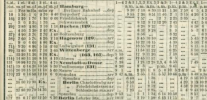
Hi, this is a screenshot from the Bradshaw's Continental Rail Guide September 1888. I'm trying to learn how to read timetables, and while I was looking at this page, I couldn't understand how to read it.

I understand the sections being separated, and that (for example) the middle part is coming from Berlin, while the bottom part is coming from Hamburg. I also understand that it's referencing the miles on the far left (it shows from Berlin to Hamburg, it's a 177 mile long track).

But beyond that, I have a hard time understanding (for example) what m.pf means or what 1 CL, or 2-4 CL are. If traveling the full distance from Hamburg to Berlin, I'm having difficulty understanding whether each town shown is a stop, or why some of those times are 1,2,3 a.m. while only showing one arrival time.

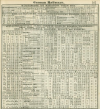
Any help is appreciated. Only other question I would have (in case anyone would know) but did these guides have the cost for these tickets? The original file (link shows the page I was on) https://archive.org/details/BradshawsContinentalRailGuideSeptember1888/page/166/mode/1up is a little daunting from someone who's never read a Bradshaw before!

== Doublepost prevention - post automatically merged: ==

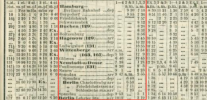
Okay, so I think I misunderstood the 1,2,3 a.m. segment, and that the numbers above the a.m. are maybe train numbers. I included another screenshot but boxed in red what I'm talking about. So would taking the first train from Hamburg to Lehrter Station, according to this, take from 7:10 a.m. - 3:19 p.m. (18 stops)?

== Doublepost prevention - post automatically merged: ==

Appreciate you taking the time to read.
 

Attachments
  • Screenshot_20240926-001252~2.png
    Screenshot_20240926-001252~2.png
    1,012.7 KB · Views: 94
  • Screenshot_20240926-020959~2.png
    Screenshot_20240926-020959~2.png
    400.1 KB · Views: 92
  • IMG_20240926_021341.png
    IMG_20240926_021341.png
    423.9 KB · Views: 91
Last edited:
Sponsor Post - registered members do not see these adverts; click here to register, or click here to log in
R

RailUK Forums

hexagon789

Veteran Member
Joined
2 Sep 2016
Messages
18,304
Location
Glasgow
But beyond that, I have a hard time understanding (for example) what m.pf means or what 1 CL, or 2-4 CL are. If traveling the full distance from Hamburg to Berlin, I'm having difficulty understanding whether each town shown is a stop, or why some of those times are 1,2,3 a.m. while only showing one arrival time.
The 1CL, 2-4CL etc is classes of accommodation. In Britain at this time we had 3 classes, though not all trains conveyed all 3. In Germany they had a 4th Class as well. 1CL is a train with only 1st Class, 2-4CL means it has 2nd, 3rd and 4th Class, Ex. 3CL means it has all except 3rd Class.

That second point is one of the difficulties with old timetables, sometimes it's not clear if a time aganst a place means a station call by that train or the arrival there by a connection. In this case I think your 7.10am example does have all those as stops, but I could be mistaken.
 
Last edited:

Gloster

Veteran Member
Joined
4 Sep 2020
Messages
12,977
Location
Up the creek
Major stations have both arrival and departure times shown, but minor ones will only have one: this is normally the departure, although towards the end of the run they may be arrival ones. Generally, if there is neither at the end of the dots you should look up at the previous are. or dep. appears and then treat it as though there was a ditto in the following lines (Glöwen-Nauen are like this, all dep.). Some stations will have the arr. and dep. separated by other stations that are usually inset: these are connections or a diverging route. You have to know whether these are connections out of or in to the train at the junction: at Spandau the first dep. is for connections to Charlottenberg, Friedrichstrasse and Schlesische (these are all inset); the second dep. at Spandau (not inset) is for the main route on to Lehrter.
 

The exile

Established Member
Joined
31 Mar 2010
Messages
9,372
Location
Somerset
Hi, this is a screenshot from the Bradshaw's Continental Rail Guide September 1888. I'm trying to learn how to read timetables, and while I was looking at this page, I couldn't understand how to read it.

So would taking the first train from Hamburg to Lehrter Station, according to this, take from 7:10 a.m. - 3:19 p.m. (18 stops)?

== Doublepost prevention - post automatically merged: ==

Appreciate you taking the time to read.
Looks like it. Probably a lot more than 18 stops - like the later Continental timetables issued by Cooks this is only a summary timetable showing principle stops. Note the very long layover at Hagenow Land during which it is overtaken by the following train.
 

Sir Felix Pole

Established Member
Joined
21 Oct 2012
Messages
2,170
Location
Wilmslow
The indent indicates connecting services - in this case from Berlin Schelesischer Banhof (renamed Ostbanhof in 1950). It there were through carriages from the indent stations there would be a note to that effect.

Not exactly an expansive service is it - you would think that by 1888 there would be an express service between Berlin and Hamburg?
 

Gloster

Veteran Member
Joined
4 Sep 2020
Messages
12,977
Location
Up the creek
I reckon the distances are in miles as Bradshaw was very much written for the British: none of these foreign distances, thank you. (I have tried checking it against the European Rail Timetable, but my maths is all over the place due to lack of sleep.)
 

hexagon789

Veteran Member
Joined
2 Sep 2016
Messages
18,304
Location
Glasgow
I reckon the distances are in miles as Bradshaw was very much written for the British: none of these foreign distances, thank you. (I have tried checking it against the European Rail Timetable, but my maths is all over the place due to lack of sleep.)
It has 'K. M.' at the top of the column

Edit: at least I thought it did, but I see it's actually an E which has faded.
 

The exile

Established Member
Joined
31 Mar 2010
Messages
9,372
Location
Somerset
Not exactly an expansive service is it - you would think that by 1888 there would be an express service between Berlin and Hamburg?
I wonder if they’re in a separate table (or even running via a different route for some reason). Compared with Berlin and Hamburg, none of the intermediates is exactly significant so it’s surprising that the service seems to have no limited stop services.
That said - railway development in Germany was several decades behind us - though they caught up fairly quickly!
 
Last edited:

Gloster

Veteran Member
Joined
4 Sep 2020
Messages
12,977
Location
Up the creek
I would think that this was the main route from Hamburg to Berlin. There were a couple of not too bad alternatives: to Uelzen and then via Salzwedel to Stendal to join the main route from Hannover, going from Wittenberge to Stendal or a northern swing via Lübeck or Schwerin to Güstrow and Neustrelitz. But all of these are longer, probably slower and unlikely to have many (or any) through trains.
 

The exile

Established Member
Joined
31 Mar 2010
Messages
9,372
Location
Somerset
I would think that this was the main route from Hamburg to Berlin. There were a couple of not too bad alternatives: to Uelzen and then via Salzwedel to Stendal to join the main route from Hannover, going from Wittenberge to Stendal or a northern swing via Lübeck or Schwerin to Güstrow and Neustrelitz. But all of these are longer, probably slower and unlikely to have many (or any) through trains.
There was also the alternative via Lueneburg and Dannenberg to Wittenberge - but that’s unlikely to have been used by expresses.
 

Gloster

Veteran Member
Joined
4 Sep 2020
Messages
12,977
Location
Up the creek
There was also the alternative via Lueneburg and Dannenberg to Wittenberge - but that’s unlikely to have been used by expresses.

I was looking at the reprint of a 1925 map and was limiting my choice to main and secondary lines. There were plenty of zig-zag routes you could take if you had the time and inclination.
 

Sir Felix Pole

Established Member
Joined
21 Oct 2012
Messages
2,170
Location
Wilmslow
According to European Rail TT Hamburg Hbf to Berlin Hbf is 299km (186miles) via Uelzen, Stendal so the distances appear to be in miles - unsurprising for a British publication! Hamburg Hbf was opened in 1906 replacing, amongst others, Berliner Banhof, and Berlin Hbf, of course, 2006 accounting for the discrepancy.
 

30907

Veteran Member
Joined
30 Sep 2012
Messages
21,950
Location
Airedale
The indent indicates connecting services - in this case from Berlin Schelesischer Banhof (renamed Ostbanhof in 1950). It there were through carriages from the indent stations there would be a note to that effect.

Not exactly an expansive service is it - you would think that by 1888 there would be an express service between Berlin and Hamburg?
Two trains in the table are shown as Ex. and are significantly faster with journey times a bit over 5 hours, so about 35mph including stops.
No idea why two are labelled Ex2 and two Ex3, or what Ex incthe 4th class column means. Presumably there are general notes, or notes for each country?
 

etr221

Established Member
Joined
10 Mar 2018
Messages
1,595
It has 'K. M.' at the top of the column

Edit: at least I thought it did, but I see it's actually an E which has faded.
E.M. for English miles, I would think. When European countries went metric, what their previous systems were (many used their own, different, 'miles'), and how long the change took, are matters needing research. Bradshaw was just using what its likely, English, users were used to, rather than having to struggle with unfamiliar foreign units - Cooks Continental TT was still giving distance in miles in 1970.
 

Sir Felix Pole

Established Member
Joined
21 Oct 2012
Messages
2,170
Location
Wilmslow
It is interesting to look at the 1899 Reichsbahn TT for the route (available on Timetable World to view - Table 3) to see how it developed.

DR TT

The service is still pretty 'thin' but at least there is a one recognisable express in each direction, with just one call at Wittenberge.
 

Gloster

Veteran Member
Joined
4 Sep 2020
Messages
12,977
Location
Up the creek
Two trains in the table are shown as Ex. and are significantly faster with journey times a bit over 5 hours, so about 35mph including stops.
No idea why two are labelled Ex2 and two Ex3, or what Ex incthe 4th class column means. Presumably there are general notes, or notes for each country?

Possibly they were expresses and the 2 or 3 indicated that they carried 2nd or 3rd Class as well as 1st: 1st only might have been the default position for expresses. I worked back to the beginning of the German section, but it moved straight from Dutch to German, so presume that the explanatory notes would be right at the beginning of the book.
 

hexagon789

Veteran Member
Joined
2 Sep 2016
Messages
18,304
Location
Glasgow
E.M. for English miles, I would think. When European countries went metric, what their previous systems were (many used their own, different, 'miles'), and how long the change took, are matters needing research. Bradshaw was just using what its likely, English, users were used to, rather than having to struggle with unfamiliar foreign units - Cooks Continental TT was still giving distance in miles in 1970.
I realise that now, I initially read the one on the relevant table as a K but having looked at the markings over the column against other tables I see it is an E.
 

The exile

Established Member
Joined
31 Mar 2010
Messages
9,372
Location
Somerset
Possibly they were expresses and the 2 or 3 indicated that they carried 2nd or 3rd Class as well as 1st: 1st only might have been the default position for expresses. I worked back to the beginning of the German section, but it moved straight from Dutch to German, so presume that the explanatory notes would be right at the beginning of the book.
Do we have a UK Bradshaw from the same year for comparison? Chances are they’ll use similar codes.
 

Gloster

Veteran Member
Joined
4 Sep 2020
Messages
12,977
Location
Up the creek
Do we have a UK Bradshaw from the same year for comparison? Chances are they’ll use similar codes.

There is no help there as the system of provision in the UK was much simpler and so the classes are not indicated. (This is from the reprint of the 1895 edition.)
 

Taunton

Veteran Member
Joined
1 Aug 2013
Messages
12,272
Continental railways long had different classes in different trains - even the 1950s-60s Trans Europe Express network, although quite thin, was fully first class only. I don't know when Germany gave up 4th Class (wooden seats, if any?), but second class lasted to 1956, where in Britain it was mostly abolished by 1900. 3rd class stayed as the default standard because it had been embedded in much legislation.

It was also the case that there was little middle-long distance travel overall, especially in Germany with its onetime separate states. Hamburg was a Free City. Berlin was in Prussia, which itself seems to have rumbled steadily westwards over time, leaving behind much of its origins in what is now Poland (which, likewise, was moved westwards, as if on wheels, by Stalin in 1945). So there wasn't a lot of traffic offering between the different points. The trains in the timetable might anyway have had as many mail/package vehicles as passenger carriages.
 

Bevan Price

Established Member
Joined
22 Apr 2010
Messages
8,329
At least one of the longer station stops will have been a water stop. There may even have been an intermediate loco change, possibly at Wittenberge.
 

IzzyMarrie

New Member
Joined
26 Sep 2024
Messages
2
Location
Topsham
The 1CL, 2-4CL etc is classes of accommodation. In Britain at this time we had 3 classes, though not all trains conveyed all 3. In Germany they had a 4th Class as well. 1CL is a train with only 1st Class, 2-4CL means it has 2nd, 3rd and 4th Class, Ex. 3CL means it has all except 3rd Class.

That second point is one of the difficulties with old timetables, sometimes it's not clear if a time aganst a place means a station call by that train or the arrival there by a connection. In this case I think your 7.10am example does have all those as stops, but I could be mistaken.
Thank you! I don't know why I didn't think of class when I saw the CL, but it makes a lot of sense.

== Doublepost prevention - post automatically merged: ==

I imagine this stands for marks and pfennigs, i.e. they show the fares for the different classes (Cl.)
As it turns out, it does! I had somebody else tell me as such, and I looked it up to confirm.

== Doublepost prevention - post automatically merged: ==

Major stations have both arrival and departure times shown, but minor ones will only have one: this is normally the departure, although towards the end of the run they may be arrival ones. Generally, if there is neither at the end of the dots you should look up at the previous are. or dep. appears and then treat it as though there was a ditto in the following lines (Glöwen-Nauen are like this, all dep.). Some stations will have the arr. and dep. separated by other stations that are usually inset: these are connections or a diverging route. You have to know whether these are connections out of or in to the train at the junction: at Spandau the first dep. is for connections to Charlottenberg, Friedrichstrasse and Schlesische (these are all inset); the second dep. at Spandau (not inset) is for the main route on to Lehrter.
Thank you for the insight. Seriously, everyone's been a lot of help.

== Doublepost prevention - post automatically merged: ==

Looks like it. Probably a lot more than 18 stops - like the later Continental timetables issued by Cooks this is only a summary timetable showing principle stops. Note the very long layover at Hagenow Land during which it is overtaken by the following train.
Thank you!

== Doublepost prevention - post automatically merged: ==

According to European Rail TT Hamburg Hbf to Berlin Hbf is 299km (186miles) via Uelzen, Stendal so the distances appear to be in miles - unsurprising for a British publication! Hamburg Hbf was opened in 1906 replacing, amongst others, Berliner Banhof, and Berlin Hbf, of course, 2006 accounting for the discrepancy.
So funny thing, but I'm an American and actually had no idea that it was standard in Britain to use miles. However, when I was looking at the end station in Berlin on Wikipedia to see what the distance on that track would've been to Hamburg, it showed miles. It was only one number off, so I assumed it had to be miles, but I wasn't sure if it was standard to show miles in Britain (again, always assumed it would be different).

== Doublepost prevention - post automatically merged: ==

Two trains in the table are shown as Ex. and are significantly faster with journey times a bit over 5 hours, so about 35mph including stops.
No idea why two are labelled Ex2 and two Ex3, or what Ex incthe 4th class column means. Presumably there are general notes, or notes for each country?
Thanks for your reply, and to echo another member, it looks like those were express.

== Doublepost prevention - post automatically merged: ==

Oh interesting!
E.M. for English miles, I would think. When European countries went metric, what their previous systems were (many used their own, different, 'miles'), and how long the change took, are matters needing research. Bradshaw was just using what its likely, English, users were used to, rather than having to struggle with unfamiliar foreign units - Cooks Continental TT was still giving distance in miles in 1970.

== Doublepost prevention - post automatically merged: ==

Continental railways long had different classes in different trains - even the 1950s-60s Trans Europe Express network, although quite thin, was fully first class only. I don't know when Germany gave up 4th Class (wooden seats, if any?), but second class lasted to 1956, where in Britain it was mostly abolished by 1900. 3rd class stayed as the default standard because it had been embedded in much legislation.

It was also the case that there was little middle-long distance travel overall, especially in Germany with its onetime separate states. Hamburg was a Free City. Berlin was in Prussia, which itself seems to have rumbled steadily westwards over time, leaving behind much of its origins in what is now Poland (which, likewise, was moved westwards, as if on wheels, by Stalin in 1945). So there wasn't a lot of traffic offering between the different points. The trains in the timetable might anyway have had as many mail/package vehicles as passenger carriages.
Thanks for the bit of history lesson. It's always interesting hearing about different countries, and Germany during the late 1800s has been of interest to me lately. I was studying Victorian England first, and then gravitated over to Germany. It's been a fun rabbit hole.

== Doublepost prevention - post automatically merged: ==

At least one of the longer station stops will have been a water stop. There may even have been an intermediate loco change, possibly at Wittenberge.
What is a water stop? Excuse my ignorance, but would that have been to cool down the train? Or was it to make sure passengers had the time to stretch their legs and get water and food?

== Doublepost prevention - post automatically merged: ==

Also, if it isn't obvious, I'm new to forums, so if anyone got multiple notifications while I was replying to others, I'm sorry. I wasn't sure if I needed to reply to everyone directly, or if I could just post a reply and people would be notified.
 
Last edited:

WesternLancer

Veteran Member
Joined
12 Apr 2019
Messages
15,125
What is a water stop? Excuse my ignorance, but would that have been to cool down the train? Or was it to make sure passengers had the time to stretch their legs and get water and food?
Water stop would be to top up the steam engines water tank which needs to happen periodically during a journey powered by steam engine.

Boiling the water to make the steam is what makes them go so you get through a fair bit of water over the distance. But population density in Europe means you tend to do that top up when also stopping at a station for passengers to get on / off. Might indeed be long enough for people to get refreshments too I suppose.

Same would happen in the US of course but I can’t recall if there is a different US railroading term for it. My sense was that in some unpopulated areas of the US the water stops might be in the middle of nowhere as the railroad was laid through open and depopulated country, although perhaps those stops then became communities simply by virtue of that being where the trains needed to stop to refill water.
 
Last edited:

etr221

Established Member
Joined
10 Mar 2018
Messages
1,595
Continental railways long had different classes in different trains - even the 1950s-60s Trans Europe Express network, although quite thin, was fully first class only. I don't know when Germany gave up 4th Class (wooden seats, if any?), but second class lasted to 1956, where in Britain it was mostly abolished by 1900. 3rd class stayed as the default standard because it had been embedded in much legislation.
Something to note is the British change from 3 to 2 classes was to abolish 2nd (and in general upgrade 3rd class to what it had been). In Europe the class abolished was 1st (which I gather superior to its British equivalent). In many countries 'express' trains were far more distinct, and often 1st & 2nd only (as they often had been in Britain: alongside the Midland revolution in abolishing 2nd class was admitting 3rd to all trains - other companies followed suit) - as 1st went, they got downgraded to 2nd class only. By the 1950s, the only remaining 3 class services were the anglo-continental boat trains, and the system was standardised across Europe by changing our 3rd to 2nd; and continental 2nd and 3rd to 1st and 2nd. That tradition is why TEEs (and the like) were 1st only (might be better understood as 'not lowest (i.e. 3rd)').
It was also the case that there was little middle-long distance travel overall, especially in Germany with its onetime separate states. Hamburg was a Free City. Berlin was in Prussia, which itself seems to have rumbled steadily westwards over time, leaving behind much of its origins in what is now Poland (which, likewise, was moved westwards, as if on wheels, by Stalin in 1945). So there wasn't a lot of traffic offering between the different points. The trains in the timetable might anyway have had as many mail/package vehicles as passenger carriages.
It might be worth comparing with the amount of middle-long distance travel in Britain: how many more long distance trains might there have been here? The idea of medium-long distance travel, and its spread down from the upper class, took time to develop. It was probably earlier and faster in Britain, but Europe followed...

Something I did learn - having been in conversation with a German is that metric system became the national system in 1872, following unification into the 2nd Reich. All those German states had their own units (with different length 'miles')...

== Doublepost prevention - post automatically merged: ==

At least one of the longer station stops will have been a water stop. There may even have been an intermediate loco change, possibly at Wittenberge.
I'm wondering how far locos worked in Germany at the time: it may only have been a 100 miles or so.
 
Last edited:

norbitonflyer

Established Member
Joined
24 Mar 2020
Messages
5,733
Location
SW London
So funny thing, but I'm an American and actually had no idea that it was standard in Britain to use miles.
Certainly would have been in 1888. We didn't go metric in any big way until the 1970s, and never completed the process - even now miles are used for distances and speeds, both on road and rail.
 

Taunton

Veteran Member
Joined
1 Aug 2013
Messages
12,272
Three classes in Europe were still pretty widespread until WW2, which swept away many defunct traditions. Notably, in Germany in the late 1930s, the new high speed FDT diesel trains, of which the best known, the "Flying Hamburger", nonstop Berlin to Hamburg, is very relevant to this thread, were second class only, in the egalitarian spirit of the times, with existing main line services continuing to offer first, second and third classes. The "Hamburger" did only have 100 second class seats in just a 2-car diesel, which shows something of the limited demand even then between the cities.

For loco changes (instead of 'water stops') across Europe, an account in The Locomotive Magazine from 1901 (don't worry, I'm not quite that old, it was reprinted in a recent book) of a journey on The Orient Express describes an incessant series of loco changes, 22 being required between Paris and Istanbul, with four just on the section across France alone, so mostly 100 miles or less. This despite the locos commonly being compounds, one of whose (few) upsides being a saving of water consumption.
 
Last edited:

Rescars

Established Member
Joined
25 May 2021
Messages
2,544
Location
Surrey
...

Something I did learn - having been in conversation with a German is that metric system became the national system in 1872, following unification into the 2nd Reich. All those German states had their own units (with different length 'miles')...

== Doublepost prevention - post automatically merged: ==
To a Victorian user of Bradshaws, I imagine miles would have made sense and anything else would have been confusing. Worth googling German pre-metric units of measurement though. All sorts of intriguing weights and measures. Depending where you were, there were either 10 or 12 zoll (inches) to the fuss (foot). I found a miniature gauge line in Switzerland recently which quotes its track gauge in zoll. Is this sort of thing still commonplace I wonder? Every other track gauge I have come across in Switzerland (of which there are several) has been quoted in metric units.

Was Bradshaw's Continental Guide aimed just at the British market? Was there a homegrown equivalent published in Germany I wonder? If so, it could be entertaining to compare and contrast the contents.
 

Sir Felix Pole

Established Member
Joined
21 Oct 2012
Messages
2,170
Location
Wilmslow
Three classes in Europe were still pretty widespread until WW2, which swept away many defunct traditions. Notably, in Germany in the late 1930s, the new high speed FDT diesel trains, of which the best known, the "Flying Hamburger", nonstop Berlin to Hamburg, is very relevant to this thread, were second class only, in the egalitarian spirit of the times, with existing main line services continuing to offer first class. The "Hamburger" did only have 100 seats in just a 2-car diesel, which shows something of the limited demand even then between the cities.

The Summer 1939 DR timetable does actually show a pretty decent express and semi-fast service apart from the 'Hamburgers' - available on Timetable World - Table 55. I think they were more akin to the 'Coronation' services of the LNER with a supplement charged.

DR 1939

I was surprised how poor the 1888 timetable was - as others have said it took a while for Germany to get its act together after unification.
 
Status
Not open for further replies.

Top