
HMIR is His Majesty's Inspectorate of Railways. The inland revenue is more properly referred to as His Majesty's Revenue and Customs. (HMRC).HMIR, which I always called just Inland Revenue, having a pathological aversion to the concept of Majesty.

-
Our new ticketing site is now live! Using either this or the original site (both powered by TrainSplit) helps support the running of the forum with every ticket purchase! Find out more and ask any questions/give us feedback in this thread!
You are using an out of date browser. It may not display this or other websites correctly.
You should upgrade or use an alternative browser.
You should upgrade or use an alternative browser.
Things in living memory which seem very anachronistic now
- Thread starter GordonT
- Start date
Sponsor Post - registered members do not see these adverts; click here to register, or click here to log in
R
RailUK Forums

Peter Mugridge
Veteran Member
Other way round; it's HMRI - His Majesty's Railway Inspectorate.HMIR is His Majesty's Inspectorate of Railways.
Indeed. I even got it the right way around a few posts back!Other way round; it's HMRI - His Majesty's Railway Inspectorate.

Killingworth
Established Member
Or a snowstorm in a globeone thing which i haven’t seen in an long time is one of those pens which reveals a naked lady when tipped upside down. Or equally a little plastic cruise ship sails from one end of the pen to the other.
one thing which i haven’t seen in an long time is one of those pens which reveals a naked lady when tipped upside down. Or equally a little plastic cruise ship sails from one end of the pen to the other.
On that note - Page 3 girls!
Ah yes, there was a time where the snowstorm in a globe was realistic becaise the fluid was some clear oil. These days it is water which makes the snowflakes settle more like gravel.Or a snowstorm in a globe

brad465
Veteran Member
"Just before we leave let's have a look at tomorrow's papers: The Times and Telegraph lead with industrial strife while in The Sun we can see that Caroline from Dagenham, has got a terrific pair of no*ks." - Hugh Dennis on things you wouldn't hear on a new's programme.On that note - Page 3 girls!
Crystal from Hull always had some fantastic take on astrophysics or economics."Just before we leave let's have a look at tomorrow's papers: The Times and Telegraph lead with industrial strife while in The Sun we can see that Caroline from Dagenham, has got a terrific pair of no*ks." - Hugh Dennis on things you wouldn't hear on a new's programme.
Bradford PA
Member
On the same theme - Topless barmaidsOn that note - Page 3 girls!
Loco-hauled trains which split en route. For example the Birmingham-Glasgow/Edinburgh loco-hauled services of the 80s, including the early years of the "Wessex Scot" and its Paddington-originating predecessor.
They were of course rather an interesting concept and it would be nice to have them back. I never did actually see them split though, Carstairs being further from home than Paris and I was still at school hence no funds to get up there.
== Doublepost prevention - post automatically merged: ==
== Doublepost prevention - post automatically merged: ==
Never knew it was that old: I thought it appeared in around 1982, but that's maybe just because teletext-enabled TVs became more popular round then. Certainly I didn't encounter it, and its ITV version Oracle, until that year.
They were of course rather an interesting concept and it would be nice to have them back. I never did actually see them split though, Carstairs being further from home than Paris and I was still at school hence no funds to get up there.
== Doublepost prevention - post automatically merged: ==
Or a snowstorm in Southern England. Commonplace in the 80s, almost extinct nowadays "thanks" to climate change.Or a snowstorm in a globe
== Doublepost prevention - post automatically merged: ==
This could be in ‘You know you’re getting old’ but Ceefax is 50 years old today. Remember it fondly.
Never knew it was that old: I thought it appeared in around 1982, but that's maybe just because teletext-enabled TVs became more popular round then. Certainly I didn't encounter it, and its ITV version Oracle, until that year.
Last edited:
HMRC is not just the Inland Revenue though - it was a merger of Inland Revenue and HM Customs & Excise.HMIR is His Majesty's Inspectorate of Railways. The inland revenue is more properly referred to as His Majesty's Revenue and Customs. (HMRC).
I don't think the Inland Revenue ever had a HM title preceeding it in documentation.
And lapdancers/poledancers at relatively inauspicious establishments.On the same theme - Topless barmaids

Xenophon PCDGS
Veteran Member
Bernard Manning being his usual self at the Embassy Club....
Merle Haggard
Established Member
The post above about loco-hauled trains splitting en route reminds me of the wheel-tapper at Carstairs when the Glasgow and Edinburgh sections were separated.
When was the last time one was heard?? Certainly seems anachronistic now.
When was the last time one was heard?? Certainly seems anachronistic now.
Xenophon PCDGS
Veteran Member
Grate blacking.
Perhaps the expression "housewife".
Female house occupant scrubbing the front step every week possibly with "Vim" or similar scouring powder.
Really house-proud folk used to put a kind of coloured wax on their step. Blue or red. Then buff it up. Not us.
Same one's whose daughters went to violin lessons.
Female house occupant scrubbing the front step every week possibly with "Vim" or similar scouring powder.
Really house-proud folk used to put a kind of coloured wax on their step. Blue or red. Then buff it up. Not us.
Same one's whose daughters went to violin lessons.
I believe the Caledonian Sleeper still split off the Edinburgh portion at Carstairs.Loco-hauled trains which split en route. For example the Birmingham-Glasgow/Edinburgh loco-hauled services of the 80s, including the early years of the "Wessex Scot" and its Paddington-originating predecessor.

Whistler40145
Established Member
None existence of Risk Assessments
And, on the Highland, the Aberdeen, Fort William and Inverness portions split at Edinburgh.I believe the Caledonian Sleeper still split off the Edinburgh portion at Carstairs.
Peter Wilde
Member
Going out to buy one of those little, brown, cylindrical, bayonet-fitted Bakelite plugs, in order to plug some small electrical appliance into the overhead light fitting in one's bedroom. Also one could get multi-socketed adaptors of the same design, in order to plug things into the light socket while still having the light on. Liable to end up blowing the house fuse if not careful about the wattage of what one was plugging in!
Another thing - going with mother to our local station in South London, not to catch a train, but for her to visit the coal merchant’s office in the goods yard to order our heating fuel for next winter.
Another thing - going with mother to our local station in South London, not to catch a train, but for her to visit the coal merchant’s office in the goods yard to order our heating fuel for next winter.
Already mentioned once or twice earlier in the thread.Going out to buy one of those little, brown, cylindrical, bayonet-fitted Bakelite plugs, in order to plug some small electrical appliance into the overhead light fitting in one's bedroom. Also one could get multi-socketed adaptors of the same design, in order to plug things into the light socket while still having the light on. Liable to end up blowing the house fuse if not careful about the wattage of what one was plugging in!
Killingworth
Established Member
These were still in regular use in my lifetime but does anyone still use one today?
Can anyone explain to younger readers exactly how it works?
I avoided slide rule use and went straight to a pocket calculator.
This one was used by my aunt during WW2 when she was doing unknown war work in London. I think she was living on a houseboat near Chiswick in 1951. I was too young to have the workings explained to me. Mathematics seems to have been her great interest.
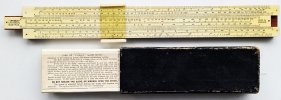
Can anyone explain to younger readers exactly how it works?
I avoided slide rule use and went straight to a pocket calculator.
This one was used by my aunt during WW2 when she was doing unknown war work in London. I think she was living on a houseboat near Chiswick in 1951. I was too young to have the workings explained to me. Mathematics seems to have been her great interest.
I had one, but didn't use it much.These were still in regular use in my lifetime but does anyone still use one today?
Can anyone explain to younger readers exactly how it works?
I avoided slide rule use and went straight to a pocket calculator.
This one was used by my aunt during WW2 when she was doing unknown war work in London. I think she was living on a houseboat near Chiswick in 1951. I was too young to have the workings explained to me. Mathematics seems to have been her great interest.
View attachment 166247
The main problem is that you can only reliably achieve three significant figure accuracy, as opposed to four with books of tables (another anachronism of course!).
All academic now, but mattered then!
swt_passenger
Veteran Member
- Joined
- 7 Apr 2010
- Messages
- 34,272
You probably need to revise or understand multiplication and division using log tables first. The slide rule you’re looking at has all sorts of extra scales for directly reading trig functions like sine cos tan etc, but it basically has logarithmic scales that you add to multiply, and subtract to divide. It’s a lot easier to explain with a basic educational slide rule, your example is an advanced version. The key thing about slide rules is you needed to work out your expected range for your answer in your head, because for example multiplying a number like 20x20 would be done exactly the same way as 200x200.These were still in regular use in my lifetime but does anyone still use one today?
Can anyone explain to younger readers exactly how it works?
I avoided slide rule use and went straight to a pocket calculator.
This one was used by my aunt during WW2 when she was doing unknown war work in London. I think she was living on a houseboat near Chiswick in 1951. I was too young to have the workings explained to me. Mathematics seems to have been her great interest.
View attachment 166247
I think in a previous discussion of slide rules we had it was decided they only had a relatively short life in secondary education. I’m 70 next birthday and of an age group who generally used slide rules at school, older people might have only used log tables , but we used both. Then with calculators appearing teaching slide rules stopped only a few years later.
Last edited:
Merle Haggard
Established Member
Making calculations were a lot quicker with slide rules than with log tables - with the latter, you generally had to write the numbers down. With practice, you could be very quick with a slide rule - probably quicker than the early simple electric calculators.
B.R. Accounting centres used the mechanical calculator (the name of which I've forgotten) which had 10 (?)rows of numbers and a revolving handle - again, the people I saw using them were very quick. Had to be numerate as well, though; for instance, multiplying by 18 didn't involve turning the handle 18 times; you set the scale to tens and rotated forward twice, then set to units and went in reverse twice. Quicker to do than explain!
B.R. Accounting centres used the mechanical calculator (the name of which I've forgotten) which had 10 (?)rows of numbers and a revolving handle - again, the people I saw using them were very quick. Had to be numerate as well, though; for instance, multiplying by 18 didn't involve turning the handle 18 times; you set the scale to tens and rotated forward twice, then set to units and went in reverse twice. Quicker to do than explain!

dangie
On Moderation
Starting my apprenticeship in 1967 we had to learn to use the slide rule.These were still in regular use in my lifetime but does anyone still use one today?
Can anyone explain to younger readers exactly how it works?
I avoided slide rule use and went straight to a pocket calculator.
This one was used by my aunt during WW2 when she was doing unknown war work in London. I think she was living on a houseboat near Chiswick in 1951. I was too young to have the workings explained to me. Mathematics seems to have been her great interest.
View attachment 166247
As a coincidence we were talking about the slide rule in the pub last night. Three of us, all of a similar age, had in our younger days learnt to use the slide rule. We all said we’d now forgotten how.
I'm not a power user, but here's mine set up to calculate pi x r squared with r on the C line and the answer on A. Also very easy to see the reverse question - if the answer is 20 what's the value of r?
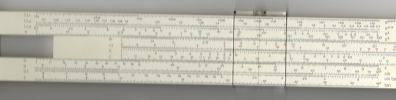
I got to use a simpler version along with log tables for my O levels in 1977, but calculators allowed for A levels in 1979.
I got to use a simpler version along with log tables for my O levels in 1977, but calculators allowed for A levels in 1979.
Xenophon PCDGS
Veteran Member
Do schools today still use the books of logarithms that were once de rigeur in any Mathematics class in secondary schools.
They've not been in use in quite some time. My secondary school years were in the 90s and I've never seen one of those books.Do schools today still use the books of logarithms that were once de rigeur in any Mathematics class in secondary schools.
Pocket-sized scientific calculators started out in the 1970s so 20 years later they were affordable for that masses. I don't recall the model I had, but it could draw a graph in black and white on its display.