• Our new ticketing site is now live! Using either this or the original site (both powered by TrainSplit) helps support the running of the forum with every ticket purchase! Find out more and ask any questions/give us feedback in this thread!

GC incident at Peterborough (04/05)

Status
Not open for further replies.

Deepgreen

Established Member
Joined
12 Jun 2013
Messages
7,481
Location
Gomshall, Surrey
AIUI on the Lumo, it didn't 'safely' negotiate the points - luggage was thrown from the racks and some passengers were injured when it fell.
Sorry, I meant without derailing - there are of course other safety issues before that point is reached (no pun intended).
 
Sponsor Post - registered members do not see these adverts; click here to register, or click here to log in
R

RailUK Forums

zwk500

Veteran Member
Joined
20 Jan 2020
Messages
18,621
Location
Northampton
Sorry, I meant without derailing - there are of course other safety issues before that point is reached (no pun intended).
Yes, but if the standard of railway journey was 'well we stayed on the tracks, didn't we?' I can't see passengers being too keen on a second go. The speed through points could arguably be slightly higher - train in Europe feel to me to have a slightly harder swing across at junction but that might just be me - but I still think 'luggage stays in the rack' is a reasonable minimum to maintain.
 

Deepgreen

Established Member
Joined
12 Jun 2013
Messages
7,481
Location
Gomshall, Surrey
Yes, but if the standard of railway journey was 'well we stayed on the tracks, didn't we?' I can't see passengers being too keen on a second go. The speed through points could arguably be slightly higher - train in Europe feel to me to have a slightly harder swing across at junction but that might just be me - but I still think 'luggage stays in the rack' is a reasonable minimum to maintain.
Agreed, of course, it was just an tangential observation about a potential permitted speed increase without any discomfort (which may be without any real merit on this case anyway). 'Soup stays in the bowl' might also be a measure!
 

zwk500

Veteran Member
Joined
20 Jan 2020
Messages
18,621
Location
Northampton
'Soup stays in the bowl' might also be a measure!
'Coffee in the cup' today, surely ;)

More seriously, upping speed through points even if within the tolerances for passengers and derailments would have increased wear and so more expensive maintenance. It would also potentially cause various overlaps and signal spacings to need review.
 

Steve Harris

Established Member
Joined
11 Dec 2016
Messages
1,200
Location
ECML
I suspect that although the layout has been there for years, sending nonstop trains round through the outer platforms has only really started since open access services began to be woven round other services.
OR more likely, IMO, because a platform was built on the Up Fast meaning a train is more likely to occupy the Up Fast and other services having to be routed through Plat 1/2 whereas in the past they would of used the UF.
 

Surreytraveller

On Moderation
Joined
21 Oct 2009
Messages
3,905
A point that has occured to me here is that, if trains have 'safely' negotiated these points at well over twice the 30mph limit, would there be a case for, say, a 40mph limit (and still provide the necessary passenger comfort and stability), or would the extra 10mph add no tangible benefit? Of course there would still be the issue of over-speeding to tackle if errors are made on the approach.

== Doublepost prevention - post automatically merged: ==


Sorry - mistook it for Hull Paragon - corrected now.
There's more to it - track maintenance, signal sighting distances and overlaps once past the points that may be impaired by a 10mph increase
 

ainsworth74

Forum Staff
Staff Member
Global Moderator
Joined
16 Nov 2009
Messages
31,120
Location
Redcar
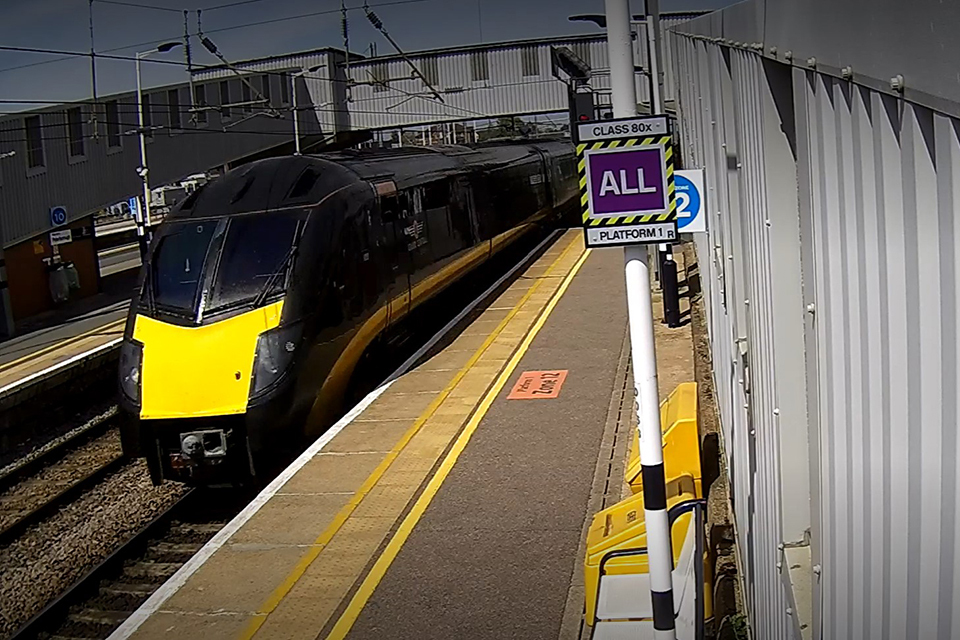
The RAIB are now investiging this incident for a full report:

At around 13:00 hrs on 4 May 2023, the 09:54 hrs Sunderland to King’s Cross service, operated by Grand Central, passed over three sets of points at Spital Junction on the northern approach to Peterborough station at a speed of around 65 mph (104 km/h). This was above the maximum permitted speed over the junction which is initially 30 mph (48 km/h) reducing to 25 mph (40 km/h).

The excessive speed over the points led to the train lurching sideways. This resulted in a number of minor injuries being sustained by passengers, with some being thrown from their seats.

The train subsequently came to a stand at Peterborough station under emergency braking. The train did not derail during the incident, and subsequent inspections found that no damage was caused to the infrastructure of the railway, or to the vehicles.

The train involved in the incident was not due to call at Peterborough. It had been approaching the station on a fast line, before being routed onto a slower line via the points where the overspeed occurred. The route onto this slower line was being displayed by the junction signal situated on the approach to the points.

RAIB is currently investigating an overspeed incident at this location which occurred on 17 April 2022. The report of this investigation will be published soon. More information can be found here: https://www.gov.uk/government/news/overspeeding-incident-at-peterborough-station.

On 25 May 2023, RAIB issued urgent safety advice to Network Rail and transport undertakings who operate trains on the East Coast Main Line through Peterborough station. This advised the relevant duty holders to take immediate steps, either operationally, or by technical means, to mitigate this risk. The urgent safety advice can be found here: https://www.gov.uk/government/publi...e-022023-overspeeding-through-spital-junction.

Our investigation into this more recent incident will seek to identify the sequence of events which led to it. This will include consideration of:

  • the way in which the train was driven
  • any factors which may have influenced the actions of the driver of the train
  • the condition of the signalling system at the time of the incident
  • the nature of the reported injuries
  • any underlying management factors
Our investigation is independent of any investigation by the railway industry or by the industry’s regulator, the Office of Rail and Road.

We will publish our findings, including any recommendations to improve safety, at the conclusion of our investigation. This report will be available on our website.


 

ainsworth74

Forum Staff
Staff Member
Global Moderator
Joined
16 Nov 2009
Messages
31,120
Location
Redcar
The RAIB have now published their full report into this incident which can be found here and the summary is included below:

Summary​

At around 13:00 hrs on 4 May 2023, the 09:54 hrs Sunderland to London King’s Cross Grand Central service passed over three sets of points forming part of Spital Junction at excessive speed. The maximum permitted speed over the junction, which is to the north of Peterborough station, is initially 30 mph (48 km/h) reducing to 25 mph (40 km/h). The data recorder from the train indicated that the points had been traversed at a speed of 66 mph (106 km/h).

The speed of the train over the junction resulted in sudden sideways movements of the coaches. This led to some passengers being thrown from their seats, with some receiving minor injuries.

RAIB’s investigation found that the overspeeding was caused by the driver of the train not reacting appropriately to the signal indication they had received on the approach to the junction. This signal was indicating that the train was to take a diverging route ahead which had a lower speed limit than the straight-ahead route. The driver’s expectation was that the train was being routed straight ahead and their application of driving awareness skills was not sufficient to overcome that expectation.

UK railway signalling principles mean that the control of speed at diverging junctions such as this is dependent on drivers reacting to signal information given at considerable distances. This, and exemptions granted in the past from fitting engineered protective measures beyond the signal, places the reliance on drivers correctly observing and responding to all the information given by the signal. This was a factor in this incident.

Testing and analysis by RAIB also found that the junction indicator element of the signal may not have been as conspicuous as the main aspect of the signal at the point the driver observed and reacted to the signal. This is a possible factor.

Three underlying factors were identified by the investigation. Grand Central had not provided the driver with the necessary non-technical skills or additional strategies to manage the risk present at this signal. This was a possible underlying factor. Network Rail and East Coast Main Line train operators had not effectively controlled the risk of overspeeding at this junction both at the time the signal’s operation was changed in 2013 and following a previous overspeeding incident at the same location in April 2022. Thirdly, Network Rail does not control the risk of overspeeding at locations where there is a long distance between the approach released protecting signal and the junction itself, once a proceed aspect has been given to drivers.

RAIB observed that Grand Central had not identified the risks associated with the signal in its route risk assessment and was not managing the development plans for the driver in accordance with its own processes. RAIB also observed that Network Rail’s reliability centred maintenance regime does not include a means to effectively manage degradation of junction indicator modules fitted with light emitting diodes (LEDs).

A similar incident occurred at the same location (RAIB report 06/2023), 13 months before this incident. Following this more recent incident, RAIB issued urgent safety advice in May 2023 to Network Rail and operators of trains on the East Coast Main Line through Peterborough station. This advice alerted them that suitable arrangements may not be in place to mitigate the risk of trains travelling southbound through Spital Junction at excessive speeds when signalled from the Up Fast line on to the Up Slow lines at Peterborough station. Duty holders were advised that they should take immediate steps, either operationally, or by technical means, to mitigate this risk.

Recommendations​

RAIB has made four new recommendations as a result of this investigation. The first recommendation is for Grand Central to review and amend its training and competence management processes to provide its drivers with the necessary non-technical skills or additional strategies to manage the risk encountered at signals which may show different aspects to those usually encountered.

The second recommendation asks Network Rail and train operators to review the processes by which they derive, share and implement safety learning from accidents and incidents that involve shared risks across organisations.

The third recommendation is for RSSB to review the standards specifying the relative brightness of main aspects and junction indicators on signals to understand the effects on conspicuity of the complete signal up to the maximum distance at which a signal is required to be readable, to minimise the risk of drivers not correctly reading signals.

The fourth recommendation, arising from an observation, is for Network Rail to manage the risk of a driver not seeing a route indication because of the gradual reduction in light output of LED signals, which occurs over time.

RAIB has also identified two learning points during the investigation. The first relates to train operators ensuring that their route risk assessments include the risks to their services from signals which may show different aspects to those usually encountered. The second reminds transport undertakings of the importance of managing the competence of safety critical staff effectively and in accordance with their own processes.

Also mentioned within this report are the learning points from RAIB’s investigation into a previous incident at this location on 17 April 2022. These relate to the need for train operators to ensure that drivers maintain alertness when approaching junction signals and that train operator emergency plans should specifically include processes to deal with the aftermath of overspeeding incidents.
 

bengley

Established Member
Joined
18 May 2008
Messages
1,987
Interesting to note pages 45/46

They go into a lot of detail about the alignment of the signal aspect and the associated junction indicator.
The Junction indicator is pointing far too high and as everyone will know with LEDs, they have a much smaller viewing angle than filament lamps - just look at a motorway VMS sign next time you pass under it, they almost disappear when you get close.

I have noted this myself on occasion at some signals where the JI is much harder to see than the aspect itself. More needs to be done to ensure proper alignment of signals!
 

lineclear

Member
Joined
29 Mar 2016
Messages
137
Location
Yorkshire
I am reminded of Ladbroke Grove, in which it is most likely that Driver Hodder read what he perceived as a single yellow aspect, and did not subsequently notice that SN109 signal was red, despite the red aspect being visible for eight seconds. Here, the driver read what he perceived as a green aspect without any junction indicator, and did not subsequently notice that P468 signal had a position two junction indicator lit, despite it being in view for sixty three seconds.
 

rower40

Member
Joined
1 Jan 2008
Messages
583
Off-the-wall/out-of-the-box thinking here...

At some junctions, Preliminary Route Indicators are fitted, allowing faster approach of trains taking diverging routes. I.e. the driver has more warning that the diverging route is set, and can stop at or before the junction signal if wrong-routed.

In the geography of this location, there was 700m between the protecting signal and the diverging pointwork. Is there a case for a different kind of route indicator somewhere in those 700m, as a reminder that the signal was showing that a diverging route (and, in this case, a much lower speed route) was set?

It could be as simple as a subsequent triangular "Advance Warning Indicator with Directional Arrow" Permanent Speed Restriction sign, but illuminated if the diverging route is set.

(I'm trying to think of a word that means the opposite of "Preliminary", but "Postliminary" doesn't quite cut it.)
 

Dave W

Member
Joined
27 Sep 2019
Messages
889
Location
North London
My perception is that this report is very much painting the incident as a driver falling into a systemic trap. Yes it acknowledges the unexplained failure of the driver to react to the signal which was displaying correctly, but it goes into a lot of detail - more than most RAIB reports - about the systems in place around the signal.
 

ainsworth74

Forum Staff
Staff Member
Global Moderator
Joined
16 Nov 2009
Messages
31,120
Location
Redcar
My perception is that this report is very much painting the incident as a driver falling into a systemic trap. Yes it acknowledges the unexplained failure of the driver to react to the signal which was displaying correctly, but it goes into a lot of detail - more than most RAIB reports - about the systems in place around the signal.
Agreed which I also thinks make sense seeing as it was the second, very similar, incident at that exact signal in as many years. That, to me, would tend to suggest a system failure rather than an individual lapse.
 

Railsigns

Established Member
Joined
15 Feb 2010
Messages
2,754
In the geography of this location, there was 700m between the protecting signal and the diverging pointwork. Is there a case for a different kind of route indicator somewhere in those 700m, as a reminder that the signal was showing that a diverging route (and, in this case, a much lower speed route) was set?

It could be as simple as a subsequent triangular "Advance Warning Indicator with Directional Arrow" Permanent Speed Restriction sign, but illuminated if the diverging route is set.
In practice, you'd just install a standard permissible speed warning indicator with directional arrow between the junction signal and the points, and an associated AWS magnet that's suppressed when a non-applicable route is set. This had already been done in a couple of places where there's a long distance between the junction signal and the points.
 

Efini92

Established Member
Joined
14 Dec 2016
Messages
2,137
I am reminded of Ladbroke Grove, in which it is most likely that Driver Hodder read what he perceived as a single yellow aspect, and did not subsequently notice that SN109 signal was red, despite the red aspect being visible for eight seconds. Here, the driver read what he perceived as a green aspect without any junction indicator, and did not subsequently notice that P468 signal had a position two junction indicator lit, despite it being in view for sixty three seconds.
I wouldn’t say the 2 incidents are similar. It was possible (if the correct circumstances were met) that a filament signal could appear to be showing a yellow when in actual fact it was showing a red. I have seen it once myself.
The Peterborough incidents are classic examples of skill fade and drivers only seeing what they are expecting to see.
It happened a Crewe a few years ago, a train not booked to stop was routed through platform 11, the driver only saw the green. The result of that was the Signaller’s will now only show a yellow to avoid further overspeeding incidents. Perhaps this is something that could be done there as a short term measure.
 

43066

Veteran Member
Joined
24 Nov 2019
Messages
12,089
Location
London
In practice, you'd just install a standard permissible speed warning indicator with directional arrow between the junction signal and the points, and an associated AWS magnet that's suppressed when a non-applicable route is set. This had already been done in a couple of places where there's a long distance between the junction signal and the points.

Kettering North (in the up direction) has exactly that.
 

BrummieBobby

Member
Joined
16 May 2022
Messages
157
Location
Birmingham
It happened a Crewe a few years ago, a train not booked to stop was routed through platform 11, the driver only saw the green. The result of that was the Signaller’s will now only show a yellow to avoid further overspeeding incidents. Perhaps this is something that could be done there as a short term measure.

I believe in the airline industry this is called "confirmation bias" essentially a pilot believing that his instruments confirm his initial belief, even if they are indicating something different. I suspect this may be a factor at Peterborough.

It is one of the reasons why, if I am not able to signal a non-stopping train "middle road" and I am required to put them through a platform, then I will only give single yellow / clear on approach.
 

Efini92

Established Member
Joined
14 Dec 2016
Messages
2,137
I believe in the airline industry this is called "confirmation bias" essentially a pilot believing that his instruments confirm his initial belief, even if they are indicating something different. I suspect this may be a factor at Peterborough.

It is one of the reasons why, if I am not able to signal a non-stopping train "middle road" and I am required to put them through a platform, then I will only give single yellow / clear on approach.
Yes it is, it’s also driving on past experiences rather than what’s infront of them. The human factor.
Slightly off topic but is it possible to receive flashing yellows on the down fast approaching Crewe?
 

Wilts Wanderer

Established Member
Joined
21 Nov 2016
Messages
3,199
Yes it is, it’s also driving on past experiences rather than what’s infront of them. The human factor.
Slightly off topic but is it possible to receive flashing yellows on the down fast approaching Crewe?

I believe yes but not for platform 11. IIRC you get a flashing sequence into platform 6?
 

Meerkat

Established Member
Joined
14 Jul 2018
Messages
9,276
As an outsider I am surprised that the signal cleared to green, and not yellow due to the dramatically lower speed limit. Or at least there should be an AWS alarm for much slower diverging aspects?
Also surprised that the train continued without an inspection - how did they know something hadn’t been damaged enough to fail later?
Would a theatre JI display 3 or nothing if the straight through route was set - just wondering whether a theatre JI would be clearer at that site??
Reads like the signal needs a white surround to the black backing board, to better link the JI with the signal.
Bit surprised the driver is still driving considering that this was the latest of several incidents - not because I think they shouldn’t be but because of my inference from drivers’ comments about how they fear a career ending incident.
 

John Webb

Established Member
Joined
5 Jun 2010
Messages
3,780
Location
St Albans
I wouldn’t say the 2 incidents are similar. It was possible (if the correct circumstances were met) that a filament signal could appear to be showing a yellow when in actual fact it was showing a red. I have seen it once myself.
The Peterborough incidents are classic examples of skill fade and drivers only seeing what they are expecting to see.
It happened a Crewe a few years ago, a train not booked to stop was routed through platform 11, the driver only saw the green. The result of that was the Signaller’s will now only show a yellow to avoid further overspeeding incidents. Perhaps this is something that could be done there as a short term measure.
Network Rail altered the signal involved soon afterwards so it does only show a Yellow aspect for diverging moves.
As an outsider I am surprised that the signal cleared to green, and not yellow due to the dramatically lower speed limit. Or at least there should be an AWS alarm for much slower diverging aspects?
There was a warning board with AWS magnet, according to the RAIB Report.
Also surprised that the train continued without an inspection - how did they know something hadn’t been damaged enough to fail later?
Would a theatre JI display 3 or nothing if the straight through route was set - just wondering whether a theatre JI would be clearer at that site??....
Theatre Route indicators can only be used at low speeds - 25mph, I think? Might be appropriate, perhaps, here?
 

357

Established Member
Joined
12 Nov 2018
Messages
2,284
There was a warning board with AWS magnet, according to the RAIB Report.
A long way before the signal though. If you look at Google maps it's just as you come around the right hand curve.
 

Harpo

Established Member
Joined
21 Aug 2024
Messages
3,901
Location
Newport
It is one of the reasons why, if I am not able to signal a non-stopping train "middle road" and I am required to put them through a platform, then I will only give single yellow / clear on approach.
A laudable thing to be doing and for all the right reasons but if you’re doing this without SBIs you’re covering for a system deficiency and transferring the risk to yourself.

Drivers may not realise it’s being done manually and guess where any problems arising from an instance of a driver not getting 1Y then step up, could land?

Sorry to be doomy. Just don’t want anyone getting grief for trying to be decent people.
 
Status
Not open for further replies.

Top