• Our new ticketing site is now live! Using either this or the original site (both powered by TrainSplit) helps support the running of the forum with every ticket purchase! Find out more and ask any questions/give us feedback in this thread!

Transport for Wales Class 230

Lurcheroo

Established Member
Joined
21 Sep 2021
Messages
1,241
Location
Wales
The cost of the 230's was never estimated that high, many factors are included, if the project had been successful that cost would have never escalated, TFW are running it to attempt to show they are applying a green strategy when in fact the gen sets are continuously running to enable the units to complete a round trip, this wasn't the initial intention. So looking at the performance a 230 will use more fuel than a 150 and actually ironically produce more emissions. As train crew many said that they (TFW) should have re-engined and refurbished 5 x 150's or acquired the 165's from Chiltern, the latter having the perkins equivalent 158 engines that would easily keep to time. The reason the performance improved was the extra 5 - 7 minutes run time from Central to Bidston with longer layover times at both ends, without this they would never have kept to the 150 timings of 57 minutes.
Not to mention the FOI information on the 197’s is just the unit cost. I wonder how much they’ve come to cost with all of their delays and issues. Us Cambrian crews still aren’t trained on them yet and they’re still being tested on here.
I do wonder if the 230’s could keep to better time if they had less issues
 
Sponsor Post - registered members do not see these adverts; click here to register, or click here to log in
R

RailUK Forums

Invincible

Member
Joined
23 Apr 2022
Messages
856
Location
Surrey
the gen sets are continuously running to enable the units to complete a round trip, this wasn't the initial intention. So looking at the performance a 230 will use more fuel than a 150 and actually ironically produce more emissions.
Seems the Ford diesel engines do not like being switched on and off, although other diesel engines in hybrid buses do?
I notice the new hybrid Ford Ranger pick up truck uses petrol engines.

However the 230 engines in tick over pulling out of stations when using batteries (recharging on the move) should use less fuel overall and emissions than 197s or 150s when the 230 battery, engine management software and air filter upgrades are completed?.

Although diesel and battery hybrid operation in buses is now common, in trains still being refined in several countries.
 
Last edited:

TDK

Established Member
Joined
19 Apr 2008
Messages
4,164
Location
Crewe
Seems the Ford diesel engines do not like being switched on and off, although other diesel engines in hybrid buses do?
I notice the new hybrid Ford Ranger pick up truck uses petrol engines.

However the 230 engines in tick over pulling out of stations when using batteries (recharging on the move) should use less fuel overall and emissions than 197s or 150s when the 230 battery, engine management software and air filter upgrades are completed?.

Although diesel and battery hybrid operation in buses is now common, in trains still being refined in several countries.
I think the reason for the gen sets shutting down and overheating is due to the fact they're housed in a box, poor design but then again probably not designed to run constantly, time will tell on their performance after the upgrades but looking at the design, to be honest I won't hold my breath. The batteries are now time expired also so that's another £6-8m being spent unless they've already been replaced, they are a total disaster I feel.

== Doublepost prevention - post automatically merged: ==

Not to mention the FOI information on the 197’s is just the unit cost. I wonder how much they’ve come to cost with all of their delays and issues. Us Cambrian crews still aren’t trained on them yet and they’re still being tested on here.
I do wonder if the 230’s could keep to better time if they had less issues
If the 230's were designed better I'm sure they could easily have kept to the 150 timings, however, the 197's couldn't, this was the reasoning in the run time increase, I was shocked that TFW were boasting a Ppm of 80% on the line from 50%, 80% ppm is also a very poor figure but I doubt upper management with their lack of railway experience actually knew that. Let's hope the upgrades do the trick, they've cost too much so far to be honest.
 

Invincible

Member
Joined
23 Apr 2022
Messages
856
Location
Surrey
I think the reason for the gen sets shutting down and overheating is due to the fact they're housed in a box, poor design but then again probably not designed to run constantly, time will tell on their performance after the upgrades but looking at the design, to be honest I won't hold my breath.
Although in a road vehicle the engines are in a box, engine compartment. The important thing is to ensure the radiators, air filters and fans are working well.
The engines are designed for vans and pickups so should be able to run all day.

But in hybrid mode they should be able to switch off approaching stations and switch back on after leaving stations, rather than just go into tick over?
 

Wyrleybart

Established Member
Joined
29 Mar 2020
Messages
2,633
Location
South Staffordshire
Although in a road vehicle the engines are in a box, engine compartment. The important thing is to ensure the radiators, air filters and fans are working well.
The engines are designed for vans and pickups so should be able to run all day.

But in hybrid mode they should be able to switch off approaching stations and switch back on after leaving stations, rather than just go into tick over?
Thanks "TDK" for your comments, particularly that Geo Fencing idea, Sadly I think that ATW and TfW were hooked into a dream that hasn't become reality. IMHO Vivarail should have rebuilt 230001 or 230002 with the "features" it was selling, so that a hybrid battery 230 could be proven over the route, particularly with the ability to shut the diesels down in "environmentally sensitive" locations.

Fact is we are now where we are and maybe two or three extra 197s would replace the five condemned 230s, by cycling the class 197 diagrams.
 

Prime586

Member
Joined
26 May 2023
Messages
292
Location
Knowsley
Although in a road vehicle the engines are in a box, engine compartment. The important thing is to ensure the radiators, air filters and fans are working well.
The engines are designed for vans and pickups so should be able to run all day.

But in hybrid mode they should be able to switch off approaching stations and switch back on after leaving stations, rather than just go into tick over?
As I've mentioned before, in a road vehcle application the primary mode of cooling comes from the radiator and engine bay being perpendicular to the airflow over the vehicle (i.e it's facing the front) and the faster the vehicle goes, the greater the airflow is (and the cooling fans will then be turned off by the ECU).

The genset rafts in the 230 have to draw air in that is flowing parallel to the radiator (i.e. along the carriage sides) into a box that's tightly-packed with equipment and it is then exhausted through a hole in the top of the box into the space between the raft and the carriage floor. It relies on the fans operating constantly to provide the airflow, and will never work as efficiently as in a road vehicle application.

As to the engines running constantly, my experience of numerous diesel-powered cars with start-stop systems is that the system is disabled when the engine is cold (as it needs to keep the main starter battery topped up after cold cranking, or the assist battery charge is depleted after a cold soak), when the engine is hot (as it needs the alternator current to power the cooling fans to avoid draining the battery, also during a DPF regen when the fans have to run full blast to provide airflow to cool the 700-degree DPF during and after it's burn cycle) or when large electrical (e.g. heated windows) or mechanical (e.g aircon) loads are engaged at idle.

The Battery Management System they are using for the genset raft's onboard batteries will likely override any commands from the geofencing system to shut down the engine if it thinks there's the likelihood the engine will not restart, and will go to idle instead.
 
Last edited:

Lurcheroo

Established Member
Joined
21 Sep 2021
Messages
1,241
Location
Wales
Fact is we are now where we are and maybe two or three extra 197s would replace the five condemned 230s, by cycling the class 197 diagrams.
The 230’s aren’t condemned.

What you do you mean by cycling the 197 diagrams?
 

Wyrleybart

Established Member
Joined
29 Mar 2020
Messages
2,633
Location
South Staffordshire
The 230’s aren’t condemned.

What you do you mean by cycling the 197 diagrams?
The 230s will inevitably condemned at the point where the cost more to keep in service than they are worth.

I meant that by cycling the 197 diagrams a 197 could spend a day on the Borderlands, then end up at Chester for exam overnight, then switch to a Manchester-Llandudno diagram ending at say Salop. A unit off a Manchester-Llandudno diagram might end up on Chester overnight, then cover a Borderlands circuit the nexy day.
 

Lurcheroo

Established Member
Joined
21 Sep 2021
Messages
1,241
Location
Wales
The 230s will inevitably condemned at the point where the cost more to keep in service than they are worth.
Maybe, maybe not. As of yet, they are not condemned.

I meant that by cycling the 197 diagrams a 197 could spend a day on the Borderlands, then end up at Chester for exam overnight, then switch to a Manchester-Llandudno diagram ending at say Salop. A unit off a Manchester-Llandudno diagram might end up on Chester overnight, then cover a Borderlands circuit the nexy day.
So, just how the 197’s operate on the line now then?
 

Caaardiff

Established Member
Joined
9 Jun 2019
Messages
1,385
The 230s will inevitably condemned at the point where the cost more to keep in service than they are worth.

I meant that by cycling the 197 diagrams a 197 could spend a day on the Borderlands, then end up at Chester for exam overnight, then switch to a Manchester-Llandudno diagram ending at say Salop. A unit off a Manchester-Llandudno diagram might end up on Chester overnight, then cover a Borderlands circuit the nexy day.
There's already two 197s working the line and they cycle between Wrexham and Chester each day already.
You'd only need 1 more 197 to replace the 230s. But those 197s were always intended for other routes.
As a short term measure TFW could keep some more 153s, on top of those already being retained for HOWL services, and use them to operate Swanline and West Wales services, freeing up 197s and the 230s could go.
TFW are in too deep with them to pull the plug though.
 

Lurcheroo

Established Member
Joined
21 Sep 2021
Messages
1,241
Location
Wales
You'd only need 1 more 197 to replace the 230s. But those 197s were always intended for other routes.
Plus there were plans for a half hourly service which needed 4 diagrams, hence the acquisition of 5 230’s. So you’d need at least 4 197’s to replace them in full (if they still want the half hourly service). Personally I don’t want to see 197’s taken from other routes to cover the borderlands as that would be a reduction in capacity. If they decide to get rid of the 230’s and acquire additional 197’s for the route then that would be fine, I have no specific love for the 230’s.

TFW are in too deep with them to pull the plug though.
Well they’ve certainly committed to trying to sort them out so not likely to see any changes to the fleet.
 

Wyrleybart

Established Member
Joined
29 Mar 2020
Messages
2,633
Location
South Staffordshire
Plus there were plans for a half hourly service which needed 4 diagrams, hence the acquisition of 5 230’s. So you’d need at least 4 197’s to replace them in full (if they still want the half hourly service). Personally I don’t want to see 197’s taken from other routes to cover the borderlands as that would be a reduction in capacity. If they decide to get rid of the 230’s and acquire additional 197’s for the route then that would be fine, I have no specific love for the 230’s.


Well they’ve certainly committed to trying to sort them out so not likely to see any changes to the fleet.
I agree to some degree, but the plans for the 230s have changed somewhat compared to their initial blurb. We were told the 230s would work some services on the Blaenau branch, as well as some Chester-Crewe work in addition to the Borderlands route. IIRC that was before the first 230 had even been delivered to the route.

Obviously, with the benefit of a huge slice of hindsight we now know that couldn't have happened, but right from day 1 it was unlikely that 60mph 230s would operate the Crewes, as well as the ECS moves to Llandudno Junction even if they managed the tortuous branch. The one benefit of the Blaenau branch would have been the regen braking on the downhill journeys would presumably fill the batteries up and save on brake blocks.

I think Vivarail gave the industry a good starting point for battery powered trains but the Borderlands requirements were not stringent enough to successfully trial a prototype before 230006-010 were built and delivered.
 

Invincible

Member
Joined
23 Apr 2022
Messages
856
Location
Surrey
As I've mentioned before, in a road vehcle application the primary mode of cooling comes from the radiator and engine bay being perpendicular to the airflow over the vehicle (i.e it's facing the front) and the faster the vehicle goes, the greater the airflow is (and the cooling fans will then be turned off by the ECU).

The genset rafts in the 230 have to draw air in that is flowing parallel to the radiator (i.e. along the carriage sides) into a box that's tightly-packed with equipment and it is then exhausted through a hole in the top of the box into the space between the raft and the carriage floor. It relies on the fans operating constantly to provide the airflow, and will never work as efficiently as in a road vehicle application.

As to the engines running constantly, my experience of numerous diesel-powered cars with start-stop systems is that the system is disabled when the engine is cold (as it needs to keep the main starter battery topped up after cold cranking, or the assist battery charge is depleted after a cold soak), when the engine is hot (as it needs the alternator current to power the cooling fans to avoid draining the battery, also during a DPF regen when the fans have to run full blast to provide airflow to cool the 700-degree DPF during and after it's burn cycle) or when large electrical (e.g. heated windows) or mechanical (e.g aircon) loads are engaged at idle.

The Battery Management System they are using for the genset raft's onboard batteries will likely override any commands from the geofencing system to shut down the engine if it thinks there's the likelihood the engine will not restart, and will go to idle instead.
Thanks for your insight, although hybrid operation is now common in road vehicles it is not in rail trains.
From this in April seems TfW will continue to continue 230 development, there is a risk they could replace them with diesel trains
The 230;Battery Management System is still being updated by TfW and GWR. The latest batteries and software upgrades will enable more understanding of not having to depend on the diesel for recharging.
Guess the driver is unaware of the background workings. One future feature could be a screen to open when they are stationary to check battery, filter sensors and engine status?.

From the article each train currently has 4 100 KW batteries, which may be replaced by the latest design batteries with less chance of overheating.

So are there also separate batteries for starting the diesels and things like heating?
 

Prime586

Member
Joined
26 May 2023
Messages
292
Location
Knowsley
From the article each train currently has 4 100 KW batteries, which may be replaced by the latest design batteries with less chance of overheating.

So are there also separate batteries for starting the diesels and things like heating?
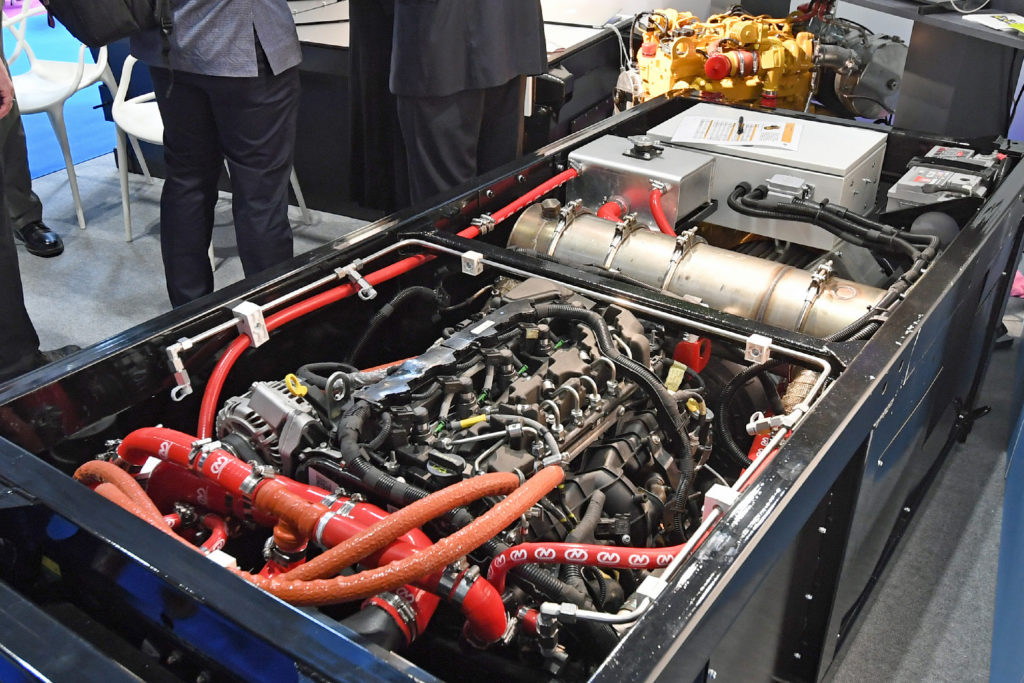
Each genset raft has it's own 12V battery to power it's starter, ECU, fans and other electrical ancilliaries. Here's the picture of the genset raft I posted earlier in the thread:
Vivarail-Diesel-Generator-Raft-1024x683.jpg

In the upper right corner you can see the large 12V battery, and the engine's alternator on top of the engine at the lower left. The Battery Management System I referred to in my previous post is part of the Start-Stop system (from the Ford Ranger it comes from) which is implemented in the engine's ECU.

In the Ranger, if the engine is idling, the vehicle's forward speed drops below a certain threshold and the electrical and mechanical load criteria are met, the ECU will shut the engine off until the clutch or accelerator pedalis pressed, which will cause it to restart the engine. If the BMS detects the electrical load is too high, or the battery charge state is too low, it will tell the ECU to disable the Start-Stop system to prevent a failure to restart.

The BMS for the traction battery rafts (which receives the output power from the three-phase alternator under the cylindrical tank and grey control cabinet) is a totally separate system. The carriage heating will be driven from the traction batteries as well (it will be the same system developed for the battery only units).

If they had thought about it a bit more, they could have used a heat exchanger-based carriage heating system that used recovered heat from the genset rafts and the overheating battery rafts (which inexplicably had no cooling system implemented as part of their design).
 
Last edited:

Lurcheroo

Established Member
Joined
21 Sep 2021
Messages
1,241
Location
Wales
I agree to some degree, but the plans for the 230s have changed somewhat compared to their initial blurb. We were told the 230s would work some services on the Blaenau branch, as well as some Chester-Crewe work in addition to the Borderlands route. IIRC that was before the first 230 had even been delivered to the route.
Ahh perhaps initially there was no plan for a half hourly service on the borderlands. Maybe that’s become a thought with them now being dedicated to that line.
 

craigybagel

Established Member
Joined
25 Oct 2012
Messages
5,829
I agree to some degree, but the plans for the 230s have changed somewhat compared to their initial blurb. We were told the 230s would work some services on the Blaenau branch, as well as some Chester-Crewe work in addition to the Borderlands route. IIRC that was before the first 230 had even been delivered to the route.

Obviously, with the benefit of a huge slice of hindsight we now know that couldn't have happened, but right from day 1 it was unlikely that 60mph 230s would operate the Crewes, as well as the ECS moves to Llandudno Junction even if they managed the tortuous branch. The one benefit of the Blaenau branch would have been the regen braking on the downhill journeys would presumably fill the batteries up and save on brake blocks.

Ahh perhaps initially there was no plan for a half hourly service on the borderlands. Maybe that’s become a thought with them now being dedicated to that line.
Their use on Blaneau and Crewe - Chester was only ever meant to be temporary. It was always the plan that once the 197s arrived the 230s on those routes would be cascaded to join the others on Bidstons and the service would go from hourly to half hourly. In the end that phase was skipped for various reasons, and all 5 units went straight to Bidston. Sadly, they're still not relatable enough several years later to allow a half hourly service be introduced.
 

Wyrleybart

Established Member
Joined
29 Mar 2020
Messages
2,633
Location
South Staffordshire
Each genset raft has it's own 12V battery to power it's starter, ECU, fans and other electrical ancilliaries. Here's the picture of the genset raft I posted earlier in the thread:
Vivarail-Diesel-Generator-Raft-1024x683.jpg

If they had thought about it a bit more, they could have used a heat exchanger-based carriage heating system that used recovered heat from the genset rafts and the overheating battery rafts (which inexplicably had no cooling system implemented as part of their design).
Thanks very much for explaining this. IMHO Vivarail were still very much developing battery traction technology when their business failed. From what you say, I wonder if Vivarail deliberately tried to kee pthe installations as simple s possible to achieve the "quick change" status - being able to swap a raft in 15 minutes using a stacker truck. Perhaps battery coolling matrices would complicate it ?
 

Prime586

Member
Joined
26 May 2023
Messages
292
Location
Knowsley
Thanks very much for explaining this. IMHO Vivarail were still very much developing battery traction technology when their business failed. From what you say, I wonder if Vivarail deliberately tried to kee pthe installations as simple s possible to achieve the "quick change" status - being able to swap a raft in 15 minutes using a stacker truck. Perhaps battery coolling matrices would complicate it ?
They only had to look at the design practices used in other, more mature EV fields. All electric road vehicles have some form of temperature regulation (for both cooling and heating - Lithium batteries do not tolerate being charged or discharged in cold or temperatures either) in their battery packs, as it's a fundamental law of battery physics that cells (no matter which chemistry is used) will heat up while being discharged or charged, with the rate of temperature change usually being linked to the rate of charge or discharge.

As Lithium-based batteries offer very high discharge and charging currents, and the hazards involved if they are allowed to go into thermal runaway, temperature monitoring and cooling of the cells is a critical feature. VivaRail at least implemented the temperature monitoring function, but thought they could get away without the cooling/heating system. It could easily have been implemented as a self-contained system in each battery raft to maintain the 'quick change' feature, with a radiator and fans similar to the engine rafts, but at the expense of the number of cells thay could fit in each raft.

I'm not even sure the 'quick change' feature made much sense, for the battery rafts at least. I can see why it was attractive for the genset rafts (especially given the number of engine failures they ended up getting), but the only reasons for needing a 'quick change' battery raft would be if you were expecting a high failure rate in the calls, or if you were implementing a system where battery charging was achieved by swapping the battery rafts out, which is not something that is really practical with a train (it's barely practical with EV road vehicles).
 

CaergwrleKen

Member
Joined
2 Oct 2019
Messages
162
Location
Caergwrle
Here we are at another timetable change, not a major one i know but again it looks like only one 230 out so the fleet is still only going to cover half a diagram per day probably until at least December again. What an absolute waste of money. And the 197s still being kept off the mainline which is struggling with shortages of trains.
 

Lurcheroo

Established Member
Joined
21 Sep 2021
Messages
1,241
Location
Wales
Here we are at another timetable change, not a major one i know but again it looks like only one 230 out so the fleet is still only going to cover half a diagram per day probably until at least December again. What an absolute waste of money. And the 197s still being kept off the mainline which is struggling with shortages of trains.
Timetable changes don’t really mean a lot to the 230’s. The only thing that will be likely change the situation is the mods being successful.

Edit- 12:10
Just seen that July had the highest number of journeys made on the Wrexham - Bidston line since TFW took over in 2018.
 
Last edited:

Bertie the bus

Established Member
Joined
15 Aug 2014
Messages
3,216
Edit- 12:10
Just seen that July had the highest number of journeys made on the Wrexham - Bidston line since TFW took over in 2018.
They've increased the number of services by 50% so it would be a very poor state of affairs if that wasn't the case but it doesn't make the countless £millions spent value for money or the ridiculous lengths they have gone to to save face and keep the 230s operating worthwhile.
 

Xenophon PCDGS

Veteran Member
Joined
17 Apr 2011
Messages
35,439
Location
A typical commuter-belt part of north-west England
They've increased the number of services by 50% so it would be a very poor state of affairs if that wasn't the case but it doesn't make the countless £millions spent value for money or the ridiculous lengths they have gone to to save face and keep the 230s operating worthwhile.
Henry Posner III of the Railroad Development Corporation showed commercial wherewithal in giving the Class 230 project enough time and money to be a success if that was possible and when it began to look like a money drain for no realistic successful ending, took the only correct decision and ended the project.
 

Caaardiff

Established Member
Joined
9 Jun 2019
Messages
1,385
With the amount of work that's gone into the 230's. What is their expected lifespan?
 

Wyrleybart

Established Member
Joined
29 Mar 2020
Messages
2,633
Location
South Staffordshire
They only had to look at the design practices used in other, more mature EV fields. All electric road vehicles have some form of temperature regulation (for both cooling and heating - Lithium batteries do not tolerate being charged or discharged in cold or temperatures either) in their battery packs, as it's a fundamental law of battery physics that cells (no matter which chemistry is used) will heat up while being discharged or charged, with the rate of temperature change usually being linked to the rate of charge or discharge.

As Lithium-based batteries offer very high discharge and charging currents, and the hazards involved if they are allowed to go into thermal runaway, temperature monitoring and cooling of the cells is a critical feature. VivaRail at least implemented the temperature monitoring function, but thought they could get away without the cooling/heating system. It could easily have been implemented as a self-contained system in each battery raft to maintain the 'quick change' feature, with a radiator and fans similar to the engine rafts, but at the expense of the number of cells thay could fit in each raft.

I'm not even sure the 'quick change' feature made much sense, for the battery rafts at least. I can see why it was attractive for the genset rafts (especially given the number of engine failures they ended up getting), but the only reasons for needing a 'quick change' battery raft would be if you were expecting a high failure rate in the calls, or if you were implementing a system where battery charging was achieved by swapping the battery rafts out, which is not something that is really practical with a train (it's barely practical with EV road vehicles).
I agree. The quick change feature for the diesel pods on the diesel 230s yes. But the the setup for the battery structure would be different in nature I would have thought. I am disappointed that none of the parties involved were actually able to run a battery hybrid testbed 230 over the route a few times before the sale was agreed. Computer simulations cannot always deliver robust and reliable data. and it seems to be the 230s will be a millstone around the Senedd's neck for as long as they are in service.

Quote
Henry Posner III of the Railroad Development Corporation showed commercial wherewithal in giving the Class 230 project enough time and money to be a success if that was possible and when it began to look like a money drain for no realistic successful ending, took the only correct decision and ended the project.

And that is the problem whose funds were Vivarail using ? Was it all Henry Posner III, or was there still UK money tied up in the project ? Were the D78 cars the best to use ? I understand that one of the five class 484s at Ryde is a "Christmas tree". How planned was that whilst vivarail was still trading ?
 

Xenophon PCDGS

Veteran Member
Joined
17 Apr 2011
Messages
35,439
Location
A typical commuter-belt part of north-west England
And that is the problem whose funds were Vivarail using ? Was it all Henry Posner III, or was there still UK money tied up in the project ?
I would be interested to know if the Railroad Development Corporation were aware of any UK finance of size and knowing that, would ensure they terminated their interest and left matters in charge of any residual UK finance which would be great enough to keep Vivarail afloat.
 

Invincible

Member
Joined
23 Apr 2022
Messages
856
Location
Surrey
I understand that one of the five class 484s at Ryde is a "Christmas tree".
From the Island Line Class 484 Reliability thread 19 Aug 2024
Post #154 quoting Chris125
Testing about to begin on flood damaged 484001:
Admissions have been made to Island Echo that Island Line has struggled to acquire a number of parts for the new trains, so 001 was cannibalised to keep the other trains going.

Now, bosses say that the situation has been resolved and 001 is being recommissioned to bring Island Line back up to a 5-train fleet. Islanders can expect to see 484001 back on the tracks this week and it should be fully operational within a matter of days
 

Cowley

Forum Staff
Staff Member
Global Moderator
Joined
15 Apr 2016
Messages
18,933
Location
Devon
From the Island Line Class 484 Reliability thread 19 Aug 2024
Post #154 quoting Chris125

This is going to start leading us off topic if we’re not careful.
The thread discussing Island Line 484s is here if anyone wants to discuss those:
Thanks
 

Top