Our new ticketing site is now live! Using either this or the original site (both powered by TrainSplit) helps support the running of the forum with every ticket purchase! Find out more and ask any questions/give us feedback in this thread!
This being Scotland, it would be quite on-brand for a political demand for some unnecessary requirement to be incorporated as 100% essential in the design brief. Limiting options and increasing costs.
Though with the current budget situation, I’m also thinking there’s likely to be a preference for second hand.
Has anyone considered hauling 385s as push-pull stock?
Actually that is not a fair comparison, the 4/5 car voyagers replaced 7 car HSTs and 8 car hauled class 47 and 86 trains. I dispute that the highland main line regularly needs more than 5 coaches per hour in each direction also given now that you sometimes get a 3 car 170 with 2 hour gaps.
It's not as straightforward as that. Best to check the timetabling, but it's more like a 4/5 car voyager every hour replaced an HST or loco hauled service every two hours.
I'm just conscious that electrification is not as advanced at the current time as the Scottish Government were hoping it would be, therefore they may feel like going immediately to new-build bi/tri-mode units may not be best.
It's a fair enough point, however it has already been indicated by management both past and present within ScotRail and Transport Scotland (Alex Hynes, Michael Mathieson, Fiona Hyslop to name a few) that the new procurement brief will be at the very minimum bi-modes, with considerations given to tri-modes with batteries if technology and the extent of electrification allows. Politically and even so within Transport Scotland/ScotRail management, level boarding and maximising accessibility requires lower floors, something no off-lease stock has.
I highly doubt the above will change, especially in the face of Scottish Government budget reductions which has focussed less so on the railway barring one or two pilot schemes including the now ill-fated off-peak blanket fares trial.
I don't understand what you're trying to say here. Your pictures showed a crowded 5-carriage train, why wouldn't a 7- or 8-coach train be an improvement?
The picture shows a 5-car HST full and standing. But that 5 car HST was designed to maximise luggage space more than any other HST interior design before it. By this I mean in terms of space between table bays of 4, additional luggage stacks, greater ceiling height leading to increased overhead space (a natural advantage of carriages which don't house underfloor engines like the 158/170s) and 6 (originally 2) public bike spaces. This inevitably trades off on the number of seats per metre compared to a higher density set up, but is efficient with how much luggage you can fit in for every seat lost. ScotRail clearly deem this an equitable trade off of mutual benefits (less seats but more luggage space per passenger), and to a larger extent this has worked out well barring a huge chunk of Inverness services and the odd Aberdeen service even after further investment in additional onboard luggage space (which my train on both occasions had).
In regards to 7/8 coach trains, my point was in relation to 222s, mainly their luggage space. Taking the 222s as-is, a 7-car has fewer standard class seats than a 5-car ScotRail HST (236 vs 280). If you swap a full first class coach with a standard one you'd gain around 60 standard seats, taking you to barely 20 or so seats more than a HST. And that's before luggage considerations. To keep it fair, include a 36 metre allowance for a 222 comparison to take into account the HST power cars being dead-space in passenger capacity terms - which works out at being a 6 car 222 rounded down (from 6.4).
To match the luggage density of a ScotRail spec Mk3, you'd need to remove seats to allow for room between table of 4 on the floor between the bays, as well as remove more seats to make way for luggage stacks, as well as adding additional bike spaces to match ScotRail HST's 6. All good and well in theory, except that's you now lost your 20 additional seats in a 7-car 222 vice a 5-car HST and being 10m longer (151m of a 5-car HST vs 162m of a 7-car 222).
But what about the ceiling space overhead? That has not yet been considered.
The 222's Voyager profile (as opposed to tilting profile, as Pendolinos and Mk4s prove) inhibits small cases or larger bags going above seats due to the inward protrusion of the ceiling housing electrical equipment. Therefore the same luggage that would go overhead on a HST or other DMU would mostly have be accommodated on the floor or on luggage stacks on a 222. Given we've already modified them to house the additional luggage space to match that of a 5-car HST, you would need to at least double these to mitigate. Less seats, more racks, poor use of space - leaving you with a far less seats per metre ratio per 23m carriage than a HST despite this already being the case to begin with.
Therefore, a 7-car would struggle to accommodate these changes efficiently and any more coaches above this could be seen to be a poor and inefficient use of resources given the unit cost of operating the sets compared to rolling stock that is more adaptable/flexible to making a better use of onboard space. And that's including the hypothetical 36 metres gained for passengers when considering the use of space that 2 HST power cars would have taken up which otherwise would take us to an overall train length slightly shorter than a 7-car 222 anyway.
222s are great if you're looking to throw in a stop gap to get the HSTs off the network in the shortest possible time be it due to union pressure, safety concerns, or operational or short term economic factors. They can also be made to work if you accept the clear and obvious trade offs in space, efficiency and resultant operational cost. But all things considered, are they really an appropriate long term solution for what ScotRail need? Absolutely not.
For arguments sake while TPE Mk5s would give you an improved passenger outcome in this regard vs 222s, they are shorter in carriage length, fewer in set numbers and therefore not enough to replace every HST set. And with one locomotive they cannot match HST timings. Also unsuitable.
== Doublepost prevention - post automatically merged: ==
Could the current overcrowding be because Scotrail is operating a reduced timetable on many routes? When Scotrail order these trains they should make sure that they order enough to eventually offer an hourly service on the Highland Main Line.
True, that could be the case. But I've seen it both ways both before and during the timetable changes. And should passenger forecasts increase at the pre-covid rate, I would argue it is only indicative of what is to come over the next 10 years.
I am not sure that Inverness to Aberdeen warrents IC stock. (Yes I know they are both cities, but so are Newcastle and Carlisle and that doesn't require IC stock either)!
The Scottish Government, ScotRail, and Transport Scotland disagree with you there. If you define IC stock as 125mph+, you'd have a point. If you define it as 'end door' stock with comfier seats, a first class, and catering facilities - I'd argue less so.
I believe it is such an arbitrary thing as to how one would class something as IC stock or a route 'requiring' them, especially since many people on here tend to fit rolling stock narratives entirely based on what exists now in terms of which route is currently operated by which stock (regardless of appropriateness), rather than what they might otherwise require in reality.
For example, it's this same line of thinking which I think causes the assumption that every Northern service between York/Leeds/Sheffield/Manchester should be doomed to run with 2 or 3 coaches with suburban spec and doors at 1/3s, for the sake of the fact that that is what it is now. Or in contrast, that Chiltern must replace their Mk3s with LHCS (ie Mk5s) at all costs simply because they are LHCS and nothing else fits that narrative. It's a funny ol' quirk against the far more complex economic reality of running a sustainable modern railway.
21 units would be required in service at any one time to give hourly services on;
Aberdeen - Edinburgh
Aberdeen - Glasgow
Inverness - Perth - (Edinburgh/Glasgow alternatley)
To cover maintenance and a spare maybe 25 x 5 car trains would be needed
With these frequencies a well designed 5 car train should suffice for the vast majority of the time (granted folk who board at Stirling to travel to Glasgow at 8am may have to stand but this is by choice given the ex-Alloa locals will arrive with many seats spare)
A larger train would not be needed for the majortity of the time and taxpayer money has to be speny wisely (unless it goes on a new ferry).
It's a tough one on set numbers. The number of HSTs are not sufficient to cover every intercity diagram, even when considering regional stock rotations. Especially so if it is being considered for any IC fleet to include the West Highland Line or Far North Lines. Based on my point above in response to 222s and the current HST shortfalls, I reckon at least 6 coaches would need to be the minimum if the set is well designed and is efficient in its use of space. Maybe even 7 coaches given on some occasions in the past a 6 coach 170/158 still faces the same problems in the busy seasons (and that any IC design for ScotRail may inevitably have less seating density than 170s/158s which would need to be negated with additional coaches).
Diesel-hauling Class 385 sets, as was suggested, would require a new fleet of EMUs to replace the 385s on their current routes. Better to have a purpose-built type for the much longer lines operated by Scotrail's HSTs.
I don't disagree that that should apply to the Aberdeen/Inverness route, but then perhaps to other lines too, Glasgow/Carlisle via Dumfries in particular. Electrifying Barrhead/Kilmarnock, which must happen soon, surely, would make a shorter variant of whatever bi-mode units replace the HSTs a viable option there.
The Scottish Government, ScotRail, and Transport Scotland disagree with you there. If you define IC stock as 125mph+, you'd have a point. If you define it as 'end door' stock with comfier seats, a first class, and catering facilities - I'd argue less so.
I believe it is such an arbitrary thing as to how one would class something as IC stock or a route 'requiring' them, especially since many people on here tend to fit rolling stock narratives entirely based on what exists now in terms of which route is currently operated by which stock (regardless of appropriateness), rather than what they might otherwise require in reality.
This is also a route that serves two airports. Generally airport routes are better suited to suburban stock enhanced with greater luggage capacity.
The big problem is that the electrification programme is so far behind the reasonable aspirations of the Scottish people. Dingwall to Montrose should have been electrified at the same time as the line between Aberdeen and Inverness was being improved.
The big problem is that the electrification programme is so far behind the reasonable aspirations of the Scottish people. Dingwall to Montrose should have been electrified at the same time as the line between Aberdeen and Inverness was being improved.
It's not as straightforward as that. Best to check the timetabling, but it's more like a 4/5 car voyager every hour replaced an HST or loco hauled service every two hours.
Well not on the core routes, New Street - Sheffield/Bristol/Manchester/Reading was basically hourly before the intoduction of Voyagers. New Street to Reading was xx:06 every hour, Manchester Piccadilly to New Street and beyond was xx:17 each hour with additional services mid-afternoon that travelled from Edinburgh/Glasgow via Bolton.
Anyway, this is probably off-topic now (apologies)
And its box of parts includes the C-Series trains for Australia, which are not low floor. Electrically there are plenty of 25kv equipment trains being delivered.
Ultimately there are a number of scaleable existing proven designs, and software which works, which many of the world manufacturers could call on for the order.
Possibly talking roughly 150 vehicles, so a completely new design is probably unrealistic in both development cost and possible testing risk. To some extent it is better to choose a design with a few minor compromises (as it is cloned from another order) that works, than try and get the perfect train which causes no end of problems as it uses untried parts
And its box of parts includes the C-Series trains for Australia, which are not low floor. Electrically there are plenty of 25kv equipment trains being delivered.
Ultimately there are a number of scaleable existing proven designs, and software which works, which many of the world manufacturers could call on for the order.
Possibly talking roughly 150 vehicles, so a completely new design is probably unrealistic in both development cost and possible testing risk. To some extent it is better to choose a design with a few minor compromises (as it is cloned from another order) that works, than try and get the perfect train which causes no end of problems as it uses untried parts
Fully agree that's the right approach. The Australian Transperth network has high platforms around 1100mm so a lower floor isn't needed. Stadler has their UK FLIRT bodyshell and Alstom will soon have their Irish X'trapolis also proven in service, both suitable for British loading gauge and platfrom height. Both could be configured as an 'intercity train' with high quality lower density interiors, and both have alternative and hybrid power options. The key will be modularity with such trains, perhaps starting their lives as bi- or tri-mode but eventually ditching the diesel generator units and fuel tanks altogether as wiring is expanded such that battery range alone can cover remaining gaps, or an alternative range extending prime mover can be substituted.
I do wonder what the price per unit for the "expensive" FLIRT option would be if a single long term contract to replace the Scotrail HST sets, GWR regional fleet, SWR 159's, EMR Sprinters and the TfW Mark 4 sets was tendered.
Wouldn't have to be the same interior spec or even unit size but a long term rolling programme would I suspect bring the cost down a lot.
Although, this argument could be applied to any supplier at least Stadler is a known quantity with the potential for level boarding built in. Won't happen though it'll end up being Bombardier to keep Derby open or CAF "manufacturing" parts kits from Spain in South Wales.
I do wonder what the price per unit for the "expensive" FLIRT option would be if a single long term contract to replace the Scotrail HST sets, GWR regional fleet, SWR 159's, EMR Sprinters and the TfW Mark 4 sets was tendered.
Wouldn't have to be the same interior spec or even unit size but a long term rolling programme would I suspect bring the cost down a lot.
Although, this argument could be applied to any supplier at least Stadler is a known quantity with the potential for level boarding built in. Won't happen though it'll end up being Bombardier to keep Derby open or CAF "manufacturing" parts kits from Spain in South Wales.
Based on recent big orders in Italy, Germany, Austria etc for 140-200 km/h (87-125mph) speed trains is anything from €2.3m to €3.4m (pounds 2m to 2.9m) average per vehicle (dividing contract value by quantity).
I guess the range of prices depends on specs, but generally this seems to be lot lower than some recent UK orders (of which there has only be two recent orders in last 4 years) which suggests much cheaper to have big framework agreement of standard design, (even if different batches are fitted out differently).
So there is very strong case for big framework agreements, and order shared between various operators, rather than each ordering smallish numbers of 50-200 vehicles.
We are currently seeking applications for our Rolling Stock Programme Manager vacancy.
Reporting to the Head of New fleet Procurement & Delivery, you will use your professional and technical expertise to support counterparts in Scottish Rail Holdings, ScotRail Trains and Caledonian Sleeper Ltd to develop and maintain a rolling stock strategy which will cover maintenance, renewal and replacement of life expired rolling stock. You will ensure that the strategy takes into account the rolling stock implications of a new infrastructure projects, and that current fleet operates sufficiently to meet required performance targets.
Is it too cynical to ponder whether the procurement is just to Prove they can’t afford it whilst showing the unions etc that they tried? Or are the HSTs so bad it would save money to bin them?
Except that jamming multiple engines in the micro vehicle has caused overheating issues hasn’t it - would they survive the long slogs over The Scottish mountains?
Would Flirts need two power packs and then cause platform length issues in Scotland?
What is the max speed specified in the procurement - I vaguely remember that the Scots government wanted to increase the speeds, particularly to Aberdeen?
What is the max speed specified in the procurement - I vaguely remember that the Scots government wanted to increase the speeds, particularly to Aberdeen?
The Aberdeen road had a number of line speed increases a few years back,they were supposed to be looking at line speed improvements but that quietly went away probably due to cost and lack of worthwhile time gains.
Not much of an issue for the stations where the HSTs already overhang. Could always be less of an issue if you get a bespoke designed Flirt where the power packs are housed in dedicated power cars or integrated into a few carriages - in a similar fashion to how Eurostar e300 coaches directly behind the power cars have an additional few metres in length for electrical equipment and a grill vent over a regular bogie.
What is the max speed specified in the procurement - I vaguely remember that the Scots government wanted to increase the speeds, particularly to Aberdeen?
It's not been specified yet, not at least publically. Really early on in the process.
I believe the speed improvements were just public mootings made by Alex Hynes in an interview with Gareth Dennis, as well as a few headline grabbers for positive PR when ScotRail Alliance marketing was hitting its peak pre covid.
The only public documents available on this come from Network Rail's studies evolving from the Scotland Route Study, which focusses on line speed improvements on track layout rationalisation and electrification enabling faster accelerating EMUs as opposed to bumping up the limits and re-desigining signalling blocks on straighter alignments.
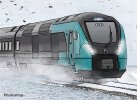
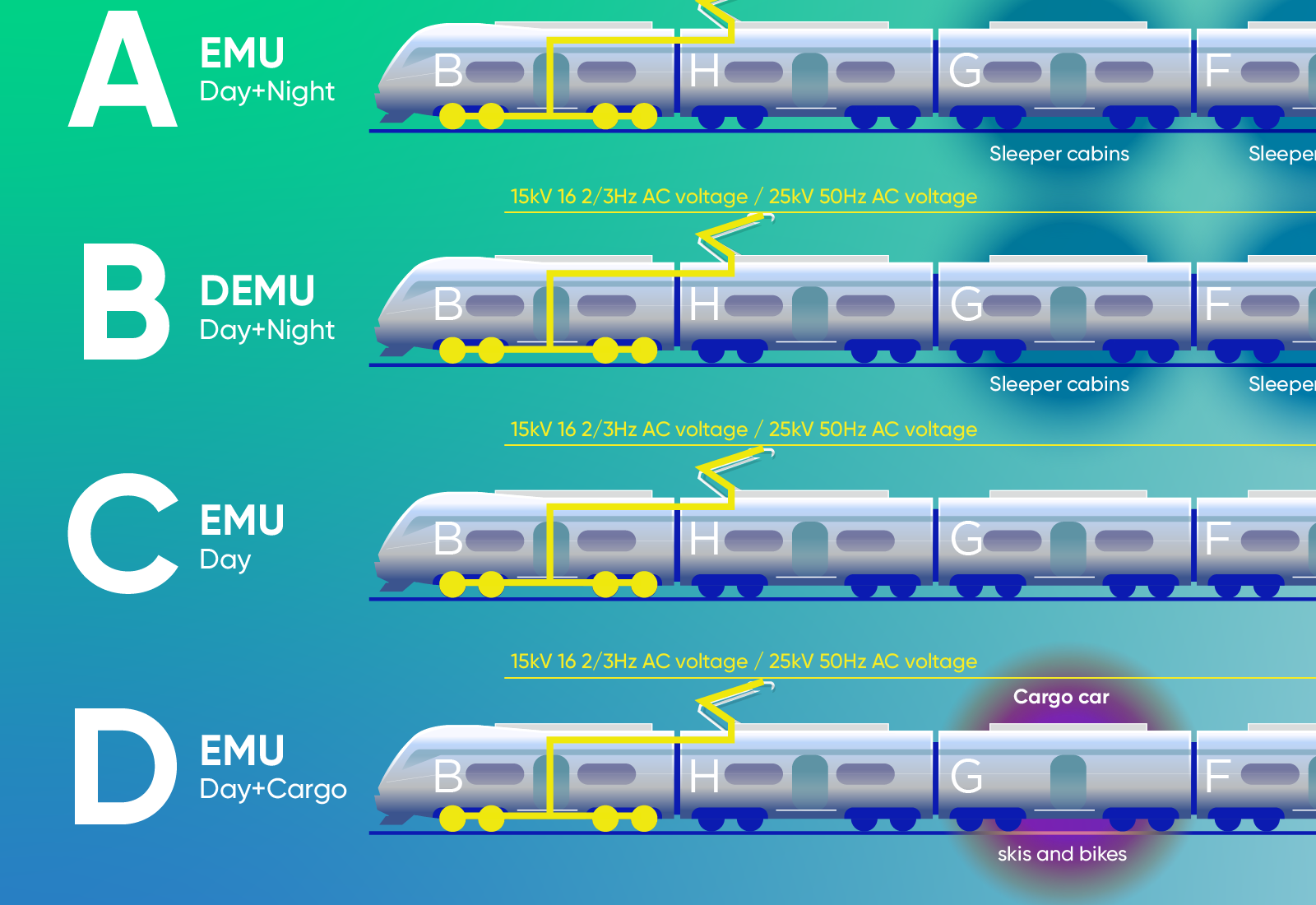
This is an interesting idea- last year, Stadler signed a contract in Norway for new long distance trains, compromising 4 design variations. One of these incorporates a diesel end car for use on unelectrified lines- the below image is a mockup from Railcolor news and the article for it is linked below. So, it’s not out of the question for FLIRT family trains to have this layout.
Earlier in 2023, Norske Tog and Stadler signed a contract for 17 eight-car trains for both day/night services in northern Norway. If successful, Norske Tog can order up to 83 extra […]
This is an interesting idea- last year, Stadler signed a contract in Norway for new long distance trains, compromising 4 design variations. One of these incorporates a diesel end car for use on unelectrified lines- the below image is a mockup from Railcolor news and the article for it is linked below. So, it’s not out of the question for FLIRT family trains to have this layout.
Earlier in 2023, Norske Tog and Stadler signed a contract for 17 eight-car trains for both day/night services in northern Norway. If successful, Norske Tog can order up to 83 extra […]
It's also fully bogied and not articulated, and has classic 26m coaches (I think).
Stadler will literally build anything you like as long as you can do it from their modular components. That sort of thing is their bread and butter because of the differing requirements of the various Swiss narrow gauge lines, a market they basically have sewn up.
This is an interesting idea- last year, Stadler signed a contract in Norway for new long distance trains, compromising 4 design variations. One of these incorporates a diesel end car for use on unelectrified lines- the below image is a mockup from Railcolor news and the article for it is linked below. So, it’s not out of the question for FLIRT family trains to have this layout.
Earlier in 2023, Norske Tog and Stadler signed a contract for 17 eight-car trains for both day/night services in northern Norway. If successful, Norske Tog can order up to 83 extra […]
That could be an issue- however, they could also consider fitting half of a driving car with batteries instead? A high-capacity battery (with proper long-term support from Stadler) would negate the need to string up lots and lots of wires, especially if they erect OHLE at the terminus stations for it to recharge/run off electric power.
Is it too cynical to ponder whether the procurement is just to Prove they can’t afford it whilst showing the unions etc that they tried? Or are the HSTs so bad it would save money to bin them?
I mean, if you ordered now they'd probably be in service around 2030 - right when the guaranteed lease for the HSTs ends, and keeping them much longer than that is probably unrealistic anyway, so you need something to replace them.
Except that jamming multiple engines in the micro vehicle has caused overheating issues hasn’t it - would they survive the long slogs over The Scottish mountains?
Would Flirts need two power packs and then cause platform length issues in Scotland?
you can go up to 6-cars per power-pack and match the power available on a 3-car in diesel. AIUI, there was an issue with the engines in the 755s which caused the overheating issue, which has now been resolved
That could be an issue- however, they could also consider fitting half of a driving car with batteries instead? A high-capacity battery (with proper long-term support from Stadler) would negate the need to string up lots and lots of wires, especially if they erect OHLE at the terminus stations for it to recharge/run off electric power.
This is an interesting idea- last year, Stadler signed a contract in Norway for new long distance trains, compromising 4 design variations. One of these incorporates a diesel end car for use on unelectrified lines- the below image is a mockup from Railcolor news and the article for it is linked below. So, it’s not out of the question for FLIRT family trains to have this layout.
Earlier in 2023, Norske Tog and Stadler signed a contract for 17 eight-car trains for both day/night services in northern Norway. If successful, Norske Tog can order up to 83 extra […]
Hard agree- transformational instead of a compromise.
Here’s an unserious idea- ScotRail takes on the remaining 175s and 180s to provide extra capacity, with 180s on the express services. (If Haymarket found the HSTs a handful, just wait till they meet the Coradia family!) /s
Hard agree- transformational instead of a compromise.
Here’s an unserious idea- ScotRail takes on the remaining 175s and 180s to provide extra capacity, with 180s on the express services. (If Haymarket found the HSTs a handful, just wait till they meet the Coradia family!) /s
Well, it can get cold in Scotland, so maybe those units' tendency to self-immolate might come in handy to warm your hands and maybe toast the odd marshmallow.
In all seriousness, if any existing units are to be taken as a stopgap the 222s make most sense.
Are there any trimode loco designs available at the moment? Those Mk5 coaches (plus some more new builds from the same family) would provide significant flexibility to deal with seasonal and individual passenger flow variations, and be potentially compatible with the decarbonisation plan too.
I don't know if loco hauled provides anything gangwayed multiple units can't do better.
The only question then is whether Stadler has the capability to design a cab with a gangway.
I don't know if loco hauled provides anything gangwayed multiple units can't do better.
The only question then is whether Stadler has the capability to design a cab with a gangway.
More instant flexibility - additional carriages for more crowded trains at shorter notice, and the possibility to add one or two carriages (seeing as single/double car MUs are rare these days, and for some fairly good reasons).
More instant flexibility - additional carriages for more crowded trains at shorter notice, and the possibility to add one or two carriages (seeing as single/double car MUs are rare these days, and for some fairly good reasons).
We are aware of an issue with emails from the Forum to Microsoft-based email accounts (hotmail/outlook/live.com email addresses). This is being looked into currently, thanks for your patience meanwhile.