• Our new ticketing site is now live! Using either this or the original site (both powered by TrainSplit) helps support the running of the forum with every ticket purchase! Find out more and ask any questions/give us feedback in this thread!

How about a staff pay "triple lock"?

Status
Not open for further replies.

Merle Haggard

Established Member
Joined
20 Oct 2019
Messages
3,916
Location
Northampton
A triple lock for rail pay is just as much a terrible idea as the triple lock for pensions is.

Almost exactly twenty five years ago the (Labour) Chancellor of the Exchequer announced that 'due to the poor state of the economy' the pension annual increase would be 75p per week.The reaction to this eventually resulted in the 'triple lock'.
 
Sponsor Post - registered members do not see these adverts; click here to register, or click here to log in
R

RailUK Forums

Harpo

Established Member
Joined
21 Aug 2024
Messages
3,843
Location
Newport
What would be much more useful would be a speculative discussion on how to end the triple lock for the state pension, which is becoming unsustainable.
How much would you like the state pension to have shrunk to, in real terms, by the time you retire?

But beware, if the tax relief on workplace pension contributions also becomes ‘unsustainable’ they might cost a lot more too.
 

Merle Haggard

Established Member
Joined
20 Oct 2019
Messages
3,916
Location
Northampton
How much would you like the state pension to have shrunk to, in real terms, by the time you retire?

I find the ageism on this forum interesting.
I wonder why people consider that a pension is irrelevant to their own situation. Everyone reaches pensionable age or dies before then and with these alternatives to become a pensioner sounds like good fortune.
An increase in pension now has an effect on the pension level of all future pensioners.
 

SuspectUsual

Established Member
Joined
11 Jul 2018
Messages
6,746
There is at least a moral case for having it with pensions as many pensioners have no or limited other sources of income, yet often have higher than average costs for things like heating where they are at home more.

There might be a moral case for linking pensions to inflation, as that's an indicator of the change in the pensioners' cost of living, but there is no moral case at all for linking pensions to wage growth whatsoever
 

Helvellyn

Established Member
Joined
28 Aug 2009
Messages
2,574
This sounds reasonable on paper but the Law of Unintended Consequences could very kick in quite quickly.

Firstly, the risk that two of the three conditions would be above inflation - 2.5% or average wages. That's the case now. But of everyone's wages go up above inflation those costs have to get passed on via higher costs - stoking inflation, which is how you can get into a 1970s style wage/price spiral.

Secondly, by forcing increased staff costs into a business you could see faster moves towards automation to reduce exposure to fixed costs. Yes, there are lots of roles that can't be replaced but ultimately you will get more pressure on why certain roles should exist.


It's one of the challenges with the minimum wage. Everyone supports the above average increases in theory but then questions why their Latte from Costa has shot up in price (not just the in-store staff who need pay rises but delivery drivers, staff in warehouses, etc.). You also see lower paid staff catching up with more senior roles, who in turn demand above average rises to keep a pay differential - not always given. But then people say why should I do this job for the same pay as that one? That's happened to my partner in a GP practice where they were being asked to managed receptionists now on effectively the same pay!
 

HSTEd

Veteran Member
Joined
14 Jul 2011
Messages
20,315
I find the ageism on this forum interesting.
I wonder why people consider that a pension is irrelevant to their own situation. Everyone reaches pensionable age or dies before then and with these alternatives to become a pensioner sounds like good fortune.
An increase in pension now has an effect on the pension level of all future pensioners.
Given that the pension age that I will be subject to has risen several years in my lifetime and is continuing to increase, there is a significant chance that I will not live long enough to collect a pension in any case.

Beyond that, the triple lock is slowly but surely bleeding the state to death.
Given changing demographics and the ratcheting, simple arithmetic will render it unsustainable before I reach pension age, assuming I live that long.

The current plans to increase pension age to pay for the triple lock are essentially robbing future pensioners to keep the party going for current pensioners.
The triple lock essentially guarantees that pensions will consume an ever greater share of GDP until, eventually, the state finances utterly collapse.
 

Trainbike46

Established Member
Joined
18 Sep 2021
Messages
4,371
Location
belfast
As things are, every couple of years we have industrial strife while a new pay deal is sorted out.

So how about going more "long term" and applying something like the pensioner triple lock on a long term basis, e.g. maybe a ten year deal or more? That is, an agreement that each year wages automatically increase by, for example, the higher of general inflation, RPI or a fixed percentage?

Obviously separate discussions could be had regarding productivity changes and the likes, but this seems a reasonable basic? I'd be happy with it.
I don't think we need a triple lock really - a long term deal of annual increases with CPI of the previous year would likely be acceptable to the unions, and be better than they've done in recent years if you exclude pay increases with changes in conditions. hopefully, you could then have negotiations over any changes in conditions without too much strike pressure, at least initially.

== Doublepost prevention - post automatically merged: ==

It would be a remarkably reasonable basis as far as the unions are concerned, but completely unreasonable for those paying the bill, whether taxpayer or farepayer.
The triple lock has resulted in a real terms increase over both earnings and prices of 11% since it was introduced in 2011/12. I'm not sure on what basis that could be justified, as it guarantees real increases year on year, due to the cherry picking of the best of three bases each year.

See here for a (relatively) plain English explanation of why the triple lock guarantees above inflation increases over time.

that's a fair criticism, but state pension is still too low to reasonably live on - so above inflation increases that push it towards something you can live on are a good thing in my view
 

Bletchleyite

Veteran Member
Joined
20 Oct 2014
Messages
113,321
Location
"Marston Vale mafia"
I don't think we need a triple lock really - a long term deal of annual increases with CPI of the previous year would likely be acceptable to the unions, and be better than they've done in recent years if you exclude pay increases with changes in conditions. hopefully, you could then have negotiations over any changes in conditions without too much strike pressure, at least initially.

That sounds a good compromise to be honest, and avoids the superinflationary aspect of the triple lock. A double lock maybe? :)

What isn't acceptable is what some have been suggesting, namely that public spending should be reduced by giving public sector workers effective pay cuts where private sector workers are not experiencing the same thing. Inflationary rises need to be a given, and were until Thatcherism kicked in, because otherwise you're going backwards. If money needs to be saved from the public purse, other options need to be considered, though that's by no means a given as there are other options like increasing taxation.
 

HSTEd

Veteran Member
Joined
14 Jul 2011
Messages
20,315
I don't think we need a triple lock really - a long term deal of annual increases with CPI of the previous year would likely be acceptable to the unions, and be better than they've done in recent years if you exclude pay increases with changes in conditions. hopefully, you could then have negotiations over any changes in conditions without too much strike pressure, at least initially.
Would the unions have any reason to ever agree any changes in conditions though?
Once you concede inflationary pay deals ad infinitum, any leverage the state has to negotiate with is gone.

This guaranteeing inflation-linked pay deals just seems a recipe for stasis without end.
 

HSTEd

Veteran Member
Joined
14 Jul 2011
Messages
20,315
I'd be happy with a static, boring, reliable railway myself. One I can set my watch by, and one where fares just go up by inflation each year.
Well, that likely just means that the requirement for public financial support will grow year on year until a political rupture occurs.

EDIT:
A largely static (it was still largely a steam railway with some diesels slapped on top) railway in the face of a changing economy is how we ended up with Beeching.
 

Trainbike46

Established Member
Joined
18 Sep 2021
Messages
4,371
Location
belfast
What short memories you all have. Who became Prime Minister just 2 years and 4 days ago? What happened when they tried to introduce an economic policy that was widely regarded as unsustainable?

This is a speculative discussion, so I invite you to speculate. If you gave the Wages Triple Lock policy to the Office for Budget Responsibility (other economic forecasters are available) what do you think would be the impact on the forecast trajectory for inflation? What would be the impact on the forecast trajectory for government borrowing and debt?
increasing the pay of public sector workers with CPI isn't at all comparable to massively dropping taxes with zero explanation of how that will be paid for. Part of the issue with Truss's policies was that there weren't any public forecasts of impact at all - which noone here is suggesting.

Taxes do tend to increase amount raised with inflation as well, for starters! If you actually were to do some modelling before you introduce it, then you would have a reliable explanation of how you're paying for it, so it shouldn't panic any money markets

I find it remarkable how many people drew the lesson "public spending is bad" out of Truss, when a lesson like "Very large increases in government spending or reductions in tax income, without any justification of how to pay for it or quality economic modelling explaining the impacts on the economy and the government budget will scare money markets" would have been more accurate.
 

Bletchleyite

Veteran Member
Joined
20 Oct 2014
Messages
113,321
Location
"Marston Vale mafia"
Well, that likely just means that the requirement for public financial support will grow year on year until a political rupture occurs.

Only if you take the nonsensical political approach that taxation income doesn't also need to increase each year by inflation. That's how inflation works - everything needs to go up by the same amount.

That was all working fine until Thatcher started fiddling with it.

== Doublepost prevention - post automatically merged: ==

I find it remarkable how many people drew the lesson "public spending is bad" out of Truss, when a lesson like "Very large increases in government spending or reductions in tax income, without any justification of how to pay for it or quality economic modelling explaining the impacts on the economy and the government budget will scare money markets" would have been more accurate.

It's fairly normal in the populist Right to deliberately draw the wrong conclusions from something and use it against your opponents. Trump is a master of it, and the Torygraph is full of it (sadly I now see more of it due to it being free with Apple News now).
 

Trainbike46

Established Member
Joined
18 Sep 2021
Messages
4,371
Location
belfast
Would the unions have any reason to ever agree any changes in conditions though?
Once you concede inflationary pay deals ad infinitum, any leverage the state has to negotiate with is gone.

This guaranteeing inflation-linked pay deals just seems a recipe for stasis without end.
you could introduce a lot of the desired conditions as part of a new gbr-grade for new entrants and any on existing deals that would like to switch. You could even repeat this every few years for all new entrants, if more changes are required.

There's various reasons a union would agree to changes in conditions - some are in their members interest, they could offer a one-off extra pay rise or tie desirable changes in conditions to undesirable ones.

== Doublepost prevention - post automatically merged: ==

That sounds a good compromise to be honest, and avoids the superinflationary aspect of the triple lock. A double lock maybe? :)
What would the other part of your double-lock be? Inflation and?
What isn't acceptable is what some have been suggesting, namely that public spending should be reduced by giving public sector workers effective pay cuts where private sector workers are not experiencing the same thing. Inflationary rises need to be a given, and were until Thatcherism kicked in, because otherwise you're going backwards. If money needs to be saved from the public purse, other options need to be considered, though that's by no means a given as there are other options like increasing taxation.
Agreed. Expecting workers to keep accepting net cuts to their income year after year is what has driven so many strikes in recent years - from barristers to doctors to railways to civil servants.

It's truly damaging to the functioning of so many sectors, and leading to things like legal aid pay that is way too low, which is harming availability and therefore the functioning of our justice system
 
Last edited:

Harpo

Established Member
Joined
21 Aug 2024
Messages
3,843
Location
Newport
There's various reasons a union would agree to changes in conditions - some are in their members interest, they could offer a one-off extra pay rise or tie desirable changes in conditions to undesirable ones.
Exactly how the supposedly ‘militant’ ASLEF has agreed such a huge variety of differing business-focussed T&Cs across the country, with each set tailored to that employer’s needs. But that narrative doesn’t appeal to the DailyExpressGraph.
 

HSTEd

Veteran Member
Joined
14 Jul 2011
Messages
20,315
Only if you take the nonsensical political approach that taxation income doesn't also need to increase each year by inflation. That's how inflation works - everything needs to go up by the same amount.

That was all working fine until Thatcher started fiddling with it.
Well the railway would just become more and more expensive and the public will eventually come to see it is as not worth the money it is costing them.
It's not unreasonable that people might come to that conclusion.

The railway exists because it serves a purpose, this purpose inevitably changes with the times. If the railway does not change with the times then it will eventually cease to serve that purpose and that will be the end.
 

Trainbike46

Established Member
Joined
18 Sep 2021
Messages
4,371
Location
belfast
Well the railway would just become more and more expensive and the public will eventually come to see it is as not worth the money it is costing them.
It's not unreasonable that people might come to that conclusion.

The railway exists because it serves a purpose, this purpose inevitably changes with the times. If the railway does not change with the times then it will eventually cease to serve that purpose and that will be the end.
noone is disagreeing that things need to change at times - Both me and bletchleyite have regularly argued for changes on the railway on this forum
 

Bletchleyite

Veteran Member
Joined
20 Oct 2014
Messages
113,321
Location
"Marston Vale mafia"
noone is disagreeing that things need to change at times - Both me and bletchleyite have regularly argued for changes on the railway on this forum

Indeed, including some quite controversial ones. However, "everything has to get cheaper so rich people can pay less tax" is just flawed in the extreme and cannot possibly have good outcomes.

"Singapore on Thames" is often cited, but Singapore knows it needs to invest in very high quality public transport to get economic benefits!
 

HSTEd

Veteran Member
Joined
14 Jul 2011
Messages
20,315
noone is disagreeing that things need to change at times - Both me and bletchleyite have regularly argued for changes on the railway on this forum
But there are changes that unions are unlikely to ever agree to without major leverage, for example reductions in headcount.

Given demographic changes, maintenance of railway employment has effects even beyond the extremely high cost of labour. (The next century will be characterised by crippling and ever increasing shortages of labour)

The railway has to embrace increases in automation and the like, especially as competing technologies are showing improving labour efficiency.
 

John R

Established Member
Joined
1 Jul 2013
Messages
6,099
that's a fair criticism, but state pension is still too low to reasonably live on - so above inflation increases that push it towards something you can live on are a good thing in my view
We're digressing somewhat, but everyone who works has an opportunity to make other pension provision over their working lifetime. Either by being part of an occupational scheme, or making their own private pension provision, which has been available for at least 50 years. (For railway workers, they do of course have a gold standard defined benefit scheme, one which most private sector employees would love to have.)

If you want to have more than a subsistence level of retirement, you need to make provision throughout your lifetime, not rely on the state.

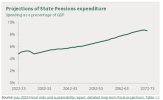
Also note that pensions credit is available for those who do find themselves below subsistence level. Much better that if there is money available, pensions credit is widened and increased, rather than the state pension inexorably increases, putting a much higher burden on those who are still working who ultimately pay for it through taxes and NI. The attached graph shows how the triple lock will gradually add to the burden of state pension payments as a proportion of GDP over time - this from a briefing paper available in the House of Commons library.
 

Attachments

  • Screenshot 2024-09-10 084019.png
    Screenshot 2024-09-10 084019.png
    105.7 KB · Views: 15

Meerkat

Established Member
Joined
14 Jul 2018
Messages
9,276
What isn't acceptable is what some have been suggesting, namely that public spending should be reduced by giving public sector workers effective pay cuts where private sector workers are not experiencing the same thing.
I can assure you that when things aren’t going well private sector workers can get zero pay rises!
And are at far far higher risk of a downturn leading to redundancy…often on just statutory payout.
The problem is that nationalisation/public sector means the government can promise service levels without funding pay high enough to recruit and retain the necessary staff - without the equivalent of franchisees saying “nah, not bidding for that”.

but everyone who works has an opportunity to make other pension provision over their working lifetime.
Only if they have the spare cash…..
But I agree that the triple lock is inexcusable. Aside from the obvious financial reasons it is pretty undemocratic - the pensioners vote for it and then can vote for economic policies whilst being largely insulated from the consequences.
 

Trainbike46

Established Member
Joined
18 Sep 2021
Messages
4,371
Location
belfast
We're digressing somewhat, but everyone who works has an opportunity to make other pension provision over their working lifetime. Either by being part of an occupational scheme, or making their own private pension provision, which has been available for at least 50 years. (For railway workers, they do of course have a gold standard defined benefit scheme, one which most private sector employees would love to have.)

If you want to have more than a subsistence level of retirement, you need to make provision throughout your lifetime, not rely on the state.

Also note that pensions credit is available for those who do find themselves below subsistence level. Much better that if there is money available, pensions credit is widened and increased, rather than the state pension inexorably increases, putting a much higher burden on those who are still working who ultimately pay for it through taxes and NI. The attached graph shows how the triple lock will gradually add to the burden of state pension payments as a proportion of GDP over time - this from a briefing paper available in the House of Commons library.
it would be interesting if the graph showed what proportion is due to the triple-lock, and what proportion is due to demographic changes (ie more people over pension age).

I agree there are alternative options, like improvements to pension credit, to deal with the fact that state pension is too low to live of by itself.

Just to add, I do agree that in principle the triple lock is a bad idea. Just that in practice, the current implementation is probably overall an improvement, so not a priority to worry about for me.
 

JonathanH

Veteran Member
Joined
29 May 2011
Messages
23,325
What isn't acceptable is what some have been suggesting, namely that public spending should be reduced by giving public sector workers effective pay cuts where private sector workers are not experiencing the same thing.
Is it actually true that private sector workers are not experiencing the same thing? Plenty of people have fallen back relative to inflation since 2008.

Changes to pay reflect demand for particular skills and sometimes there are downward corrections, driven perhaps by a race to the bottom. As noted by others, the minimum wage has forced up pay at the bottom of the pay scale, but beyond that pay has stagnated, not just in the public sector. The official statistics don't really differentiate between merit and inflationary increases.
 

Magdalia

Established Member
Joined
1 Jan 2022
Messages
7,386
Location
The Fens
That's how inflation works - everything needs to go up by the same amount.
No, that's not how inflation works. Everything goes up by different amounts. It is how relative prices change, and why Central Banks usually aim for a little bit of inflation (around 2%), instead of stable prices.

That was all working fine until Thatcher started fiddling with it.
That's incorrect. In the 1970s, immediately before Thatcher was first elected, the UK had huge problems with inflation, which peaked at over 25% in 1975.

Almost exactly twenty five years ago the (Labour) Chancellor of the Exchequer announced that 'due to the poor state of the economy' the pension annual increase would be 75p per week.The reaction to this eventually resulted in the 'triple lock'.
That's incorrect too. At the time pensions was on a "single lock", linked to prices. In that year the inflation rate was only just above zero, hence the small increase.

It's one of the challenges with the minimum wage. Everyone supports the above average increases in theory but then questions why their Latte from Costa has shot up in price (not just the in-store staff who need pay rises but delivery drivers, staff in warehouses, etc.). You also see lower paid staff catching up with more senior roles, who in turn demand above average rises to keep a pay differential - not always given. But then people say why should I do this job for the same pay as that one? That's happened to my partner in a GP practice where they were being asked to managed receptionists now on effectively the same pay!
The impact of increases in the minimum wage on inflation is almost always overlooked. And it is a good example of why prices have to be able to move relative to each other, not all go up by the same amount. The latte in Costa goes up by a lot more than the jar of coffee in the supermarket, partly because it has more labour input.

This guaranteeing inflation-linked pay deals just seems a recipe for stasis without end.

It could be worse than that. It could lead to a feedback loop of spiralling inflation.

How much would you like the state pension to have shrunk to, in real terms, by the time you retire?
You are making an assumption there.


increasing the pay of public sector workers with CPI isn't at all comparable to massively dropping taxes with zero explanation of how that will be paid for. Part of the issue with Truss's policies was that there weren't any public forecasts of impact at all - which noone here is suggesting.
Where are the forecasts of the impact on the public sector finances of increasing the pay of all public sector workers in line with CPI? As I said before, if you asked the Office for Budget Responsibility to estimate the impact of this on future trajectories of inflation and government debt, what do you think they would say?
 

43066

Veteran Member
Joined
24 Nov 2019
Messages
12,089
Location
London
As things are, every couple of years we have industrial strife while a new pay deal is sorted out.

So how about going more "long term" and applying something like the pensioner triple lock on a long term basis, e.g. maybe a ten year deal or more? That is, an agreement that each year wages automatically increase by, for example, the higher of general inflation, RPI or a fixed percentage?

Obviously separate discussions could be had regarding productivity changes and the likes, but this seems a reasonable basic? I'd be happy with it.

It’s an interesting question. I’m not sure I’d be in favour of a triple lock however, as you note, there is rightly an expectation of an inflation linked pay rise each year. That was certainly my experience in the private sector non railway roles prior to joining the railway, and has generally been the case on the railway in recent years, even without industrial action (at least prior to the dispute). No reason in principle why that shouldn’t continue.

Why should wages automatically increase if there is no commensurate link to either revenue, productivity or cost management targets ? The taxpayer shouldn't be on the hook for railworkers salaries increasing automatically with no question.

What’s being discussed isn’t a real terms increase in wages, it’s merely a measure to ensure pay keeps pace with inflation. You appear to be suggesting everyone should have to increase productivity every year just to be paid the same in real terms. That’s clearly a nonsensical position, and a recipe for ever decreasing pay.

There is at least a moral case for having it with pensions as many pensioners have no or limited other sources of income, yet often have higher than average costs for things like heating where they are at home more.

There is no such moral case across the board. The current cohort of pensioners are the richest segment of society, and they have benefited from the triple lock transferring yet more wealth to them, entirely thanks to their tendency to vote conservative - morals don’t come into it. People are wising up to that hence why the Tories now have a demographic time bomb on their hands (AIUI the last GE was the first where the baby boomer cohort didn’t make up the majority of the electorate).

By all means support pensioners who are genuinely in need, but a triple lock being awarded to those people who have benefited from massive real terms property price inflation, and who in many cases already receive gold plated private pensions far more generous than anything the curent generation of working people will receive, is ridiculous in economic terms.
 
Last edited:

Trainbike46

Established Member
Joined
18 Sep 2021
Messages
4,371
Location
belfast
The impact of increases in the minimum wage on inflation is almost always overlooked. And it is a good example of why prices have to be able to move relative to each other, not all go up by the same amount. The latte in Costa goes up by a lot more than the jar of coffee in the supermarket, partly because it has more labour input.
All kind of items go up and down in price all the time, for many factors, including labour costs, material availability, good or bad harvests, changes in company profit margins, etc. That final one is often underestimated, for some reason.
Where are the forecasts of the impact on the public sector finances of increasing the pay of all public sector workers in line with CPI? As I said before, if you asked the Office for Budget Responsibility to estimate the impact of this on future trajectories of inflation and government debt, what do you think they would say?
Currently they don't exist, obviously. However, between some people talking about it as an option and it being introduced, either as government policy or as a long-term pay deal, such modelling should be done. Pretending that nothing will happen between people discussing an idea and actually implementing it doesn't serve anyone, and is pretty disingenuous to be honest.

Regarding the impact - I don't see any reason why linking pay to either CPI or CPIH for the previous year*, is likely to lead to anything particularly negative. In fact, it seems no more than fair.

*the reason I say we should use a previous year rather than the predictions for the current is to prevent predictions from becoming self-fulfilling through their impact on goverment policies and pay rises.
 

JonathanH

Veteran Member
Joined
29 May 2011
Messages
23,325
You appear to be suggesting everyone should have to increase productivity every year just to be paid the same in real terms. That’s clearly a nonsensical position, and a recipe for ever decreasing pay.
How do you incentivise development and progress if you don't increase productivity and give people pay increases for just doing their job?

There is absolutely a place for the minimum wage to keep pace with inflation. As people progress to roles with a greater degree of management responsibility, it is right that the pay increase is all at risk.
 

Bletchleyite

Veteran Member
Joined
20 Oct 2014
Messages
113,321
Location
"Marston Vale mafia"
How do you incentivise development and progress if you don't increase productivity and give people pay increases for just doing their job?

What's wrong with just doing the same job really well throughout your career and getting inflation each year? Suits a lot of people to do that.

This idea that people have to seek constant progression is a horribly Thatcherite idea. What if you derive great pleasure from just doing a really good job of sweeping the streets or serving in a shop each day for 50 years or so?
 

Magdalia

Established Member
Joined
1 Jan 2022
Messages
7,386
Location
The Fens
Regarding the impact - I don't see any reason why linking pay to either CPI or CPIH for the previous year*, is likely to lead to anything particularly negative.

There is a ratchet effect. It is very easy for inflation to increase, and very difficult and painful to bring it down again.

And what about the impact on the public finances, which you are completely ignoring? Is it going to be paid for out of higher taxes or higher borrowing? If taxes are increased, what impact does that have on the private sector of the economy? If borrowing is increased, what impact does that have on interest rates, and the interest costs on the existing government debt?
 

Alex C.

Member
Joined
7 Jan 2014
Messages
251
This is my biggest frustration around the discourse around public sector pay (which now includes rail staff) for the last few years/since 2010 - you can only really take one long term position:

- Pay should increase each year on average (either measured by inflation - CPI or RPI or wider earnings growth)
- Public sector pay should progressively get worse over time, either because they don't deserve the increases, they aren't making productivity improvements, or it's an unfair burden on the taxpayer.

If you are arguing for option two, then don't be surprised when you get strikes. Inflation pay increases are the norm in the private sector[1] and this included the privatised TOCs. Trying to renege on that is unfair on those it effects.

If you are arguing for option one, you can build up goodwill to leverage this for a short period - e.g the junior doctors who accepted significant pay stagnation until it became clear the government had no intention of restoring the pay in the long term and initiated their significant industrial dispute.

I think that in an idealistic world, there should be an automatic link to earnings growth, perhaps with some flexibility around averaging over a three year period for example - and I would also be comfortable with then linking this to a minimum service obligation, written into any contracts issued to new members of staff which would provide some resilience in the long term - I accept that proposal alone would cause significant discontent with the unions and isn't likely to be easy to achieve.

This is slightly more off topic but I'd actually go further and suggest that the broader pensions triple lock should just be linked to earnings growth, to give pensioners a wider stake in the opportunity available to people of working age. And historically (until 2008) earnings growth has outpaced inflation.

[1] not everyone gets a pay increase every year, those who do are fortunate - but in aggregate, private earnings growth has been higher than public sector earnings growth for much of the last 14 years. This has led to other problems, in particular the ability of the public sector to recruit high quality employees - for example, my current role in the private sector pays 4x an equivalent public sector role advertised in the cabinet office last year - and the over-promotion of people to retain them when simple private sector pay negotiation would have done the same job without the accompanying reduction in overall competence.

 
Status
Not open for further replies.

Top