
• Our new ticketing site is now live! Using either this or the original site (both powered by TrainSplit) helps support the running of the forum with every ticket purchase! Find out more and ask any questions/give us feedback in this thread!

Help With Signal Box Diagram

Status
Not open for further replies.

Andy873

Established Member
Joined
23 Mar 2017
Messages
1,424
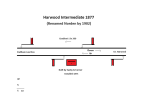
Having looked at many signal box diagrams over the years I decided to have a go at one.

This one is of the original Norden box which is believed to have been installed in 1875 two years before this line opened. But I need help and suggestions please!

Firstly, there are no known diagrams of this box. This box was half way between the western junction and the first town along and as you can see it's just the double track, no points or sidings to contend with.

Chris Littleworth believed the box had ten levers but puts a question mark after the number 10, that said other things he stated but questioned I have since found to be correct so I'm going with 10 levers.

Secondly, I'm presuming both lines had a distant and home / stop signals which gives me 4 working levers, would there be any more in use? maybe two for detonators perhaps?

Thirdly, I don't know the distances between to distant and home signals, could anyone suggest a suitable distance?

The 1890's town maps don't cover this area as it's in the countryside. The 1909 OS map shows it however by then it was closed and two new boxes installed either side of this older one and as such can't go off the signal post locations from 1909.

I would very much welcome any ideas, suggestions, even corrections, e.g. I've placed both home signals either side of the box?

Attached is my very basic first ever attempt at a box diagram...

Thanks,
Andy.
 

Attachments
  • Norden Box 1.png
    Norden Box 1.png
    16.2 KB · Views: 45
Last edited:
Sponsor Post - registered members do not see these adverts; click here to register, or click here to log in
R

RailUK Forums

John Webb

Established Member
Joined
5 Jun 2010
Messages
3,788
Location
St Albans
Andy - is the gradient rising in the direction of the arrow, just for clarification?
And how far away were the adjacent boxes?
 

Andy873

Established Member
Joined
23 Mar 2017
Messages
1,424
Andy - is the gradient rising in the direction of the arrow, just for clarification?
And how far away were the adjacent boxes?
John, yes the gradient is rising up in the direction of the arrow / towards Padiham Junction.

The 1884 sectional appendix lists this box as being 1 mile 1180 yards from Gt. Harwood box and 1 mile and 1320 yards from the junction.
 

Gloster

Veteran Member
Joined
4 Sep 2020
Messages
13,063
Location
Up the creek
A couple of points:

On diagrams the distances that are marked are from the box, normally (I think) the centre of the lever frame.
In addition to Worked levers, you can have Spare ones (fitted in the frame but not connected) or Spaces (no lever fitted).
If you are guessing or using photos, etc. it is always best to add something on the lines of ‘Diagram reconstructed from incomplete known information.’

You are certainly starting with one with minimal information; usually you can at least find the signal posts on an old OS map as a starting point. There might have been detonator placers, but I suspect that the frame was pretty simple: was the box built because there was a plan to have a mine or some industry in the area and so it included provision for more points and signals to allow for this?
The distance to the signals is, at any box, affected by a mass of variables: gradient, factors affecting visibility (curvature, bridges, buildings, etc.), speeds, etc.
Signals were normally to the left of the line, but could be on the other side if that was felt necessary for sighting purposes.

It is very difficult to reconstruct a diagram without a fair bit of initial information.
 

Andy873

Established Member
Joined
23 Mar 2017
Messages
1,424
You are certainly starting with one with minimal information; usually you can at least find the signal posts on an old OS map as a starting point.
Absolutely agree with you on both points, but sadly the 1890's map sheet where the box was is missing from the NLS website.

All I can say is that the box was on a low embankment, possible only around five feet high which shortly (going left from the box) shallows to ground level and then the track goes into a cutting. Going right, the embankment deepens to around say 12 - 15 feet before (once again) running into a cutting.

Imagine a gentle S bend, to the box's left the track curves downwards, to the right, upwards.

Question - In the 1884 sectional appendix the L&Y list the signal "cabins" with the block post black dot, however there is no block post symbol for this box - Would a non block post box (especially with such a simple layout) ever have had a box diagram?

If you are guessing or using photos, etc. it is always best to add something on the lines of ‘Diagram reconstructed from incomplete known information.’
Absolutely! I would make it known this was only a guess, my own impression and certainly not accurate.

Can we agree on the basic principle that both home / stop signals would have had distant ones before them?

Looking at other distant signals along the line, the distance from their boxes varies from around 800 yards to 1200 plus yards so that's no help.

EDIT:-
For some reason the quote option has disappeared! but to answer @Gloster's question about industry planned near by - No, there was nothing planned at this location.
 
Last edited:

Rescars

Established Member
Joined
25 May 2021
Messages
2,610
Location
Surrey
This is just speculative guessing, but if this had been a block post, presumably it would have had starters as well as home signals. It may also have had a trailing crossover too. There may have been provision for some of this with spare levers in the frame if it was thought the traffic might warrant this in the near future. What was the purpose of this sidingless mid-section box, I wonder? Surely not to allow two trains to occupy a single block at the same time. AIUI the BoT weren't overly keen on mid-section non-block boxes in the light of the accident at Foxcote on the S&D, but that was a single line and I may be creating confusion here by conflating issues.
 

Gloster

Veteran Member
Joined
4 Sep 2020
Messages
13,063
Location
Up the creek
I can only presume that, in the lack of other reasons, the L&Y thought that traffic might build up sufficiently to justify shorter sections, but such did not happen and they closed the box. In such a situation it might just have been provided with a Home and Distant on each road, but with a ten lever frame that made provision for extension of the layout at a later date. There was, or so I understand, no absolute insistence on having a Starter as well as a Home, but no doubt it was preferred: by the Inspecting Officers if no one else. However, if doing it as cheaply as possible because the long term situation was uncertain, the L&Y may just have gone for the minimum.

N.b. if you have a signal box, then there is a block section either side: you can’t have an open signal box in a section, because that immediately divides it into two sections. There is nothing peculiar about the arrangement at Norden, except possibly the short distances. Foxcote was in the middle of a single line section and was illegally used to allow two trains to follow each other through the section, when only one should have been allowed in the whole section.
 

Rescars

Established Member
Joined
25 May 2021
Messages
2,610
Location
Surrey
I can only presume that, in the lack of other reasons, the L&Y thought that traffic might build up sufficiently to justify shorter sections, but such did not happen and they closed the box. In such a situation it might just have been provided with a Home and Distant on each road, but with a ten lever frame that made provision for extension of the layout at a later date. There was, or so I understand, no absolute insistence on having a Starter as well as a Home, but no doubt it was preferred: by the Inspecting Officers if no one else. However, if doing it as cheaply as possible because the long term situation was uncertain, the L&Y may just have gone for the minimum.

N.b. if you have a signal box, then there is a block section either side: you can’t have an open signal box in a section, because that immediately divides it into two sections. There is nothing peculiar about the arrangement at Norden, except possibly the short distances. Foxcote was in the middle of a single line section and was illegally used to allow two trains to follow each other through the section, when only one should have been allowed in the whole section.
Thanks for your n.b. I fully take you point about a box like Norden having a block section on either side. I can't quite see how this fits with Andy873's copy of the L&Y sectional appendix in which Norden doesn't have the block post black dot though.
 

Gloster

Veteran Member
Joined
4 Sep 2020
Messages
13,063
Location
Up the creek
Thanks for your n.b. I fully take you point about a box like Norden having a block section on either side. I can't quite see how this fits with Andy873's copy of the L&Y sectional appendix in which Norden doesn't have the block post black dot though.

Quite possibly it indicated that the box was built and may have received the (minimum) basic equipment, but never actually opened. Or it had both opened and closed before the Sectional Appendix was compiled, or had not yet opened. Whatever it was, if I didn’t have a dot it probably was not open, as a box, although it might be a ground frame: were they indicated by a symbol?

However, as with everything, one needs to be familiar with the particular practices of the relevant railway at that specific time.
 

Rescars

Established Member
Joined
25 May 2021
Messages
2,610
Location
Surrey
Quite possibly it indicated that the box was built and may have received the (minimum) basic equipment, but never actually opened. Or it had both opened and closed before the Sectional Appendix was compiled, or had not yet opened. Whatever it was, if I didn’t have a dot it probably was not open, as a box, although it might be a ground frame: were they indicated by a symbol?

However, as with everything, one needs to be familiar with the particular practices of the relevant railway at that specific time.
An explanation such as this seems most likely. It seems improbable that it would have been a ground frame without so much as a single siding to operate.
 

Gloster

Veteran Member
Joined
4 Sep 2020
Messages
13,063
Location
Up the creek
I have had a look at the 1909 25” map and there are two S.B. marked: one just east of the bridge near Norden Farm and the other a bit east of Lower Cunliffe. There is another further west serving the sidings alongside the Leeds & Liverpool Canal and another just north of Blow Up Cottages. Could it be that the L&Y was looking at sending goods traffic over the Great Harwood Loop and so had plenty of signal boxes in order to keep the trains moving: only the minimum number of signals would be required for this.
 

Andy873

Established Member
Joined
23 Mar 2017
Messages
1,424
On diagrams the distances that are marked are from the box, normally (I think) the centre of the lever frame.
Were these distances from a box to a signal "as the crow flies"? or the length of cable from the box to the signal? Distance from the box to the signal along the tracks?

I have had a look at the 1909 25” map and there are two S.B. marked: one just east of the bridge near Norden Farm and the other a bit east of Lower Cunliffe. There is another further west serving the sidings alongside the Leeds & Liverpool Canal and another just north of Blow Up Cottages. Could it be that the L&Y was looking at sending goods traffic over the Great Harwood Loop and so had plenty of signal boxes in order to keep the trains moving: only the minimum number of signals would be required for this.
From the point of view of signal boxes, the 1909 map shows the original boxes plus the new one that were built. In short, it shows all the boxes that ever existed along the branch except for the new Padiham box which replaced that station's east & west boxes in 1913.

As we move east from the junction (Blackburn end), the first box just north of Blow up cottages (a name that has always had me curios!) was Little Harwood. It opened in 1899 and was only opened during the summer months to ease acceptance of trains running back to the junction. This box closed 7 October 1909. The next one was Queen Brick siding box, this opened in 1904 to control access to the new brick works and its sidings. Next along is the box I'm drawing (badly) Harwood Intermediate (renamed Norden by 1902). There is confusion here as to when it actually closed. Some say 1904 when Queen Brick box opened, some say 1907 when it was replaced by the new (second) Norden box. This second Norden box was indeed situated east of Norden road bridge (roughly 880 yards further east from Norden box 1).

Do we know (or can find out) just when in say 1909 the area was revised? summer time when it's hopefully warmer / drier? would such details exist?

I ask because the first box I mention in the above paragraph (Little Harwood) was still used / open in 1909 and the corresponding OS map from that year shows the location of signal posts near it, perhaps this one I could draw a little more accurately?

Could it be that the L&Y was looking at sending goods traffic over the Great Harwood Loop and so had plenty of signal boxes in order to keep the trains moving: only the minimum number of signals would be required for this.
Yes, possibly although there was already a fair amount of freight trains using the line around the early years of the 20th Cent.

To give you an idea of the goods traffic, this is an extract from a WTT (1-Oct-1905):

Goods - Weekdays
Blackburn to Rose Grove 4 am SX
Blackburn to Gt. Harwood 8.58 am SX
Blackburn to Padiham (listed as 8.58 am - same as previous one?)
Preston to Burnley 10.04 am (express)
Blackburn to Rose Grove 1.35 pm SX
Miles plating to Chorley 1.55 am (Rose Grove) express MX
Rose Grove to Preston 4.20 am (Fish) MX
Burnley to Lostock Hall 5.30 am SO
Rose Grove to Blackburn 6.00 am SO
Rose Grove to Gt. Harwood 6.10 am
Rose Grove to Gt. Harwood 12.00 am SX
Leeds & Bradford to Blackpool Central (express) 11.57 am
Padiham to Blackburn 3.30 pm SO
Rose Grove to Blackburn (express) SX
Gt. Harwood to Wigan 11.10 pm
Plus two more Padiham to Rose Grove.

Goods - Sundays
Blackburn to Rose Grove Special Mail express 5.25 am
Rose Grove to Lostock Hall Fast goods 5.25 am

Plus you also had the regular passenger services, 16 going east towards Burnley 11 going west towards Blackburn.
 
Last edited:
Status
Not open for further replies.

Top