• Our new ticketing site is now live! Using either this or the original site (both powered by TrainSplit) helps support the running of the forum with every ticket purchase! Find out more and ask any questions/give us feedback in this thread!

Capacity of HS2 Euston, and Old Oak Common when used as a terminus

Status
Not open for further replies.

Nottingham59

Established Member
Joined
10 Dec 2019
Messages
3,356
Location
Nottingham
How many trains per hour will Old Oak Common and Euston handle when operating as a terminus?
I've seen various numbers:

OOC
  • The 2020 full business case for HS2 Phase 1 said that Old Oak Common (OOC) as a terminus was expected to handle 3tph when the service opened to Birmingham, and 6tph when Handsacre opened, with no increase over 6tph after phase 2a to Crewe.
  • Chris Gibbs' super-Pendolino proposal mentioned, if I remember correctly, that OOC should be able to handle around 8tph as a terminus.
EUSTON
  • The full HS2 service was designed with 3 minute headways, i.e. 20tph, but the Indicative Train Service Specification (TSS) assumed 18tph to allow recovery time, of which one path was unused, giving 17tph to a Euston with 11 or 10 platforms, calculated at 30 minute turnarounds, with one platform spare.
  • The HS2 Phase 2b Western Leg: Crewe to Manchester: An Update on the Strategic Outline Business Case (Jan 2022) gives an indicative TTS of 10tph for phase 2a and 11tph for just the Western arm of 2b.
  • When Sunak cancelled phase 2 last year and rescoped Euston to 6 platforms, the government said "We will not provide a tunnel between Euston and Euston Square underground station or design features we do not need. Instead we will deliver a 6-platform station
    which can accommodate the trains we will run to Birmingham and onwards
    ". They didn't say what trains those would be, but I assume they meant the 11tph mentioned in the 2022 SOBC.
  • It seems that Sunak's diminished Euston will still have a grade-separated throat, so HS2 except for Euston would still have the 18tph capacity originally envisaged.
Are these numbers reasonable? Will it be possible to terminate 11tph from a 6-platform station at Euston? How many more could it handle? What does this mean for designing pedestrian flows within the station? And for planning railway operations?

For what it's worth, these are my best guesses. But I'm not really familiar with the operational aspects of turning trains round at terminii. Your thoughts would be appreciated.
  • When the service starts just to Birmingham, I think Old Oak Common could handle 4tph from the central two platforms which will have access the scissors crossover at the western end of the OOC box. HS2 should develop procedures to enable all four trains per hour to depart from just one platform, so that the other can be used a spare. This still gives a 15 minutes platform reoccupation time for what will be a simple 40-minute commuter service to Birmingham. Shinkansen services in Japan turn round more than this.
  • When the tunnels to Euston are ready, then I suggest they could be used as reversing sidings for OOC. Trains arriving on the Up platforms (5 and 6) would set-down only, then reverse back onto Down platforms (1 and 2) for the next departures. By going round the back, these trains would not conflict with the trains using the central platforms 3 and 4. On a 30-minute cycle time, this gives 8tph at OOC.
  • When Euston opens, Handsacre will be a constraint at first. I'd expect the government to run as many HS2 trains as possible, at the expense of WCML traffic. Currently Handsacre takes 3 freight, 1 slow and 7 fasts per hour and LUMO seem to have found an eighth fast path. Six platforms should be able to handle 4tph to Birmingham, and 8tph though Handsacre.
Ultimately Handsacre will get bypassed, constraints north of Crewe will be fixed, and 400m platforms will be built at Manchester, Preston and Edinburgh. I think a 6-platform Euston could ultimately handle 14tph.
  • 4tph to Birmingham calling at Interchange and Curzon St - all off one platform
  • 4tph to Manchester calling at Crewe, Airport, Piccadilly - all from one platform
  • 1 platform spare
  • 6tph off 3 platforms, for a mix of destinations to Liverpool, Preston, Scotland and places in between, with splitting and joining en route. This is a much more complicated operation from a passenger flow perspective.
The 4tph services might work best as a turn-up-and-go commuter service: no seat reservations and just get on the next train from Platform X. If it were necessary to limit passenger numbers, I'd have some barrier mechanism to admit only 1100 passengers to Birmingham and 1100 passengers to Manchester every 15 minutes. And the same at Curzon St+Interchange. This gating capability would need to be added in to the station design.

If HS2 is ever to run at its design capability of 18tph, then I think it will need 8 platforms at Euston.

What do you think? Are 15min turnround times achievable? How many platforms should Euston have?
 
Sponsor Post - registered members do not see these adverts; click here to register, or click here to log in
R

RailUK Forums

SynthD

Established Member
Joined
4 Apr 2020
Messages
2,061
Location
UK
Do you want what is achievable, or what solves an ongoing peak-time mess? The idea of having the spare platform, path, minutes are for when events don’t follow plans.

Do you want to (largely) prevent 17/18tph from running to Euston if future generations want it? We’ve already heard that the savings of reducing the platforms was more than cancelled out by the frequent revisions of the building and engineering plans.

How does turn up and go fit with the requirement for booked seating only? This is probably a ticketing matter for the mid 2030s, but the 70 minute window ticket trial is probably the seed of the solution. Indicate your rough time of arrival, firm it up when you arrive at Euston.

4tph isn’t necessarily 15min turnaround, account for train movements. 12 minutes to cycle 2200 people seems risky, especially at times when non regular passengers are common.
 

Nottingham59

Established Member
Joined
10 Dec 2019
Messages
3,356
Location
Nottingham
Do you want what is achievable, or what solves an ongoing peak-time mess?
Just trying to understand what the constraints are on system capacity.

The idea of having the spare platform, path, minutes are for when events don’t follow plans.
I understand it's good practice to be able to run the planned timetable with one platform out of use for any reason. So you need to plan for one spare.

Do you want to (largely) prevent 17/18tph from running to Euston if future generations want it?
Of course not! We must keep the option of running 18tph on HS2 at sometime in the future. It would be a scandalous waste of that expensively bought capacity if the design of Euston made this impossible. I think 18tph should be achievable off 8 platforms at Euston, but I'm interested in what others might think about that. I'm sure Six will not be enough.

We’ve already heard that the savings of reducing the platforms was more than cancelled out by the frequent revisions of the building and engineering plans.
And they're redesigning Euston yet again as we speak. With the risk that it will only ever have 6 platforms. I think that would still be enough to handle 14tph, but only if you treat HS2 as a high-volume commuter railway to the two primary destinations.

How does turn up and go fit with the requirement for booked seating only? This is probably a ticketing matter for the mid 2030s, but the 70 minute window ticket trial is probably the seed of the solution. Indicate your rough time of arrival, firm it up when you arrive at Euston.
I'm wondering if booked seating only is necessary on a 40 minute commuter train journey. Especially if it means slower train turnaround times.

4tph isn’t necessarily 15min turnaround, account for train movements.
I meant 15-minute cycle time, if that's the right term.

12 minutes to cycle 2200 people seems risky, especially at times when non regular passengers are common.
Well, HS2 Ltd believe that 500 people can all board a 400m train in less than two minutes at Old Oak Common. I genuinely don't know if that's going to be possible. (It sounds quite unrealistic to me.)
 

JamesT

Established Member
Joined
25 Feb 2015
Messages
4,919
Well, HS2 Ltd believe that 500 people can all board a 400m train in less than two minutes at Old Oak Common. I genuinely don't know if that's going to be possible. (It sounds quite unrealistic to me.)
The 400m long train is likely formed of 16 carriages, so 32 doors for boarding. The train will be level with the platform, which makes it quicker than most trains where you’re stepping up. I think I read that ticketing will discourage Euston-Old Oak Common journeys, so all passengers will either boarding (out of London), or exiting (in to London).
It may depend how well they can distribute passengers along the platform, but that speed of boarding doesn’t sound too far-fetched.
 
Joined
2 Feb 2019
Messages
1,039
Was the 10 platform single-stage design recommended by the Oakervee Review completed so it is available to build? If yes why not use that? No point in spending yet more money developing yet another design for 8 platforms which would probably not be enough anyway to fully use the capacity of HS2.
It appears 10 platforms would enable 16 tph which is probably the most that would ever be run on HS2.
While the DfT’s view that 10 platforms are sufficient, this is disputed by this expert advice which considers that a 10-platform station can only reliably support 16 tph.
 

JamesT

Established Member
Joined
25 Feb 2015
Messages
4,919
Was the 10 platform single-stage design recommended by the Oakervee Review completed so it is available to build? If yes why not use that? No point in spending yet more money developing yet another design for 8 platforms which would probably not be enough anyway to fully use the capacity of HS2.
It appears 10 platforms would enable 16 tph which is probably the most that would ever be run on HS2.
The primary issue with all the previous designs was the cost. The most recent estimate for 10 platform single-stage was £4.8bn. The proposed budget for the Euston station was about half of that. So another £100m for another design might be a bargain if they can save a £bn or two.
 

HSTEd

Veteran Member
Joined
14 Jul 2011
Messages
20,386
As previously noted, not all six platform stations are created equal.

Given the uniform train fleet, it is probably possible to engineer a soluution that allows something approaching 18 trains per hour to terminate in a six platform station, especially if two of the platforms at Old Oak are configured to allow turnbacks in disruption.
If it is possible, it would probably require the use of technologies more commonly associated with Metros than "traditional" high speed railways.

I think crew change during disruption is likely to be the limiting factor on how fast a six platform station could cycle trains.

A six platform station will likely have to start sending trains out in whatever order they are ready to depart, which means it may be difficult to always guarantee a trainset stays on its planned diagram.
IIRC the HS2 core stations are envisaged as being equipped with platform edge doors. If you could make use of autoreverse between Old Oak Common and Euston, that might ease things considerably - or if you went to full blown driverless on that segment, so that the driver could disembark at OOC to meet their next train.


EDIT:

As for the grade separated throat, neither of the two Shinkansen lines that terminate at Tokyo stations have one, and yet operate termini at very high intensity regardless.
The Tohoku shinkansen manages to peak at ~15 trains per hour from four platforms!
It's certainly nice to have, but it is likely possible to operate at very high intensity without it.

An ETCS Level 3 Hybrid solution with block lengths far shorter than the trains, using a highly tuned track layout can probably be engineered to handle 18 arrivals and departures, especially as some will be able to occur simultaneously. How much assurance of the required performance you could get is a different question.
 
Last edited:

The Planner

Veteran Member
Joined
15 Apr 2008
Messages
19,749
How many trains per hour will Old Oak Common and Euston handle when operating as a terminus?
I've seen various numbers:

OOC
  • The 2020 full business case for HS2 Phase 1 said that Old Oak Common (OOC) as a terminus was expected to handle 3tph when the service opened to Birmingham, and 6tph when Handsacre opened, with no increase over 6tph after phase 2a to Crewe.
  • Chris Gibbs' super-Pendolino proposal mentioned, if I remember correctly, that OOC should be able to handle around 8tph as a terminus.
EUSTON
  • The full HS2 service was designed with 3 minute headways, i.e. 20tph, but the Indicative Train Service Specification (TSS) assumed 18tph to allow recovery time, of which one path was unused, giving 17tph to a Euston with 11 or 10 platforms, calculated at 30 minute turnarounds, with one platform spare.
  • The HS2 Phase 2b Western Leg: Crewe to Manchester: An Update on the Strategic Outline Business Case (Jan 2022) gives an indicative TTS of 10tph for phase 2a and 11tph for just the Western arm of 2b.
  • When Sunak cancelled phase 2 last year and rescoped Euston to 6 platforms, the government said "We will not provide a tunnel between Euston and Euston Square underground station or design features we do not need. Instead we will deliver a 6-platform station
    which can accommodate the trains we will run to Birmingham and onwards
    ". They didn't say what trains those would be, but I assume they meant the 11tph mentioned in the 2022 SOBC.
  • It seems that Sunak's diminished Euston will still have a grade-separated throat, so HS2 except for Euston would still have the 18tph capacity originally envisaged.
Are these numbers reasonable? Will it be possible to terminate 11tph from a 6-platform station at Euston? How many more could it handle? What does this mean for designing pedestrian flows within the station? And for planning railway operations?
There are a load of moving parts to it, such as the agreed turnaround time, platform reoccupation values and platform end margins depending on the layout. Euston has to be grade separated to get the high numbers.
For what it's worth, these are my best guesses. But I'm not really familiar with the operational aspects of turning trains round at terminii. Your thoughts would be appreciated.
  • When the service starts just to Birmingham, I think Old Oak Common could handle 4tph from the central two platforms which will have access the scissors crossover at the western end of the OOC box. HS2 should develop procedures to enable all four trains per hour to depart from just one platform, so that the other can be used a spare. This still gives a 15 minutes platform reoccupation time for what will be a simple 40-minute commuter service to Birmingham. Shinkansen services in Japan turn round more than this.
You don't plan a spare platform, you would spread it across the two, it still allows recovery and also spreads the passenger flow. You are only doing 4tph from one platform with single digit turnarounds. Assume a 3 minute platform reoccupation (at best, with closing up sections as part of ETCS it might get to 2, but I still expect it to be 3 minutes with a 400m train). Lets use 11 minutes turnaround. Train departs xx.56, next one in xx.03, 11 minute turnaround, depart xx.14, next one in xx.17, departs xx.28, next one in xx.31, departs xx.42, next one in xx.45, departs xx.56. Leaves you 4 minutes recovery in an hour at the top of the hour. Won't take a lot for that to fall over. Japan is a bad example, their culture is so wildly different to ours, passengers here won't behave the same.
  • When the tunnels to Euston are ready, then I suggest they could be used as reversing sidings for OOC. Trains arriving on the Up platforms (5 and 6) would set-down only, then reverse back onto Down platforms (1 and 2) for the next departures. By going round the back, these trains would not conflict with the trains using the central platforms 3 and 4. On a 30-minute cycle time, this gives 8tph at OOC.
Show your working here. You still need a decent platform occupation to make sure the train is empty before it goes off to the reversing tunnel, then a turnaround time in the tunnel. If we are using 2x200m sets, there will be no walkthrough so walking 400m to reverse, unless you are employing extra driver resource to get on at termination and drive the train back into the platform. Trains still conflict with 3 and 4 in 1 and 2 remember depending on layout.
  • When Euston opens, Handsacre will be a constraint at first. I'd expect the government to run as many HS2 trains as possible, at the expense of WCML traffic. Currently Handsacre takes 3 freight, 1 slow and 7 fasts per hour and LUMO seem to have found an eighth fast path. Six platforms should be able to handle 4tph to Birmingham, and 8tph though Handsacre.
They haven't "found" an eighth path, its there anyway as part of Dec 22. Its just everyone wants it.
Ultimately Handsacre will get bypassed, constraints north of Crewe will be fixed, and 400m platforms will be built at Manchester, Preston and Edinburgh. I think a 6-platform Euston could ultimately handle 14tph.
  • 4tph to Birmingham calling at Interchange and Curzon St - all off one platform
See above
  • 4tph to Manchester calling at Crewe, Airport, Piccadilly - all from one platform
See above
  • 1 platform spare
"Why are we building a platform we don't need, how much do we save by not building it, get rid"
What do you think? Are 15min turnround times achievable? How many platforms should Euston have?
It depends how many people you throw at it, is cleaning done whilst travelling, station, platform and circulation design etc. You need to be reasonable and allow 4-5 minutes to empty a set, passengers clearing the platform, passengers getting to the platform, 4-5 minutes to board it. Doesn't leave you a lot.
 
Joined
2 Feb 2019
Messages
1,039
There are a load of moving parts to it, such as the agreed turnaround time, platform reoccupation values and platform end margins depending on the layout. Euston has to be grade separated to get the high numbers.
If a grade separated 10 platform HS2 Euston can reliably support 16 trains per hour on HS2 how many trains per hour on HS2 would a 6 platform HS2 Euston reliably support?
 

eldomtom2

On Moderation
Joined
6 Oct 2018
Messages
2,401
Won't take a lot for that to fall over. Japan is a bad example, their culture is so wildly different to ours, passengers here won't behave the same.
I hear this a lot but I've never been fully convinced - I've never heard any numbers being put to this supposed difference in passenger behaviour (nor even really an explanation as to what the difference is), and of course passenger behaviour is not the only limit to turnaround time. Even taking passenger behaviour differences as true and unchangeable, there may still be lessons that could be learned from Japan in other areas.
 

HSTEd

Veteran Member
Joined
14 Jul 2011
Messages
20,386
If HS2 ever gets close to full in passenger terms, its likely that a very large fraction of passengers will be regular or semi regular users.

So it is probably possible to "discipline" the boarding procedure to some degree.
The use of PEDs would allow painted waiting and "keep clear" areas which would speed unloading and loading.
 

Belperpete

Established Member
Joined
17 Aug 2018
Messages
3,710
How many trains per hour can the Elizabeth line platforms at Paddington handle when in terminus mode (i.e. services not running through onto GW)?

The SE high speed services at St Pancras seem to turn round very quickly, and that is with everyone having to toddle down to the end of the platform. With a platform with multiple access and egress points along its length, should be even quicker.
 

Manutd1999

Member
Joined
21 Feb 2021
Messages
549
Location
UK
If we assume that most HS2 trains are going to be 200m (or maybe re-arranged to be ~ 250m), how feasible would it be for HS2 to access the existing platforms 12-16 at Euston?

The original plans showed HS2 on a lower level, but the tunnels could rise to the same level as the existing lines instead?
 

Gareth

Established Member
Joined
10 Mar 2011
Messages
1,505
I doubt the engineering work to make it so would make it much cheaper than just building to appropriate number of platforms in the new terminal. In fact, it would quite likely be more expensive.
 

Nottingham59

Established Member
Joined
10 Dec 2019
Messages
3,356
Location
Nottingham
If we assume that most HS2 trains are going to be 200m (or maybe re-arranged to be ~ 250m), how feasible would it be for HS2 to access the existing platforms 12-16 at Euston?
HS2 rolling stock could use the WCML to access the classic platforms at Euston

The original plans showed HS2 on a lower level, but the tunnels could rise to the same level as the existing lines instead?
There's a steep up gradient from the tunnels. (1 in 25 I think). So no real prospect of accessing P12-16 from HS2, without digging them out and relaying at a lower level.
 

Transilien

Member
Joined
10 Mar 2024
Messages
767
Location
Ayrshire
Well, HS2 Ltd believe that 500 people can all board a 400m train in less than two minutes at Old Oak Common. I genuinely don't know if that's going to be possible. (It sounds quite unrealistic to me.)
Does this mean that the Euston scramble will remain?
 

Manutd1999

Member
Joined
21 Feb 2021
Messages
549
Location
UK
There's a steep up gradient from the tunnels. (1 in 25 I think). So no real prospect of accessing P12-16 from HS2, without digging them out and relaying at a lower level.
That's a shame as it would greatly simply the options for a smaller Euston.

Related to the original post, I reckon an 6-platform HS2 station would be sufficient in the medium-term.

Even assuming something is done about capacity north of Handsacre, I don't see more than ~11ph using HS2 for the foreseeable future:
3-4ph Birmingham
3ph Manchester
2ph Liverpool
2ph Preston/Scotland

Furthermore, I think it's likely that the rolling-stock contract will be amended to give ~250m sets to avoid a reduction in capacity vs the Pendalino's. 400m sets may be kept for Birmingham, but even that is questionable when there would be enough capacity to increase frequency instead.

30 min turnarounds should be fairly comfortable for 250m sets (Avanti already does it...), so 6x platforms would be enough for the envisaged operation.

Ideally there would also be some form of passive provision for additional platforms in case HS2 is extended in the future, but I'm not sure how viable that is?

The station itself would be the cheapest possible build option, sacrificing a lot of the wider re-generation project if necessary. We need to focus on getting the minimum viable product delivered IMO.
 
Last edited:

chris2

Member
Joined
25 Apr 2023
Messages
205
Location
Southampton
The primary issue with all the previous designs was the cost. The most recent estimate for 10 platform single-stage was £4.8bn. The proposed budget for the Euston station was about half of that. So another £100m for another design might be a bargain if they can save a £bn or two.

If a smaller Euston station permanently limits the whole of HS2 to less than the capacity of the rest of the route, it would be instructive for decision makers to know the total amount of money wasted on building the Phase 1 route’s unusable capacity (station platforms, grade separation, signalling etc). If you were to include that as a cost, the cheaper Euston probably wouldn’t turn out any cheaper.

When the NAO report comes out about it (albeit after the fact, when it can do nothing about the outcome), it will surely make this exact point.
 

The Planner

Veteran Member
Joined
15 Apr 2008
Messages
19,749
If a grade separated 10 platform HS2 Euston can reliably support 16 trains per hour on HS2 how many trains per hour on HS2 would a 6 platform HS2 Euston reliably support?
What paramaters are we using? Its not just plucking a number out the air. Its not clear what the 16tph is based on.

== Doublepost prevention - post automatically merged: ==

There's a steep up gradient from the tunnels. (1 in 25 I think). So no real prospect of accessing P12-16 from HS2, without digging them out and relaying at a lower level.
Also requires remodelling the throat, and likely drives a resignalling.

== Doublepost prevention - post automatically merged: ==

Does this mean that the Euston scramble will remain?
Depends on how the Euston HS2 layout is built.
 

Nottingham59

Established Member
Joined
10 Dec 2019
Messages
3,356
Location
Nottingham
Show your working here. You still need a decent platform occupation to make sure the train is empty before it goes off to the reversing tunnel, then a turnaround time in the tunnel. If we are using 2x200m sets, there will be no walkthrough so walking 400m to reverse, unless you are employing extra driver resource to get on at termination and drive the train back into the platform. Trains still conflict with 3 and 4 in 1 and 2 remember depending on layout.
My working for OOC as a terminus is as follows:

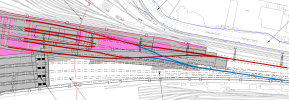
The country end of OOC has trackwork that allows trains arriving via the northern tunnel to access platforms 6, 5, 4, 3. Departing trains can reach the southern tunnel from platforms 4, 3, 2, 1. Trains terminating on platforms 3 & 4 can therefore use the diamond crossover within the OOC station box to reverse without impacting on other services or having to run wrong-line to the Victoria Road crossover box to the west of the station.

1722066473647.png

Provided that
  • there are enough lifts and elevators along the length of the platform to clear arriving passengers quickly up to the mezzanine level,
  • departing passengers are allowed onto the platforms to wait for the next incoming train,
  • drivers set back
  • all trains from platform 3 go to Birmingham Interchange and Curzon St, so there is no need for passengers to wait around for a later train
Then I believe that trains on platform 3 could turn round with just 10 minutes platform occupancy time, allowing 4tph off each platform on a 15-minute cycle. Cleaning etc. could be done in Birmingham, which has 7 platforms and is only 40 minutes away. I'm suggesting that HS2 start the overture service to Birmingham at 4tph off one platform to demonstrate the feasibility of that intensity of service, but knowing that the other platform is available if needed at times of disruption.


The next stage is to use all the platforms at OOC to terminate more trains. By this time, I am assuming that the tunnels to Euston have been completed. During the ten year wait for Euston to be built, I propose that the London end of OOC station has track laid into the tunnels. The final layout of the throat at OOC is not very flexible, so I would use a "temporary" track layout for the decade before Euston opens.

It would be possible for all six platforms to be connected to one of the tunnels to Euston, within the foorprint of the final track layout proposed for the eastern throat of OOC. Trains arriving at platforms 5 and 6 could use the tunnel as a reversing siding to access platforms 1, 2, 3, 4, all of which have direct access to the mainline departure tunnel.

1722069465863.png

Alternatively, you could use both tunnels to Euston as reversing sidings. This would add redundancy, but I think you would have to terminate platforms 3 and 4. Trains arriving on platforms 5 and 6 could use either tunnel to reverse into platforms 1 and 2 for the next departure. Both tunnels could also be used as an extended storage siding for additional trains or hot spares, if required, using the full length evacuation walkway in each tunnel for staff access.

1722069813759.png

We know that HS2 trains arriving trains at platform 5 and 6 can discharge half their load in two minutes, so they should be empty within three. Having the P5/6 platform island exit only would simplify passenger flow here. I would hope that interior CCTV and person detection technology in the trains will be sufficient to check if they are empty, but allow 5 minutes for a walk-through to check.

With drivers setting back, I would expect that trains could reverse, platform to platform, in ten minutes, but occupying the headshunt and diamond crossing for no more than five minutes. So this reversing route would have a five-minute headway, which corresponds to 12tph.

At the departure platforms 1 and 2, loading should take just three minutes.

So overall, the theoretical capacity of OOC is 4tph terminating at each of platforms 3 and 4, and trains going round the back to get from P5/6 to P1/2 at 12tph.

So the proposal to terminate 8tph at Old Oak Common seems quite conservative, now I think about it.

Is the five minutes allowed for to move into a siding and reverse out reasonable? At 10mph, a 400m train traverses its own length in 1m40s.
 

Attachments

  • 1722069799083.png
    1722069799083.png
    677.6 KB · Views: 6

The Planner

Veteran Member
Joined
15 Apr 2008
Messages
19,749
My working for OOC as a terminus is as follows:

The country end of OOC has trackwork that allows trains arriving via the northern tunnel to access platforms 6, 5, 4, 3. Departing trains can reach the southern tunnel from platforms 4, 3, 2, 1. Trains terminating on platforms 3 & 4 can therefore use the diamond crossover within the OOC station box to reverse without impacting on other services or having to run wrong-line to the Victoria Road crossover box to the west of the station.
Are you assuming P6 is the northern most platform?
View attachment 162468

Provided that
  • there are enough lifts and elevators along the length of the platform to clear arriving passengers quickly up to the mezzanine level,
  • departing passengers are allowed onto the platforms to wait for the next incoming train,
  • drivers set back
  • all trains from platform 3 go to Birmingham Interchange and Curzon St, so there is no need for passengers to wait around for a later train
Then I believe that trains on platform 3 could turn round with just 10 minutes platform occupancy time, allowing 4tph off each platform on a 15-minute cycle. Cleaning etc. could be done in Birmingham, which has 7 platforms and is only 40 minutes away. I'm suggesting that HS2 start the overture service to Birmingham at 4tph off one platform to demonstrate the feasibility of that intensity of service, but knowing that the other platform is available if needed at times of disruption.
HS2 will be on such a high performance target that you will not use a single platform. There is no requirement to anyway, they will use all the platforms available.
The next stage is to use all the platforms at OOC to terminate more trains. By this time, I am assuming that the tunnels to Euston have been completed. During the ten year wait for Euston to be built, I propose that the London end of OOC station has track laid into the tunnels. The final layout of the throat at OOC is not very flexible, so I would use a "temporary" track layout for the decade before Euston opens.

It would be possible for all six platforms to be connected to one of the tunnels to Euston, within the foorprint of the final track layout proposed for the eastern throat of OOC. Trains arriving at platforms 5 and 6 could use the tunnel as a reversing siding to access platforms 1, 2, 3, 4, all of which have direct access to the mainline departure tunnel.

View attachment 162469
Considering the cost implications HS2 has suffered, why is anyone going to design, build and remove a temporary layout? How long would it take to remove the temporary layout before usage of Euston is possible, what do you do in the meantime with trains at OOC?
Alternatively, you could use both tunnels to Euston as reversing sidings. This would add redundancy, but I think you would have to terminate platforms 3 and 4. Trains arriving on platforms 5 and 6 could use either tunnel to reverse into platforms 1 and 2 for the next departure. Both tunnels could also be used as an extended storage siding for additional trains or hot spares, if required, using the full length evacuation walkway in each tunnel for staff access.

View attachment 162471

We know that HS2 trains arriving trains at platform 5 and 6 can discharge half their load in two minutes, so they should be empty within three. Having the P5/6 platform island exit only would simplify passenger flow here. I would hope that interior CCTV and person detection technology in the trains will be sufficient to check if they are empty, but allow 5 minutes for a walk-through to check.

With drivers setting back, I would expect that trains could reverse, platform to platform, in ten minutes, but occupying the headshunt and diamond crossing for no more than five minutes. So this reversing route would have a five-minute headway, which corresponds to 12tph.
So what is your proposed method of operation here? First train into 6 (assuming this the northernmost platform), uses the turn back and into 1, next into 3 reverses and goes north, then 4, reverses, goes north, 5 using the turn back into 2?

At the departure platforms 1 and 2, loading should take just three minutes.

So overall, the theoretical capacity of OOC is 4tph terminating at each of platforms 3 and 4, and trains going round the back to get from P5/6 to P1/2 at 12tph.

So the proposal to terminate 8tph at Old Oak Common seems quite conservative, now I think about it.

Is the five minutes allowed for to move into a siding and reverse out reasonable? At 10mph, a 400m train traverses its own length in 1m40s.
I must be misunderstanding this, so are you suggesting 4tph in P3, 4th P4, and 4tph in P5 and 6 to get 12tph total? or 6tph in P5 and 6tph in P6 to make 20tph?

Have a try at platforming that on a piece of paper and see where you run out of reversing capacity or creating clashes and putting a performance buffer in.
 

Snow1964

Established Member
Joined
7 Oct 2019
Messages
11,287
Location
West Wiltshire
If a smaller Euston station permanently limits the whole of HS2 to less than the capacity of the rest of the route, it would be instructive for decision makers to know the total amount of money wasted on building the Phase 1 route’s unusable capacity (station platforms, grade separation, signalling etc). If you were to include that as a cost, the cheaper Euston probably wouldn’t turn out any cheaper.
With the current layout at Old Oak, can comfortably terminate 2 trains an hour in centre platforms, and if all the trains are identical then 3 per hour would be fairly easily too.

At the moment the HS1-HS2 link is shelved, although as the tunnels outside Euston have not yet been dug, and the plans for the junctions to the link exist, wouldn't be too hard at this stage to put them back in (but a hell of a task to add them later when trains are running). If (and it currently is big if) it gets reinstated then in theory could terminate some trains at Stratford and/or Ebbsfleet.

So if Euston could handle 12 or 13 trains per hour, could in theory still fully utilise the 18tph HS2. Of course if not much happens with high speed destinations north of Birmingham very questionable if there would be demand for that number.

Much more realistic to see Eurostar or a European low cost operator call at Stratford International and Birmingham (and as contract was let for building all 7 platforms at Curzon Street), designating a couple of platforms for International services, (along with few passport scanners/desks at Stratford) might be lot cheaper than building bigger Euston. Dont rule out one train every couple of hours to a European holiday hotspot, even if it's only one train per day to each area. Think replacing short haul holiday flights from Midlands airports rather than commuter service between Birmingham and London for extra services.
 

Manutd1999

Member
Joined
21 Feb 2021
Messages
549
Location
UK
If a smaller Euston station permanently limits the whole of HS2 to less than the capacity of the rest of the route, it would be instructive for decision makers to know the total amount of money wasted on building the Phase 1 route’s unusable capacity (station platforms, grade separation, signalling etc). If you were to include that as a cost, the cheaper Euston probably wouldn’t turn out any cheaper.
I disagree. HS2 may be able to handle 18+ per hour, but that doesn't mean we should be designing everything to that target. Surely we should be doing a bottom-up approach, i.e. looking at a realistic service spec, adding a bit for future growth and then designing Euston? Future-proofing everything is a great ideal, but if it increases cost above what government is willing to pay then it actually harms the project.

Without the Eastern Leg (very unlikely to be restored in full), around 11ph is a realistic medium-term service pattern IMO (4ph Birmingham, 3ph Manchester, 2ph Liverpool, 1ph Lancaster, 1ph Scotland)

Looking futher into the future, it's plausible that a connection towards Derby could be added which would enable an extra 2ph to Sheffield. We may also see open access operators or electrification to enable additional destinations (North Wales etc.). But even if all of that happens, it's hard to see more than ~4ph extra being required.

So a station with capacity for 12-15ph is probably required (6 to 8 platforms). If HS2 Phase XXX wants to add more than this in the future, then it will have to work out how to add more station capacity as part of that project.
 
Last edited:

chris2

Member
Joined
25 Apr 2023
Messages
205
Location
Southampton
I'm not saying the original design specification compels you have to design every additional element to the same capacity. But I am arguing that the waste ought to be calculated and made known to decision makers. If for no other reason than the subsequent analysis of the decision will draw exactly these kind of implications to light - "£20 billion of HS2 spend made obsolete by smaller Euston". etc etc.

Anyway, I'm obviously not expecting anyone involved to be paying any attention to my point, I would just like to see it built, that's all.
 

JonathanH

Veteran Member
Joined
29 May 2011
Messages
23,408
Much more realistic to see Eurostar or a European low cost operator call at Stratford International and Birmingham (and as contract was let for building all 7 platforms at Curzon Street), designating a couple of platforms for International services, (along with few passport scanners/desks at Stratford) might be lot cheaper than building bigger Euston. Dont rule out one train every couple of hours to a European holiday hotspot, even if it's only one train per day to each area. Think replacing short haul holiday flights from Midlands airports rather than commuter service between Birmingham and London for extra services.
Wow, that is some fantasy. Are people from the Midlands all going to go on holiday to Paris or Brussels? How is running 'short haul holiday' trips going to be 'low cost'? Railways work best with lots of people all going to the same place. Eurostar doesn't run such many services now despite a population of 10 million plus people in its catchment area.

I get that there will be a surplus of platforms constructed at Curzon Street, but I think the response to the National Audit Office was that HS2 will only fit out the platforms they need. Therefore, like Stratford International, the facilities won't exist for international travel. The idea of a HS2-HS1 link has long been folly.
 

SynthD

Established Member
Joined
4 Apr 2020
Messages
2,061
Location
UK
I'm not saying the original design specification compels you have to design every additional element to the same capacity.
I would. Are we going to pretend that each decade of building HS2 has to follow contemporary trends like the length of skirts. No, it was designed by experts as an efficient whole and we must see that through to get our moneys worth.
 

chris2

Member
Joined
25 Apr 2023
Messages
205
Location
Southampton
I would. Are we going to pretend that each decade of building HS2 has to follow contemporary trends like the length of skirts. No, it was designed by experts as an efficient whole and we must see that through to get our moneys worth.
Quite.
 

HSTEd

Veteran Member
Joined
14 Jul 2011
Messages
20,386
I would. Are we going to pretend that each decade of building HS2 has to follow contemporary trends like the length of skirts. No, it was designed by experts as an efficient whole and we must see that through to get our moneys worth.
It was designed in a fundamentally different environment using cost estimates that are now hopelessly optimistic and outdated.

HS2 is not divinely inspired and is not inherently perfect.
All that insisting on the original spec will do is ensure no further work takes place at all.

HS2 had vast quantities of political capital at its disposal, it now has very little.
The scheme has failed, it will not be revived.

The question now is how to salvage what can be salvaged. Building HS2s desired ten or eleven planned station is not going to happen.
As we've seen in the press, there is very little money for infrastructure at all, and HS2 will be at the back of that queue
 

Trainbike46

Established Member
Joined
18 Sep 2021
Messages
4,382
Location
belfast
Does this mean that the Euston scramble will remain?
Not necessarily, the boarding time at OOC clearly assumes that passengers will be on the platform before the train arrives, just as it works on most through-stations worldwide

== Doublepost prevention - post automatically merged: ==

I disagree. HS2 may be able to handle 18+ per hour, but that doesn't mean we should be designing everything to that target. Surely we should be doing a bottom-up approach, i.e. looking at a realistic service spec, adding a bit for future growth and then designing Euston? Future-proofing everything is a great ideal, but if it increases cost above what government is willing to pay then it actually harms the project.

Without the Eastern Leg (very unlikely to be restored in full), around 11ph is a realistic medium-term service pattern IMO (4ph Birmingham, 3ph Manchester, 2ph Liverpool, 1ph Lancaster, 1ph Scotland)

Looking futher into the future, it's plausible that a connection towards Derby could be added which would enable an extra 2ph to Sheffield. We may also see open access operators or electrification to enable additional destinations (North Wales etc.). But even if all of that happens, it's hard to see more than ~4ph extra being required.

So a station with capacity for 12-15ph is probably required (6 to 8 platforms). If HS2 Phase XXX wants to add more than this in the future, then it will have to work out how to add more station capacity as part of that project.
I'd say you want your capacity constraints to be upgradeable. The restrictions north of birmingham are (by building phase 2a and/or the eastern leg). Depending on the design used, Euston may be upgradeable. For example, building the first half of the original two-stage 11-platform design* would give you 6 platforms in a way that would be upgradeable to 11 if needed in the future. Building a 6 or 8 platform station, and either utilising the entire footprint, or selling off excess land would make it really difficult (read: expensive) to expand the capacity in the future, likely killing off any future expansion plans.

Therefore, I think we should either build the full thing (ideally 11 platforms), or build something smaller that is designed with future expansion in mind. The full thing is my preferred option, but obviously other people may have different view

*other station designs are available
 
Last edited:

Mgameing123

Member
Joined
29 Apr 2023
Messages
1,063
Location
Denmark
Euston Station should be scrapped if it can’t get the 11 platforms. What Sunak did was a huge scandal in its own.
 
Status
Not open for further replies.

Top