• Our new ticketing site is now live! Using either this or the original site (both powered by TrainSplit) helps support the running of the forum with every ticket purchase! Find out more and ask any questions/give us feedback in this thread!

Netherton Road escape shaft (Victoria line)

Status
Not open for further replies.

announcements

Member
Joined
31 Mar 2011
Messages
718
Hi all,

Owing to the Victoria line having a long gap between Finsbury Park and Seven Sisters stations, there is a mid-point ventilation and escape shaft between these two stations. My question is, has this ever been used for a passenger evacuation or it not, what would prompt it to ever be used?

Presumably, there is only a small gap blocked by cable runs to access it from track level. Certainly no platform is visible, for example, as per the set up for the Wessex Road shaft (T4 loop) explored on Secrets of the Underground, which has its own stub platform. Similarly, the shaft between T2&3 and T5 stations is clearly visible from onboard the train as the emergency exit door is lit up.

There is no evidence of any lights on when you pass it at speed, so presumably it is pitch black until someone manages to find a light switch. Then presumably the T/Op would have to wait in the train until everyone is off, so the passengers would be left to their own devices to climb the stairs and exit at street level. I wonder how practical a space it actually is to be a designated evacuation point.

Interesting, the drawing for the Old Ford shaft has been posted here on RailUK before:


I wonder if the set up is similar at Netherton road? However, I think the Netherton Road shaft may be fitted between the two running lines rather than requiring a separate cross passage.
 
Sponsor Post - registered members do not see these adverts; click here to register, or click here to log in
R

RailUK Forums

Dstock7080

Established Member
Joined
17 Feb 2010
Messages
3,540
Location
West London
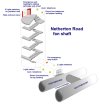
Netherton Road fan shaft:
When an authorised detrainment is to take place between Finsbury Park and Seven Sisters stations, the service manager will decide whether Netherton Road fan shaft is to be designated an evacuation point.
The customer service supervisor/manager at Seven Sisters will normally carry out the role of the detrainment supervisor and make all the necessary protection arrangements for detraining customers.
The controller will make jarrangements to switch off the following traction current sections:
Seven Sisters to Manor House (southbound)
Manor House to Seven Sisters and Northumberland Park depot (northbound).

The instructions for detraining customers on to the track are in Rule Book 4 Moving a stalled train and authorised detrainments. the track level emergency exit to the shaft is located in the northbound tunnel, approximately midway between Finsbury Park and Seven Sisters stations.
to assist staff with locating the emergency exit, there are eight luminous markers positioned either side of the emergency exit point.
for southbound detrainments, there is a cross-passage leading to the northbound tunnel and emergency exit point.
 

Attachments

  • IMG_4880.jpeg
    IMG_4880.jpeg
    353.6 KB · Views: 282
Last edited:

announcements

Member
Joined
31 Mar 2011
Messages
718
Thank you for the information. Assuming the diagram is accurate, access appears to be through a proper gated door, rather than having to duck under cable runs as many of the other intermediary shafts along the line. Contrary to the Old Ford shaft diagram, there doesn't appear to be a separate ventilation tunnel, highlighting the primary function of Netherton Road as access/escape.

I wonder if it has ever been used in all the years the Victoria line has been opened or if anyone has any recounts of visiting it? There are shafts fitted between all stations along the Victoria line, but I don't think many of them double up as escape shafts in quite the same way Netherton Road does.

Certainly the TfL Property Asset Database does note Somerleyton Road (end of the overrun tunnels beyond Brixton platforms) is labelled as emergency escape also.
 
Last edited:

edwin_m

Veteran Member
Joined
21 Apr 2013
Messages
28,760
Location
Nottingham
I don't recall hearing of any of these non-station shafts ever having been used for an actual evacuation. If a train is unable to move, it's probably better in most circumstances to have people walk along the track to a station where staff will be available to assist.
 

announcements

Member
Joined
31 Mar 2011
Messages
718
I have had a look at the following Victoria line DEV. At 9:51 I reckon it could be it on the left:

There are (blue) car count signs both preceding and following this exact point, implying that if the T/Op has to detrain, these would be of use. The passageway to the right would be a cross passage but doesn't look easy to manoeuvre with all those cables. To the left is presumably where the gate is, but it's a bit blurry.
 
Last edited:

bramling

Veteran Member
Joined
5 Mar 2012
Messages
20,445
Location
Hertfordshire / Teesdale
Thank you for the information. Assuming the diagram is accurate, access appears to be through a proper gated door, rather than having to duck under cable runs as many of the other intermediary shafts along the line. Contrary to the Old Ford shaft diagram, there doesn't appear to be a separate ventilation tunnel, highlighting the primary function of Netherton Road as access/escape.

I wonder if it has ever been used in all the years the Victoria line has been opened or if anyone has any recounts of visiting it? There are shafts fitted between all stations along the Victoria line, but I don't think many of them double up as escape shafts in quite the same way Netherton Road does.

Certainly the TfL Property Asset Database does note Somerleyton Road (end of the overrun tunnels beyond Brixton platforms) is labelled as emergency escape also.

I don’t think Brixton / Somerleyton Road is an escape facility.

Netherton Road has a fan shaft as well, but IIRC it’s essentially separate from the escape shaft.

There are a few locations across the combine, including on the Victoria Line, where vent shafts are designated as intervention locations. However in virtually all such cases the access is rudimentary at best, generally involving ladders.
 

announcements

Member
Joined
31 Mar 2011
Messages
718
Ok, it's possible the street map data has labelled Somerleyton road incorrectly. Or perhaps there is a rudimentary ladder there, deemed enough for a T/Op to escape if needed!

The use of ladders probably wouldn't be good enough for emergency service intervention.
 

bramling

Veteran Member
Joined
5 Mar 2012
Messages
20,445
Location
Hertfordshire / Teesdale
Ok, it's possible the street map data has labelled Somerleyton road incorrectly. Or perhaps there is a rudimentary ladder there, deemed enough for a T/Op to escape if needed!

The use of ladders probably wouldn't be good enough for emergency service intervention.

As far as emergency services goes, we are talking about very extreme emergency situations. Definitely not suitable for either staff or passenger access / egress.
 

TheTallOne

Member
Joined
2 Jan 2024
Messages
265
Location
Birmingham
Not Netherton Road, but a different escape route was featured on yesterday's episode of Secrets of the London Underground (S04E04).

On the TV channel called "Ewan Yesterday" or catch up on "U" (I think that's what it is called now?) - UKTV Play as was.


Tim and Siddy explore South Kentish Town – a station once on the Northern line, but abandoned more than a century ago. Tube trains still run through it, creating an eerie atmosphere and the spookiest sound they’ve ever heard in a tube station. They explore the disused passageways, reveal the ventilation shafts still working to keep air circulating on the Northern Line today, and tell the story of the passenger once stranded at the station after getting off a train by mistake.
 

announcements

Member
Joined
31 Mar 2011
Messages
718
It would be interesting to know if any of the abandoned stations have ever been used for an evacuation. Down Street, for instance, is set up to be used as one.
 

edwin_m

Veteran Member
Joined
21 Apr 2013
Messages
28,760
Location
Nottingham
Not Netherton Road, but a different escape route was featured on yesterday's episode of Secrets of the London Underground (S04E04).

On the TV channel called "Ewan Yesterday" or catch up on "U" (I think that's what it is called now?) - UKTV Play as was.

The guy from TfL emergency team mentioned what I previously suggested, that the preference if evacuation is necessary would be to go via the nearest station. Getting several hundred people, some with infirmities, up that narrow spiral staircase would be a major undertaking presenting safety issues of its own.
 

bramling

Veteran Member
Joined
5 Mar 2012
Messages
20,445
Location
Hertfordshire / Teesdale
It would be interesting to know if any of the abandoned stations have ever been used for an evacuation. Down Street, for instance, is set up to be used as one.

They aren’t really intended for evacuation, though it could happen in extreme emergency. In most cases the arrangements simply aren’t suitable for large numbers of passengers to be egressed.

The exception is the ones between Baker Street and Finchley Road, simply due to the long distance between stations.

Nowadays you’d also quite possibly run into issues with staff not being familiar with them.
 

announcements

Member
Joined
31 Mar 2011
Messages
718
Indeed, and Down Street presents a labyrinth of different tunnels and rooms, which would mean you risk losing passengers! The emergency exit elements e.g. phosphorescent strips etc. must be more intended for the workers who use Down Street to access the IMR.

I did ask a similar question to a Crossrail worker re: their mid-tunnel shafts. He told me that, again, the preference would be to use the side walkways and take passengers to the nearest station. The shafts themselves are fitted with decent staircases and even passenger lifts, however these are first and foremost intended for intervention access e.g. by emergency services.
 
Last edited:

bramling

Veteran Member
Joined
5 Mar 2012
Messages
20,445
Location
Hertfordshire / Teesdale
Indeed, and Down Street presents a labyrinth of different tunnels and rooms, which would mean you risk losing passengers! The emergency exit elements e.g. phosphorescent strips etc. must be more intended for the workers who use Down Street to access the IMR.

I did ask a similar question to a Crossrail worker re: their mid-tunnel shafts. He told me that, again, the preference would be to use the side walkways and take passengers to the nearest station. The shafts themselves are fitted with decent staircases and even passenger lifts, however these are first and foremost intended for intervention access e.g. by emergency services.

On the latter point, some escape shafts come up in areas which are quite remote from the line they serve, and in some cases any alternative rail services.

On the Jubilee Line for example it would be quite an issue to have 1,000 passengers suddenly appear at somewhere like Downtown Road or Druid Street. In fact, I don’t think the Jubilee Line ones can really properly be used for escape, as they aren’t built with separate inwards and outwards routes, which later ones are.

The most extreme case is some of the ones for the Piccadilly Line around Heathrow airport, though in their case the airport would arrange to collect people.
 

announcements

Member
Joined
31 Mar 2011
Messages
718
On the Jubilee Line for example it would be quite an issue to have 1,000 passengers suddenly appear at somewhere like Downtown Road or Druid Street. In fact, I don’t think the Jubilee Line ones can really properly be used for escape, as they aren’t built with separate inwards and outwards routes, which later ones are.
Seems like a retrograde step then as I am sure the 1970s' Southampton Street shaft between Charing Cross and Aldwych had proper access from track to top of shaft. I can't find the webpage now, but there was a detailed account with photographs. S3 of Secrets of the Underground also visits this area.
 
Joined
31 Dec 2019
Messages
995
Location
uk
Most evacuation shafts, I would imagine, are there should passengers detrain themselves in a 7/7 style incident and gravitate to the nearest thing that resembles an exit. They would not ever be considered by any control teams.
 

bramling

Veteran Member
Joined
5 Mar 2012
Messages
20,445
Location
Hertfordshire / Teesdale
Seems like a retrograde step then as I am sure the 1970s' Southampton Street shaft between Charing Cross and Aldwych had proper access from track to top of shaft. I can't find the webpage now, but there was a detailed account with photographs. S3 of Secrets of the Underground also visits this area.

Depends how you define proper access. Southampton Street is a spiral staircase, and from memory I don’t think there’s width for two people to pass comfortably - it is very narrow. The handrail is very low, the stair treads are lattice, and the shaft is rather deep - these three factors combine to make using it a rather unnerving experience. The JLE shafts are better for sure, but even since then standards have moved on.

Everything post JLE, that is T5, Crossrail and Battersea, has separate inwards and outwards routes, so that firefighters don’t clash with people trying to escape. No other facilities anywhere on LU have this design.

== Doublepost prevention - post automatically merged: ==

Most evacuation shafts, I would imagine, are there should passengers detrain themselves in a 7/7 style incident and gravitate to the nearest thing that resembles an exit. They would not ever be considered by any control teams.

Essentially yes. They are there primarily for contractor and staff access, and happen to provide a means of emergency escape if required.

The only locations which are officially designated as emergency escape are Old Ford, Netherton Road, Kennington Park, Kennington Green, Sanctuary Road, Wessex Road, T5C, and the three disused stations between Baker Street and Finchley Road. I think it may also be the case that a couple of others can be added to this, such as King’s Cross (Met) disused, possibly St Mary’s, and possibly Mark Lane.

There is a further number where exit is possible, and a further specific list which are designated as intervention (not escape) points - note these two groups don’t entirely match up.

Note that people are perhaps assuming LU has a greater working knowledge of its assets than is actually the case! There are people who know these locations inside out, and thus have the knowledge of what is and isn’t viable at each individual location. However collectively LU doesn’t really have this knowledge readily at its fingertips. Hence apart from the locations listed above, it’s very unlikely an evacuation would ever use a disused location. You’d have to have a very problematic scenario where it would be contemplated.

The likes of Netherton Road exist specifically because of the long distance between stations, hence there are rather more laid-down procedures and training for their use. For something like Down Street or South Kentish Town I find it hard to envisage any scenario where they would be used for passengers, barring an extreme emergency. Even then if you had a situation where people were having to escape under their own initiate I’m not sure who is going to take the risk of walking up a network of dimly lit passageways in the hope of finding a way out. Remember that train operators have no knowledge of these locations except that they exist, so wouldn’t have any more familiarity than the passengers.
 
Last edited:

Xylenated

Member
Joined
31 Jul 2024
Messages
8
Location
London
I don’t think Brixton / Somerleyton Road is an escape facility.

Netherton Road has a fan shaft as well, but IIRC it’s essentially separate from the escape shaft.

There are a few locations across the combine, including on the Victoria Line, where vent shafts are designated as intervention locations. However in virtually all such cases the access is rudimentary at best, generally involving ladders.
The shaft at Brixton is divided with a wall top to bottom. Half of it is a sheer drop down with no ladders, and the other half has a staircase up into the substation above.
 

announcements

Member
Joined
31 Mar 2011
Messages
718
Thanks for the information. Mm
There are no operating staff procedures to use Somerleyton Road shaft
This was said in a previous post. Perhaps the staircase is not intended to ever be used, even for T/Ops trapped there if a train has been taken out of service? Still, you'd think there would still be operating instructions just in case it ever needs to be used. The station supervisors at Mile End, for instance, have to do periodic checks of the Old Ford escape shaft.
 
Status
Not open for further replies.

Top