• Our new ticketing site is now live! Using either this or the original site (both powered by TrainSplit) helps support the running of the forum with every ticket purchase! Find out more and ask any questions/give us feedback in this thread!

Why is HS2 Edgcott roadbridge so big?

Status
Not open for further replies.

bnc2018

Member
Joined
14 May 2021
Messages
51
Location
Banbury, Oxfordshire
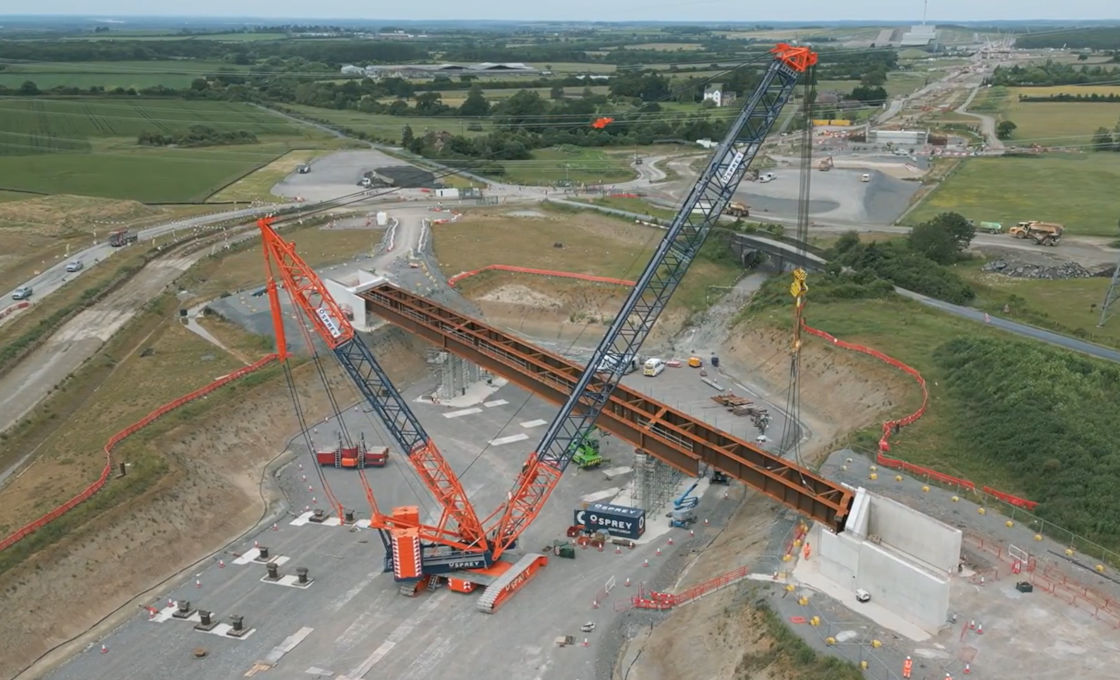
HS2 have just completed bridge beams at Edgcott Road.
Per the text, seems bridges for 5 miles are being made wide enough for the freight line to be reinstated alongside the high speed line


Mods note - split from this thread

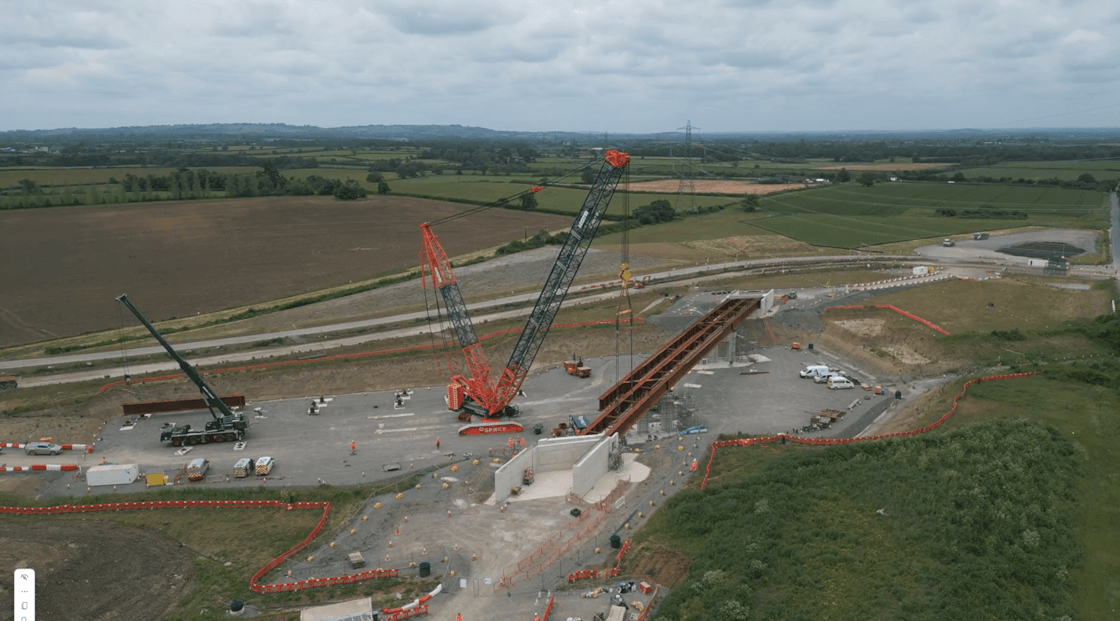
This is a common question I have when looking at HS2 works, but was it really necessary to build that bridge quite so far from the road it's for? The amount of new road that will need to be built to realign the existing road over it is enormous.

This picture in particular highlights the distance:
3e7864abd3f44ba09939d96192449711.png
 
Last edited by a moderator:
Sponsor Post - registered members do not see these adverts; click here to register, or click here to log in
R

RailUK Forums

Nottingham59

Established Member
Joined
10 Dec 2019
Messages
3,332
Location
Nottingham
Maybe the power lines had something to do with it? Thry couldn't use a big crane right next to the old bridge. I'd have thought that the cost of new approach roads were relatively small compared to the cost of a 112m clear span road bridge.

bd07fc73d3794efd9efa154f5dbd8781.png


For me the question is why they need such an enormous bridge just to cross four railway tracks?
 

Snow1964

Established Member
Joined
7 Oct 2019
Messages
11,107
Location
West Wiltshire
Maybe the power lines had something to do with it? Thry couldn't use a big crane right next to the old bridge. I'd have thought that the cost of new approach roads were relatively small compared to the cost of a 112m clear span road bridge.

bd07fc73d3794efd9efa154f5dbd8781.png


For me the question is why they need such an enormous bridge just to cross four railway tracks?
The picture does make you wonder if it has been built on a money no object basis, compared to original brick bridge behind.

What are those wide side spans for, why do they apparently need two parallel wide haul roads (on left of picture), the cutting looks wide enough for rather more than 4 (well spaced) tracks.

I realise may be bit of future proofing but rather feels like building a 6 track line in this picture.
 

JamesT

Established Member
Joined
25 Feb 2015
Messages
4,856
Maybe the power lines had something to do with it? Thry couldn't use a big crane right next to the old bridge. I'd have thought that the cost of new approach roads were relatively small compared to the cost of a 112m clear span road bridge.

bd07fc73d3794efd9efa154f5dbd8781.png


For me the question is why they need such an enormous bridge just to cross four railway tracks?
It’s described as 112m between the abutments. With the pillars there it’s going to be considerably less than that.
 

Nottingham59

Established Member
Joined
10 Dec 2019
Messages
3,332
Location
Nottingham
It’s described as 112m between the abutments. With the pillars there it’s going to be considerably less than that.
Yes, you're right. What I had thought were temporary construction supports are actually permanent concrete pillars. But it's still an enormous bridge.
 

zwk500

Veteran Member
Joined
20 Jan 2020
Messages
18,523
Location
Northampton
Yes, you're right. What I had thought were temporary construction supports are actually permanent concrete pillars. But it's still an enormous bridge.
Remember that HS2 will have a wider loading gauge profile and wider track centers than a typical UK railway. Through a bridge I expect that the struture profile will also need to be wider than is normal because of the greater air displacement from 350kph vs 160kph. The embankments supporting the abutments will also be at a considerably easier gradient than the adjacent brick bridge, however it does still seem rather large when compared to bridges over HS1.
 

Benjwri

Established Member
Joined
16 Jan 2022
Messages
3,296
Location
Bath
It has to be so wide because the existing freight line which used to run here before HS2 will be reinstated next to it, and a fair amount of clearance is required between the freight line and HS2.
 

Benjwri

Established Member
Joined
16 Jan 2022
Messages
3,296
Location
Bath
It's that which fuels the perception that elements of the line have been over-engineered. In this case, it is a narrow, minor road.
The opinion of which I would say is fuelled by a need of those observing to find ways it is overdesigned. It is fairly conservatively designed given the requirements set out, of which the design speed is debatable, given the trains won’t achieve it, although some might call it an unusual case of forward thinking.

I’m sure HS2 would love to close such a small road, but doing so with planning laws would be more expensive. It is also the site of a new substation and feeder station which might require the bridge not to have a weight limit (Although having a published weight limit would probably not be possible regardless.)
 

zwk500

Veteran Member
Joined
20 Jan 2020
Messages
18,523
Location
Northampton
It's that which fuels the perception that elements of the line have been over-engineered. In this case, it is a narrow, minor road.
What the bridge is carrying does not really matter to the length of the bridge, though. It could be carrying a bridleway or a motorway, but it's what is underneath that drives the length.

At this location I expect the need for safe separation between the NR Classic line and HS2's mainline is driving a lot of additional width. The required distances for safe space between the HS2 tracks and NR tracks will be high, especially if there is a physical boundary fence between them.
 
Last edited:

swt_passenger

Veteran Member
Joined
7 Apr 2010
Messages
34,270
What the bridge is carrying does not really matter to the length of the bridge, though. It could be carrying a bridleway or a motorway, but it's what is underneath that drives the length.
Also the wider shape of the modern standard cutting slopes will always tend to lengthen overbridges.
 

Nottingham59

Established Member
Joined
10 Dec 2019
Messages
3,332
Location
Nottingham
What the bridge is carrying does not really matter to the length of the bridge, though. It could be carrying a bridleway or a motorway, but it's what is underneath that drives the length.
True. Except that a motorway bridge would have to be built on the skew. They would, of course, curve a minor road so that the bridge was built at right angles to the track.....
 

Nottingham59

Established Member
Joined
10 Dec 2019
Messages
3,332
Location
Nottingham
From counting the zig zags, I reckon the centre span is 48m, and the side spans are 32m each. And there looks like at least 5m of flat ground between each pillar and the start of the embankment. So that's 48+2x5=58m of railway being built here.

HS2 is supposed to take 22m between fences, as shown in this diagram from: High Speed Rail: Investing in Britain’s Future Consultation February 2011.

1721216244510.png

The new bridge over the 2-track Ditton Goods line in Warrington has clear span of 12.8m. So that's 35m in total.

Perhaps someone who knows more about railway civil engineering can help me out here.

How much width does a twin track freight line need? Does the access road need to go through the centre span too? What are the flat areas outside the pillars for? Where on earth does the need for a 48m centre span come from?
 

Benjwri

Established Member
Joined
16 Jan 2022
Messages
3,296
Location
Bath
So it is less skew than the original, but this still doesn't explain why the structure is quite so generously built.
I think adequate explanation has been given as to that construction. The bridge is built to handle 4 tracks, significant spacing is required between the conventional and high speed lines because of the speed difference and clearances. It looks further because this takes it over the maximum span the abutments can handle, so pillars have had to be installed on either side before the abutments with a minimal span between.

I think sometimes this forum does need reminding it spends half its time complaining about how 100 years ago we didn’t leave space for upgrading lines today, and the other half complaining how we leave passive provision for such things in modern projects.
 

hwl

Established Member
Joined
5 Feb 2012
Messages
8,254
For info, this is the plan of the Edgcott Road overbridge.

View attachment 161907
From: https://www.gov.uk/government/publi...f-commons-select-committee-2016-country-south (Map title: Route passes Buckinghamshire Railway Centre)
So it is less skew than the original, but this still doesn't explain why the structure is quite so generously built.
That plan is very old I think I've seen a much newer one, the key point is that the main grey region will contain the auto transformer site which is on the far side of the "freight" track. Hence there will be lost of need for road ways on both side. The OHLE will probably be sectioned at this point with neutral section along with plenty of OHLE structures for feeds and sectioning.
The upper grey region (mostly just out of crop) is the new NatGrid Quainton GSP - tapped into the existing East Claydon - Crowley 400kV, the current routing of which is shown by the grey dotted line, and the future route in red (current and future routes are the same west of the mast to the west of the rail alignment). Pylon locations shown as squares.
 

stuving

Member
Joined
26 Jan 2017
Messages
725
The planning application for this bridge itself only went in last year - it's 23/00529/APP Realignment of Edgcott Road Overbridge and associated earthworks and other works... (Bucks CC). Two items relevant to the discussion here are the section along the bridge and the planning statement.

Here's a couple of quotes from that:
3.1.3 Following the publication of the HS2 Phase 1 ES (as amended) and subsequent Supplementary Environmental Statements (SES) and Additional Provision Environmental Statement (AP ES), the design of Edgcott Road Overbridge has been further developed. As part of this development the location of the Edgcott Road Overbridge has been relocated south from its original position to avoid a safety clash with the National Grid overhead power lines.
3.2.13 Even though the modified design increases the bridge’s total length from 70m to 112m to comply with train accidental collision protection rules, the use of a weathering steel solution results in significant reduction in use of concrete for the superstructure and the relocation (realignment) of the Overbridge to the south allows the bridge to be lifted into place whilst avoiding the overhead power lines. Off-site construction is maximised through steel girders, precast permanent formwork and precast parapets.
 

Nottingham59

Established Member
Joined
10 Dec 2019
Messages
3,332
Location
Nottingham
I think adequate explanation has been given as to that construction. The bridge is built to handle 4 tracks, significant spacing is required between the conventional and high speed lines because of the speed difference and clearances.
Thank you. But just asserting that clearance is needed is not an explanation.

And the spacing is more than "significiant". The centre span of this bridge is 50 metres wide. That is wide enough to accommodate both carriageways of an eight-lane motorway including central reserve, hard shoulders and verge.


1721287031000.png
[image shows the design standard cross section of 8-lane rural motorway: distance from verge to verge = 40.5m.]


The planning application for this bridge itself only went in last year - it's 23/00529/APP Realignment of Edgcott Road Overbridge and associated earthworks and other works... (Bucks CC). Two items relevant to the discussion here are the section along the bridge and the planning statement.
Thank you. That is really helpful.

In case it's of interest to others, this is the longitudinal section of the bridge, showing the location of the HS2 and potential freight tracks.

1721288780821.png

And this is the plan section.

1721289541008.png
The 30 degree skew of the bridge means that the 50m central span provides 43m clearance across the tracks.

... the modified design increases the bridge’s total length from 70m to 112m to comply with train accidental collision protection rules

Does anyone have information about these Train Accident Collision Protection rules? Presumably they were brought in after the initial HS2 design in 2016, shown in post #17 above. And I wonder how much cost did they add to the HS2 project?
 

snowball

Established Member
Joined
4 Mar 2013
Messages
8,144
Location
Leeds
I thought of posting earlier that the current steep side slopes might be flattened out for the eventual layout, filling the side spans, but didn't, as I had no specific evidence. However the latest diagram confirms this. There are even substantial sections of flat ground at the top, under the bridge - maybe to facilitate safe inspection of the bearings?
 

Nottingham59

Established Member
Joined
10 Dec 2019
Messages
3,332
Location
Nottingham
For another comparison, the 38m span of the bridge at Westenhanger accommodates two tracks of 300kph HS1, two tracks of the 100mph SE mainline, and the entirety of Westenhanger Station.

1721297953905.png

OK. So 43m for HS2 + freight lines is not such an extreme outlier. I'm starting to understand the logic behind the HS2 design decisions now (however warped that logic may be). And also why the Benefit Cost Ratio of HS2 showed that it was such poor value for money.
 
Last edited:

12LDA28C

Established Member
Joined
14 Oct 2022
Messages
5,058
Leaves space for doubling should the Aylesbury Spur for EWR ever happen, I would assume.

It will happen, and it's only planned to be a single line anyway.

== Doublepost prevention - post automatically merged: ==

How much width does a twin track freight line need? Does the access road need to go through the centre span too? What are the flat areas outside the pillars for? Where on earth does the need for a 48m centre span come from?

The freight line is not twin track, only single, as I replied in post #10.
 

12LDA28C

Established Member
Joined
14 Oct 2022
Messages
5,058
Yes you did, but HS2 are making provision for a twin track line. One track for MCJ3, and one other for "Provision for future track". As shown in post #21

That's interesting as there is no suggestion that there will be any requirement for a fourth line to ever be installed. AFAIK there is no indication even in long-term plans that the line from Quainton towards Claydon will be subject to doubling although it seems that these days many new track formations include space for an additional line, even if there is nothing currently planned. Whilst some might consider this a sensible approach, it certainly adds significant cost to any project and the extra capacity may never be needed.

The important consideration in this particular area is that the freight line is relaid to sufficient speed (in this case 90mph) to provide the required infrastructure for the 'Aylesbury spur' to see passenger trains in the future.
 

Nottingham59

Established Member
Joined
10 Dec 2019
Messages
3,332
Location
Nottingham
That's interesting as there is no suggestion that there will be any requirement for a fourth line to ever be installed. AFAIK there is no indication even in long-term plans that the line from Quainton towards Claydon will be subject to doubling although it seems that these days many new track formations include space for an additional line, even if there is nothing currently planned. Whilst some might consider this a sensible approach, it certainly adds significant cost to any project and the extra capacity may never be needed.

The important consideration in this particular area is that the freight line is relaid to sufficient speed (in this case 90mph) to provide the required infrastructure for the 'Aylesbury spur' to see passenger trains in the future.
Two tracks would enable more EWR trains to get to Aylesbury. Say 2tph to Milton Keynes, and 2tph to Cambridge, perhaps. If the Oxford-Cambridge Arc develops, it will need those sort of connections.
 

12LDA28C

Established Member
Joined
14 Oct 2022
Messages
5,058
Two tracks would enable more EWR trains to get to Aylesbury. Say 2tph to Milton Keynes, and 2tph to Cambridge, perhaps. If the Oxford-Cambridge Arc develops, it will need those sort of connections.

EWR is Oxford - Cambridge.

The 'Aylesbury' spur is not considered part of the main scheme to such an extent that until recently it was suggested that it might not even happen. Whilst making provision for future expansion is a good thing, having 4tph EWR trains departing Aylesbury is never going to happen. There isn't the capacity at Aylesbury for a start, and scope to change that is extremely limited. There's no way you would fit 4tph round the booked freight to Calvert either.
 
Status
Not open for further replies.

Top