• Our new ticketing site is now live! Using either this or the original site (both powered by TrainSplit) helps support the running of the forum with every ticket purchase! Find out more and ask any questions/give us feedback in this thread!

ASLEF vs. RMT

Status
Not open for further replies.
Sponsor Post - registered members do not see these adverts; click here to register, or click here to log in
R

RailUK Forums

eldomtom2

On Moderation
Joined
6 Oct 2018
Messages
2,374
IIRC workshop staff were generally members of the various engineering unions, the same as their counterparts at rolling stock manufacturers.
 

chuff chuff

Member
Joined
25 Sep 2018
Messages
670
When I joined BR it was a closed shop, which meant that you HAD to join the appropriate union. I was handed the joining form (already filled out for me ready to sign IIRC) by my personnel officer (or staff officer as they were called in those days) on my first day as part of my induction.
The same for me though we were given the form by the roster clerk on our first day.
 

D6130

Established Member
Joined
12 Jan 2021
Messages
9,046
Location
West Yorkshire/Tuscany
Tensions between ASLEF and the NUR - which had been simmering since the 1955 ASLEF strike - were still pretty raw when I joined the railway in 1975 (as a TSSA member initially). At that time, the two General Secretaries - Ray Buckton of ASLEF and Sid Weighell of the RMT - were barely on speaking terms. They had hated each other since they were at school together in Northallerton between the wars. They both joined the LNER as engine cleaners on the same day and throughout their footplate careers - spent mainly at York - they were active in different unions. Their mutual antipathy did nothing to help BR industrial relations in the 1970's and '80s. I have a copy of Sid Weighell's autobiography "Weighells within Wheels" at home and it's a very interesting read. However, I'm not aware of Mr Buckton having written a similar book.
 

Rescars

Established Member
Joined
25 May 2021
Messages
2,540
Location
Surrey
I recall an occasion in the late 70s when a proposed reorganisation caused a number of managers who were TSSA members to threaten to join the NUR. I can't recall now how the matter was resolved, but in the end I don't think anyone went ahead with their threats to change their union allegiances.
 

MadMac

Established Member
Joined
13 Jun 2008
Messages
1,494
Location
Moorpark, CA
I recall an occasion in the late 70s when a proposed reorganisation caused a number of managers who were TSSA members to threaten to join the NUR. I can't recall now how the matter was resolved, but in the end I don't think anyone went ahead with their threats to change their union allegiances.
In the early 80s, a significant number of managers in the Glasgow HQ (mostly in the S&T Department) left TSSA and joined the British Transport Officers’ Guild. An additional grade called Principal Technical Officer had been introduced in the P&T (Professional and Technical) grades: this created the issue that a PTO producing design could well be paid more than the manager (MS1) who had to check it, and the TSSA seemed disinterested in trying to solve the problem.
 

Rescars

Established Member
Joined
25 May 2021
Messages
2,540
Location
Surrey
In the early 80s, a significant number of managers in the Glasgow HQ (mostly in the S&T Department) left TSSA and joined the British Transport Officers’ Guild. An additional grade called Principal Technical Officer had been introduced in the P&T (Professional and Technical) grades: this created the issue that a PTO producing design could well be paid more than the manager (MS1) who had to check it, and the TSSA seemed disinterested in trying to solve the problem.
This is probably straying off thread, but does anyone know what happened to BTOG?
 

75A

Established Member
Joined
31 Mar 2021
Messages
2,042
Location
Ireland (ex Brighton 75A)
It was pretty much the same for me in 1978. I think it was just one of the bits of paperwork I had to sign on my first day.
Me to in 1980, signed the form and was given a metal badge which was expected to be worn on your jacket lapel, still got it somewhere.
 

Gloster

Veteran Member
Joined
4 Sep 2020
Messages
12,975
Location
Up the creek
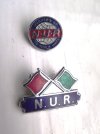
One of these no doubt?

Recollection is that the upper (circular) one came automatically from the NUR, but the other (the two flags) was sold by the NUR and the proceeds went to the Widows and Orphans fund. I also had both on my signalman’s jacket.
 

Belperpete

Established Member
Joined
17 Aug 2018
Messages
3,617
In the early 80s, a significant number of managers in the Glasgow HQ (mostly in the S&T Department) left TSSA and joined the British Transport Officers’ Guild. An additional grade called Principal Technical Officer had been introduced in the P&T (Professional and Technical) grades: this created the issue that a PTO producing design could well be paid more than the manager (MS1) who had to check it, and the TSSA seemed disinterested in trying to solve the problem.
I seem to recall that there was always a pay differential between grades. So an MS1 who had a PTO working for him would earn more than that PTO. But the kind situation you described could occur if you were an MS1 checking another PTO's work. However, I am sure that kind of situation could exist already with STOs - just that it was more likely to occur with PTOs.

I remember a big pay and grading exercise where the most senior STOs were regraded to MS1, and the tranche below regraded to PTO, backdated by about two years as I recall. They all received substantial lump sums for the backdating. Then the next month, all those who had been upgraded to MS1 got two year's worth of overtime pay taken back off them! In many cases, they had a negative pay packet, and got little the next month either. They were not happy, particularly as they ended up getting substantially less overall than their juniors who had been upgraded to PTO. Again, the TSSA seemed disinterested.

Because I joined at just the wrong time, I wasn't upgraded. But the effect was that I left work on Friday senior to several dozen staff, and came in on Monday junior to them all. Needless to say what the TSSA thought about it "don't rock the boat" I was told.
 

Big Jumby 74

Established Member
Joined
12 Feb 2022
Messages
2,238
Location
UK
No, no, no, it was an ASLEF one
Apologies. That is me being in NUR (my old union) mode....:rolleyes:

== Doublepost prevention - post automatically merged: ==

I seem to recall that there was always a pay differential between grades.
Even in clerical grades, MS1 was barely worth the grade (in actual pay terms), as any CO5 who was prepared for a modest amount of overtime could out pace the former. Obviously times change, and more recently I understand in certain areas there has been a various mix of no overtime being granted (no money) and Managers being paid cash overtime due to staff shortages. Can't really compare today with the old days!
 
Last edited:

MadMac

Established Member
Joined
13 Jun 2008
Messages
1,494
Location
Moorpark, CA
I seem to recall that there was always a pay differential between grades. So an MS1 who had a PTO working for him would earn more than that PTO. But the kind situation you described could occur if you were an MS1 checking another PTO's work. However, I am sure that kind of situation could exist already with STOs - just that it was more likely to occur with PTOs.
There was a pay differential between grades, but the problem arose because an additional grade (PTO) was inserted into the structure without any regard for the ”knock-on effect” of doing so.
 

GRALISTAIR

Established Member
Joined
11 Apr 2012
Messages
10,492
Location
Preston Lancs
My grandmother and then father bequeathed to me, my Grandfather's NUR badge. He was killed on the railway in 1959 as a track worker. NUR was always discussed in our house.

I certainly remember the Ray Buckton -Sid Weighell era - not with fondness though!
 

furnessvale

Established Member
Joined
14 Jul 2015
Messages
4,901
In the early 80s, a significant number of managers in the Glasgow HQ (mostly in the S&T Department) left TSSA and joined the British Transport Officers’ Guild. An additional grade called Principal Technical Officer had been introduced in the P&T (Professional and Technical) grades: this created the issue that a PTO producing design could well be paid more than the manager (MS1) who had to check it, and the TSSA seemed disinterested in trying to solve the problem.
I never thought a move to BTOG was possible for MS1 grades. I was promoted to MS1 in 1973 and the possibility was never mentioned. I left for pastures new in 1976 so never went any higher.
 

Big Jumby 74

Established Member
Joined
12 Feb 2022
Messages
2,238
Location
UK
I certainly remember the Ray Buckton -Sid Weighell era - not with fondness though!
I can understand that. Once I departed 'on track' (signalling) roles and moved to clerical side, I remained with NUR, never joined TSSA, and after a number of years ceased with NUR/RMT as well. These matters have to be a personal choice for the individuals concerned, although I did hear odd comments from one or two hard line union people (within the clerical environment) to the effect that people who were non union, were benefiting (by way of wage increases) from the 'struggles' of those who still paid their dues. Am well aware this subject is a hot potato for some, but as said, it is for the individual to decide what is best for them/their family's/their circumstances etc.
 

Clarence Yard

Established Member
Joined
18 Dec 2014
Messages
3,266
I joined in the 1970’s when it was still a closed shop - everyone had to join a union, without exception. At KX, the salaried staff used to join TSSA, the footplate staff ASLEF and the conciliation staff NUR. On the M&EE workshop side, the fitters were AUEW, electricians EEPTU and the smiths were with the boilermakers. The workshop staff used to be represented nationally by the “Confed”, a grouping of those trades and others. I think you had to be a senior officer grade (i.e. higher than MS5) to get into BTOG.

Although some drivers depots were recognised as NUR (largely due to historical reasons) and if you joined the NUR in any grade, as you moved up or around, you tended to stick with them but poaching of members by another union was strictly prohibited by a TUC agreement (the Bridlington Agreement) and the NUR fell foul of this in the mid to late 1970’s and some members had to join or rejoin another union.

At KX the guards used to be paid out at the south end of the station. The drivers (& workshop staff) at the north end of west side offices. One pay day the south end pay point was out of action and management announced that everyone would get paid out at the north end. There was nearly a strike by the drivers who didn’t exactly help matters by singing “The guard is the man” while they were passing the queue of guards. Management had to set up an alternative pay point for the guards fairly quickly!

There was no love lost between ASLEF and the NUR. One day Sid Weighell was being interviewed for TV in Room 127 West Side KX and ASLEF men took turns in starting a Deltic that was sitting on 8! But whether you were ASLEF, NUR or TSSA, everyone hated the TGWU - they represented the bus and truck drivers and were very anti-rail.

 

Belperpete

Established Member
Joined
17 Aug 2018
Messages
3,617
At KX the guards used to be paid out at the south end of the station. The drivers (& workshop staff) at the north end of west side offices. One pay day the south end pay point was out of action and management announced that everyone would get paid out at the north end. There was nearly a strike by the drivers who didn’t exactly help matters by singing “The guard is the man” while they were passing the queue of guards. Management had to set up an alternative pay point for the guards fairly quickly!
When I started on BR, I was supposed to be on four-weekly pay, but my first pay was a week's pay paid in cash until I hit the four-weekly cycle. Unfortunately someone boobed, and my next four-weekly pay was also paid in cash rather than into the bank. To further compound the error, it was directed to the Blacksmith's Shop pay office at Wimbledon - the Blacksmith's Shop had been closed and demolished several year's before! I recall spending several hours following my pay packet around as it got passed between the various booking offices and pay offices at Wimbledon until I finally caught up with it - then it was straight down to the bank to pay in the largest sum of cash I had ever had in my pocket!

== Doublepost prevention - post automatically merged: ==

I did hear odd comments from one or two hard line union people (within the clerical environment) to the effect that people who were non union, were benefiting (by way of wage increases) from the 'struggles' of those who still paid their dues.
This was quite common thinking when the closed shop ended, not just among hard-line unionists. It was still collective bargaining, so the unions were still doing the negotiating, but everyone got the pay rise negotiated by the union, member or not. Not unnaturally this led to accusations of non members free riding - they got the benefit without paying the dues.
 
Last edited:

Rescars

Established Member
Joined
25 May 2021
Messages
2,540
Location
Surrey
I joined in the 1970’s when it was still a closed shop - everyone had to join a union, without exception. At KX, the salaried staff used to join TSSA, the footplate staff ASLEF and the conciliation staff NUR. On the M&EE workshop side, the fitters were AUEW, electricians EEPTU and the smiths were with the boilermakers. The workshop staff used to be represented nationally by the “Confed”, a grouping of those trades and others. I think you had to be a senior officer grade (i.e. higher than MS5) to get into BTOG.
This takes me back. I wonder if anyone has a copy of the Machinery of Negotiation which set out the basis for negotiation between the union and management. IIRC it also contained all sorts of details about precedents which had been established previously.
 

Belperpete

Established Member
Joined
17 Aug 2018
Messages
3,617
This takes me back. I wonder if anyone has a copy of the Machinery of Negotiation which set out the basis for negotiation between the union and management. IIRC it also contained all sorts of details about precedents which had been established previously.
Are you talking about "the red book", that contained details of agreements going back to year dot? Staff could buy them from the union. After privatisation, in the company that I worked for, staff who retained BR conditions were known as "red book" staff.
 

Rescars

Established Member
Joined
25 May 2021
Messages
2,540
Location
Surrey
Are you talking about "the red book", that contained details of agreements going back to year dot? Staff could buy them from the union. After privatisation, in the company that I worked for, staff who retained BR conditions were known as "red book" staff.
Yes indeed. IIRC there were additional volumes covering various subsidiaries. The BTH version was black.

== Doublepost prevention - post automatically merged: ==

ISTR they were bankrupt - through lack of membership - and merged with the plumbers' union , of all things, in the early- or mid- 1980s.
Alas how the mighty are fallen!
 

Indigo Soup

Established Member
Joined
17 May 2018
Messages
1,485
This was quite common thinking when the closed shop ended, not just among hard-line unionists. It was still collective bargaining, so the unions were still doing the negotiating, but everyone got the pay rise negotiated by the union, member or not. Not unnaturally this led to accusations of non members free riding - they got the benefit without paying the dues.
Such thinking is still around. In a previous job (non-railway, but notoriously unionised) I was for many years one of the few non-union members of my team, and this was one of the principal arguments put forward for why I should join the union. I did, in the end, but not for that reason.

Ironically, the last remaining non-union member of the team wound up leaving the company for reasons a trade union would have been all over.
 

En

Member
Joined
18 Jun 2024
Messages
178
Such thinking is still around. In a previous job (non-railway, but notoriously unionised) I was for many years one of the few non-union members of my team, and this was one of the principal arguments put forward for why I should join the union. I did, in the end, but not for that reason.

Ironically, the last remaining non-union member of the team wound up leaving the company for reasons a trade union would have been all over.
But equally for those whoare not union members it's 'put up and shut up ' aobut TaCoS / Pay rises / re-grading when recignised TUs are the primary/sole bodies used in consultation...
Tradues Union membrership should ultimately be a matter of personal conscioence , which is seey those TUs who offer additional subscriptions ot a one or both of a general Political fund and an Affiliated political fund on to of thei ordinary Subs for workplace representation ( individual and collective)
 
Status
Not open for further replies.

Top