This will be found, likely, a weird / abstruse matter -- have wondered whether it properly belongs here, or in one or another different sub-forum; but as it concerns a railway elsewhere than in Britain... as ever, "mods, please adjust if you see fit".
Brought to mind by recent "chat" elsewhere on the Forums, about towns in the USA called Woodstock. In my undoubted all-time favourite railway book, Bryan Morgan's The End of the Line (as a bore concerning which, I sometimes fear that I approach gold-medal-winning heights): the author muses in his brief "wrapping-up" chapter, on railways in distant parts of the world -- some no longer in operation, even in the 1950s -- with which he would or might (strictly theoretically) wish for first-hand acquaintance. He gives a couple of paragraphs thus, to the Americas: including a mention in the bygoing, of "the line from Woodstock in Vermont... which shut in such a sinister fashion that sleety Good Friday long ago".
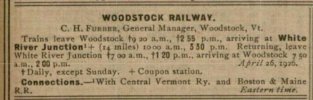
Googling led me to a brief article on Wiki, re what must be the subject thereof: the Woodstock Railway (not "Railroad"), a 14-mile-long small local independent rail undertaking ("short line" in US parlance) in the state of Vermont: standard gauge, connecting with the wider rail network at White River Junction, and running to the town of Woodstock. Operational from 1875 until abandonment in 1933. Mention in general, of road competition's role in its demise; as with many such lines in that part of the world, in that era. No direct allusion to any suspension of services -- temporary or permanent -- on any Good Friday, in inclement weather or otherwise. The article does state that the last train ran on Saturday April 15th, 1933. Wondering prompted -- the right time of year for ("had it been so") that day to be the one immediately after Good Friday: Morgan perhaps slightly misinformed; and / or being authorially terse / imprecise for the sake of effect; thus, might whatever grim thing happened, have indeed done so on the Friday -- essentially dealing the coup de grace to the railway, but with its still being possible (and this actually what done) for the last day of operation to be on the day after?
I have always felt mildly curious about this matter, since first reading The End of the Line sixty-plus years ago; without curiosity having been so consuming as to inspire me to diligent research. If readers of this post might know more details about the alluded-to sinister doings in the Vermont backwoods; I'd be most interested and grateful, to learn of same.
ETA: abovementioned "chat", on sub-forum "General Discussion", thread And In Other News: a brief exchange (two posts) between myself and another participant, on 21/6.
Brought to mind by recent "chat" elsewhere on the Forums, about towns in the USA called Woodstock. In my undoubted all-time favourite railway book, Bryan Morgan's The End of the Line (as a bore concerning which, I sometimes fear that I approach gold-medal-winning heights): the author muses in his brief "wrapping-up" chapter, on railways in distant parts of the world -- some no longer in operation, even in the 1950s -- with which he would or might (strictly theoretically) wish for first-hand acquaintance. He gives a couple of paragraphs thus, to the Americas: including a mention in the bygoing, of "the line from Woodstock in Vermont... which shut in such a sinister fashion that sleety Good Friday long ago".
Googling led me to a brief article on Wiki, re what must be the subject thereof: the Woodstock Railway (not "Railroad"), a 14-mile-long small local independent rail undertaking ("short line" in US parlance) in the state of Vermont: standard gauge, connecting with the wider rail network at White River Junction, and running to the town of Woodstock. Operational from 1875 until abandonment in 1933. Mention in general, of road competition's role in its demise; as with many such lines in that part of the world, in that era. No direct allusion to any suspension of services -- temporary or permanent -- on any Good Friday, in inclement weather or otherwise. The article does state that the last train ran on Saturday April 15th, 1933. Wondering prompted -- the right time of year for ("had it been so") that day to be the one immediately after Good Friday: Morgan perhaps slightly misinformed; and / or being authorially terse / imprecise for the sake of effect; thus, might whatever grim thing happened, have indeed done so on the Friday -- essentially dealing the coup de grace to the railway, but with its still being possible (and this actually what done) for the last day of operation to be on the day after?
I have always felt mildly curious about this matter, since first reading The End of the Line sixty-plus years ago; without curiosity having been so consuming as to inspire me to diligent research. If readers of this post might know more details about the alluded-to sinister doings in the Vermont backwoods; I'd be most interested and grateful, to learn of same.
ETA: abovementioned "chat", on sub-forum "General Discussion", thread And In Other News: a brief exchange (two posts) between myself and another participant, on 21/6.
Last edited: