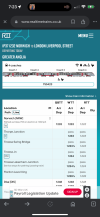
WRT the four car 755, from the train diagrams we get in catering this service is scheduled as a single unit, with the triple traction diagrammed to swap off the 1146 arrival (1000 off LST) before coming back on to take over the 2000 up train. In practice, I don't think I've ever seen this happen and the 11-car has stayed on all day.According to RTT the 1500 LST-NRW was a 4-car Class 755 today - can anyone confirm this? Apparently there was also a 15-car Class 720 to Ipswich as well! I would imagine this wouldn’t happen?

-
Our new ticketing site is now live! Using either this or the original site (both powered by TrainSplit) helps support the running of the forum with every ticket purchase! Find out more and ask any questions/give us feedback in this thread!
You are using an out of date browser. It may not display this or other websites correctly.
You should upgrade or use an alternative browser.
You should upgrade or use an alternative browser.
Greater Anglia Class 755s (Regional Trains)
- Thread starter swt class 450
- Start date
Sponsor Post - registered members do not see these adverts; click here to register, or click here to log in
R
RailUK Forums

dk1
Veteran Member
WRT the four car 755, from the train diagrams we get in catering this service is scheduled as a single unit, with the triple traction diagrammed to swap off the 1146 arrival (1000 off LST) before coming back on to take over the 2000 up train. In practice, I don't think I've ever seen this happen and the 11-car has stayed on all day.
Yes it did. Was full triple traction throughout.

What is the reason for doing this rather than just using 745s?Yes it did. Was full triple traction throughout.
dk1
Veteran Member
What is the reason for doing this rather than just using 745s?
Not enough of them to go round basically.
Could they use 720s?Not enough of them to go round basically.
oh god please no. the bimodes are bad enough for onboard crewCould they use 720s?
dk1
Veteran Member
Could they use 720s?
That was the plan in peak hours before the pandemic and a few Norwich drivers started training. Two 10-car sets were to be based in Victoria sidings at Trowse overnight but this got cancelled and has never restarted. Only Liverpool Street (Anglia Railways) sign them. However as the hourly Ipswich-Peterborough & a few other service enhancements never happened, a surplus of 755s allowed their use instead and are far more suitable as have 2+2 seating with tables and are signed by all Norwich, Ipswich & Liverpool Street traincrew.
Last edited:
Adrian1980uk
Member
- Joined
- 24 May 2016
- Messages
- 842
That was the plan in peak hours before the pandemic and a few Norwich drivers started training. Two 10-car sets were to be based in Victoria sidings at Trowse overnight but this got cancelled and has never restarted. Only Liverpool Street (Anglia Railways) sign them. However as the hourly Ipswich-Peterborough & a few other service enhancements never happened, a surplus of 755s allowed their use instead and are far more suitable as have 2+2 seating with tables and are signed by all Norwich, Ipswich & Liverpool Street traincrew.
I do think it's only a matter of time (couple of years) before extra peak time services are required but it should be a new plan where Stansted express units are used and even more 720s are used on the Stansted run as hopefully passenger numbers continue to rise. If Ely junction is finally done the service enhancements will take the 755 surplus.

For some obvious reason ga will never use 720s north of Ipswich on geml when they can occasionally run them as furthest to Ely & kings Lynn mostly Ely in peak hours on the waml which is a bit of a waste the amount of units ordered to take up all of the Anglia network. They only ordered 20 745s with mostly 8 required on Stansaid express with the 1 or 2 720 diagrams due to Norwich intercity using most of the 745/1s since the June 24 timetable has kicked in now left w the remaining 12 to fill in for a 30 min ic diagram which includes 10 slots. They have to keep at least 2 745s off for a day for maintenance & for backup incase 1 unit booked for the day faces a fault. Mostly about 2/3 unit swaps to Stansaid when at Liverpool Street. Recently there has been a few occasional muck ups when rtt has shown when a 720 was on a swap over from stansaid to form the 07:30 to Norwich & for that they have to platform alternate soon as the next flirt diagram returns.Could they use 720s?
It always seems to remain as the same as 11 cars all day for 6 daily runs I’m not sure why they would want to come up with this idea & swap to a 4 car for the 12:30 & 15:00 2nd slot run & not stick to the planned proportion while displayed on rtt that is part of the June timetable. Normally it sits for about 40 mins on the platform for the return journey instead of multiple ecs moves to depot because of a 4 car slot agreed which hasn’t even been approved already 3 weeks into the new timetable.WRT the four car 755, from the train diagrams we get in catering this service is scheduled as a single unit, with the triple traction diagrammed to swap off the 1146 arrival (1000 off LST) before coming back on to take over the 2000 up train. In practice, I don't think I've ever seen this happen and the 11-car has stayed on all day.
Attachments

Haywain
Veteran Member
- Joined
- 3 Feb 2013
- Messages
- 24,817
That would mean that a few trains would lack level boarding, and I wouldn't see that sort of inconsistency being desirable.Could they use 720s?

Mikey C
Established Member
- Joined
- 11 Feb 2013
- Messages
- 8,277
I assume one of the reasons for using 745s on the Stansted Express is that an airport service, where passengers have lots of luggage, really benefits from level boarding.
The whole thing was doomed from the start. 18 from 20 was too optimistic. Two years ago, they only needed 13 but substitutions were a weekly occurrence, often for several days. The Stansted operation is awkward because only one of the nine diagrams starts or ends at Norwich. It's impossible to attach a unit to or from Norwich so that means 100 mile empty stock moves when one fails. Sometimes they are towed by a diesel loco.

Railperf
Established Member
- Joined
- 30 Oct 2017
- Messages
- 3,684
Wasn't it said that the planned faster timetable ( yet to be implemented) would allow more diagrams to be run by fewer units?The whole thing was doomed from the start. 18 from 20 was too optimistic. Two years ago, they only needed 13 but substitutions were a weekly occurrence, often for several days. The Stansted operation is awkward because only one of the nine diagrams starts or ends at Norwich. It's impossible to attach a unit to or from Norwich so that means 100 mile empty stock moves when one fails. Sometimes they are towed by a diesel loco.
I imagine using a triple 755 unit incurs greater track access charges and energy consumption, and additional maintenance costs. So at some point ( most likely a timetable change and uplift of frequency on Peterborough etc) a decision might have to be made to prioritise the 745s on Norwich services and retain fewer 745's on the Stansted route. It would be useful to build the last few 720's to an interior standard suitable for the airport run ..more luggage racks etc, but ultimately keeping those units on their desire diagrams will prove hard to fulfill as we saw with 379's ending up on Cambridge services and 317's on Stansted services.
believe it's 4/9 /1 diagrams start or end at norwich, with units starting on 0630 + 1200 ex-NRW up, and finishing on 1630 + 1900 ex-LST down trains. personally i think it would be better to have a standard fleet of 20 and interwork the norwich trains with the two BIS stansted services, and hand the stoppers over to 720s, but that involves a lot of investment they won't put inThe whole thing was doomed from the start. 18 from 20 was too optimistic. Two years ago, they only needed 13 but substitutions were a weekly occurrence, often for several days. The Stansted operation is awkward because only one of the nine diagrams starts or ends at Norwich. It's impossible to attach a unit to or from Norwich so that means 100 mile empty stock moves when one fails. Sometimes they are towed by a diesel loco.
dk1
Veteran Member
believe it's 4/9 /1 diagrams start or end at norwich, with units starting on 0630 + 1200 ex-NRW up, and finishing on 1630 + 1900 ex-LST down trains. personally i think it would be better to have a standard fleet of 20 and interwork the norwich trains with the two BIS stansted services, and hand the stoppers over to 720s, but that involves a lot of investment they won't put in
It would still be far better to keep all 745s on the Norwich route with 720s working the Stansted Express preferably modified for airport use. That means a uniform 720 operation on the West.
There are no real Norwich stoppers on the GEML now as the Chelmsford call off peak has been taken out and added to the faster hourly service in each direction to give a more even journey time. Trolley catering would also not be possible on the 720s with their dreadfully narrow aisles.
Railperf
Established Member
- Joined
- 30 Oct 2017
- Messages
- 3,684
Yes, but what do you do with the 'spare' 745's? Will the DfT be happy with them sitting around unless they can be used on the GEML to other destinations? Probably not. Granted there seem to be enough 720's to provide the Stansted service and keep WAML entirely 720 operated. The question is which services on the GEML warrant a 12-car 745 off-peak? Especially as the stock is still based mainly at Norwich? I'd put my neck out and say use them on Ipswich services, but then these diagrams interwork with Colchester and Clacton. So a complete rewrite oif diagrams and personnel could be needed. That would also affect layover times at Liverpool Street too. Is that a possibility?It would still be far better to keep all 745s on the Norwich route with 720s working the Stansted Express preferably modified for airport use. That means a uniform 720 operation on the West.
There are no real Norwich stoppers on the GEML now as the Chelmsford call off peak has been taken out and added to the faster hourly service in each direction to give a more even journey time. Trolley catering would also not be possible on the 720s with their dreadfully narrow aisles.
There doesn't seem to be an easy answer here as to what to do with them unless you extend the Ipswich services to Norwich - and utilise them that way, but not sure how many extra units that would consume.
Anyway, getting back OT, are there any reflections on the 755's now that they have been in service for close to four years? Are there any lessons to be learned re door layouts, interior layouts, traction etc?
Seems to me that the units are quite light footed and could have done with some more powered axles. Also should the 755/3's have had at least a single extra engine - possibly two - which would have offered a greater level of redundancy? IN fact should they really have all been 4-car rather than a mix of 3 and four cars? From a passenger point of view, my only gripe is the very slow movement of the toilet door. Takes an age to close.
Last edited:
dk1
Veteran Member
Yes, but what do you do with the 'spare' 745's? Will the DfT be happy with them sitting around unless they can be used on the GEML to other destinations? Probably not. Granted there seem to be enough 720's to provide the Stansted service and keep WAML entirely 720 operated. The question is which services on the GEML warrant a 12-car 745 off-peak? Especially as the stock is still based mainly at Norwich? I'd put my neck out and say use them on Ipswich services, but then these diagrams interwork with Colchester and Clacton. So a complete rewrite oif diagrams and personnel could be needed. That would also affect layover times at Liverpool Street too. Is that a possibility?
There doesn't seem to be an easy answer here as to what to do with them unless you extend the Ipswich services to Norwich - and utilise them that way, but not sure how many extra units that would consume.
Anyway, getting back OT, are there any reflections on the 755's now that they have been in service for close to four years? Are there any lessons to be learned re door layouts, interior layouts, traction etc?
Seems to me that the units are quite light footed and could have done with some more powered axles. Also should the 755/3's have had at least a single extra engine - possibly two - which would have offered a greater level of redundancy? IN fact should they really have all been 4-car rather than a mix of 3 and four cars? From a passenger point of view, my only gripe is the very slow movement of the toilet door. Takes an age to close.
There wouldn’t be any 745s sitting around as they would be redeployed on the GEML covering Liverpool Street to Ipswich & some Clacton services.
Although not so much umph the 755/3s easily keep time in diesel mode but it’s the capacity that lets them down now particularly on any trains that serve Cambridge along with some East Suffolk line services. Any rumours of batteries replacing the weights in these units power backs to add to their green credentials seems to have gone off the boil. Would be great if 14 extra ‘B’ coaches could be ordered to make them an all 4-car fleet for flexibility although I must admit to not knowing the full implications of this on the Sudbury branch.
There wouldn’t be any 745s sitting around as they would be redeployed on the GEML covering Liverpool Street to Ipswich & some Clacton services.
Although not so much umph the 755/3s easily keep time in diesel mode but it’s the capacity that lets them down now particularly on any trains that serve Cambridge along with some East Suffolk line services. Any rumours of batteries replacing the weights in these units power backs to add to their green credentials seems to have gone off the boil. Would be great if 14 extra ‘B’ coaches could be ordered to make them an all 4-car fleet for flexibility although I must admit to not knowing the full implications of this on the Sudbury branch.
I think only 2 coaches are currently platformed at Marks Tey
dk1
Veteran Member
The
Thank you.
== Doublepost prevention - post automatically merged: ==
Ah @Railperf i think what you are doing wrong is pressing ‘close’ before the door on the UAT has fully opened. This makes it close very slowly. Try waiting if you can and you’ll find it closes much quicker.
I think only 2 coaches are currently platformed at Marks Tey
Thank you.
== Doublepost prevention - post automatically merged: ==
Ah @Railperf i think what you are doing wrong is pressing ‘close’ before the door on the UAT has fully opened. This makes it close very slowly. Try waiting if you can and you’ll find it closes much quicker.
RUK
Member
Is 3 x 4-car too long to form a triple traction?Would be great if 14 extra ‘B’ coaches could be ordered to make them an all 4-car fleet for flexibility
Adrian1980uk
Member
- Joined
- 24 May 2016
- Messages
- 842
That would decrease some flexibility but realistically that's only a temporary issue that needs to fixed as more than likely once the tables are fitted to the 745/1s they would take another one from Stansted and use a pair of 720s there.Is 3 x 4-car too long to form a triple traction?
dk1
Veteran Member
Yes mate. Can't be accommodated.Is 3 x 4-car too long to form a triple traction?
No, 3x 4 car is authorised everywhere the 12 car 745s are (on the GE).Is 3 x 4-car too long to form a triple traction?
Last edited:
dk1
Veteran Member
No, 3x 4 car is authorised everywhere the 12 car 745s are (on the GE).
We don’t operate 3x4-car 755s.

jammmmmsssssss
Member
I think 3x 4 car 755s would be the same length as a 13 car 745 because of the power packNo, 3x 4 car is authorised everywhere the 12 car 745s are (on the GE).
I've never seen a 755/3 operate a Cambridge service, but I know even the 4-coach ones can be very full. I wonder how a 5-coach EMU variant could fare for operating these services. It wouldn't be much longer than 755/4, and would likely still meet crash-safety standards (same number of Jacob's bogies). The cost and hit to flexibility may cause issues though as the Cambridge services often change into Lowestoft ones at Ipswich.There wouldn’t be any 745s sitting around as they would be redeployed on the GEML covering Liverpool Street to Ipswich & some Clacton services.
Although not so much umph the 755/3s easily keep time in diesel mode but it’s the capacity that lets them down now particularly on any trains that serve Cambridge along with some East Suffolk line services. Any rumours of batteries replacing the weights in these units power backs to add to their green credentials seems to have gone off the boil. Would be great if 14 extra ‘B’ coaches could be ordered to make them an all 4-car fleet for flexibility although I must admit to not knowing the full implications of this on the Sudbury branch.

Halish Railway
Established Member
I’ve been on a 755/3 on a Cambridge to Ipswich service if that’s what you’re referring to.I've never seen a 755/3 operate a Cambridge service
dk1
Veteran Member
I’ve been on a 755/3 on a Cambridge to Ipswich service if that’s what you’re referring to.
755/3s operate through to Cambridge from Ipswich & Norwich on a daily basis. At peak times they regularly cause complaints on X.
== Doublepost prevention - post automatically merged: ==
I've never seen a 755/3 operate a Cambridge service, but I know even the 4-coach ones can be very full. I wonder how a 5-coach EMU variant could fare for operating these services. It wouldn't be much longer than 755/4, and would likely still meet crash-safety standards (same number of Jacob's bogies). The cost and hit to flexibility may cause issues though as the Cambridge services often change into Lowestoft ones at Ipswich.
How would an EMU work? Cambridge-Stowmarket & Ely-Trowse are not wired.
Whoops, forgot about the area after Stowmarket.755/3s operate through to Cambridge from Ipswich & Norwich on a daily basis. At peak times they regularly cause complaints on X.
== Doublepost prevention - post automatically merged: ==
How would an EMU work? Cambridge-Stowmarket & Ely-Trowse are not wired.
jammmmmsssssss
Member
I've been on the 1646 Cambridge to Ipswich when it was a 755/3. Every seat, aisle and vestibule was completely full and the few people that arrived just as it was about to leave couldn't get on. That was only once though. Sometimes that same service as a 755/3 has seats left as well. (I only travel on Mondays)755/3s operate through to Cambridge from Ipswich & Norwich on a daily basis. At peak times they regularly cause complaints on X.
== Doublepost prevention - post automatically merged: ==
How would an EMU work? Cambridge-Stowmarket & Ely-Trowse are not wired.