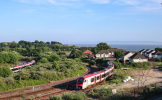
There is only one diesel engine on a 756, compared with four on a 231. They are not designed to run any great distance on diesel.
It's not obvious to me that this follows.
I would assume they run like a hybrid road vehicle where the battery is charged from the diesel (and from dynamic braking?) rather than running the battery flat then going over to diesel power as an emergency power source.
Not quite a fair comparison I realise, but I believe a (non plug in) hybrid double decker bus can run from a car engine (1.9 litre engine vs 7 litre).
Also (putting the higher speed of a 231 aside), a 231 seems to be somewhat overpowered because a 3 car FLIRT (755/3) only has two engines (of the same type as a 756, I believe).
So now it's just a factor of two.
The 231s will of course travel significant distances without overhead power, so if the intention is that they need lots of time under the wires to charge the batteries sufficiently to get to Bridgend and back, it's going to make life hard if disruption means they have to turn round at Cardiff, and they won't be able to manage a shuttle service on part of the VoG during engineering works as they are
today next weekend.
Four trains per hour to Bargoed, two to Rhymney.
Assuming we're not at cross purposes, has this descope been officially announced?
A month ago TfW were saying (
https://news.tfw.wales/news/june-2024-timetable-change#:~:text=Metro Changes,and Merthyr to/from Cardiff.)
The changes are the next step in the creation of the South Wales Metro, which will eventually see 4 trains per hour from Treherbert, Aberdare, Rhymney and Merthyr to/from Cardiff.
My comments on 231 diagrams were aimed at their eventual use on the mainline.
Yes I got confused for a moment and forgot that the 231s are temporary.