• Our new ticketing site is now live! Using either this or the original site (both powered by TrainSplit) helps support the running of the forum with every ticket purchase! Find out more and ask any questions/give us feedback in this thread!

Banking locos on the WCML in 1950s-60s

Status
Not open for further replies.

Springs Branch

Established Member
Joined
7 Nov 2013
Messages
1,683
Location
Where my keyboard has no £ key
We've had a couple of interesting threads recently on freight workings on the northern WCML towards the end of steam.

These made me realise I have a gap in my knowledge of that era - which I couldn't easily answer from my book collection or on-line searching. It's regarding provision of banking locos . . .

It's well known that banking assistance was routinely provided to many goods trains and some passenger services in the northbound direction. Typically:-
  • Oxenholme-Grayrigg.
  • Tebay-Shap Summit.
  • Beattock-Beattock Summit.
My question is, were banking engines ever on standby at strategic locations to help southbound trains over the same summits?

E.g. Penrith - Shap Summit, or Carstairs - Beattock Summit?

I understand the southbound gradients over the fells are a little easier than northbound (a figure of "only" 1-in-125 up from Penrith to Shap springs to mind).

Were steam drivers generally expected to manage these unaided?
 
Sponsor Post - registered members do not see these adverts; click here to register, or click here to log in
R

RailUK Forums

Gloster

Veteran Member
Joined
4 Sep 2020
Messages
13,042
Location
Up the creek
I have had a look at the Cumbrian Railways Association chatline and I found one thread with a bit of information about Shap southbound. It seems that the practice in the later steam and early diesel days was to adjust the loads so that, with a few specific exceptions, the trains could be handled by a single loco through from Carlisle. However, as some northbound trains were double-headed over Shap, rather than banked, there were often locos waiting in Carlisle to head back south: in addition to saving a path they could provide additional power if attached to the front of a southbound train.
 

furnessvale

Established Member
Joined
14 Jul 2015
Messages
4,914
In wet weather at Preston, it was very common for northbound freights on the through lines to stall on the bank and have to be banked out by the next freight, which in turn also stalled.

On one occasion,a freight was routed via platform 1 and stalled, but not before a 3 x 3 coach passenger DMU had been platformed behind it. Without further ado, the DMU banked the freight out with passengers hanging out of the windows cheering!
 

thesignalman

Member
Joined
9 Jan 2012
Messages
166
It's well known that banking assistance was routinely provided to many goods trains and some passenger services in the northbound direction. Typically:-
  • Oxenholme-Grayrigg.
  • Tebay-Shap Summit.
  • Beattock-Beattock Summit.
My question is, were banking engines ever on standby at strategic locations to help southbound trains over the same summits?
Not to my knowledge. Nor is there provision in the Sectional Appendix to permit it.

John
 

Harvester

Established Member
Joined
9 Nov 2020
Messages
1,785
Location
Notts
It's well known that banking assistance was routinely provided to many goods trains and some passenger services in the northbound direction. Typically:-
  • Oxenholme-Grayrigg.
  • Tebay-Shap Summit.
  • Beattock-Beattock Summit.
My question is, were banking engines ever on standby at strategic locations to help southbound trains over the same summits?

E.g. Penrith - Shap Summit, or Carstairs - Beattock Summit?
I can well remember visits to Carlisle as a youngster on summer Saturdays in the early sixties. Many steam hauled trains from the north would arrive double headed, with Polmadie Standard Class 5s often used as pilots, but double headers never seemed to head north. This suggests that northbound trains in need of assistance over Beattock would have a banker provided, whereas those deemed so coming south started the journey with an extra loco up front!
 

Springs Branch

Established Member
Joined
7 Nov 2013
Messages
1,683
Location
Where my keyboard has no £ key
With those trains which were double-headed (as opposed to banked) on the LMR sections, would it have been normal to attach the extra loco on the front at Carnforth, rather than at Oxenholme or Tebay, and run it through to Carlisle?

If the extra loco was making the much longer trip to Carlisle and back, this might have risked depleting the supply of engines & crews available at Tebay or Oxenholme for subsequent trains.

I'm not sure how much of a role Carnforth Shed had in providing extra motive power for getting trains over the fells.
 

Gloster

Veteran Member
Joined
4 Sep 2020
Messages
13,042
Location
Up the creek
With those trains which were double-headed (as opposed to banked) on the LMR sections, would it have been normal to attach the extra loco on the front at Carnforth, rather than at Oxenholme or Tebay, and run it through to Carlisle?

If the extra loco was making the much longer trip to Carlisle and back, this might have risked depleting the supply of engines & crews available at Tebay or Oxenholme for subsequent trains.

I'm not sure how much of a role Carnforth Shed had in providing extra motive power for getting trains over the fells.

From the thread on the CRA chat line, it seemed that normal practice was to attach the loco at Preston. I would suspect that Carnforth or Tebay attachments would normally only occur if a loco was steaming badly, although there might be occasions when Preston didn’t have a loco and Carnforth did. The problem with these two would be that it would be an extra stop that blocked the main running-line.
 

thesignalman

Member
Joined
9 Jan 2012
Messages
166
From memory, double-heading was typically provided only to passenger trains, probably when trains had been strengthened during the summer. This was probably planned ahead, and Preston would be the logical place to attach them as few would have stopped at Carnforth.

Unplanned calls for bad steaming would surely be more likely to be banked than piloted.

Carnforth's only involvement would have usually been in the provision of the Oxenholme bankers. These were not as heavily worked as the Tebay ones and latterly spent most of their day doing nothing.

John
 

Harvester

Established Member
Joined
9 Nov 2020
Messages
1,785
Location
Notts
Carnforth's only involvement would have usually been in the provision of the Oxenholme bankers. These were not as heavily worked as the Tebay ones and latterly spent most of their day doing nothing.
Interestingly Carnforth continued to provide a steam banker at Oxenholme well into 1968. The practice ceased after Saturday 4th May 1968 with BR Standard 75027 being provided for the last duty, but it probably did spend the day doing nothing!
 
Last edited:

edwin_m

Veteran Member
Joined
21 Apr 2013
Messages
28,749
Location
Nottingham
Unplanned calls for bad steaming would surely be more likely to be banked than piloted.
Would this have been permitted on sections such as Carnforth-Oxenholme where banking didn't normally take place? I'd expect at least "assistance in rear" with the assisting engine coupled up, to avoid the risk of it falling behind then colliding with the train.
 

furnessvale

Established Member
Joined
14 Jul 2015
Messages
4,914
I can well remember visits to Carlisle as a youngster on summer Saturdays in the early sixties. Many steam hauled trains from the north would arrive double headed, with Polmadie Standard Class 5s often used as pilots, but double headers never seemed to head north. This suggests that northbound trains in need of assistance over Beattock would have a banker provided, whereas those deemed so coming south started the journey with an extra loco up front!
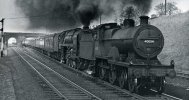
To add a little human interest to the story. Page 44 of "Treacy's Routes North" shows a Preston 2P piloting a Britannia south from Carlisle in 1957. The fireman on the 2P is my brother, then a 17 year old Preston passed cleaner on one of his first main line firing jobs. They had just piloted another heavy express north from Preston and were due back on the cushions, but as they entered Carlisle the foreman was waiting to request they forego their break and pilot another express back that was standing waiting for a pilot. The driver didn't need asking twice as it generated 6 hours mileage money! A quick trip to turn and back they went. My brother's thoughts on the matter were not recorded.

Photo copyright Eric Treacy, Patrick Whiehouse and John Powell
 

Attachments

  • img029a.jpg
    img029a.jpg
    236.3 KB · Views: 32

6Gman

Established Member
Joined
1 May 2012
Messages
9,228
I am of the view that among the thousands of books published on railway subjects (many of them repetitive) the one we really, really need is one called "Assistance Required" covering the subject of the planned provision of banking and pilot locomotives - Shap, Beattock, Lickey, the South Devon banks, the S&D, and all the other lesser-known locations.

For example, I'm told there is only one place on the ECML where passenger trains could be banked ...
 

Harvester

Established Member
Joined
9 Nov 2020
Messages
1,785
Location
Notts
For example, I'm told there is only one place on the ECML where passenger trains could be banked ...
Durham? There was usually a V3 located there in steam days, to give heavy southbound trains a push across the viaduct!
 

thesignalman

Member
Joined
9 Jan 2012
Messages
166
Would this have been permitted on sections such as Carnforth-Oxenholme where banking didn't normally take place? I'd expect at least "assistance in rear" with the assisting engine coupled up, to avoid the risk of it falling behind then colliding with the train.
No - assisting in rear has to be specified in the Sectional Appendix and it was not authorised between Carnforth and Oxenholme. But why stop at Carnforth when a perfectly good banker was available at Oxenholme? Agreed it is mostly uphill north of Carnforth but nothing is severe until leaving Oxenholme. Even then it doesn't compare with Shap and a good number of freights would run unassisted to Grayrigg.

The only time a stop at Carnforth would seem appropriate would be to declare the loco a failure rather than just poor steaming, in which case it would most likely be replaced rather than piloted.

Interestingly Carnforth continued to provide a steam banker at Oxenholme well into 1968. The practice ceased after Saturday 4th May 1968 with BR Standard 75027 being provided for the last duty, but it probably did spend the day doing nothing!

I didn't witness that and my memories are of 2-6-4T locos at Oxenholme, but I guess those had already been withdrawn by then. If my memory is correct, the D85xx type took over at Oxenholme when steam finished. I don't know if they were deployed at Tebay too, but that seems likely.

John
 

Gloster

Veteran Member
Joined
4 Sep 2020
Messages
13,042
Location
Up the creek
I didn't witness that and my memories are of 2-6-4T locos at Oxenholme, but I guess those had already been withdrawn by then. If my memory is correct, the D85xx type took over at Oxenholme when steam finished. I don't know if they were deployed at Tebay too, but that seems likely.

John

Steam banking from Tebay finished and the the shed closed on 31-12-1967. Thereafter four Claytons were outbased from Kingmoor, but loose-coupled freight was transferred to the Settle & Carlisle from 04-03-1968. From 06-05-1968 just four trains a week were to be banked, but this ended on 04-05-1970, although it had probably ended earlier.

Summary of a lengthy post on the CRA chatline.
 

furnessvale

Established Member
Joined
14 Jul 2015
Messages
4,914
Another interesting aside. When 50s ruled the WCML, I was working the track recording trolley south at Dillicar, when we were passed by a class 50 virtually at line speed, with 12 coaches on. Attached on rear were 2 x class 50s and another 12 coaches! All locos working hard.

I can only assume the front loco had failed but they had got it going again after receiving assistance in rear. I have always wondered how that working fitted with the rules?
 

edwin_m

Veteran Member
Joined
21 Apr 2013
Messages
28,749
Location
Nottingham
Another interesting aside. When 50s ruled the WCML, I was working the track recording trolley south at Dillicar, when we were passed by a class 50 virtually at line speed, with 12 coaches on. Attached on rear were 2 x class 50s and another 12 coaches! All locos working hard.

I can only assume the front loco had failed but they had got it going again after receiving assistance in rear. I have always wondered how that working fitted with the rules?
This accident report sheds some light on what was allowed and what actually happened on at least one occasion in 1969.


Arrangements were then made for the 22.15 Euston to Glasgow express passenger train, consisting of 12 coaches including sleeping cars, with the Beattock pilot locomotive coupled to the rear, to be used to assist the Inverness train to Beattock Summit.

The Glasgow train was carefully brought up to the rear of the Inverness train, but the two trains were not coupled together prior to assistance being given. Shortly after the assisting movement commenced, the Inverness train pulled away, with the result that a gap of 6 to 10 yards developed between the two trains. After travelling approximately 400 yards, the Inverness train suddenly came nearly to a stand, with the result that the locomotive of the Glasgow train struck its rear at about 10 m.p.h.
 

furnessvale

Established Member
Joined
14 Jul 2015
Messages
4,914

thesignalman

Member
Joined
9 Jan 2012
Messages
166
Thanks for that. My two trains were definitely hooked up doing at least 75+mph!
Legit but perhaps foolhardy . . .

I remember those double-headers, also "Accelerated Timings" (see the Hope Valley thread) in the WTT, introduced as an interim exercise before the electrification came in. By gum they could climb Shap like nothing ever had before. They were signalled with a special 4-4-6 bell signal so the signalmen knew it wasn't worth sinking into the armchair. :) It was not unknown for an "ordinary" express to be looped to let one by.

J
 

Harvester

Established Member
Joined
9 Nov 2020
Messages
1,785
Location
Notts
I didn't realise the viaduct was on a significant gradient - interesting.
Pacifics were prone to slipping when departing from the station onto the steep curved viaduct, so a banker was provided. I last saw V1/V3s in use as bankers during 1962, and then Class 24s took over for a while. Now if only 60532 had been banked………..
 

edwin_m

Veteran Member
Joined
21 Apr 2013
Messages
28,749
Location
Nottingham
I didn't realise the viaduct was on a significant gradient - interesting.
According to the Five Mile plan it's ascending at 1 in 120 through the station itself and onto the viaduct, increasing to 1 in 100 about a quarter of a mile beyond. So no scope to get the train moving on the level before hitting the gradient, or to take advantage of buffer compression.
 
Status
Not open for further replies.

Top