
Gas and electricity are natural monopolies.Rather, we're paying for the cost of a stupid regulatory regime that at one point forced suppliers to sell us gas/electricity below the price that they were paying wholesale for it, therefore driving the smaller suppliers out of business. If it had actually been a free market with suppliers allowed to set prices in accordance with market rates, then those suppliers would probably still be in business, which would have likely meant more competition and therefore lower prices.
Or to put it another way: We're paying for an example of what happens when well-meaning politicians who don't understand how markets work try to interfere with free markets for populist reasons

-
Our new ticketing site is now live! Using either this or the original site (both powered by TrainSplit) helps support the running of the forum with every ticket purchase! Find out more and ask any questions/give us feedback in this thread!
You are using an out of date browser. It may not display this or other websites correctly.
You should upgrade or use an alternative browser.
You should upgrade or use an alternative browser.
Rishi Sunak and the Conservative Party.
- Thread starter Cowley
- Start date
- Status
- Not open for further replies.
Sponsor Post - registered members do not see these adverts; click here to register, or click here to log in
R
RailUK Forums
DustyBin
Established Member
There are a lot of Brexit supporters who don't want to admit they voted for something very bad for poor reasons that are now being shown to be rubbish, and come out with all sorts of excuses for the way things have panned out. Your anecdote is a classic example of I'm not affected so there is no problem and if anyone is affected it must be their fault (i.e. victim blaming). Classic toxic right wing extremism attitude and is the kind of people the government is hoping to attract at the ballot box with their attack on the sick and disabled.
"heart over head" is often how bad decisions are made, logic is frequently superior.
Ignoring the hyperbole(!) I think you're quite wrong here. My anecdote is an example of someone with genuine expertise, who's heavily involved with their industry's representative body, providing their honest assessment of the situation. Guidance was issued and some people chose to ignore it as they didn't think it would ever be relevant. In this example they really do only have themselves to blame!
Indeed, one of the best comments on Brexit I've seen on here. If people voted for Brexit for "tribal" reasons despite knowing it would cause problems for the country, and also knowing it would not benefit them personally, that is a strange decision.
I can understand a vote for Brexit made in the knowledge that it would benefit the voter personally. I would disagree with their decision, but at least I would understand.
Conversely, I found the most compelling reasons to vote remain were the entirely selfish ones! In many ways I was a classic "I'm alright, why rock the boat" type. However, I viewed Brexit as bigger than myself and my little bubble, so voted leave as it felt like the right thing for the country as a whole.
The transmission networks might be, but generation and supply are very competitive.Gas and electricity are natural monopolies.
Lost property
On Moderation
- Joined
- 2 Jun 2016
- Messages
- 739
Correct, albeit aided in no small part by the regulator not applying something called "due diligence " (see also Sunak giving away several millions to a few carefully selected mates ) along with the Tory Holy Grails " Free market ! / Privatisation !" ( the tax payer will always be available after all to bail out any failures ).Rather, we're paying for the cost of a stupid regulatory regime that at one point forced suppliers to sell us gas/electricity below the price that they were paying wholesale for it, therefore driving the smaller suppliers out of business. If it had actually been a free market with suppliers allowed to set prices in accordance with market rates, then those suppliers would probably still be in business, which would have likely meant more competition and therefore lower prices.
Or to put it another way: We're paying for an example of what happens when well-meaning politicians who don't understand how markets work try to interfere with free markets for populist reasons
Any organisation preceded by "Of" is invariably a paper tiger quango....with one notable exception, the O.R.R (thankfully ! )
edwin_m
Veteran Member
You mentioned that your friend exported stuff to the EU via the Netherlands after Brexit. Presumably before Brexit they would have just sent packages out as necessary, but they now have to send bulk loads to be distributed from NL because the paperwork and general hassle on a small consignment is just the same as for a large one.Ignoring the hyperbole(!) I think you're quite wrong here. My anecdote is an example of someone with genuine expertise, who's heavily involved with their industry's representative body, providing their honest assessment of the situation. Guidance was issued and some people chose to ignore it as they didn't think it would ever be relevant. In this example they really do only have themselves to blame!
So, unlike others, your friend planned ahead to minimise the disruption - which would have been difficult for many because of the uncertainty on what the arrangements would be right up to a few days before they came into effect. But they are still in a worse situation than before Brexit or than if we'd stayed in the single market and customs union. Sending goods in two stages increases delivery times, and/or leads to cash being tied up in stock in NL, either of which worsens cashflow and may make the business less competitive. And the distribution work done from the NL is jobs and taxes that would previously have been in the UK.
By workers from other parts of the EU exercising FOM probably! A recent discussion on the forum wasn't exactly conclusive that this would be a net contribution to the UK economy.And the distribution work done from the NL is jobs and taxes that would previously have been in the UK.

DynamicSpirit
Established Member
If a business starts or increases its activity, that contributes to growth in the country where it takes place. Brexit makes it more likely that will be in another country, either the same business moving its investment or the business not investing and a competitor elsewhere filling the gap in the market instead. The tax arising from that activity also goes to some other country instead of the UK.
That's an interesting argument, but I'm a bit sceptical of it. I assume you're thinking in terms of the EU being a larger market (population-wise) and businesses wanting to invest in the larger market. But if that kind of thing really did lead to a greater rate of investment in larger markets that was sufficient to impact growth, that would lead to larger countries normally growing faster than smaller countries, so that smaller countries gradually become much poorer (per capita) than their larger neighbours. I've never seen any indication that that happens across the World, so my strong suspicion is that it doesn't, and smaller countries are able to grow and attract business investment just as well as larger countries (or groups of countries). It's also worth bearing in mind that the oft-repeated argument that businesses would prefer to be in the EU because the population is larger ignores that the number of competing businesses is also likely to be proportional to the population: When you take that into account, there's not actually any reason for a business to expect higher sales in the EU compared to the UK, unless it's a market leader (or monopoly) that faces little competition.
If consumers and governments spend less money, that also reduces growth.
But we have no reason to believe Brexit will cause consumers and governments to spend less (beyond the one-off small loss in GDP when Brexit happened).
Here is the Bank of England deputy governor on the consequences of Brexit: https://www.theguardian.com/busines...vestment-says-bank-of-england-deputy-governor
The graph accompanying the article doesn't really give any information to allow us to deduce a permanent reduction in investment. It certainly shows investment levelling off for the couple of years immediately after Brexit, but that's easily explainable from the temporary uncertainty because at the time no-one knew what Brexit was going to look like. Then investment drops sharply during the Covid lockdown and is now very rapidly rising. The most recent data point on the graph shows investment as by far the highest it's been since 2000, but that's probably at least in part a bounce-back from Covid. We'd need a few more years of data before we can tell whether Dave Ramsden's concerns are valid in the long term.
Last edited:
edwin_m
Veteran Member
All the countries around Europe are either in the EU, wanting to join, or have trade agreements. The only exceptions are those still in Russia's orbit - and the UK. So I don't think there's any evidence there to prove or disprove your theory about smaller countries being equally viable, but there's a lot of evidence that those countries see a benefit in being part of a larger collective.That's an interesting argument, but I'm a bit sceptical of it. I assume you're thinking in terms of the EU being a larger market (population-wise) and businesses wanting to invest in the larger market. But if that kind of thing really did lead to a greater rate of investment in larger markets that was sufficient to impact growth, that would lead to larger countries normally growing faster than smaller countries, so that smaller countries gradually become much poorer (per capita) than their larger neighbours. I've never seen any indication that that happens across the World, so my strong suspicion is that it doesn't, and smaller countries are able to grow and attract business investment just as well as larger countries (or groups of countries). It's also worth bearing in mind that the oft-repeated argument that businesses would prefer to be in the EU because the population is larger ignores that the number of competing businesses is also likely to be proportional to the population: When you take that into account, there's not actually any reason for a business to expect higher sales in the EU compared to the UK, unless it's a market leader (or monopoly) that faces little competition.
Yes a company trading in a larger market is more likely to face competition, but can also exploit economies of scale. Having a free competitive market, and being able to access market leading products whatever country they are made in, is better for consumers too.
Well the deputy governor of the BoE clearly things so, and will have access to much more data than a simple year-by-year graph. If you don't believe him then there's probably not much I can say to convince you.The graph accompanying the article doesn't really give any information to allow us to deduce a permanent reduction in investment. It certainly shows investment levelling off for the couple of years immediately after Brexit, but that's easily explainable from the temporary uncertainty because at the time no-one knew what Brexit was going to look like. Then investment drops sharply during the Covid lockdown and is now very rapidly rising. The most recent data point on the graph shows investment as by far the highest it's been since 2000, but that's probably at least in part a bounce-back from Covid. We'd need a few more years of data before we can tell whether Dave Ramsden's concerns are valid in the long term.
It follows from the above two premises, neither of which you choose to believe.But we have no reason to believe Brexit will cause consumers and governments to spend less (beyond the one-off small loss in GDP when Brexit happened).
I'm not sure which of many discussions around this subject you are referring to. But isn't it self-evident that workers (even if foreign) living and working in the UK, occupying premises in the UK, spending money locally and paying UK taxes on all this, is better for the UK tax base than if all that happens in another country?By workers from other parts of the EU exercising FOM probably! A recent discussion on the forum wasn't exactly conclusive that this would be a net contribution to the UK economy.
DynamicSpirit
Established Member
All the countries around Europe are either in the EU, wanting to join, or have trade agreements.
I'm talking about the World - I'm not trying to cherry-pick just the EU. Even within Europe, smaller countries like Sweden and Holland and Luxembourg appeared to be doing fine in comparison to larger ones even before FOM and the single market etc. came in. And outside the EU, there's no indication that smaller countries systematically become progressively poorer than larger ones in similar regions and with similar standards of governance.
So I don't think there's any evidence there to prove or disprove your theory about smaller countries being equally viable, but there's a lot of evidence that those countries see a benefit in being part of a larger collective.
I would say there is evidence that comes from this: Consider that, if smaller countries really were less viable than larger ones and therefore consistently became poorer, that would be a very significant thing for all countries' economies: There's no way it wouldn't have been noticed, remarked on and become - amongst economists - a well recognised fact. But it hasn't been (other than that really tiny and remote countries - ones that are basically islands in the middle of the Pacific - tend to struggle). I read extensively and I've never seen any suggestion that smaller countries generally perform worse. So I think we can conclude that, assuming there hasn't been a massive failure of analysis, it's very likely that, once you're in the range of > 1-5 million population, country size has very little impact on long term economic performance; that very much undermines any argument that the UK is somehow economically less viable outside the EU.
Yes a company trading in a larger market is more likely to face competition, but can also exploit economies of scale. Having a free competitive market, and being able to access market leading products whatever country they are made in, is better for consumers too.
Economists do recognise diseconomies of scale too. In reality, you're correct to point out that economies of scale are important, but the other side is that the bigger the area covered by a single authority/single set of rules, the more remote those in charge and the rules tend to become from local conditions on the ground, and you also have things like bigger organisations becoming more bureaucratic and less efficient because it's harder for one person to understand everything that's going on etc. I would speculate that that is a big factor in why larger countries/groups of countries don't necessarily do better.
Well the deputy governor of the BoE clearly things so, and will have access to much more data than a simple year-by-year graph. If you don't believe him then there's probably not much I can say to convince you.
Well I guess we're even then on disbelieving people: The link @JamesT quoted in post #5753 (https://www.bankofengland.co.uk/explainers/will-inflation-in-the-uk-keep-rising) clearly showed that the experts at the Bank of England apparently do not consider Brexit to be worthy of consideration as a major factor in the UK's ongoing inflation rate, and your subsequent reply indicated disbelief. So I could counter with, If you don't believe them, there's probably not much I can say to convince you

Or we could both be a bit more grown up, and mutually accept that it's worth listening to what people who are experts in their field say, but that shouldn't stop us from also questioning and analysing for ourselves and having discussions like this one.
It follows from the above two premises, neither of which you choose to believe.
As far as I'm aware, I don't choose to believe stuff. I believe stuff if the evidence I see leads me to conclude that stuff is likely to be true. I would imagine the same is (hopefully) true for you.
I don't see any countries around Europe that are wanting to join the EU that are going to be net contributors to the EU budget. Of course, there are those who wish to join in order to benefit from EU funding......All the countries around Europe are either in the EU, wanting to join, or have trade agreements. The only exceptions are those still in Russia's orbit - and the UK. So I don't think there's any evidence there to prove or disprove your theory about smaller countries being equally viable, but there's a lot of evidence that those countries see a benefit in being part of a larger collective.
For workers in low paid jobs, especially doing activities that could/should be relocated elsewhere, I don't think it is self evident at all. Increasing the tax base is not much good if the tax spend is increased to the same or greater extent, nor if there are other non tax disadvantages, such as housing.I'm not sure which of many discussions around this subject you are referring to. But isn't it self-evident that workers (even if foreign) living and working in the UK, occupying premises in the UK, spending money locally and paying UK taxes on all this, is better for the UK tax base than if all that happens in another country?
DustyBin
Established Member
You mentioned that your friend exported stuff to the EU via the Netherlands after Brexit. Presumably before Brexit they would have just sent packages out as necessary, but they now have to send bulk loads to be distributed from NL because the paperwork and general hassle on a small consignment is just the same as for a large one.
They’ve always dealt in bulk due to the nature of the goods (we’re talking fuel and industrial liquids here as opposed to consumer goods).
So, unlike others, your friend planned ahead to minimise the disruption - which would have been difficult for many because of the uncertainty on what the arrangements would be right up to a few days before they came into effect.
Their argument, which I can only take at face value, is that whilst there was some uncertainty, it was possible (and indeed advisable) to plan ahead, which some people failed to do as they had their heads in the sand when it came to us actually leaving.
But they are still in a worse situation than before Brexit or than if we'd stayed in the single market and customs union.
They don’t believe they are, which again I can only take at face value. They’ve mentioned additional red tape as per my original post, but seemingly it’s just not that problematic for them.
Sending goods in two stages increases delivery times, and/or leads to cash being tied up in stock in NL, either of which worsens cashflow and may make the business less competitive. And the distribution work done from the NL is jobs and taxes that would previously have been in the UK.
As above, it’s a moot point in this particular instance, but I can see how this could be the case. However, when you consider the nature of what the UK actually exports to the EU (and around the world), I’m not sure it’s a huge issue.
edwin_m
Veteran Member
They all agreed to FOM and the single market, so they presumably all thought they'd benefit.I'm talking about the World - I'm not trying to cherry-pick just the EU. Even within Europe, smaller countries like Sweden and Holland and Luxembourg appeared to be doing fine in comparison to larger ones even before FOM and the single market etc. came in. And outside the EU, there's no indication that smaller countries systematically become progressively poorer than larger ones in similar regions and with similar standards of governance.
If you are thinking of the world then some examples would be good. Most small countries seem to be very different from the larger countries surrounding them (Singapore springs to mind) and survive by doing something different from their neighbours, and doing it better. In a larger market countries (or parts of countries) can specialise what they do well, and leave the things they do badly to someone else who does them better. That results in better productivity for the market as a whole.
The USA and China don't seem to do too badly. A common set of rules and standards allows the same product to be sold across a larger market without having to be modified or simply go through expensive re-approval to be sold somewhere else. The UK has recently recognised this by announcing that we will continue to accept CE compliance rather than forcing everyone to go through the UKCA process.Economists do recognise diseconomies of scale too. In reality, you're correct to point out that economies of scale are important, but the other side is that the bigger the area covered by a single authority/single set of rules, the more remote those in charge and the rules tend to become from local conditions on the ground, and you also have things like bigger organisations becoming more bureaucratic and less efficient because it's harder for one person to understand everything that's going on etc. I would speculate that that is a big factor in why larger countries/groups of countries don't necessarily do better.
My reply in #5754:Well I guess we're even then on disbelieving people: The link @JamesT quoted in post #5753 (https://www.bankofengland.co.uk/explainers/will-inflation-in-the-uk-keep-rising) clearly showed that the experts at the Bank of England apparently do not consider Brexit to be worthy of consideration as a major factor in the UK's ongoing inflation rate, and your subsequent reply indicated disbelief. So I could counter with, If you don't believe them, there's probably not much I can say to convince you
I'm clearly talking about effect on growth not inflation here.Looks like we're getting the inflation but without much growth to compensate.
BoE appears to be ignoring the Brexit-related dampeners of growth - sudden reduction in immigrant labour, businesses finding it more difficult to import and export.
So you would prefer that low-paid workers are made redundant and the work done overseas instead. This would apply to British workers too?For workers in low paid jobs, especially doing activities that could/should be relocated elsewhere, I don't think it is self evident at all. Increasing the tax base is not much good if the tax spend is increased to the same or greater extent, nor if there are other non tax disadvantages, such as housing.
== Doublepost prevention - post automatically merged: ==
This sounds like a business that is minimally impacted and has prepared well, though I guess it's still having to do something in the Netherlands that would previously have been done in the UK - if so there's still some degree of negative impact on the company and the UK economy.They’ve always dealt in bulk due to the nature of the goods (we’re talking fuel and industrial liquids here as opposed to consumer goods).
Their argument, which I can only take at face value, is that whilst there was some uncertainty, it was possible (and indeed advisable) to plan ahead, which some people failed to do as they had their heads in the sand when it came to us actually leaving.
They don’t believe they are, which again I can only take at face value. They’ve mentioned additional red tape as per my original post, but seemingly it’s just not that problematic for them.
As above, it’s a moot point in this particular instance, but I can see how this could be the case. However, when you consider the nature of what the UK actually exports to the EU (and around the world), I’m not sure it’s a huge issue.
Other businesses that don't supply bulk commodities, and pretty much everyone that previously sold direct to consumers across the EU without having any presence in those countries, will have been more severely affected. Given the nature of the UK economy, I'd suggest far more of our potential goods exports fall into one of those brackets.
Last edited:
DustyBin
Established Member
This sounds like a business that is minimally impacted and has prepared well, though I guess it's still having to do something in the Netherlands that would previously have been done in the UK - if so there's still some degree of negative impact on the company and the UK economy.
There’s possibly some impact, although it sounds like additional “box ticking” and exchanging of paperwork more than anything.
Other businesses that don't supply bulk commodities, and pretty much everyone that previously sold direct to consumers across the EU without having any presence in those countries, will have been more severely affected. Given the nature of the UK economy, I'd suggest far more of our potential goods exports fall into one of those brackets.
Believe it or not, if you look at our top ten exports, the only likely direct-to-consumer item on the list is beverages and tobacco (although I accept that “unspecified goods” could refer to anything!):

Taken from here:

UK trade in numbers (web version)
This also stands out from the same source:

Whilst I don’t wish to attempt to completely negate your (quite interesting!) points regarding the challenges of Brexit, we appear to be heading in the right direction when it comes to exports, certainly in terms of headline numbers.
I do not see any point in recruiting foreign low paid EU workers to come to live and work in the UK when their jobs could be done as well in the EU. Not all low paid jobs can be done elsewhere, and those can be filled with British workers, topped up if necessary.So you would prefer that low-paid workers are made redundant and the work done overseas instead. This would apply to British workers too?
The UK has already had experience with recruiting foreign low paid staff to jobs (particularly, but not only, the mills of the North West), which could have been exported to their countries of origin, and indeed were later. This quantity of immigration with an adverse effect on social cohesion to this day. We should learn from this.
There are a few problems with the data you have sourced from the cherry-picked UK government Brexit propaganda site. It's worth clicking through to the ONS source pages to gather the appropriate caveats and more relevant data.There’s possibly some impact, although it sounds like additional “box ticking” and exchanging of paperwork more than anything.
Believe it or not, if you look at our top ten exports, the only likely direct-to-consumer item on the list is beverages and tobacco (although I accept that “unspecified goods” could refer to anything!):
Taken from here:
UK trade in numbers (web version)
www.gov.uk
This also stands out from the same source:
Whilst I don’t wish to attempt to completely negate your (quite interesting!) points regarding the challenges of Brexit, we appear to be heading in the right direction when it comes to exports, certainly in terms of headline numbers.
It's interesting in the first diagram that cars are the highest value item, since this is an area where the government has invested billions in keeping the market in the UK, and where the market was quite specifically covered in the Brexit agreement. Given the special treatment, and the fact that cars are a market with very high value individual items operating in a heavily-regulated environment, it's not entirely surprising that they haven't been as heavily impacted as FMCGs or services. As you point out, the third item in the list is "other", which is likely to include all lower value items and FMCGs, which is where.
The second diagram appears to be in GBP cash terms, so is quite heavily affected by the substantial drop in the value of sterling late in 2016 and inflation over the subsequent period. Possibly most significantly there is a huge discontinuity as transitional arrangements came to an end, due both to under-reporting of trade with Europe and due to trade from previous periods being included in the 2022 figures
edwin_m
Veteran Member
Thanks for making these points which I was about to. I'd note also that cars are still affected by the uncertainty about tariffs on EVs arising from there being insufficient battery manufacturing in either the UK or the EU.There are a few problems with the data you have sourced from the cherry-picked UK government Brexit propaganda site. It's worth clicking through to the ONS source pages to gather the appropriate caveats and more relevant data.
It's interesting in the first diagram that cars are the highest value item, since this is an area where the government has invested billions in keeping the market in the UK, and where the market was quite specifically covered in the Brexit agreement. Given the special treatment, and the fact that cars are a market with very high value individual items operating in a heavily-regulated environment, it's not entirely surprising that they haven't been as heavily impacted as FMCGs or services. As you point out, the third item in the list is "other", which is likely to include all lower value items and FMCGs, which is where.
The second diagram appears to be in GBP cash terms, so is quite heavily affected by the substantial drop in the value of sterling late in 2016 and inflation over the subsequent period. Possibly most significantly there is a huge discontinuity as transitional arrangements came to an end, due both to under-reporting of trade with Europe and due to trade from previous periods being included in the 2022 figures
== Doublepost prevention - post automatically merged: ==
This might be an arguable point for future immigration, but we're looking at jobs that were in the UK before Brexit, some of which were being done by British workers, that aren't there now.I do not see any point in recruiting foreign low paid EU workers to come to live and work in the UK when their jobs could be done as well in the EU. Not all low paid jobs can be done elsewhere, and those can be filled with British workers, topped up if necessary.
The UK has already had experience with recruiting foreign low paid staff to jobs (particularly, but not only, the mills of the North West), which could have been exported to their countries of origin, and indeed were later. This quantity of immigration with an adverse effect on social cohesion to this day. We should learn from this.
DynamicSpirit
Established Member
They all agreed to FOM and the single market, so they presumably all thought they'd benefit.
True, but signing up to EU stuff wasn't a purely economic thing: There were idealistic considerations about peace in Europe/countries working together/etc. too.
If you are thinking of the world then some examples would be good. Most small countries seem to be very different from the larger countries surrounding them
The problem with specific examples is that every country has its own unique history and circumstances, so you can always claim any individual country is exceptional in some way - as you've just done with Singapore. I think here you need to look at the overall picture: Do small countries tend on average to fare worse or better economically than large countries? And since this discussion made me curious, I decided to do a bit of poking around using the World Bank Open Data, and made a spreadsheet with scatter diagrams showing the per-capita GDPs (y-axis) against population (x-axis) for all countries in different regions of the World. And below are some of the results - with each blue dot showing a country. I plotted other regions too and they all show the same picture: There is no tendency for larger countries to have higher per-capita GDPs, and actually some evidence that being a smaller country gives you a better chance of a higher per-capita GDP (As an aside, I seem to recall the SNP have used roughly that idea as an argument for Scottish independence). To my mind, this data bluntly contradicts any notion that the UK needs to be in the single market in order to be prosperous, or to have high growth.
I attached the spreadsheet in case anyone wants to check my working.
(Europe is basically all countries in Europe, as far as Latvia/Ukraine/Greece. I didn't bother separating out EU countries because I don't have unlimited time
 )
)


Attachments
Last edited:
How much actual competition is there in supply? There's some tariff window dressing and if you are a homeowner with solar, heatpumps and an EV then yes Octopus does have a lot to offer, but for everyone else it's read a meter every month (or have it read automatically if it is a smart meter that works) and get a bill. Once every year or two you fix your prices, and maybe move supplier to do so, even though every supplier charges virtually the same price as they all rely on the same generation and distribution networks. "competition".The transmission networks might be, but generation and supply are very competitive.
We saw what happened when needless "competition" was brought to the "market" - most of them collapsed as soon as there was a stiff wind
Again, please can we end the Brexit chat here? I appreciate that it can be hard to divorce the Tory Party and Brexit as it is their project but there is a dedicated thread which should be used. I have moved a few recent posts to that thread which can be found here.

MasterSpenny
Member
To get this thread back on track:
Rishi Sunak has cancelled his meeting with the Greek prime minister that was due to take place in Elgin Marbles Row, as seen here:
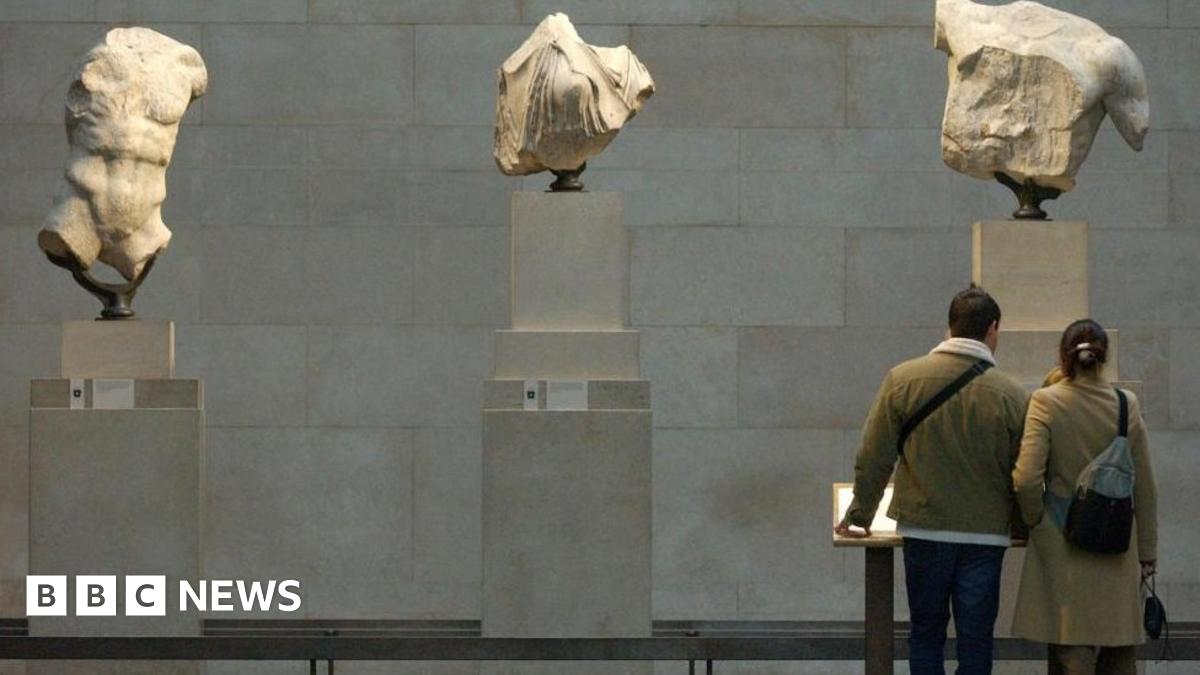
 www.bbc.co.uk
Rishi Sunak has cancelled his meeting with the Greek prime minister that was due to take place in Elgin Marbles Row, as seen here:
Sunak cancels Greek PM meeting in Parthenon Sculptures row
Kyriakos Mitsotakis, who wants the Parthenon Sculptures returned, says he is "deeply disappointed".
www.bbc.co.uk
Sunak cancels Greek PM meeting in Elgin Marbles row
A diplomatic row has broken out between the British and Greek governments over the Elgin Marbles.
The Greek Prime Minister Kyriakos Mitsotakis was due to meet Rishi Sunak in London, but No 10 cancelled it at the last minute.
A spokesman for the Greek prime minister told the BBC that he was "disappointed" the meeting had been cancelled "at the 11th hour".
The British government confirmed the meeting had been cancelled.
The cancellation came days after Mr Mitsotakis told the BBC's Laura Kuenssberg that the marbles should be returned.
"The Prime Minister is disappointed that Prime Minister Sunak cancelled their bilateral meeting at the 11th hour today," the Greek statement said.
"Greece and Britain have a very deep history of friendship and cooperation, and the Greek Government is extremely surprised by this decision.
"The prime minister was looking forward to discussing a range of topics of mutual interest including the Israel-Gaza conflict, Russia's illegal invasion of Ukraine, climate change, as well as common challenges such as migration, and of course the Parthenon Sculptures."
Sources with knowledge of the mood in the Greek government said Mr Mitsotakis was "baffled" and "annoyed."
The meeting had been due to happen at lunchtime tomorrow and, the BBC understands, was due to last 45 minutes.
But Mr Mitsotakis's appearance on the the BBC's Sunday with Laura Kuenssberg programme had irritated Rishi Sunak.
The Greek prime minister said the Elgin Marbles ought to be returned as having some of the artefacts in London and the rest in Athens is like cutting the Mona Lisa in half.
The marbles, also known as the Parthenon Sculptures, are ancient Greek treasures in the British Museum brought to the UK by the British diplomat Lord Elgin in the early 19th Century.
The British government confirmed the cancellation and said the deputy prime minister would meet the Greek PM instead.
A senior Conservative source said: "It became impossible for this meeting to go ahead following commentary regarding the Elgin marbles prior to it.
"Our position is clear - the Elgin Marbles are part of the permanent collection of the British museum and belong here. It is reckless for any British politician to suggest that this is subject to negotiation."
Mr Mitsotakis met the Labour leader Keir Starmer earlier.
To get this thread back on track:
Rishi Sunak has cancelled his meeting with the Greek prime minister that was due to take place in Elgin Marbles Row, as seen here:
Sunak cancels Greek PM meeting in Parthenon Sculptures row
Kyriakos Mitsotakis, who wants the Parthenon Sculptures returned, says he is "deeply disappointed".
Stupid arrogant idiot, Sunak.
The marbles are Greek. They belong in Greece. Who does he think he is?
This sort of imperious arrogance is the UK government's problem right now. We need politicians with a bit of humility and who treat other European countries with respect. We won't win any friends with this sort of attitude.
Kudos to Starmer for not showing the same attitude.
Last edited:
The marbles are not, however, legally owned by Greece.The marbles are Greek. They belong in Greece. Who does he think he is?

Thing is, there is a case to be made for the British Museum to acknowledge Greek ownership of the marbles and for the Greek ministry responsible for antiquities to loan them to the museum until such time as they have suitable facilities for their preservation and display. Those kind of loan arrangements have been known to last for decades.The marbles are Greek. They belong in Greece. Who does he think he is?
This sort of imperious arrogance is the UK government's problem right now. We need politicians with a bit of humility and who treat other European countries with respect. We won't win any friends with this sort of attitude.
The marbles are not, however, legally owned by Greece.
Morally you could argue that they belong there though.
And the whole arrogant attitude of the Government beggars belief, as if they won't even entertain the possibility that they might, perhaps, belong in Greece. No discussion, and the haughty disdain with which Sunak treats the Greek PM is beyond the pale.
They are apparently, according to the Tory spokesman above, not even attempting to understand the Greek position, or compromise. That is a really, really bad attitude - but it's the current Tory Government to a tee.
The sooner we get a new Government and become a nation which treats its Western allies with respect, the better.
Last edited:
DynamicSpirit
Established Member
Morally you could say they belong there though.
Morally, it looks ambiguous, and not least because the historical records that detail the precise circumstances/agreement in which they were moved to the UK appear to have been lost. It does appear that Elgin moved them here over 200 years ago at a time when the remains of the Parthenon were being systematically vandalised, so it's very likely that if they hadn't been brought here, they would have been destroyed. So it does seem that the motive was - at least in part - to preserve them.
Then there's the issue of whether these kinds of artefacts should always be owned and displayed within the country that they originated in (other than temporary loans). I'm actually quite sympathetic to that idea as a better way of localizing history, and that argument does suggest they should be returned to Greece. However, I can't help wondering how people would feel if it was the other way round and the UK Government was demanding that artefacts originally from the UK were removed from other countries and returned here: Would all the people demanding return of the Elgin Marbles support the UK in that situation, or would they be condemning the 'nationalism' of wanting stuff to be in the UK? Have people really thought through the implications of a World where, if you want to see historical artefacts in museums, you can only do so in museums local to the original area of those artefacts?
I think on balance I would support returning them, but I don't think the arguments are totally clear cut. And I do agree with you that it seems petty and ridiculous for Rishi Sunak to refuse to meet the Greek PM on account of this disagreement. Disagreements (whether on this or on any other matter) really shouldn't prevent leaders of countries from talking to each other.
Which is why the idea of recognising ownership but agreeing a (long term) loan should at least be discussed.Then there's the issue of whether these kinds of artefacts should always be owned and displayed within the country that they originated in (other than temporary loans). I'm actually quite sympathetic to that idea as a better way of localizing history, and that argument does suggest they should be returned to Greece. However, I can't help wondering how people would feel if it was the other way round and the UK Government was demanding that artefacts originally from the UK were removed from other countries and returned here: Would all the people demanding return of the Elgin Marbles support the UK in that situation, or would they be condemning the 'nationalism' of wanting stuff to be in the UK? Have people really thought through the implications of a World where, if you want to see historical artefacts in museums, you can only do so in museums local to the original area of those artefacts?
Quite right too. They were completely legally stolen by a proper British gentleman and to prove it we store them with all our other quite properly-acquired loot.The marbles are not, however, legally owned by Greece.
The British went to a lot of effort in days of yore to go around the world shooting at people until they agreed that our laws were best. It's jolly unreasonable of their descendants to complain that this form of legality doesn't hold now that we can't afford the guns anymore.
Gloster
Veteran Member
Quite right too. They were completely legally stolen by a proper British gentleman and to prove it we store them with all our other quite properly-acquired loot.
The British went to a lot of effort in days of yore to go around the world shooting at people until they agreed that our laws were best. It's jolly unreasonable of their dependents to complain that this form of legality doesn't hold now that we can't afford the guns anymore.
Exactly. They are ours: we stole them fair and square.
DynamicSpirit
Established Member
Quite right too. They were completely legally stolen by a proper British gentleman and to prove it we store them with all our other quite properly-acquired loot.
The British went to a lot of effort in days of yore to go around the world shooting at people until they agreed that our laws were best. It's jolly unreasonable of their descendants to complain that this form of legality doesn't hold now that we can't afford the guns anymore.
That satire is quite appropriate for things that we did actually loot - particularly stuff that was looted from colonies during the British Empire: I'd have absolutely no quibbles that the UK should recognise that it has no moral claim to ownership of artefacts taken in that way, and I don't doubt that there's a lot of that stuff sitting in British museums etc. But a bit of reading about the history of the Elgin Marbles quickly reveals that they don't fall into that category, and that it's very possible that we did acquire them legally and ethically (although the loss of some records makes it difficult to be sure either way).
- Status
- Not open for further replies.