• Our new ticketing site is now live! Using either this or the original site (both powered by TrainSplit) helps support the running of the forum with every ticket purchase! Find out more and ask any questions/give us feedback in this thread!

UK switching to electric vehicles discussion

Harpers Tate

Established Member
Joined
10 May 2013
Messages
2,054
Ansolutely no chance, its unenforceable.
Exactly. Even if all else fails - you can (slowly) charge your EV from a 13a outlet. I can't see how that could be monitored and thereby taxed directly. I suspect that no scheme is totally unable to be defrauded.

My own suggestion for tax replacement may be the simplest to implement. Odometer reading used as a basis for calculation at each MOT and the cost of the MOT graded accordingly, with an efficiency multiplier (so, based much as the current car tax is on liquid fuelled cars using a categorisation scheme/list). Your MOT fee is miles since last time (or since new) x £n/mile x vehicle category multiplier = tax element plus flat fee for the tester.
 
Sponsor Post - registered members do not see these adverts; click here to register, or click here to log in
R

RailUK Forums

Bald Rick

Veteran Member
Joined
28 Sep 2010
Messages
35,944
Exactly. Even if all else fails - you can (slowly) charge your EV from a 13a outlet. I can't see how that could be monitored and thereby taxed directly. I suspect that no scheme is totally unable to be defrauded.

My own suggestion for tax replacement may be the simplest to implement. Odometer reading used as a basis for calculation at each MOT and the cost of the MOT graded accordingly, with an efficiency multiplier (so, based much as the current car tax is on liquid fuelled cars using a categorisation scheme/list). Your MOT fee is miles since last time (or since new) x £n/mile x vehicle category multiplier = tax element plus flat fee for the tester.

Mine is more complex but allows dynamic and advanced pricing.

Everyone* has a sat nav. When you put your journey in, you get told in advance how much it costs. You could do this weeks in advance for an APEX ‘toll’, which would allow demand responsive pricing on the strategic network (and help smooth the peaks). High mileage users could buy season tickets.

Of course there will be plenty of people talking about how this impinges on civil liberties etc, but the fact of the matter is every new car and every smart phone is already doing this, just not with the charging.
 

The Ham

Veteran Member
Joined
6 Jul 2012
Messages
12,039
Mine is more complex but allows dynamic and advanced pricing.

Everyone* has a sat nav. When you put your journey in, you get told in advance how much it costs. You could do this weeks in advance for an APEX ‘toll’, which would allow demand responsive pricing on the strategic network (and help smooth the peaks). High mileage users could buy season tickets.

Of course there will be plenty of people talking about how this impinges on civil liberties etc, but the fact of the matter is every new car and every smart phone is already doing this, just not with the charging.

Also, whilst I own a car that doesn't mean that it's me driving it. As such, even if it was known that my car was going between A and B there's no guarantee that I'm also doing that. For some it does become more likely, in that they are the only person normally driving the car (normally, could be 99.9% of the time, but there's still a chance that, say, they are unwell and a family member or friend is using it).
 

trebor79

Established Member
Joined
8 Mar 2018
Messages
4,912
And yes - you are right on the nail with thinking of scheduling things like washing, dishwasher etc., to happen in your cheap overnight window. For a not insignificant upfront cost you could go further and equip your home with a battery system that recharges overnight and discharges in the daytime. Added bonus of being protected from power outages.
It's not as simple as that. I have a home battery system for the economic reasons, but if the grid power is cut, I have no power.
There is an "essential" outlet on the inverter which would give me up to 5kW but it's non-trivial to use this safely. Most homes in the UK have the earth connected to the neutral in the meter cabinet. Your "earth" is actually via an earth spike at a substation somewhere.
When you have a power cut, you have no idea what the fault it or where it's occurred. If a tree has come down somewhere it could be that you no longer have an earth. So if you start generating power locally and feed it into your consumer unit, you need a totally separate and guaranteed earth otherwise you've got a very dangerous installation. You also need to ensure that your local generation is isolated from your grid connection during a power cut, otherwise you risk electrocuting whoever is sent out to repair the fault (and you'd end up supplying your neighbours etc).
This all sounds simple, but it's actually not as it has implications for normal operations and even though we get power cuts (and fairly lengthy ones) several times most years I decided not to bother. Even my electrician was scratching his head a bit about how to make such a system totally compliant with the rules without incurring vast expense.
Not sure I would waste my money, as once EVs become the norm overnight demand will be similar to daytime (due to all the cars on charge) and so we are more likely to see the price being the same or similar all day.
Dynamic pricing will remain a thing, it just won't be at fixed times any more. There will be times that there is excess generation and times there is a lack.
That's why big battery storage projects are getting built, if that price arbitrage was going to disappear they wouldn't make money.
 

Bletchleyite

Veteran Member
Joined
20 Oct 2014
Messages
113,752
Location
"Marston Vale mafia"
Mine is more complex but allows dynamic and advanced pricing.

Everyone* has a sat nav. When you put your journey in, you get told in advance how much it costs. You could do this weeks in advance for an APEX ‘toll’, which would allow demand responsive pricing on the strategic network (and help smooth the peaks). High mileage users could buy season tickets.

Of course there will be plenty of people talking about how this impinges on civil liberties etc, but the fact of the matter is every new car and every smart phone is already doing this, just not with the charging.

While I know Germany does do advanced booking with the LGV-Maut I would be astonished to see this. If there is dynamic pricing it will just be based on time of day and location. Applying a train ticketing style approach to car use is just silly - it's bad enough when regional TOCs like Northern do it.
 

Noddy

Established Member
Joined
11 Oct 2014
Messages
1,656
Location
UK
Just a quick reminder: If you are like ~50% of people and use an Apple device, check where it was made. If you are like the other ~50% then, check where it was made! Tesla car (yes, I know you discounted that) - check where it was made. Point is - there is a very high probability that you are already awash with Chinese goods. MGs (and a few others) are just not hiding their origin. And for all the reviews I've recently looked at, the MG4 comes out very very well on the whole; well made, good driving etc.

And yes - you are right on the nail with thinking of scheduling things like washing, dishwasher etc., to happen in your cheap overnight window. For a not insignificant upfront cost you could go further and equip your home with a battery system that recharges overnight and discharges in the daytime. Added bonus of being protected from power outages.


It's not as simple as that. I have a home battery system for the economic reasons, but if the grid power is cut, I have no power.
There is an "essential" outlet on the inverter which would give me up to 5kW but it's non-trivial to use this safely. Most homes in the UK have the earth connected to the neutral in the meter cabinet. Your "earth" is actually via an earth spike at a substation somewhere.
When you have a power cut, you have no idea what the fault it or where it's occurred. If a tree has come down somewhere it could be that you no longer have an earth. So if you start generating power locally and feed it into your consumer unit, you need a totally separate and guaranteed earth otherwise you've got a very dangerous installation. You also need to ensure that your local generation is isolated from your grid connection during a power cut, otherwise you risk electrocuting whoever is sent out to repair the fault (and you'd end up supplying your neighbours etc).
This all sounds simple, but it's actually not as it has implications for normal operations and even though we get power cuts (and fairly lengthy ones) several times most years I decided not to bother. Even my electrician was scratching his head a bit about how to make such a system totally compliant with the rules without incurring vast expense.

Of course it does depend on the system. The Tesla Powerwall does automatically cut the house off from the grid to provide completely uninterrupted (in most cases) power to the house in the event of a grid power cut. But this is a more expensive system. The Myenergi Libbi which is slightly cheaper has the ability to be set up (by the electrician) to a specific circuit so while the other circuits in the house will be down during a power cut, the chosen circuit remains powered on from the battery. But some (many) battery systems don't have any options for ‘uninterruptible power’ at all so the house remains dead in a power cut even if there is power remaining in the battery. So if choosing a home battery system you need choose (and spend) according to what you want.
 

StKeverne1497

Member
Joined
9 Oct 2019
Messages
140
Location
Caerphilly
It's not as simple as that. I have a home battery system for the economic reasons, but if the grid power is cut, I have no power.
There is an "essential" outlet on the inverter which would give me up to 5kW but it's non-trivial to use this safely. Most homes in the UK have the earth connected to the neutral in the meter cabinet. Your "earth" is actually via an earth spike at a substation somewhere.
When you have a power cut, you have no idea what the fault it or where it's occurred. If a tree has come down somewhere it could be that you no longer have an earth. So if you start generating power locally and feed it into your consumer unit, you need a totally separate and guaranteed earth otherwise you've got a very dangerous installation. You also need to ensure that your local generation is isolated from your grid connection during a power cut, otherwise you risk electrocuting whoever is sent out to repair the fault (and you'd end up supplying your neighbours etc).
This all sounds simple, but it's actually not as it has implications for normal operations and even though we get power cuts (and fairly lengthy ones) several times most years I decided not to bother. Even my electrician was scratching his head a bit about how to make such a system totally compliant with the rules without incurring vast expense.
Earthing is a complex thing. It's not so much that you don't have an earth if you self-power and cut off from the grid, it's that you might have "stray" earths. In theory, if your uninterruptible supply is not actually connected to the earth then you are at very little risk of an electric shock from touching a live part; there's no return path. However, although the electrical earth is often (not always) in the UK either a separate connection back to the substation (TN-S, earth via (usually) the metal armour of an underground cable) or TN-C-S (earth connected to neutral) (in all cases, neutral is very strongly bonded to earth at the substation), and since water and gas (less often these days) supply pipes are metal, and since earth-bonding is a thing (connecting together anything that might be "earthy" so that it's all always at the same potential), even in the absence of the "real" earth, most UK electrical installations are earthed in all practical senses via these metal service pipes.

A modern installation might not need bonding at all these days (but try telling that to your jobbing plumber, installing a new boiler) because gas and water supply pipes are plastic.

The main problem with going off-grid is load-shedding. I don't think there is a standard domestic battery system out there which is capable of anywhere near the 23kW+ load that might be required (100A cutout, 230V nominal supply = 23kW available) except perhaps if you install multiple Teslas (I think you can parallel them?). Most (including the Tesla) seem to be 5kW continuous tops so you are going to need to subdivide your house into "essential" and "non-essential" circuits and make sure that the essential circuits cannot power anything with a heater - the obvious candidates being an electric shower (7.5kW is a small one) and a cooker (typical electric hob has a potential maximum load of 8kW), but you would also want to think carefully about other things. If you made your kitchen sockets "essential" then even a 13.5kWh Tesla battery isn't going to last very long if the dishwasher, washing machine and tumble-dryer are running and you boil a couple of kettles for calming cups of tea while microwaving a ready meal for dinner!

Hmmm, and then, what if you are using your car as the battery and the powercut is long enough that you deplete it far enough that you can't get to work in the morning?

Does anyone actually offer a car-to-grid option yet? It seems to have been one of those things that is "coming soon" for a very long time.
 

trebor79

Established Member
Joined
8 Mar 2018
Messages
4,912
Don't get a Libbi. It's just another brand (I forget which) rebadged with an added margin.
 

Noddy

Established Member
Joined
11 Oct 2014
Messages
1,656
Location
UK
Earthing is a complex thing. It's not so much that you don't have an earth if you self-power and cut off from the grid, it's that you might have "stray" earths. In theory, if your uninterruptible supply is not actually connected to the earth then you are at very little risk of an electric shock from touching a live part; there's no return path. However, although the electrical earth is often (not always) in the UK either a separate connection back to the substation (TN-S, earth via (usually) the metal armour of an underground cable) or TN-C-S (earth connected to neutral) (in all cases, neutral is very strongly bonded to earth at the substation), and since water and gas (less often these days) supply pipes are metal, and since earth-bonding is a thing (connecting together anything that might be "earthy" so that it's all always at the same potential), even in the absence of the "real" earth, most UK electrical installations are earthed in all practical senses via these metal service pipes.

A modern installation might not need bonding at all these days (but try telling that to your jobbing plumber, installing a new boiler) because gas and water supply pipes are plastic.

The main problem with going off-grid is load-shedding. I don't think there is a standard domestic battery system out there which is capable of anywhere near the 23kW+ load that might be required (100A cutout, 230V nominal supply = 23kW available) except perhaps if you install multiple Teslas (I think you can parallel them?). Most (including the Tesla) seem to be 5kW continuous tops so you are going to need to subdivide your house into "essential" and "non-essential" circuits and make sure that the essential circuits cannot power anything with a heater - the obvious candidates being an electric shower (7.5kW is a small one) and a cooker (typical electric hob has a potential maximum load of 8kW), but you would also want to think carefully about other things. If you made your kitchen sockets "essential" then even a 13.5kWh Tesla battery isn't going to last very long if the dishwasher, washing machine and tumble-dryer are running and you boil a couple of kettles for calming cups of tea while microwaving a ready meal for dinner!

Hmmm, and then, what if you are using your car as the battery and the powercut is long enough that you deplete it far enough that you can't get to work in the morning?

Does anyone actually offer a car-to-grid option yet? It seems to have been one of those things that is "coming soon" for a very long time.

The recently announced Powerwall 3 has a continuous rating of 11.5kW. It’s very rare to get a power cut of more than a few hours in the UK and if this does happen it tends to be due to extreme weather events. In that situation you’d be extremely stupid to decide to turn everything on.

As to V2G (vehicle to grid) as I understand it the Chademo system includes this in its specification and it was/is widely deployed in Japan. However, the CCS system used in Europe wasn’t developed with a V2G spec built in (it may have one now?), and and even with this there are issues with deployment in each county and getting agreements with their local grids.
 
Last edited:

jon0844

Veteran Member
Joined
1 Feb 2009
Messages
30,943
Location
UK
Its easy to enforce
I can't see how? Even with a smart meter it only measures the total power draw, so wouldn't know it was powering a bunch of convector heaters, oven, kettle, hot water cylinder or an EV (or indeed a home battery).

The Government will find other ways to raise money from car users.
 

AM9

Veteran Member
Joined
13 May 2014
Messages
16,061
Location
St Albans
Mine is more complex but allows dynamic and advanced pricing.

Everyone* has a sat nav. When you put your journey in, you get told in advance how much it costs. You could do this weeks in advance for an APEX ‘toll’, which would allow demand responsive pricing on the strategic network (and help smooth the peaks). High mileage users could buy season tickets.

Of course there will be plenty of people talking about how this impinges on civil liberties etc, but the fact of the matter is every new car and every smart phone is already doing this, just not with the charging.
Not sure what the asterixis for in "Everyone* has a sat nav." My current car doesn't (nor has any of my previous cars). Wherever I'm going, I look at a map for the last 5-10 miles, - the rest is from memory of geography. I find satnavs distracting and unless kept up to date every year, (which can cost hundreds of pounds) misleading.
Back on the subject of charging, I think that extending the various security camera networks in most towns/cities, to recording the passing of vehicles detected by ANPR, the roads that need traffic regulating will be covered and rates will be appropriate to the cost of vehicles' use on the transport system overall. The registered keeper would be billed accordingly, and failure to pay would result in the vehicle being stopped.
 

jon0844

Veteran Member
Joined
1 Feb 2009
Messages
30,943
Location
UK
Many cars don't have satnav even today as often the systems are slow, and not all are connected (so points of interest and traffic info is limited), and many people prefer to use their app of choice from their phone - so use Android Auto or Apple Car Play, neither of which are integrated with the car.

You couldn't realistically get every car using one standard system (which would need to be connected) and GPS isn't infallible.

I really think the systems won't rely on fitting every vehicle (plus older ones) with clever kit dying to be hacked, but simple proven tech like ANPR to track where vehicles are and charge that way, or impose a fee based on efficiency or something and charged annually like VED is today.

Assuming cars get charged more for driving into certain places, or at certain times, it might just encourage more use of public transport or e-bikes etc.

The Government of the day will also play a part.
 

Bald Rick

Veteran Member
Joined
28 Sep 2010
Messages
35,944
Its easy to enforce

How, exactly?

Not sure what the asterixis for in "Everyone* has a sat nav."

Ah. I meant to add a footnote.

* Either in the car (my 17 year old car has full european sat nav), or on their onine via google mals / apple maps / etc. Nevertheless, its not beyond the realms of possibility that everybody would be required to have a ‘sat nav’ (geo locator) in their car - either built in (like most cars) or a box of tricks (like those provided for certsin types of insurance). Registered through VED. and if tou dint have one, you oay the ‘all lines annual season ticket’ fee.
 

jon0844

Veteran Member
Joined
1 Feb 2009
Messages
30,943
Location
UK
My now sold car stopped getting map updates at 10 years old. It's amazing how many changes there are every year, however small, so it was pretty useless at times.

I do use the built in system from time to time now (TomTom) as the car is only two years old, gets updates and has traffic data, but I prefer Waze and use that most often.

After three years I'll have to pay to continue getting updates on the car navigation system so I may drop it. At the years, I expect that will stop being supported entirely - but I don't know as I hand the car back in 2025.
 

Bald Rick

Veteran Member
Joined
28 Sep 2010
Messages
35,944
My now sold car stopped getting map updates at 10 years old. It's amazing how many changes there are every year, however small, so it was pretty useless at times.

My car has never had a sat nav update, perhaps i should buy an up to date DVD for it!

It is fun driving on new roads and watching the satnav have a fit.
 

jon0844

Veteran Member
Joined
1 Feb 2009
Messages
30,943
Location
UK
My last car had 10 years of free updates, but then that was literally it. And the POIs were always useless, while traffic info came over the radio and could never be as detailed as the information you can get in real-time when delivered over mobile data.

It was slow, clunky and I just used my phone. The car didn't have Android Auto either.

Sadly some car makers are opting to remove Android Auto and CarPlay so they can steer you towards their own systems, which is horrible news as history will repeat itself.
 

bspahh

Established Member
Joined
5 Jan 2017
Messages
2,444
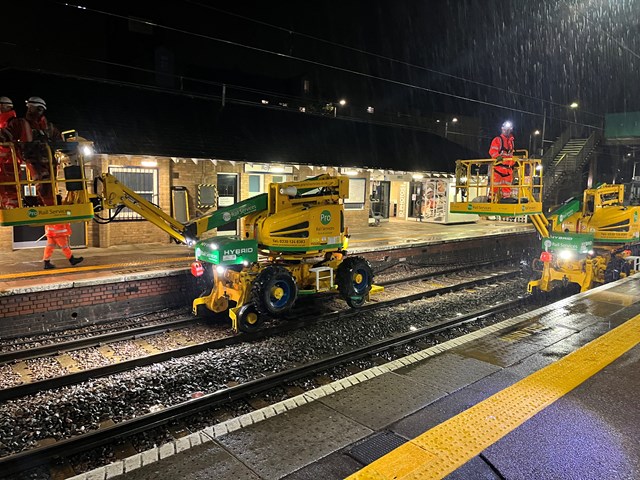
This is on electric plant equipment for engineering work:

Network Rail completes first-of-its-kind zero emission engineering work at Royston

Network Rail has completed a set of engineering work at Royston which, for the first time in its Eastern region, has been carried out with the worksite producing zero carbon emissions.

Teams worked over four nights to complete overhead line equipment renewals through the Cambridgeshire station, but traditional, carbon-intensive, diesel-powered generators and rail equipment were not used during the work.

Instead, Network Rail has piloted a zero-emission worksite, with engineers using hybrid rail engineering vehicles operating solely in battery mode, welfare facilities powered by batteries, and battery and solar powered tower lighting throughout the site.

Engineers have been working on renewing the overhead line equipment at the station and the immediate surrounding area. The work has been designed to make the equipment more resilient which means that passengers can experience smoother, more reliable journeys.

On site was an 80Kw battery pack which powered the welfare facilities and charged the rail vehicles after they had been used for the work. Engineers also used battery-powered tools, and materials such as plastics, paper and other consumables were all recyclable.

This way of working meant that zero carbon emissions were emitted on the site and is a first for Network Rail in its Eastern region. The organisation is looking at ways to roll this out across future engineering worksites after a positive pilot.

Zero emission worksites will aid Network Rail on its way to reaching its target of being net zero by 2050.

Hamish Critchell-Ward, Environment Manager at Network Rail, said: “This is a hugely positive step forward for Network Rail and the rail industry. We’re passionate about finding better, more environmentally friendly ways of carrying out essential maintenance and this is a great example of that.

“It has been great to work with industry partners on this project. Their support has been invaluable in helping this pilot be as successful as it has been. As we move forward and develop, Network Rail will continue to work closely with its supply chain to deliver environmental benefits during its work.

“This is just the beginning for us and we’re confident that this way of working will expand further into future engineering work.”

Owen Laws, Electrification & Sustainable Development Project Manager at Network Rail, said: “This project has been months in the planning and preparation, and I’m delighted that it has finally come to fruition and been so successful.

“We want this to be a rolling programme of work throughout Network Rail and I’m looking forward to helping other teams deliver engineering work projects in a more sustainable way.

“Renewing our overhead line equipment at Royston creates a more resilient railway network, improves reliability, and means more reliable journeys for passengers.

There is more at
 

stuu

Established Member
Joined
2 Sep 2011
Messages
3,773
Not sure what the asterixis for in "Everyone* has a sat nav." My current car doesn't (nor has any of my previous cars). Wherever I'm going, I look at a map for the last 5-10 miles, - the rest is from memory of geography. I find satnavs distracting and unless kept up to date every year, (which can cost hundreds of pounds) misleading.
Or free if you use Google/Apple maps... I didn't used to like satnav, but being informed of delays and closures is incredibly useful so I have it on for any long journey now, even when I know exactly where I'm going
 

jon0844

Veteran Member
Joined
1 Feb 2009
Messages
30,943
Location
UK
That's why I love Waze, because it's so useful for your regular drive for real time traffic and crowd sourced alerts for things like potholes.
 

AM9

Veteran Member
Joined
13 May 2014
Messages
16,061
Location
St Albans
Or free if you use Google/Apple maps... I didn't used to like satnav, but being informed of delays and closures is incredibly useful so I have it on for any long journey now, even when I know exactly where I'm going
No, it's nothing to do with the cost of satnavs or any more recent adaptation of mobile phone applications. It's the act of distractions whilst driving. For a long journey to somewhere new that I expect to take 3-4 hours, say, 200-250 miles which involves two or three stops, I will spend 5 minutes looking at Google maps (on a desktop or at least a tablet). A quick search to get the three suggested routes, observing the pinch points, then the critical bit, the last 5 miles to the actual destination address, which if complex, will be printed as a local map. Most of the journey I will be driving from memory of main roads aided by road signs put there for just that purpose. It may not work for some but it allows me to concentrate on the journey with no dodgy hints about turnings coming up.
So, back onto the subject matter of the thread, having a functional satnavs, or some geolocator for the purpose of establishing my charges for road use doesn't bother me, as it would allow better attribution of charges for everybody, especially those who drive everywhere and probably would consider if frivolous journeyswere appropriate if they knew that it would bring an additional avoidable cost.
 

AndrewE

Established Member
Joined
9 Nov 2015
Messages
7,360
This is on electric plant equipment for engineering work:


There is more at
Pity they say
On site was an 80Kw battery pack
I guess they meant to say 80 kWhr (but it's worrying when a technical organisation can't get things like this right. )
 

Roast Veg

Established Member
Joined
28 Oct 2016
Messages
2,327
As to V2G (vehicle to grid) as I understand it the Chademo system includes this in its specification and it was/is widely deployed in Japan. However, the CCS system used in Europe wasn’t developed with a V2G spec built in (it may have one now?), and and even with this there are issues with deployment in each county and getting agreements with their local grids.
There is limited support in ISO15118-2 for V2x, ISO15118-20 has the complete specification where supported, but this only covers the discharge of power as far as the Charging Station.

The hard part is the grid code compliance on the charging station side, as the charging station and car must be compliant (for AC discharging). The best way to support it is with an OCPP 2 compliant charger and a reliable online Charging Station Management System that can orchestrate it along with the charge requirements of the car's owner.

As far as I know chademo doesn't handle anything grid code related, but it may have some V2x support.
 

Bald Rick

Veteran Member
Joined
28 Sep 2010
Messages
35,944
I have just seen an M&S truck - approx 18tonne size (rigid) - that said on the back “this vehicle is 100% electric”.

I can‘t find anything on line about it! I know Tesco are using some electric artic tractor units for short haul stuff between logistics sites but this would be the first time I’ve seen an electric HGV in use on a main distribution run to store (it was in central St Albans).

Anybody know anythign about it?
 

bluenoxid

Established Member
Joined
9 Feb 2008
Messages
2,663
I don’t know anything about it but a Linkedin post by Alex Freudmann suggests less than six months on the road. I understand Gist has their logistics contract.
 

Bald Rick

Veteran Member
Joined
28 Sep 2010
Messages
35,944
I don’t know anything about it but a Linkedin post by Alex Freudmann suggests less than six months on the road. I understand Gist has their logistics contract.

Aha. Good detective work.

Thanks I should have checked there. Gist is actually owned by M&S - they bought them last year.

It seems I have seen 50% of the electric truck fleet! And its based in Hemel


GIST TRIALS DAF ELECTRIC HGVS AS IT CONTINUES TO EXPLORE DIESEL ALTERNATIVES​

Logistics specialist Gist has launched an extensive trial of DAF’s LF Electric fridge truck, supported by key suppliers, dealer Ford & Slater Limited, and DAF Trucks UK.

The vehicle will be based at Gist Hemel for the duration of the trial and is one of two 100% fully electric vehicles Gist is trialling as it continues to seek alternatives to reduce its carbon emissions and explore diesel alternatives. The second, the DAF CF power motive unit, is being trialled on routes from its operation in Thatcham.

DAF, through Ford & Slater, which supplies the majority of Gist’s trucks, has provided the 19-tonne rigid and 4 x 2 HGV unit for trials. Gist will use the vehicles across a number of routes, including transporting frozen products.

Kate Brown, Gist’s Director of Communications and Sustainability, said: “Moving to diesel alternatives for ambient HGV vehicles has its challenges, but finding suitable, sustainable alternatives for refrigerated transportation units adds another layer of complexity. That’s why we’re delighted to work with DAF to trial its 100% fully electric refrigerated rigid and unit. Our fleet is largely made up of refrigerated vehicles and as we continue to work on reducing our carbon emissions and creating a greener, cleaner environment we hope these trials will demonstrate that using electricity is a viable alternative.”

Laurence Drake, Managing Director of DAF Trucks adds: “As a company, we are committed to developing transport solutions for our customers that can help them deliver on their environmental and sustainability objectives. Having launched our range of zero emission CF and LF Electric trucks last year it is fantastic to see operators using them in regular operation. Working alongside likeminded partners, such as Gist, is really helping to drive the transport industry forward.”

In addition, Gist is also trialling the Volta Zero, a fully electric rigid. In partnership with Marks & Spencer and Volta Trucks, Gist is using the vehicle to support Volta’s product development by providing operational data and feedback.
 

Class 317

Member
Joined
7 Jul 2020
Messages
571
Location
Cotswolds
It's part of the Gridserve electric freight highway project. Marks and Spencer are part of this scheme.

If I have time later I'll dig out a press release to post here with more details.

Edit:

Below video explains quite a bit about it.


== Doublepost prevention - post automatically merged: ==

 
Last edited:

Roast Veg

Established Member
Joined
28 Oct 2016
Messages
2,327
Scania, MAN, and Volvo Trucks all have vehicles that are past the prototype phase as well.
 

Top