It's such a disappointment that @Sm5 hasn't managed to answer @Bald Rick's question about when that journey was last undertaken. Maybe the 500 miles was a slight overestimate. 

It's such a disappointment that @Sm5 hasn't managed to answer @Bald Rick's question about when that journey was last undertaken. Maybe the 500 miles was a slight overestimate.

Didn't The Pretenders do that ?
But they took a bit longer than 7 hours, - however they could at least get regular comfort breaks when passing through rural areas.or even The Proclaimers?!
or even The Proclaimers?!
The Niro is a great car, we have one of the new model EVs.I've done some sums based on my current energy usage and car mileage/mpg. By swapping to an EV I reckon I'd save around £1200 in fuel costs each year if I moved to the smart EV tariff. Without moving tariff it would still be £900 a year. I see no reason why I'd have to charge away from home except the odd occasion we go away. Without a price differential at the buying stage, the case for EV is getting very strong in this household.
Out of curiosity, is that from 100% to near zero, or is it within the 20% - 80% band that some manufacturers are still pushing as the best way to prolong the life of the battery? And does the manufacturer state that ultra-super-dooper-fast charging is only to be used occasionally (for example on long trips) as it also prolongs battery life to charge at a more sedate rate?For what it's worth I currently have an EV with a real world range of 180 winter or 220 summer miles.

A second hand Leaf would probably be affordable for your eldest - you can easily get a decent one for less than £15k.Out of curiosity, is that from 100% to near zero, or is it within the 20% - 80% band that some manufacturers are still pushing as the best way to prolong the life of the battery? And does the manufacturer state that ultra-super-dooper-fast charging is only to be used occasionally (for example on long trips) as it also prolongs battery life to charge at a more sedate rate?
I only ask because I occasionally look at an EV to replace the small Diesels I've been using on my commute (the last three have been Kangoo, Modus, Sandero). The commute is not quite 100 miles round (can't charge up at work) but when you delve into the numbers, even buying a car with 250 mile range doesn't seem to quite offer me the security I need.
Ignore the rest of this post, I'm just thinking aloud
Hypothetical example. My commute is mostly motorway, it's all year 'round, I can't charge up at work and occasionally (due to roadworks / accidents / other things beyond my control) have to divert by a route which is only slightly longer but involves a lot of climbing.
Claimed range: 250 miles
Range with 20/80 charging (60%): 150 miles
Derate for motorway by 10% (most manufacturers seem to say 15% or so, but my commute isn't all by motorway): 135 miles
Derate for dark, cold winter by a further 10% ish: 120 miles (I note your derate for winter is ~20%)
This leaves me with a margin of only around 20 miles for my normal commute, which is probably ok, but I'd be worried if I did use the diversionary route, and then I'd also worry about remaining battery capacity after 5 years or more. I've tended to keep cars for 10 years+ and 200,000 miles+ The Modus lasted until 220,000 miles and only went because there was a corroded structural component which was on a 16-week-if-you're-lucky-to-find-one lead time. The engine was absolutely fine and may well have lasted to 300,000 miles.
And that's ignoring the capital outlay.
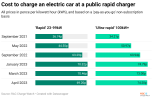
"Fuel" costs are becoming more comparable. Using one of the domestic EV tariffs, it's possible to charge at around 2½p per mile (Octopus, 7.5p/kWh, 3 miles per kWh) while I'm paying around 12p/mile for Diesel*, but charging outside the home is a whole other kettle of fish with 60p/kWh seeming to be about the lowest on offer at the moment (but I don't really know where to look so please correct me on this) which equates to approximately 20p/mile; significantly more than my Diesel costs.
My eldest doesn't need a car with 250 mile range. Commuting is 10 to 20 miles a day and doesn't involve the motorway, so a small car with 100 to 150 mile range would suit perfectly. There's pretty much no choice at that end of the market, and when you do find one availability is near zero. Also, there is no way their bank balance would cope with paying for a £25k car; something in the £15k - £20k range would be more affordable.
Our family car is a 7-seat Berlingo. While an EV Berlingo is scheduled to launch later this year, it is only available with a (comparatively) small battery! The same was true of other similar vehicles such as the Nissan NVe200. What is the point of a family car with best-case 180 mile range (I suppose it's ok for the school run), when you load it up with family and luggage and can't make it even as far as nearest in-laws without a charging stop? We'd normally do the 180 miles either in one hop, or with a short (10 minute) break for the loos. And it certainly makes going on holiday into a much more "relaxed" affair if you have to stop every 100 miles for a charge.
I'm not sure these are all "edge cases" as some are suggesting:
There will come a time when we're all driving pure EVs, and we will just adjust our lifestyle to cope (maybe I'll leave earlier in the morning so that I can drive at 60mph on the motorway instead of 70mph) but it's not here yet for us, even though it is getting there for more and more people. I'm profoundly grateful to these early adopters who are helping refine the technology so that us laggards can eventually afford (in all senses of the word) to switch.
- a car with a guaranteed 100 mile range under adverse conditions and 100,000 miles+
- a car costing less than £20k
- a car capable of taking a large family on holiday without having to stop for a 60 minute (Nissan) or 30 minute (Citroën) charge every 90 minutes of driving
*The problem with the EV tariffs is that out of the special rate, electricity is more expensive than normal tariffs, so you might need to factor this in too. Note also that the Octopus tariff only gives you six hours of 7.5p charging which at 7.5kW (typical domestic charger) is only 45kWh; the larger batteries in the 250 mile+ range cars will be 60kWh or more, though if you are sticking to the 20/80 thing that's 36kWh so do-able. For one car...

I don't yet know anyone with an electric car, whether for reasons of cost or "range anxiety". Meanwhile, according to a recent Transport Times report, the UK Govt is rowing back on its climate targets and relying on technological fixes like electric cars rather than promoting lifestyle change (less car use and flying, more public transport, walking and cycling). The report even suggests it's reluctant to upset the car lobby (surely not!)
Transport Times Events | News/Blog | Net zero policy hits a new low
Claire Haigh, Founder & CEO Greener Vision publishes her consulation on tackling the climate crisis which will run over the summer.www.transporttimes.co.uk
It's interesting to see how used prices for nearly new petrol and EV cars seem to be converging a bit. ......
Yes, all of those things. Public transport - buses as well as trains- is nowhere near meeting the challenge which reduced car use would present. The question is - will it ever be able to meet this challenge? Meanwhile the Austrian railways are ordering more double deck trains to meet the boom in travel!Right now they certainly are not even passively encouraging never mind promoting rail travel
- ongoing strikes, working to rule, not overtime etc
- cutting the stock on lease so less frequent and overcrowded trains even without short formations due maintenance backlog and component supply issues
- poorer on train experience e.g. layout, seats, luggage space, cutting wi-fi
- complex and inconsistent ticketing types/restrictions and ticket pricing plus potentially closing ticket offices
- existing infrastructure failures increasing
I think in the next few years once battery recycling becomes commercially widespread, the financial hit from a failed battery will be much lower than it is now, and you'll effectively get a new battery for your old battery plus a much lower amount of cash than you would pay today. Battery prices are still falling rapidly and there's no reason to suspect that won't continue as the supply chain ramps up.For now used EV's are still seen as a risk plus older technology in a constantly evolving sector. Even if at 10+ years many with only 100-120k miles on the clock still have say 70%+ battery life ending up statistically with e.g. 10% having a failure that is expensive so realistically not worth the cost is a fear. Of course an ICE can have a major failure too but perceived as less likely. Only time will tell.
5% of the population is a large number of unsuited people.The people who go "but my diesel car will do 600 miles without having to stop" are missing the point. Unless you have a highly unusual use case the current cars available on the market will suit 95% of the population.
5% of the population is a large number of unsuited people.
Try saying "The current rail infrastructure will get 95% of passenger to their destination"
There's a lot of talk about EVs coming with ranges of 600+ miles (subject to usual variations based on speed/temp etc) and I am not sure if that's down to more advanced development or just shoving in more battery cells (or both), but if you can charge a 250-300 mile EV in 10-20 minutes (as is possible now on some vehicles, subject to finding a suitable charger) then it seems like total overkill - unless you are living somewhere where you might need to call upon your car to provide power for long periods of time.
More batteries = more weight. When I was young, people said that not filling up your tank helped keep the weight of your vehicle down and gave improved performance. Why add more weight and cost for a range that's far beyond what you'd ever likely need*.
Hybrids are a solution for many, but what I like about an EV is the reduced maintenance cost and the reduced likelihood of big bills if you keep the car for years (or buy an old one that's 10 years old). Why include all the ICE parts that can go wrong, and potentially make them even harder to work on because of the EV kit squeezed alongside?
* Insert crazy edge-case about that trip into the country where you're miles from civilisation and need to drive all over for your two week holiday, and will never be near a charging point.
That would be a rubbish car. It would be more expensive to buy than a pure EV with a full size battery, and because if the small battery you still have to buy loads of expensive fuel.Indeed more batteries are more weight and also more cost. A real world open road as against sub 40mph range of 300 miles or 250 miles with lights and heating plus reduced battery efficiency in winter I too think would be enough for the majority. This at least double what most standard models with 50 - 60kW battery capacity can deliver now.
Most, if not all, current PHEV have a relatively small battery and an ICE engine with similar power rating to the pure ICE equivalent. The available power is far in excess of the average power at 60 - 70mph. What I would find attractive is a PHEV with around 2/3 of the battery range of the pure EV then an ICE engine and alternator/generator that can deliver the average power at 60mph if not 70mph.
The battery would cover the majority of journeys then for the longer ones start running the ICE engine once the battery is down to say 30%. Away from urban areas this 30% would nominally be maintained. In urban areas the ICE would cut out unless the battery was right down to 10%. The engine might only be 500cc but I wonder if it is the cost, weight and size of the alternator/generator that makes this ideal not practical and/or too expensive to manufacture.
With this a round trip of 250+ miles split into e.g. three 80-90 mile stages could be completed without needing either access to a charger at the stopping points, I am thinking countryside rather than urban, or finding fast rate charger(s) along the route and taking even 20 minute stops not otherwise required.
The engine might only be 500cc but I wonder if it is the cost, weight and size of the alternator/generator that makes this ideal not practical and/or too expensive to manufacture.
That would be a rubbish car. It would be more expensive to buy than a pure EV with a full size battery, and because if the small battery you still have to buy loads of expensive fuel.
No thanks.
Yes more expensive to purchase / lease than a pure EV but could it be comparable with the current PHEV that only have a small battery and a big engine?
At current fossil fuel prices using the ICE would, or at least should, be significantly more expensive than battery charged at home billed on a low overnight rate tariff. On top of the convenience if using the generator pack was 40mpg cheaper though than a public fast charger at say 75p/kWh - reference below from https://www.rac.co.uk/drive/electri...c-car-public-charging-costs-rac-charge-watch/

As well as the BMW mentioned above, the General Motors Volt / Ampera was fairly close to this concept:What I would find attractive is a PHEV with around 2/3 of the battery range of the pure EV then an ICE engine and alternator/generator that can deliver the average power at 60mph if not 70mph.
The battery would cover the majority of journeys then for the longer ones start running the ICE engine once the battery is down to say 30%. Away from urban areas this 30% would nominally be maintained. In urban areas the ICE would cut out unless the battery was right down to 10%. The engine might only be 500cc but I wonder if it is the cost, weight and size of the alternator/generator that makes this ideal not practical and/or too expensive to manufacture.

The Volt operates as a pure battery electric vehicle until its battery capacity drops to a predetermined threshold from full charge. From there, its internal combustion engine powers an electric generator to extend the vehicle's range as needed.


A second hand EV is likely to be a pretty safe purchase compared to a risk of a highly thrashed ICE car. There's much less to go wrong and less faults a seller could try and hide.
Right now they certainly are not even passively encouraging never mind prompoting rail travel
- cancellations and disruption due to ongoing strikes, working to rule, not overtime etc
- cutting the stock on lease so less frequent and/or overcrowded trains even without short formations due maintenance backlog and component supply issues.
- poorer on train experience e.g. layout, seats, luggage space, cutting wi-fi
- complex and inconsistant ticketing types/restrictions and ticket pricing plus potentially closing ticket offices
- existing infrastructure failures increasing
For now used EV's are still seen as a risk plus older technology in a constantly evolving sector. Even if at 10+ years many with only 100-120k miles on the clock still have say 70%+ battery life ending up statistically with e.g. 10% having a failure that is expensive so realistically not worth the cost is a fear. Of course an ICE can have a major failure too but perceived as less likely. Only time will tell.
Well actually no - a car which has been "thrashed" will have borne additional wear on suspension etc, which since EVs are *much* heavier than an equivalent ICE will be a potentially costly repair.
The biggest issue with *any* used car is not how it has been driven but how it has been maintained. I'd rather buy a car which might have been thrashed but has a full, comprehensive service history than one which has seemingly had "one careful owner" but hasn't had an oil change in 5 years, because I know which one will be in better shape mechanically.
== Doublepost prevention - post automatically merged: ==