• Our new ticketing site is now live! Using either this or the original site (both powered by TrainSplit) helps support the running of the forum with every ticket purchase! Find out more and ask any questions/give us feedback in this thread!

Could drawbridges be installed as an alternative to lifts at certain stations?

Status
Not open for further replies.

PTR 444

Established Member
Joined
22 Aug 2019
Messages
2,647
Location
Wimborne
For level access between platforms, one would expect a lift or footbridge/subway with ramped access. These solutions aren’t practical and economical everywhere, but I can think of another solution that could work on low-speed lines - a set of drawbridges or bascule-style bridge crossing the track. These could be manually or automatically operated and would allow simple passage across the tracks for passengers that require level access.

The downside is that they would be too risky to install on fast lines with trains passing through non-stop, and even on lines where all trains stop or pass through at low speed, you’d still need to raise the drawbridges thus limiting access to the other platform before trains arrive. For very lightly used lines, you could default the drawbridge in the down position with it only being raised just before a train arrives.

Thoughts?
 
Sponsor Post - registered members do not see these adverts; click here to register, or click here to log in
R

RailUK Forums

Bletchleyite

Veteran Member
Joined
20 Oct 2014
Messages
113,909
Location
"Marston Vale mafia"
Brockenhurst used to have one. The complication is that it needs to be interlocked with the signalling, and is more complex and isn't really any safer than a level crossing with barriers.
 

zwk500

Veteran Member
Joined
20 Jan 2020
Messages
18,679
Location
Northampton
It wouldn't be a drawbridge/bascule because when it's raised it's an obstruction and there's a risk of it falling (so you need counterweights engineered into the bridge in such a way it doesn't pose a danger to passengers.

Brockenhurst is the more commonly known moveable platform - although wasn't there also one at Malton and potentially one down in Sussex or Kent at a port? These were swing bridges rather than draw or bascule - pivoting horizontally to remain clear. Much easier to engineer that to swing clear by default, also smoother and less obtrusive on the platform for passengers.

Nowadays with unstaffed stations and the potential for failure to block a line, I can't see any suggestion getting approved. If they won't approve a foot crossing off the platform ramp, a semi-permanent obstruction of the line that would have catastrophic results if a train ploughed into it would never get the go-ahead.
 

PTR 444

Established Member
Joined
22 Aug 2019
Messages
2,647
Location
Wimborne
Brockenhurst used to have one. The complication is that it needs to be interlocked with the signalling, and is more complex and isn't really any safer than a level crossing with barriers.
That’s interesting to know. Where was this located and does anyone have photos of what it looked like? Presumably it was removed prior to the new footbridge and lifts being installed.
It wouldn't be a drawbridge/bascule because when it's raised it's an obstruction and there's a risk of it falling (so you need counterweights engineered into the bridge in such a way it doesn't pose a danger to passengers.
Ahh fair enough. I was thinking it could fold in towards the platform but there might not be sufficient space at all stations due to buildings/canopy supports in the way.
Brockenhurst is the more commonly known moveable platform - although wasn't there also one at Malton and potentially one down in Sussex or Kent at a port? These were swing bridges rather than draw or bascule - pivoting horizontally to remain clear. Much easier to engineer that to swing clear by default, also smoother and less obtrusive on the platform for passengers.
I’d be intrigued to find out how the mechanism for the movable platforms/swing bridge worked. Also were these operated manually or automatically?
Nowadays with unstaffed stations and the potential for failure to block a line, I can't see any suggestion getting approved. If they won't approve a foot crossing off the platform ramp, a semi-permanent obstruction of the line that would have catastrophic results if a train ploughed into it would never get the go-ahead.
The stations I could see a movable platform working are those where at least one platform has no step-free access, and where the linespeed is 30mph or lower and/or has no scheduled trains passing through non-stop (to minimise the risk of a serious collision).

An example of a station where this could be put into practice is Hamworthy, since it has level access to the up platform but not the down platform, necessitating a walk beneath the subway and up a flight of steps. It would be quite challenging to install a lift for this platform due to space constraints, however the line is only served by two trains per hour in each direction anyway, all of which stop (thus minimising the safety risk).
 
Last edited:

zwk500

Veteran Member
Joined
20 Jan 2020
Messages
18,679
Location
Northampton
That’s interesting to know. Where was this located and does anyone have photos of what it looked like? Presumably it was removed prior to the new footbridge and lifts being installed.
Brockenhurst: https://sremg.org.uk/artefacts/arte13.html
A slightly unusual level crossing at Halesworth (road now closed): https://commons.wikimedia.org/wiki/...worth_Station_-_geograph.org.uk_-_1034529.jpg
Malton: https://www.yorkshirewoldsrailway.org.uk/history/stations/malton-station/ (the site says the trolley was pushed back under the platform, but not clear if it was just stowed or had some kind of mechanism to retract and secure it without getting on the line)
I have definitely seen a picture of another harbour station where the tracks disappear off underneath the platform, and the article explained it was on wheels and could be removed when needed for freight to get quayside but I now cannot remember which it was.
Ahh fair enough. I was thinking it could fold in towards the platform but there might not be sufficient space at all stations due to buildings/canopy supports in the way.
It can't fold down if it's crossing a space nearly 6' wide on a 3' tall platform. You would also need it to be cantilevered sufficiently that it could hold the weight of people crossing at the heaviest potential loading (furthest from the support). A swing bridge is by far the easiest solution.
I’d be intrigued to find out how the mechanism for the movable platforms/swing bridge worked. Also were these operated manually or automatically
Almost certainly manually, but weighted or balanced in such a way that they would naturally swing clear if not held/pinned.
The stations I could see a movable platform working are those where at least one platform has no step-free access, and where the linespeed is 30mph or lower and/or has no scheduled trains passing through non-stop (to minimise the risk of a serious collision).

An example of a station where this could be put into practice is Hamworthy, since it has level access to the up platform but not the down platform, necessitating a walk beneath the subway and up a flight of steps. It would be quite challenging to install a lift for this platform due to space constraints, however the line is only served by two trains per hour in each direction anyway, all of which stop (thus minimising the safety risk).
No scheduled passes is not the same as a train will never pass through. Freight, Test trains, weedkiller/seasonal de-icers/RHTTs, and railtours can all pass through a station without prior notification. If the line is safe enough to have a solid bridge at solebar level, then IMHO the ORR should consider it safe for the barrow crossing to be used. Although Hamworthy is not the easiest station, there is additional width nearer the goods line that could be taken if lifts were to be installed.
 

PTR 444

Established Member
Joined
22 Aug 2019
Messages
2,647
Location
Wimborne
This is fascinating. Looking at the image it appears the swing bridge was guided by some sort of rail. I’d be intrigued to know how the guide wheel avoided contact with the rails of the railway track.
A slightly unusual level crossing at Halesworth (road now closed): https://commons.wikimedia.org/wiki/...worth_Station_-_geograph.org.uk_-_1034529.jpg
Another fascinating concept. I’m presuming these movable platforms swung outwards (like crossing gates would do) to open up the road to traffic?
Malton: https://www.yorkshirewoldsrailway.org.uk/history/stations/malton-station/ (the site says the trolley was pushed back under the platform, but not clear if it was just stowed or had some kind of mechanism to retract and secure it without getting on the line)
I have definitely seen a picture of another harbour station where the tracks disappear off underneath the platform, and the article explained it was on wheels and could be removed when needed for freight to get quayside but I now cannot remember which it was.
A simple way to cross the track like this is what I envisaged when creating this thread. Looks a bit big to be folded or stowed underneath the platform though!
It can't fold down if it's crossing a space nearly 6' wide on a 3' tall platform. You would also need it to be cantilevered sufficiently that it could hold the weight of people crossing at the heaviest potential loading (furthest from the support). A swing bridge is by far the easiest solution.
I was thinking more folding backwards onto the platform surface rather than down onto the line (which will definitely block it!). Even so, a requirement for cantilevers would still be problematic since they would pose a trip hazard while it is folded back (since it would form part of the platform). Also looking at the Brockenhurst example, a modern equivalent would most likely require handrails to prevent falls onto the track, which would make folding back fully onto the platform impossible.

Almost certainly manually, but weighted or balanced in such a way that they would naturally swing clear if not held/pinned.
That makes sense. I’m guessing that explains the reasoning behind having a guide rail and wheel in the Brockenhurst and Eastleigh examples.
No scheduled passes is not the same as a train will never pass through. Freight, Test trains, weedkiller/seasonal de-icers/RHTTs, and railtours can all pass through a station without prior notification. If the line is safe enough to have a solid bridge at solebar level, then IMHO the ORR should consider it safe for the barrow crossing to be used. Although Hamworthy is not the easiest station, there is additional width nearer the goods line that could be taken if lifts were to be installed.
Ahh okay. It’s just that at that location, you’d need to install a footbridge and two lifts which might not be financially justifiable. Looking at an aerial view of Hamworthy station, you could probably fit a pedestrian crossing to the west of the station, although the path leading from it to the platform might be a bit close to the goods line. Also I’m not sure what a barrow crossing is and how it differs from a normal pedestrian crossing.
 
Last edited:

Bletchleyite

Veteran Member
Joined
20 Oct 2014
Messages
113,909
Location
"Marston Vale mafia"
This is fascinating. Looking at the image it appears the swing bridge was guided by some sort of rail. I’d be intrigued to know how the guide wheel avoided contact with the rails of the railway track.

I don't see why it'd need to, it'd just roll over the top. No need for the wheels to be flanged as the bridge is fixed at the pivot.
 

zwk500

Veteran Member
Joined
20 Jan 2020
Messages
18,679
Location
Northampton
Also I’m not sure what a barrow crossing is and how it differs from a normal pedestrian crossing.
A barrow crossing is the foot crossing at the end of platform ramps, so called because it used to be provided for porters' barrows to get across the line if there was no ramp or lift. Nowadays they are almost all staff-only and many have been abolished outright. They look much like an ordinary footpath crossing but are only accessible off the platform ends.
 

PTR 444

Established Member
Joined
22 Aug 2019
Messages
2,647
Location
Wimborne
I don't see why it'd need to, it'd just roll over the top. No need for the wheels to be flanged as the bridge is fixed at the pivot.
Ahh that makes sense, so basically like the tyres of a car rolling over a level crossing?
A barrow crossing is the foot crossing at the end of platform ramps, so called because it used to be provided for porters' barrows to get across the line if there was no ramp or lift. Nowadays they are almost all staff-only and many have been abolished outright. They look much like an ordinary footpath crossing but are only accessible off the platform ends.
Thanks for the explanation, that really helps. So AIUI it’s a pedestrian crossing situated at the end of the platforms. Has the Hamworthy one ever been opened up to the public to provide level access to platform 2, and if not could it do so on a permanent basis?
 

urbophile

Established Member
Joined
26 Nov 2015
Messages
2,482
Location
Liverpool
I have a vague and distant memory of the now long-closed station at Ventnor on the Isle of Wight. It had an island platform opposite the main platform, with a single track between them. I recall a wheeled contraption which consisted of a walkway between two wooden parapets, which was normally kept on the platform of course but when necessary was wheeled across to allow access to the island.
 

30907

Veteran Member
Joined
30 Sep 2012
Messages
21,995
Location
Airedale
Has the Hamworthy one ever been opened up to the public to provide level access to platform 2, and if not could it do so on a permanent basis?
It no longer exists! It might be possible to create a slope up from the subway outside the goods line, with a R/G light crossing over it - the risk would be low because of traffic levels and speed - but I don't know if the site permits.
 

Railsigns

Established Member
Joined
15 Feb 2010
Messages
2,754
There used to be a movable sliding platform between the two departure platforms at London Paddington.
 

swt_passenger

Veteran Member
Joined
7 Apr 2010
Messages
34,317
Eastleigh still had the same type of movable bridge as Brockenhurst in the early 70s when the original P1 was still in use, and the separate station entrance building was right at the roadside, like Brockenhurst. The first linked article in post #5 has a photo at the bottom of the page.

But I just cannot see such a device making a comeback with present safety standards.
 

Annetts key

Established Member
Joined
13 Feb 2021
Messages
3,834
Location
West is best
Slightly off topic, but related to railway swing bridges, many years ago, before smartphones were a thing, I walked along a disused line that went over a former swing bridge (the bridge was still there, but the requirement for it to swing had long since ceased).

Mounted on the land next to the part of the bridge that swung away was a device very similar to a mechanical facing point lock (as used on mechanical worked points). When operated, this would test and potentially prove that the bridge had completed its operation and therefore the track was correctly aligned.

It presumably would at one time been linked to the mechanical signalling system that presumably would have existed.

Back to the topic. The modern railway is not keen on mechanical systems that need regular maintenance. Especially bespoke systems. These are expensive to provide and expensive to maintain.

Hence fixed access ramps, fixed bridges and standard lifts are always the preferred way of doing things.
 
Last edited:

zwk500

Veteran Member
Joined
20 Jan 2020
Messages
18,679
Location
Northampton
Mounted on the land next to the part of the bridge that swung away was a device very similar to a mechanical facing point lock (as used on mechanical worked points). When operated, this would test and potentially prove that the bridge had completed its operation and therefore the track was correctly aligned.
There are some videos floating round youtube showing some of the fixing and proving mechanisms on different bridges - ranging from manually (un)bolted fishplates to the bolts as you describe controlled from a signal box. The turntable at York NRM has a similar bolt system for each road.
 

Western 52

Established Member
Joined
19 Jun 2020
Messages
1,672
Location
Burry Port
I believe that Fishguard Harbour once had some form of movable bridge between the platforms. Long gone of course as there's only one platform these days.
 

Railsigns

Established Member
Joined
15 Feb 2010
Messages
2,754
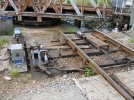
The attached photo shows the present arrangement at Banavie Swing Bridge, which includes a clamplock points style pump unit driving the main bridge bolt as well as an FPL plunger in the four-foot.
 

Attachments

  • 2013_0608_025.jpg
    2013_0608_025.jpg
    1.4 MB · Views: 68

Spartacus

Established Member
Joined
25 Aug 2009
Messages
3,851
Ahh okay. It’s just that at that location, you’d need to install a footbridge and two lifts which might not be financially justifiable. Looking at an aerial view of Hamworthy station, you could probably fit a pedestrian crossing to the west of the station, although the path leading from it to the platform might be a bit close to the goods line. Also I’m not sure what a barrow crossing is and how it differs from a normal pedestrian crossing.

Integrating such a bridge into the signalling interlocking would also be not financially viable, especially when you'd have to provide a reliable failsafe system to prevent passengers being on, or even too close to it when it moved, and prevent it being jammed in a partially obstructing position by the like of vandals.

In essence it would be similar to installing a new level crossing where the gates, when opened to foot traffic, obstructed the railway. That's not something that's ever gonna be cheap, or likely to even get the go ahead. I'd say a footbridge with ramps & steps rather than a lift would be a better solution all round.
 
Status
Not open for further replies.

Top