• Our new ticketing site is now live! Using either this or the original site (both powered by TrainSplit) helps support the running of the forum with every ticket purchase! Find out more and ask any questions/give us feedback in this thread!

Photo on a Foot Crossing, Thoughts.

Status
Not open for further replies.

Pete_uk

On Moderation
Joined
28 Jan 2017
Messages
1,552
Location
Stroud, Glos
I have a nice photo somewhere I took while crossing the tracks near me. I did check online that there was no trains about as they tend to appear rather quickly after the alarms sound.

Found it.
Picture shows a milkey low sun shining off some rails.
 

Attachments

  • IMG_20180201_105337.jpg
    IMG_20180201_105337.jpg
    3.7 MB · Views: 64
Sponsor Post - registered members do not see these adverts; click here to register, or click here to log in
R

RailUK Forums

Mcr Warrior

Veteran Member
Joined
8 Jan 2009
Messages
17,296
If I come to a level crossing with red/green lights, the lights are out and the sign says that in such circumstances I should phone the signaller but the phones have already been removed because the crossing is about to be replaced by a bridge.....do I do a 2 mile detour on foot or use the fact that I know the line is under a possession and nothing is going to be moving all that fast and cross anyway?
Is it Christmas Day?
 

VauxhallandI

Established Member
Joined
26 Dec 2012
Messages
2,749
Location
Cheshunt
As a keen photographer and former railway employee, this is tricky, but one where commonsense should prevail. I think the risk taken by the photographer was minimal, but any such photos should be accompanied by a note that no trespassing was done and that permission is required to enter private land, etc. I have taken photos while crossing places like this either pausing very briefly or actually while still walking (with a fast shutter speed). However, something not mentioned here is the fact that a camera or phone could be placed on the ground and operated from the public side of the boundary. I have no idea of the rules around this, as it is not littering or fly-tipping if the camera is then retrieved again. The size of camera would almoast certainly make it invisible to a train driver and thus would not cause stress or alarm. I'm not advocating it per se, but it is a technique seen on TV a lot, when a train appears to run over a camera operator!

== Doublepost prevention - post automatically merged: ==


At the risk of gong off-topic, I also find the painting of SLOW on roads as faintly ridiculous (especially if in, say, a 60mph zone) - has anyone ever actually slowed down as a result of these signs, I wonder.
I certainly do pay attention to the SLOW signs when driving on unfamiliar 60 mph limit country style roads
 

Mikey C

Established Member
Joined
11 Feb 2013
Messages
8,277
Thinking about it, the much bigger risk from foot crossings isn't the lone photographer, planning their perfect "moody" composition, as they're likely to be fully concentrating on what's going on around them, but rather groups of people busy talking or taking pictures of each other, and not paying attention.

Indeed the only time I got near to an issue on a crossing was with friends who were busy talking to each other and shot across the tracks without looking carefully enough. The train wasn't that close or that fast as it had only just left a station, but it was a bit of a wake up call for all concerned!
 

43066

Veteran Member
Joined
24 Nov 2019
Messages
12,089
Location
London
Never mind the public footpaths that cross dual carriageways that are motorways in all but name, where the only protection is a sign saying "Pedestrians crossing ahead".

I'd take most level crossings over one of those any day.

Those are also ridiculous, but that doesn’t somehow make railway foot and level crossings okay! The fact is level crossings and foot crossings do pose a risk - the statistics are clear on this - hence the move to close them.

As a keen photographer and former railway employee, this is tricky, but one where commonsense should prevail. I think the risk taken by the photographer was minimal, but any such photos should be accompanied by a note that no trespassing was done and that permission is required to enter private land, etc. I have taken photos while crossing places like this either pausing very briefly or actually while still walking (with a fast shutter speed). However, something not mentioned here is the fact that a camera or phone could be placed on the ground and operated from the public side of the boundary. I have no idea of the rules around this, as it is not littering or fly-tipping if the camera is then retrieved again. The size of camera would almoast certainly make it invisible to a train driver and thus would not cause stress or alarm. I'm not advocating it per se, but it is a technique seen on TV a lot, when a train appears to run over a camera operator!

If you’re going to do it, best not to mention it in public in a way that might encourage others who are less “sensible”!

Anyway here's a question:

If I come to a level crossing with red/green lights, the lights are out and the sign says that in such circumstances I should phone the signaller but the phones have already been removed because the crossing is about to be replaced by a bridge.....do I do a 2 mile detour on foot or use the fact that I know the line is under a possession and nothing is going to be moving all that fast and cross anyway?

Has this scenario actually happened? It seems odd that the crossing would be left still open with no phones - unless the possession was to enable the closure
and removal ! Common sense would surely apply.
 

Parham Wood

Member
Joined
13 Jun 2011
Messages
406
I believe that on any right of way (e.g. footpaths and bridleways as well as level crossings), your only "right" is to use them to get from one place to another. You don't have the right to stop on private land to take photos, or indeed pick flowers, watch birds or anything else.

Of course this is mostly unenforced and unenforceable. But strictly speaking the landowner could ask you to stop such activities and move on.

In the case of railway crossings, there may be additional specific regulations.
You can stop on public footpaths. I believe you can also forage eg pick blackberries legally from a public footpath.

Your legal right is to “pass and repass along the way”. You may stop to rest or admire the view, or to consume refreshments, providing you stay on the path and do not cause an obstruction. You can also take with you a “natural accompaniment” which includes a pram, or pushchair.
 

AdamWW

Established Member
Joined
6 Nov 2012
Messages
6,006
Those are also ridiculous, but that doesn’t somehow make railway foot and level crossings okay!

No, and that isn't what I was saying - I was responding a comment that crossing roads always carries risk.
However, most level crossings are far safer than trying to get across a busy dual carriageway in the gaps between cars.

Has this scenario actually happened? It seems odd that the crossing would be left still open with no phones - unless the possession was to enable the closure
and removal ! Common sense would surely apply.

Yes it has happened to me.

And I would say that common sense would apply, but presumably those who argue that as I don't work on the railways I am not equipped to judge any risks for myself and must always strictly follow the rules would say that I shouldn't use the crossing.

It seemed odd to me also that the crossing would be left open with no phones, or signs saying that the line was closed due to engineering work and the crossing could still be used. But that's how it was.
 

nanstallon

Member
Joined
18 Dec 2015
Messages
1,063
It's a well-composed and attractive photo. Nothing else to add to that.
All that needs saying - almost. The British are so neurotic with their elfansafety religion. It is time that people were made responsible for their own safety, and that people stopped trying to be 'holier than thou', looking for things to ban.
 

zwk500

Veteran Member
Joined
20 Jan 2020
Messages
18,631
Location
Northampton
Yes it has happened to me.

And I would say that common sense would apply, but presumably those who argue that as I don't work on the railways I am not equipped to judge any risks for myself and must always strictly follow the rules would say that I shouldn't use the crossing.
So the strictly correct answer is indeed this, because you never know that a ballast train or tamper isn't just around the corner. It's worth pointing out that as the railway is legally liable, it must work to the lowest common denominator however 'nannying' it feels.

However in the absence of a clear indication from the crossing 99.9999% of people are just going to cross.
It seemed odd to me also that the crossing would be left open with no phones, or signs saying that the line was closed due to engineering work and the crossing could still be used. But that's how it was.
It is indeed odd that it would be disconnected and no staff member or temporary contact number is provided.
 

Roger100

Member
Joined
30 Dec 2017
Messages
166
Location
Wingate
Wait until I mention I walked over the rail bridge near Bourne End once.
Likewise, but it was a few decades ago. There was a pub across the river to which access was provided by ringing a bell and waiting for someone to row you across. Alternatively there was the railway bridge.
 

Mikey C

Established Member
Joined
11 Feb 2013
Messages
8,277
Likewise, but it was a few decades ago. There was a pub across the river to which access was provided by ringing a bell and waiting for someone to row you across. Alternatively there was the railway bridge.
Looking at the Wikipedia article, the footbridge which now exists next to the Bourne End railway bridge was only opened in 1992, so at least 30 years ago!
 

AdamWW

Established Member
Joined
6 Nov 2012
Messages
6,006
So the strictly correct answer is indeed this, because you never know that a ballast train or tamper isn't just around the corner. It's worth pointing out that as the railway is legally liable, it must work to the lowest common denominator however 'nannying' it feels.

However in the absence of a clear indication from the crossing 99.9999% of people are just going to cross.

It is indeed odd that it would be disconnected and no staff member or temporary contact number is provided.

Yes it is odd. Nevertheless it happened and if the railway wants people to strictly follow the rules no matter what it needs to play its part and not put people in this position.

I strongly suspect that if somehow someone did manage to get hit by a ballast train the law would not look kindly on the railway having made no provision for people to cross safely, yet not closed the crossing.

I think formally this is a road occupation crossing and a parallel foot crossing on a right of way combined. It may be that the lights are there for road traffic and don't actually apply to people crossing on foot using the pedestrian gates. The sign mentioning crossing only on green does so as part of a description that only makes sense if intended to apply to crossing with a road vehicle. But if that is the case the signage is a long way from being clear and if I were to interpret it in any other way I would again be using the judgement that I'm not allowed to have.
 
Last edited:

Roger100

Member
Joined
30 Dec 2017
Messages
166
Location
Wingate
Looking at the Wikipedia article, the footbridge which now exists next to the Bourne End railway bridge was only opened in 1992, so at least 30 years ago!
At a rough guess it must have been about 20 years before the footbridge was added. I now live hundreds of miles away so I can't pop out for a look.
 

zwk500

Veteran Member
Joined
20 Jan 2020
Messages
18,631
Location
Northampton
Yes it is odd. Nevertheless it happened and if the railway wants people to strictly follow the rules no matter what it needs to play its part and not put people in this position.
Agreed
I strongly suspect that if somehow someone did manage to get hit by a ballast train the law would not look kindly on the railway having made no provision for people to cross safely, yet not closed the crossing.
I strongly suspect that if a ballast train was in the area there'd be a staff member about for a disconnected crossing.
I think formally this is a road occupation crossing and a parallel foot crossing on a right of way combined. It may be that the lights are there for road traffic and don't actually apply to people crossing on foot using the pedestrian gates. The sign mentioning crossing only on green does so as part of a description that only makes sense if intended to apply to crossing with a road vehicle. But if that is the case the signage is a long way from being clear and if I were to interpret it in any other way I would again be using the judgement that I'm not allowed to have.
Not so - an unclear instruction would be the railway's problem. There are numerous cases of the railway being given penalties and warnings for unclear signage. So long as your interpretation was reasonable and you used the crossing responsibly.
 

AdamWW

Established Member
Joined
6 Nov 2012
Messages
6,006
Not so - an unclear instruction would be the railway's problem. There are numerous cases of the railway being given penalties and warnings for unclear signage. So long as your interpretation was reasonable and you used the crossing responsibly.

Let me rephrase what I said.

The signage is very clear. It says that you must not cross with the lights out without permission from the signaller. There is no ambiguity in this statement.

What I meant was that if the intended meaning was that you may do what you like on foot and the lights only apply to road vehicles, this isn't clearly expressed.

To get this meaning I have to argue that as other instructions on the sign (open the near gates, open the far gates then cross) only make sense relating to a road vehicle then the whole sign must only relate to road vehicles and I can ignore everything on it when crossing on foot. And I really don't know if that is what they mean. The sighting distances seem reasonable to me for a foot crossing so perhaps they do. But it's only a guess.

I strongly suspect that if a ballast train was in the area there'd be a staff member about for a disconnected crossing.

Yes. Hence my "if someone did manage to get hit".
 

zwk500

Veteran Member
Joined
20 Jan 2020
Messages
18,631
Location
Northampton
Let me rephrase what I said.

The signage is very clear. It says that you must not cross with the lights out without permission from the signaller. There is no ambiguity in this statement.
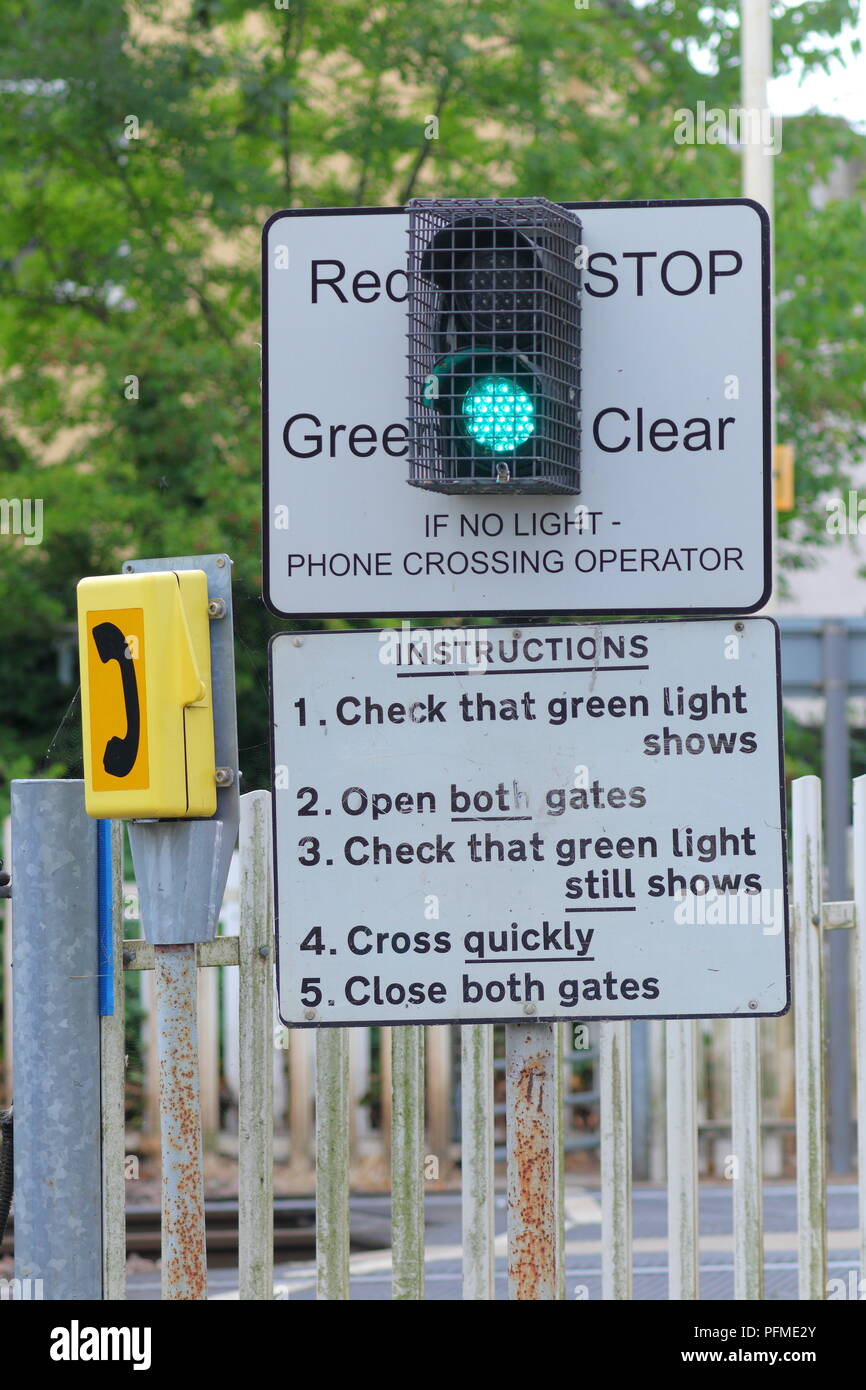
Is it similar to this sign?
a-sign-with-instructions-on-how-to-cross-a-level-crossing-in-mickletown-methley-leeds-west-yorkshire-uk-PFME2Y.jpg

What I meant was that if the intended meaning was that you may do what you like on foot and the lights only apply to road vehicles, this isn't clearly expressed.

To get this meaning I have to argue that as other instructions on the sign (open the near gates, open the far gates then cross) only make sense relating to a road vehicle then the whole sign must only relate to road vehicles and I can ignore everything on it when crossing on foot. And I really don't know if that is what they mean. The sighting distances seem reasonable to me for a foot crossing so perhaps they do. But it's only a guess.
It's not an impossible conclusion that the Red/Green lights in this situation are only for drivers - after all, a pedestrian would not need to open both gates and then come back across the road. And the signs imply that the green lights are only for those requiring to follow the instructions.
Of course the Red/Green lights and 'Phone if no light' instruction are also on pedestrian only crossings, so the lights do apply to all users, but it would be unreasonable to expect the average user of a crossing to know the national standards and conventions.

The strict answer remains the same - if you cannot contact the signaller you should find an alternative crossing. But it would not be unreasonable upon finding the lights out and the phones disconnected to look carefully both ways and then cross as quickly as is safe to do so, without pausing to take a photo.

 

al78

Established Member
Joined
7 Jan 2013
Messages
2,600
Bottom line for me is that I don't quite understand how we have so many people who have no concept of risk in the UK and need to be told everything word for word.
We live in a very safe world where risk is in general very well managed and people are sheltered from it as much as is practical. As a result I think that the concept of being aware of your surroundings and potential danger (like humans had to do back in the hunter-gatherer era where they would be frequently under threat from predators and maybe even rival tribes) is gradually being evolved out of human nature as careless people no longer pay the price for carelessness, so spatial incompetence increases as time goes on. It is similar with people who lark about along the sea front when 80+ mph winds are slamming big waves against the seawall with overtopping and storm surge risk, you occasionally get a report in the news about someone swept out to sea, or people absorbed in their smartphones who walk into the road without looking. The way to reduce carelessness is to internalise the consequences but that would not be acceptable in a civilised society or possible in some situations.
 

TheSel

Member
Joined
10 Oct 2017
Messages
1,168
Location
Southport, Merseyside
Is it similar to this sign?
a-sign-with-instructions-on-how-to-cross-a-level-crossing-in-mickletown-methley-leeds-west-yorkshire-uk-PFME2Y.jpg


It's not an impossible conclusion that the Red/Green lights in this situation are only for drivers - after all, a pedestrian would not need to open both gates and then come back across the road. And the signs imply that the green lights are only for those requiring to follow the instructions.
Of course the Red/Green lights and 'Phone if no light' instruction are also on pedestrian only crossings, so the lights do apply to all users, but it would be unreasonable to expect the average user of a crossing to know the national standards and conventions.

The strict answer remains the same - if you cannot contact the signaller you should find an alternative crossing. But it would not be unreasonable upon finding the lights out and the phones disconnected to look carefully both ways and then cross as quickly as is safe to do so, without pausing to take a photo.
Another problem with those instructions is at step 5. The user is instructed to close both gates. This, naturally, entails recrossing the line (twice) to close the 'far' gate (i.e. the one from whence the user has come). But there is no instruction to recheck that the green light still shows or that the line is clear.
 

AdamWW

Established Member
Joined
6 Nov 2012
Messages
6,006
Another problem with those instructions is at step 5. The user is instructed to close both gates. This, naturally, entails recrossing the line (twice) to close the 'far' gate (i.e. the one from whence the user has come). But there is no instruction to recheck that the green light still shows or that the line is clear.

Indeed.

It would also be more clear if 4. said something more like "Drive vehicle across quickly"
 

zwk500

Veteran Member
Joined
20 Jan 2020
Messages
18,631
Location
Northampton
As a result I think that the concept of being aware of your surroundings and potential danger (like humans had to do back in the hunter-gatherer era where they would be frequently under threat from predators and maybe even rival tribes) is gradually being evolved out of human nature as careless people no longer pay the price for carelessness, so spatial incompetence increases as time goes on.
Was it ever being evolved out or did careless people just get chalked up to 'acceptable losses' in an era when life was much cheaper.
The way to reduce carelessness is to internalise the consequences but that would not be acceptable in a civilised society or possible in some situations.
Many civilised societies don't have the same risk-averse culture the UK has - look at various approaches to safety in Continental Europe.
 

AdamWW

Established Member
Joined
6 Nov 2012
Messages
6,006
Many civilised societies don't have the same risk-averse culture the UK has - look at various approaches to safety in Continental Europe.

And our level of risk aversion varies depending on context and practicality.

You would never be allowed to take a group of nursery children through a factory with heavy machinery whizzing past inches from their heads. But you can take them along a narrow pavement next to a busy road, with appropriate precautions.
 

al78

Established Member
Joined
7 Jan 2013
Messages
2,600
And our level of risk aversion varies depending on context and practicality.

You would never be allowed to take a group of nursery children through a factory with heavy machinery whizzing past inches from their heads. But you can take them along a narrow pavement next to a busy road, with appropriate precautions.
A factory is not a public right of way so machine operators rightly aren't expected to have to look out for parties of nursery children. A road is a public right of way and one of the conditions for having a driving license is that those who externalise the greatest risk on others have the responsibility to take the most care.
 

AdamWW

Established Member
Joined
6 Nov 2012
Messages
6,006
A factory is not a public right of way so machine operators rightly aren't expected to have to look out for parties of nursery children. A road is a public right of way and one of the conditions for having a driving license is that those who externalise the greatest risk on others have the responsibility to take the most care.

Hmmm.

Even assuming that all drivers think that way (and they don't) with the best will in the world if a 3 year old jumps out in front of a fast moving car there's not much that can be done. Just as in the factory example, the only way to keep them safe is to make sure they don't stray. We accept that risk with roads but wouldn't in other contexts (I could change it to an unfenced steep drop, perhaps).

As a society we are happy to take far greater risks with road transport in return for convenience than we accept in most other areas of life.
 

Deepgreen

Established Member
Joined
12 Jun 2013
Messages
7,487
Location
Gomshall, Surrey
If you’re going to do it, best not to mention it in public in a way that might encourage others who are less “sensible”!
No, I'm certainly not going to do it. Just theoretical.


Has this scenario actually happened? It seems odd that the crossing would be left still open with no phones - unless the possession was to enable the closure
and removal ! Common sense would surely apply.

== Doublepost prevention - post automatically merged: ==

All that needs saying - almost. The British are so neurotic with their elfansafety religion. It is time that people were made responsible for their own safety, and that people stopped trying to be 'holier than thou', looking for things to ban.
Agreed - but the genie is out of the bottle and litigiousness and the blame culture is here to stay, I fear.
 

VauxhallandI

Established Member
Joined
26 Dec 2012
Messages
2,749
Location
Cheshunt
Likewise, but it was a few decades ago. There was a pub across the river to which access was provided by ringing a bell and waiting for someone to row you across. Alternatively there was the railway bridge.
Yep I had been at The Bounty for the evening…and the last boat had been and gone sometime before

== Doublepost prevention - post automatically merged: ==

Looking at the Wikipedia article, the footbridge which now exists next to the Bourne End railway bridge was only opened in 1992, so at least 30 years ago!
Yes unfortunately it was a long long time ago ☹️
 

DynamicSpirit

Established Member
Joined
12 Apr 2012
Messages
9,213
Location
SE London
The problem is one person takes 2 second, the next takes 5 seconds, then the next crouches down to get a steadier picture, and the 4th brings his tripod. A small proportion of railway photographers have also given people an unfortunate reputation for thinking that they know best, and then finding out they are wrong in circumstances that give the driver nightmares.

That's basically a slippery slope kind of logic. The trouble is, you could apply that logic to just about any human activity. Maybe I should not take a photo of myself eating a cake because someone might copy it and eat 100 cakes and make themselves ill... etc.

An example more related to the photo under discussion: I've sometimes taken photos in the middle of my street - perfectly safe because it's a quiet residential street with no through traffic and very low traffic speeds: I'm literally standing holding the camera for a second or so, so could easily move if required - and the geography means there's no way a vehicle could approach without my seeing it in plenty of time. Should I not do that because someone else might copy me on a busier street or use a tripod and then someone will copy them and before you know it, some idiot will set a tripod up in the middle of the M1 at rush hour, and apparently it'll all be because I took a photo in a location that I knew to be perfectly safe?

I do get the concern that some people do behave in a really silly, dangerous way on the railway, but I also think we need a more grown up attitude to distinguishing things that are in reality quite safe in the circumstances in which they are being done.
 
Status
Not open for further replies.

Top