• Our new ticketing site is now live! Using either this or the original site (both powered by TrainSplit) helps support the running of the forum with every ticket purchase! Find out more and ask any questions/give us feedback in this thread!

Using diesel locomotives to rescue stranded electric trains

Status
Not open for further replies.

L401CJF

Established Member
Joined
16 Oct 2019
Messages
1,486
Location
Wirral
I remember watching this video a while back showing a 37 rescuing a failed Stadler.

Well worth a watch for those interested! Video credit to "Charlie Riches".

Embedded video shows a class 37 loco coupling to a failed Stadler class 755

Edit- I realise this is not an electric train, but the same principal applies!
 
Last edited:
Sponsor Post - registered members do not see these adverts; click here to register, or click here to log in
R

RailUK Forums

Peter Mugridge

Veteran Member
Joined
8 Apr 2010
Messages
17,855
Location
Oakham
A big issue here is having a loco to rescue available with compatible couplers!
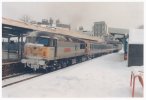
Indeed, back in February 1991 you would find the service being maintained with 56s and 47/3s in push-pull mode with EPBs and CEPs all day long.

See 56 032 here at the back end of a pair of EPBs for example ( from which I had just got off and done a subway dash to get the picture! )... Of course in those days the drivers had a wider range of both traction and route knowledge as well - the latter point having already been touched on in another post in this thread.
 

Attachments

  • Peter Archive 6545.jpg
    Peter Archive 6545.jpg
    744.1 KB · Views: 151

matchmaker

Established Member
Joined
8 Mar 2009
Messages
1,890
Location
Central Scotland
And if an EMU needs to be transported between depots over a non-electrified route (or with a different electrification type), how would it happen?
When the Cathcart Circle in Glasgow was electrified in the early 1960s the only EMU depot was at Hyndland on the North Clyde lines. The connection between the Cathcart Circle and the North Clyde lines is by way of the City Union line which was (and still is) non electrified. There were at that time very few air braked diesel locos so if EMU stock had to be taken from the Circle to Hyndland for repair/servicing ex-Caledonian steam locos which still retained their Westinghouse brake were used. In due course Class 20s were fitted with air brakes for this purpose.
 

Craig1122

Member
Joined
14 May 2021
Messages
375
Location
UK
When the Cathcart Circle in Glasgow was electrified in the early 1960s the only EMU depot was at Hyndland on the North Clyde lines. The connection between the Cathcart Circle and the North Clyde lines is by way of the City Union line which was (and still is) non electrified. There were at that time very few air braked diesel locos so if EMU stock had to be taken from the Circle to Hyndland for repair/servicing ex-Caledonian steam locos which still retained their Westinghouse brake were used. In due course Class 20s were fitted with air brakes for this purpose.
Similar situation in London with tube stock from the Northern City line being diesel hauled to depot through Crouch End until the Northern City became part of BR.
 

Falcon1200

Established Member
Joined
14 Jun 2021
Messages
6,611
Location
Neilston, East Renfrewshire
The real big issue is why Network Rail and immediate predecessors even allowed trains on the network without universally compatible couplers of the previous 150 years.

Coupling issues certainly go back to BR days, who for example ordered two incompatible fleets for use on much the same routes; Classes 312 and 313 for the Great Northern electrification.
 

ComUtoR

Established Member
Joined
13 Dec 2013
Messages
9,562
Location
UK
South Eastern have invited expressions of interest for fleet replacement, this is one of the options they are considering:

https://www.railjournal.com/fleet/southeastern-tenders-new-rolling-stock-fleet/#:~:text=The new fleet must be,up to 70 additional cars.

"Bidders must also provide options for supplying the new trains with traction batteries for operation in depots and sidings, on the main line during power failures and on non-electrified routes for a distance of up to 32km."

Note that it's only an option they're exploring as subject to cost benefit analysis.

There's a big clue here.

The real big issue is why Network Rail and immediate predecessors even allowed trains on the network without universally compatible couplers of the previous 150 years.

Probably because the new couplers are better. It's the same reason why I'm sitting here replying on an Intel i7 laptop and not by carrier pigeon.
 

Craig1122

Member
Joined
14 May 2021
Messages
375
Location
UK
There's a big clue here.
I presume Hoo, however Steve White (SE MD) is quite active on Twitter and was talking up the possible uses on the existing network for failures, depots etc. He also made it clear it's far from decided and that batteries would need to be justified.
 

Irascible

Established Member
Joined
21 Apr 2020
Messages
2,233
Location
Dyfneint
The thing is that nowadays it's usually faster, and simpler to rescue a unit with another unit. Not least because on most lines the nearest thing is probably the unit stuck behind!

Having been sat on a train ( circa 1980 ) somewhere near Taplow for about an hour, had a period of maneuvering and then once the trundle into Paddington was complete had to walk down not just my train but the one in front as well - complete with literally steaming class 50 - not a new idea! :D ( this was before the concourse extension ate a lot of platform length ). Given the state of the 50s at the time it's a wonder there wasn't a double length failure to cope with...

But yes, you don't have to rescue a unit with a locomotive specifically, you just need something that'll move it. A unit can go about it's business moving passengers around when it's not needed for rescues. If the power's down, I think just getting to trains to move them is going to be a logistical nightmare... the more we wire up the bigger the attraction of some bi-mode capability becomes.
 

Meerkat

Established Member
Joined
14 Jul 2018
Messages
9,276
I suspect massively and quickly. The holy grail in the automotive world is a 400-500 mile actual range on an EV, roughly the same as an average petrol car. The desire to achieve this quickly to drive EV adoption is going to make battery tech develop very quickly as huge amounts of money are poured into it.
You cannae break the laws of physics (chemistry)!
I thought they had hit a bit of a wall with the chemistry and there wasn’t anything particularly promising on the horizon?
How heavy would a limp mode/depot battery actually be anyway? It would have to be fairly big to be significant compared to the normal train weight.
 

zwk500

Veteran Member
Joined
20 Jan 2020
Messages
18,658
Location
Northampton
You cannae break the laws of physics (chemistry)!
I thought they had hit a bit of a wall with the chemistry and there wasn’t anything particularly promising on the horizon?
How heavy would a limp mode/depot battery actually be anyway? It would have to be fairly big to be significant compared to the normal train weight.
I believe @Bald Rick has provides figures before. The short answer is that they wouldn't be a problem.
 

Surreytraveller

On Moderation
Joined
21 Oct 2009
Messages
3,905
Too complicated these days. Back in the old days when it was just a hook and air pipe you could connect anything to anything. These days, even if the couplers are compatible, the software on the computer probably won't be. Then there's driver traction knowledge
 

Bald Rick

Veteran Member
Joined
28 Sep 2010
Messages
35,965
Their weight, and the expense of maintaining and periodically replacing said batteries will count against this, of course. As they get smaller and lighter that will improve over time

You cannae break the laws of physics (chemistry)!
I thought they had hit a bit of a wall with the chemistry and there wasn’t anything particularly promising on the horizon?
How heavy would a limp mode/depot battery actually be anyway? It would have to be fairly big to be significant compared to the normal train weight.


I believe @Bald Rick has provides figures before. The short answer is that they wouldn't be a problem.

Depends what you want to use the battery for.

If it is only going to be a couple of times a day for depot shunting and a ‘limp’ mode for occasional use when the power is off, or some (very, very unlikely) problem with the tractors system between the pan / shoe and the battery, then an automotive spec Lithium ion battery pack of about 200kWh would be good enough to move a 4car emu for around 30 miles. That will weigh a bit more than a tonne or so, which is essentially negligible on a 4 car unit weighing 150tonnes+. As the full battery capacity would rarely be used, this would be good for 10-15 years or more, ie replacement at midlife refurbs.

If it is going to be used repeatedly every day, then you want Lithium Titanate (LTO) batteries. About twice the price, and a little less battery capacity per unit of weight, but has the benefit of much less degradation, and thus many more ’charge cycles’ before needing to be replaced. It can also be charged more quickly. An LTO battery of 200kWh would be nearer 2 tonnes, again essentially negligible on a 4 car unit, and be about the size of a double fridge / freezer.

The ROG 93s have LTO batteries, albeit only 80kWh IIRC.

As @zwk500 says, none of this is a problem. I fully expect that all future orders of electric rolling stock, and probably any diesel-electric stock too, have some form of traction battery on board.

 
Last edited:

01d-and

Member
Joined
12 May 2021
Messages
130
Location
WORCESTERSHIRE
Back in the day , I was on a train out of Euston when the 86 expired somewhere near Watford. The guard informed us that a spare diesel was available at Willesdon and a spare driver was available at Rugby - or was that the other way around ?? ;)
 

43066

Veteran Member
Joined
24 Nov 2019
Messages
12,089
Location
London
Depends what you want to use the battery for.

If it is only going to be a couple of times a day for depot shunting and a ‘limp’ mode for occasional use when the power is off, or some (very, very unlikely) problem with the tractors system between the pan / shoe and the battery, then an automotive spec Lithium ion battery pack of about 200kWh would be good enough to move a 4car emu for around 30 miles. That will weigh a bit more than a tonne or so, which is essentially negligible on a 4 car unit weighing 150tonnes+. As the full battery capacity would rarely be used, this would be good for 10-15 years or more, ie replacement at midlife refurbs.

If it is going to be used repetedly every day, then you want Lithium Titanate (LTO) batteries. About twice the price, and a little less battery capacity per unit of weight, but has the benefit of much less degradation, and thus many more ’charge cycles’ before needing to be replaced. It can also be charged more quickly. An LTO battery of 200kWh would be nearer 2 tonnes, again essentially negligible on a 4 car unit, and be about the size of a double fridge / freezer.

The ROG 93s have LTO batteries, albeit only 80kWh IIRC.

As @zwk500 says, none of this is a problem. I fully expect that all future orders of electric rolling stock, and probably any diesel-electric stock too, have some form of traction battery on board.

Thanks - it’s amazing how quickly battery tech seems to have improved of late.
 

bahnause

Member
Joined
30 Dec 2016
Messages
1,047
Location
bülach (switzerland)
This problem can actually only be solved on a network-wide basis. The rail TOC are not likely to be suitable for this. The SBB and BLS solve this with the rescue trains. These have the appropriate adapters on board, are available around the clock and the staff is trained for these towing services:

Throughout Switzerland, 330 SBB Intervention employees ensure that unexpected events impact rail traffic as little as possible and that operations quickly return to normal. To do so, they have 16 special fire-fighting and rescue trains at their disposal along with a range of other rail and road vehicles.
 
Last edited by a moderator:

BoroAndy

Member
Joined
11 Jan 2020
Messages
272
Location
Scarborough
Plus finding a Driver with sufficient spare time to carry out the rescue, and route knowledge, the latter often an issue when an electric train is stranded on a line with little or no freight traffic.
As regards route knowledge, wouldn't you take a regular driver for that route as a pilot to assist the diesel loco driver?
 

Clarence Yard

Established Member
Joined
18 Dec 2014
Messages
3,277
If you had one spare, yes!

The problem these days isn’t incompatible couplers - it’s that there are relatively few locos about and if you get a traction failure that needs assistance, the probability is that you have other trains all around it, not locos. And on todays railway you can get a load of stuck trains in a very short time, such is the density of traffic on some lines. The infrastructure on most lines just isn’t provided for diverting round either. This lack of infrastructure makes the idea of having dedicated rescue trains a fairly useless one.

You can have a unit with as many batteries as you want but if it’s stuck in the knitting or that’s down around it, it’s not going anywhere. If it has no air because it has hit something, it isn’t going anywhere in a hurry either. Meanwhile other trains will start to pile up around it.

Having rescued a fair few trains in my career, it was much easier in the days when we had plenty of spare locos and crews to do it. Nowadays even if a loco (belonging to someone else) is sitting there in a siding, it won’t be much good for an afternoon rescue if it isn’t going to be crewed until 22.00 at the earliest.
 

Taunton

Veteran Member
Joined
1 Aug 2013
Messages
12,332
Thanks - it’s amazing how quickly battery tech seems to have improved of late.
Or not ... because I recall 50 years ago, 1973, at university in Edinburgh, we were all grandly shown the new Battery Bus, which was going to take over from diesel. Except it had only about 20 seats, did a nippy 30mph out of the depot (journalists present) and a not-so-nippy 15mph a couple of hours later - but would be "better next year", as "battery technology is advancing so quickly". And I've been hearing that from the battery industry's PR team it seems every year since (including possibly nowadays from the grandson of the chap who did so all those years ago).

There's a photo of the bus on that trial in Princes Street here on the web :

 
Last edited:

FGW_DID

Established Member
Joined
23 Jun 2011
Messages
3,037
Location
81D & 81E
Surprised it’s not been mentioned already, that’s why there is a Dellner coupler fitted Class 57 (currently 57312) at Reading TCD, it’s the London & Thames Valley rescue loco. If that’s not available, any of the GWR 57/6 can be used with an emergency coupler as happened last week when the OLE was damaged in the Ealing Broadway / Acton area.
 

43066

Veteran Member
Joined
24 Nov 2019
Messages
12,089
Location
London
Or not ... because I recall 50 years ago, 1973, at university in Edinburgh, we were all grandly shown the new Battery Bus, which was going to take over from diesel. Except it had only about 20 seats, did a nippy 30mph out of the depot (journalists present) and a not-so-nippy 15mph a couple of hours later - but would be "better next year", as "battery technology is advancing so quickly". And I've been hearing that from the battery industry's PR team it seems every year since (including possibly nowadays from the grandson of the chap who did so all those years ago).

There's a photo of the bus on that trial Princes Street here on the web :

It looks like a glorified milk float!
 

12LDA28C

Established Member
Joined
14 Oct 2022
Messages
5,058
Bit difficult to take him with you if he's on the failed train halfway down the line!

Indeed, although these days any crew on a standby loco would most likely sign the route - not much point having a loco and crew available if they don't sign the road. A case in point is the West Coast driver who assisted the LNER train from York to Doncaster a week ago.
 

zwk500

Veteran Member
Joined
20 Jan 2020
Messages
18,658
Location
Northampton
Indeed, although these days any crew on a standby loco would most likely sign the route - not much point having a loco and crew available if they don't sign the road. A case in point is the West Coast driver who assisted the LNER train from York to Doncaster a week ago.
West Coast have national route notice though, because of their charter business, so it's not a reasonable comparison to e.g. A FOC being purloined to rescue somthing.
 

D365

Veteran Member
Joined
29 Jun 2012
Messages
13,197
Sorry I should have been a bit clearer. Yes EMUs (or whatever train) have airbrakes. But its how those brakes are controlled that is different. It's my understanding that EMUs and the like control the airbrakes by electrical signals where as freight locos is done through air pipes and valves etc. That's why passenger stock is usually hauled with translator vehicles that effectively translates the braking input from the loco into something the train can understand...or hauled unbraked....at least that is how I understand things.
Yes you're right. I'm not sure about the very latest units, but definitely second-generation multiple units use Westcode braking which needs 'translation' as you say.
 

Doomotron

Established Member
Joined
25 Jun 2018
Messages
1,427
Location
Kent
It isn't a locomotive but it is in the same vein; during the beast from the east there was at least one instance of a Class 171 pulling a 377 when it couldn't get any power, if discussions on RailUK are anything to go by.
 

Deepgreen

Established Member
Joined
12 Jun 2013
Messages
7,490
Location
Gomshall, Surrey
Indeed, back in February 1991 you would find the service being maintained with 56s and 47/3s in push-pull mode with EPBs and CEPs all day long.

See 56 032 here at the back end of a pair of EPBs for example ( from which I had just got off and done a subway dash to get the picture! )... Of course in those days the drivers had a wider range of both traction and route knowledge as well - the latter point having already been touched on in another post in this thread.
A great shot, and I wonder how the 56 was controlled - presumably from its rear/front cab but with what communiction with the EPB driver, or were the 56s compatible with EPB stock and could be controlled from the driving cab?
 

Peter Mugridge

Veteran Member
Joined
8 Apr 2010
Messages
17,855
Location
Oakham
A great shot, and I wonder how the 56 was controlled - presumably from its rear/front cab but with what communiction with the EPB driver, or were the 56s compatible with EPB stock and could be controlled from the driving cab?
Sorry, I have no idea how the controlling was done. I believe it wasn't the only 56 active that day, although it's certainly the only one I managed to bash but I did also ride a 47/3 with a pair of CEPs from Waterloo East to Cannon Street so that was clearly working on a push-pull basis as well.

Further discussion would be a bit off topic for this thread, but it does underline the point of the thread: in those days just about anything could rescue and fully work with just about anything else with the exception of control system differences ( red circle, blue diamond, something triangle... that sort of thing )
 

Falcon1200

Established Member
Joined
14 Jun 2021
Messages
6,611
Location
Neilston, East Renfrewshire
in those days just about anything could rescue and fully work with just about anything else with the exception of control system differences ( red circle, blue diamond, something triangle... that sort of thing )

Not really, by that time there already scores of sets with automatic couplers, eg Tightlock and BSI, which could not, without the use of adapters, be hauled by anything other than compatible types.
 

Deepgreen

Established Member
Joined
12 Jun 2013
Messages
7,490
Location
Gomshall, Surrey
Sorry, I have no idea how the controlling was done. I believe it wasn't the only 56 active that day, although it's certainly the only one I managed to bash but I did also ride a 47/3 with a pair of CEPs from Waterloo East to Cannon Street so that was clearly working on a push-pull basis as well.

Further discussion would be a bit off topic for this thread, but it does underline the point of the thread: in those days just about anything could rescue and fully work with just about anything else with the exception of control system differences ( red circle, blue diamond, something triangle... that sort of thing )
I have this rather grainy shot of 33034 hauling a 4EPB plus 4CIG rake at Ashtead in February 1985, but as the loco is leading, 'remote control' wasn't an issue. I imagine it may have run round at Dorking but it's possible it returned in push mode.6981834628_948fcd5376_oa.jpg
 
Status
Not open for further replies.

Top