I'm surprised that this has happened but it also begs the question of why not consult the public before actually making changes and not when you've announced them? It would make situations like this avoidable.The 52 service will continue to operate

-
Our new ticketing site is now live! Using either this or the original site (both powered by TrainSplit) helps support the running of the forum with every ticket purchase! Find out more and ask any questions/give us feedback in this thread!
You are using an out of date browser. It may not display this or other websites correctly.
You should upgrade or use an alternative browser.
You should upgrade or use an alternative browser.
McGill's Buses - Renfrewshire & Inverclyde
- Thread starter overthewater
- Start date
Sponsor Post - registered members do not see these adverts; click here to register, or click here to log in
R
RailUK Forums
Stan Drews
Established Member
- Joined
- 5 Jun 2013
- Messages
- 2,151
I understand from the local politicians that the stay of execution is to allow them (the politicians) some time to find some funding sources, and if it really is the ‘vital’ service that is being suggested.I'm surprised that this has happened but it also begs the question of why not consult the public before actually making changes and not when you've announced them? It would make situations like this avoidable.
I'm not in Barrhead that often but I must admit the only service that I've ever seen busy there is the 51.I understand from the local politicians that the stay of execution is to allow them (the politicians) some time to find some funding sources, and if it really is the ‘vital’ service that is being suggested.
Stan Drews
Established Member
- Joined
- 5 Jun 2013
- Messages
- 2,151
Yeah, it and the 3 are the busy routes.I'm not in Barrhead that often but I must admit the only service that I've ever seen busy there is the 51.
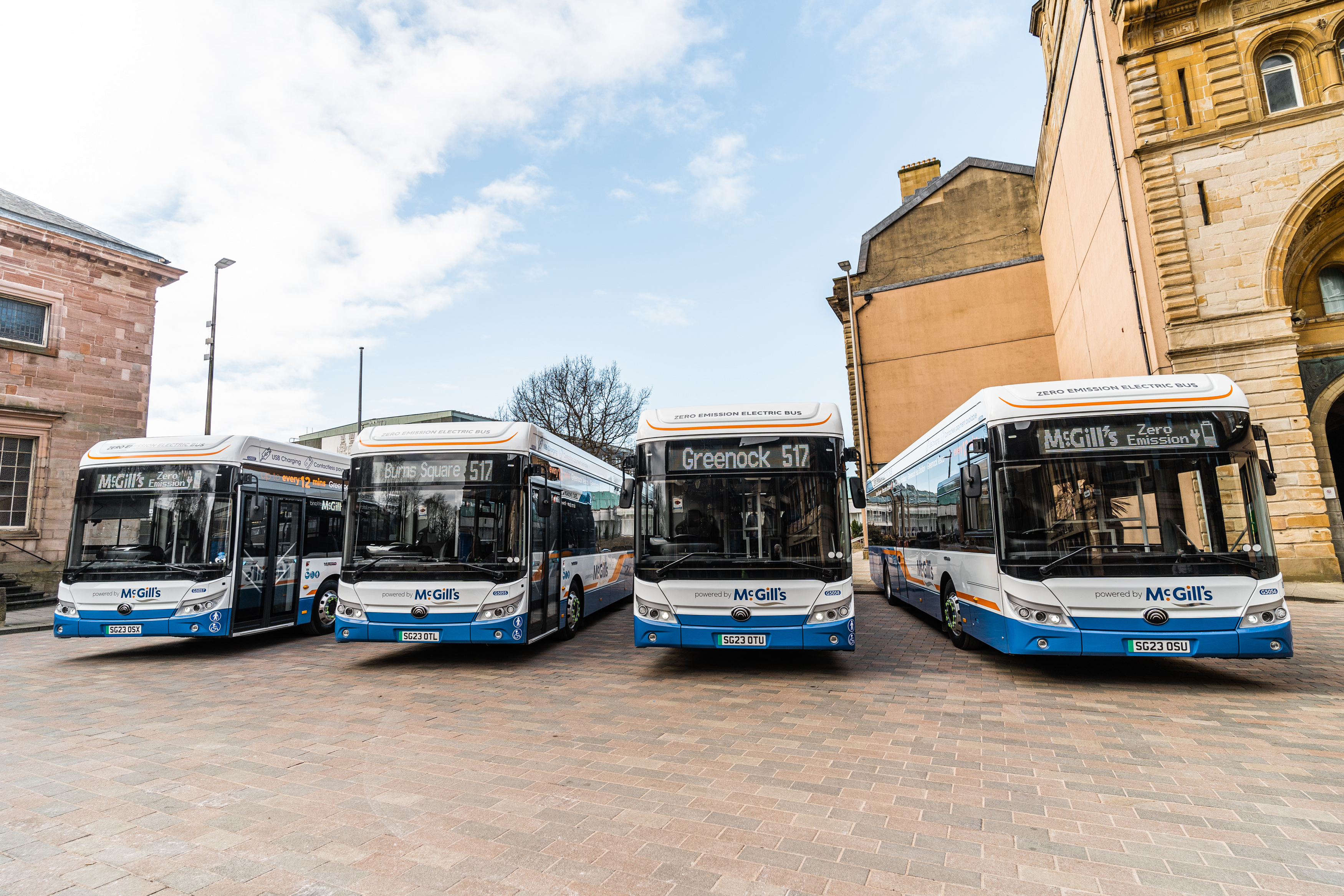
Inverclyde Electric Route launches at the end of the month. 517, 531, 532, 533 all going electric.
 www.mcgillsbuses.co.uk
Inverclyde Goes Electric!
The new electric fleet will cover services 531, 532, 533 & 517.
www.mcgillsbuses.co.uk
The further order of 14 Yutong buses, will be the first in Inverclyde a huge step towards our fleet becoming zero emission.
The new buses will enhance the passenger experience, with buses being fitted out with USB charging points at every seat and with minimal noise making rides smooth and comfortable.
The new electric fleet will cover services 531, 532, 533 & 517, and to mark this occasion three of our electric buses will be on show at our launch event at Port Glasgow, Coronation Park Friday 24th from 2pm and Greenock, Clyde Square Tuesday 28th from 2pm.
Last edited by a moderator:

roadierway77
Member
The first of the new batch of Yutongs entered service today, those being Inchinnan-based 5059-61, 5063 and 5064 and Johnstone-based 5065-68. Each batch has spent most of the day on the 64 and 61 respectively. Details for the new vehicles are slowly being added on bustimes.org.
In addition, as mentioned in the Scotland East thread, the cascade of E200s from west to east has begun. 2231-33 and 8011-13 are confirmed to have been transferred to Larbert today.
In addition, as mentioned in the Scotland East thread, the cascade of E200s from west to east has begun. 2231-33 and 8011-13 are confirmed to have been transferred to Larbert today.
Stan Drews
Established Member
- Joined
- 5 Jun 2013
- Messages
- 2,151
A company source has recently provided the following details of the 10 new Yutong E10s (5500-9) & 31 Yutong E12s (5055-85), on their enthusiast Facebook page.
| G5500 | SG23OSA |
| G5501 | SG23OSE |
| G5502 | SG23OSJ |
| G5503 | SG23OSK |
| G5504 | SG23OSB |
| G5505 | SG23OSF |
| G5506 | SG23OSM |
| G5507 | SG23OSC |
| G5508 | SG23OSD |
| G5509 | SG23OSL |
| G5055 | SG23OTL |
| G5056 | SG23OSU |
| G5057 | SG23OSX |
| G5058 | SG23OTU |
| I5059 | SG23OTM |
| I5060 | SG23OTN |
| I5061 | SG23OTR |
| I5062 | SG23OTY |
| I5063 | SG23OTA |
| I5064 | SG23OTV |
| J5065 | SG23OSR |
| J5066 | SG23OTZ |
| J5067 | SG23OTP |
| J5068 | SG23OTS |
| J5069 | SG23OTW |
| J5070 | SG23OTX |
| J5071 | SG23OSN |
| J5072 | SG23OSO |
| J5073 | SG23OSP |
| J5074 | SG23OSV |
| J5075 | SG23OSW |
| J5076 | SG23OSY |
| J5077 | SG23OSZ |
| J5078 | SG23OTC |
| J5079 | SG23OTD |
| J5080 | SG23OTE |
| J5081 | SG23OTF |
| J5082 | SG23OTH |
| J5083 | SG23OTJ |
| J5084 | SG23OTK |
| J5085 | SG23OTB |

GusB
Established Member
Confirmed by whom? Please remember to post your sourceThe first of the new batch of Yutongs entered service today, those being Inchinnan-based 5059-61, 5063 and 5064 and Johnstone-based 5065-68. Each batch has spent most of the day on the 64 and 61 respectively. Details for the new vehicles are slowly being added on bustimes.org.
In addition, as mentioned in the Scotland East thread, the cascade of E200s from west to east has begun. 2231-33 and 8011-13 are confirmed to have been transferred to Larbert today.

roadierway77
Member
Apologies, user Mullac321 stated on the Scotland East thread that they saw the aforementioned vehicles at Larbert. There was also a photo posted on the private McGill’s enthusiast Facebook group of these vehicles in Larbert depot, though I can't share it here as it was 1. posted in a private group and 2. I have have not asked for permission to share it.Confirmed by whom? Please remember to post your source
GusB
Established Member
All you had to do was state the source of the information. If it's from a private group on Facebook, there's nothing to stop you posting the link to the main group page. Someone may wish to join, after all.Apologies, user Mullac321 stated on the Scotland East thread that they saw the aforementioned vehicles at Larbert. There was also a photo posted on the private McGill’s enthusiast Facebook group of these vehicles in Larbert depot, though I can't share it here as it was 1. posted in a private group and 2. I have have not asked for permission to share it.
sbrignall72
Member
Does anyone know where citaro 3359 is, doesn't even appear on bus times? Many thank in advance.
Last edited by a moderator:

I would assume with Midland Bluebird, as 3357-3363 are with MidlandDoes anyone know where citaro 3359 is, doesn't even appear on bus times? Many thank in advance.

voidwxrranty
Member
3359 is VOR (vehicle off road) at the moment. Its engine died back in October.Does anyone know where citaro 3359 is, doesn't even appear on bus times? Many thank in advance.
Last edited by a moderator:
Falcon1200
Established Member
5072, 5073 and 5074 were all in action on Tuesday (7th March), the first and last on the 7 and the middle one on the 51.
Well, the next cuts on the way are going to be as grim as I thought they'd be. The article in the Daily Record mentions what to expect on May 1st.

 www.dailyrecord.co.uk
McGill's puts the brakes on Renfrewshire bus services
The company says a 25 per cent increase in costs and reduction in government support means the cuts – due to come into affect on May 1 – are unavoidable.
The company says a 25 percent increase in costs and reduction in government support means the cuts – due to come into effect on May 1 – are unavoidable.
Seven services are to be withdrawn and more than a dozen reduced as McGill’s Buses slashes its routes across Renfrewshire.
The private bus company revealed the cuts to services as part of its revised timetable to come into effect from Monday, May 1.
The changes come as a Scottish Government subsidy to support public transport following the pandemic draws to a close on March 31.
A particular blow for McGill’s, the company says its operating costs have soared by 25 per cent since before the pandemic, making some provision simply unaffordable.
But Neil Bibby, MSP for West Scotland, described the move as “very concerning”.
All parts of the local authority area are affected by the proposals, as is neighbouring Barrhead and Inverclyde.
Circular routes serving town centres and local residential areas have been particularly hit, with the number 31 Cochrane Castle to Houston Square being withdrawn alongside the Barrhead circular bus, number 52, and Neilston Circular, number 54.
But McGill’s say these areas will still have bus cover with the variation of other bus routes, including the number 20 in Johnstone and 66 in Neilston.
The 64 Linwood to Gallowhill service is being axed and a new 7A service introduced and an extension to the 61 bus route.
In Paisley, the number 17 bus will no longer operate on Sundays and will have a reduced timetable Monday to Saturday.
The bus, which runs from Foxbar past the Royal Alexandra Hospital, through Paisley town centre to the Queen Elizabeth University Hospital, will specifically see cuts before 8am and after 5pm on weekdays.
The number 38 will also cease journeys between Johnstone and Kilbarchan and Spateston.
A host of other bus routes will see the frequency of buses reduced alongside the hours of operation.
This includes bus numbers 6, 7, 10, 17, 20, 21, 30, 32, 38, 51.
Ralph Roberts, CEO of McGill’s Group, said the Scottish Government’s covid recovery cash for public transport has “allowed more bus services to run than would otherwise be affordable” in past two years.
“The pandemic has resulted in changes to how, when and why people travel,” he said.
“More recently, the industry, like wider economy and the population at-large, has been hit by inflationary pressures – such as fuel, energy, materials and wage costs.
“It now costs us approximately 25 per cent more to keep buses on the road than it did before covid.”
The number of journeys being made is between 80 and 90 per cent of pre-pandemic levels but the massive increase in costs means the bus timetable and services has had to be reworked.
Mr Roberts added: “Whilst we fully recognise the extent of service changes, we have worked hard to try and adjust other McGill’s services to cover some or all of the cancelled service routes.”
The revised timetable has been sent to Strathclyde Partnership for Transport (SPT) which has the power to step in with financial support where journeys or services are considered to be socially necessary.
But Paisley-based Mr Bibby said Holyrood can’t simply write a blank cheque – and urged the Scottish Government to look at the examples in Leeds and Manchester where bus services have been taken back under public control.
“It is very concerning that bus companies are considering yet more drastic cuts,” he said.
“I know people in our community are getting extremely frustrated with the reduction in services.
“To avoid these cuts, the Scottish Government should provide more support for bus operators but there should be no more blank cheques for these private companies.
“Any further support should have strict conditions attached to maintain services, cap fares and to help bring buses back under public control.”

markymark2000
On Moderation
The 17 and 38 seem like a managed decline. The 17 never got properly reinstated after COVID and the 38 got cut back from Kilbarchan and Spateston in the name of reliability and now all of a sudden it's not viable. Seems very convenient.
Trnsprt4Sctlnd
Member
I believe the 17 was never gonna be a great money maker for them to begin with.The 17 and 38 seem like a managed decline. The 17 never got properly reinstated after COVID and the 38 got cut back from Kilbarchan and Spateston in the name of reliability and now all of a sudden it's not viable. Seems very convenient.
The very fact it ran alongside the frequent 38 on a portion of its route then, not to mention First's 9 service including all the buses run along Partick, the 17 was never gonna be a success. Its only notable quality was for it to connect Paisley and Partick.
The 38 is being cut back to the area it makes most of its money whereas McGill's local town service can most take up the slack around Kilbarchan, Spateston & Johnston.
17 was a busy route - Arriva days used to have a double deck duplication at 5pm and it got an frequency increase and an evening service it never had before when many other things were being cut. I was, until I moved, a frequent user and it was often very busy with students to Glasgow Uni plus the office workers around Charing Cross were big users.
Covid and WFH in 2020 hit the student and office worker market and by the time they returned the service was gone. I always felt the diversion into the QUEH bus station took too long and never really picked up or dropped off that many. The Arriva route stopped at Shieldhall flyover in both directions but I understand why they did it.
The 77 picks up a lot of cross tunnel flows now, but I don't think it really competed with the 17. The main market for the 17 was elsewhere linking Paisley to the QUEH and West End. There is a market for a service there, and given leisure & education passengers returning quicker the west end makes sense) but McGill's don't seem to have the interest in it and passengers will have drifted away now. Indeed, you have to think a direct Foxbar to Glasgow link might have further boosted it!
Covid and WFH in 2020 hit the student and office worker market and by the time they returned the service was gone. I always felt the diversion into the QUEH bus station took too long and never really picked up or dropped off that many. The Arriva route stopped at Shieldhall flyover in both directions but I understand why they did it.
The 77 picks up a lot of cross tunnel flows now, but I don't think it really competed with the 17. The main market for the 17 was elsewhere linking Paisley to the QUEH and West End. There is a market for a service there, and given leisure & education passengers returning quicker the west end makes sense) but McGill's don't seem to have the interest in it and passengers will have drifted away now. Indeed, you have to think a direct Foxbar to Glasgow link might have further boosted it!
Looks like the 20 is now going to service the Castles and that local service will go. Not sure there was ever value in taking the least well used parts of busy routes and making them their own services. A change is really off putting for many passengers and I don't think bus companies understand that well enough.The 38 is being cut back to the area it makes most of its money whereas McGill's local town service can most take up the slack around Kilbarchan, Spateston & Johnston.
The problem with bus companies is the lack of warning before making cuts. I don't think changes would ever go down well for any operator but getting feedback for about a month before finalising changes would go a long way. Operators would probably find out where people actually want to go and you could probably provide a more accurate service with less buses as a result. There are some services that are were predictably going to fail from day one and this could be more easily avoided with a lot more customer feedback.Looks like the 20 is now going to service the Castles and that local service will go. Not sure there was ever value in taking the least well used parts of busy routes and making them their own services. A change is really off putting for many passengers and I don't think bus companies understand that well enough.
I don't think they've been helped by the decline of Renfrewshire towns though. I'm not in Renfrewshire that often anymore but Johnstone, Paisley and Erskine in particular seem quite poor compared to even a few years ago and I wouldn't say Barrhead or Renfrew etc are much better.
Last edited:
The problem with bus companies is the lack of warning before making cuts. I don't think changes would ever go down well for any operator but getting feedback for about a month before finalising changes would go a long way. Operators would probably find out where people actually want to go and you could probably provide a more accurate service with less buses as a result. There are some services that are were predictably going to fail from day one and this could be more easily avoided with a lot more customer feedback.
I don't think they've been helped by the decline of Renfrewshire towns though. I'm not in Renfrewshire that often anymore but Johnstone, Paisley and Erskine in particular seem quite poor compared to even a few years ago and I wouldn't say Barrhead or Renfrew etc are much better.
I agree it's not the fact there is change, but that some service revisions to me don't seem to be much of an improvement. That said, McGill's with software and access to income and passenger numbers should know the issues and the market as well as anyone.
Most towns are declining, particularly in retail offering. Kilmarnock, East Kilbride, Paisley... Even Glasgow and out of town places like Braehead aren't quite as full and busy as they once were in my opinion.
Renfrewshire was over bussed in the past and thinking back to 15 years ago, it was unsustainable and needed change. It just feels like some key links are unmet and with a decline in both frequency and some services, I think people will be lost to bus use.
Quite frankly the privatised market seems to be struggling and it wouldn't be a surprise to see franchising seriously talked about. Indeed would probably be a good thing for the private operators in giving them guaranteed income.
I think the main reasons we've not had franchising are purely because the councils are majorly short of cash and our government spent a fortune on the trains and getting them back into public control.I agree it's not the fact there is change, but that some service revisions to me don't seem to be much of an improvement. That said, McGill's with software and access to income and passenger numbers should know the issues and the market as well as anyone.
Most towns are declining, particularly in retail offering. Kilmarnock, East Kilbride, Paisley... Even Glasgow and out of town places like Braehead aren't quite as full and busy as they once were in my opinion.
Renfrewshire was over bussed in the past and thinking back to 15 years ago, it was unsustainable and needed change. It just feels like some key links are unmet and with a decline in both frequency and some services, I think people will be lost to bus use.
Quite frankly the privatised market seems to be struggling and it wouldn't be a surprise to see franchising seriously talked about. Indeed would probably be a good thing for the private operators in giving them guaranteed income.
I can honestly see buses being public run within 5-10 years if the price rises of everything slow down a bit. I'm fine with private operation as long as there is a bit of regulation with it. Mcgills have probably contributed to their own demise a lot more than other companies over the years though. I was having a read back through the early comments on this thread and some of the decision making over prices and services has been moronic.
overthewater
Established Member
- Joined
- 16 Apr 2012
- Messages
- 9,117
Plus it doesn't help its fleet is filled with lots of electric buses which must be costing a fortune to run.
Last edited by a moderator:
GusB
Established Member
You'll have to show your working on this - what makes you think McGill's electric buses are more expensive to run than diesel vehicles?Plus it doesn't help its fleet is filled with lots of electric buses which must be costing a fortune to run.
overthewater
Established Member
- Joined
- 16 Apr 2012
- Messages
- 9,117
McGill's said it costs more did they not?

 www.route-one.net
Electricity costs impact procurement plans at McGill’s
A bus operator in Scotland has said that rising electricity costs have caused it to reconsider its procurement plans.
www.route-one.net
A bus operator in Scotland has said that rising electricity costs have caused it to reconsider its procurement plans.
McGill’s Buses Managing Director Ralph Roberts tweeted on 8 February that the increase in electricity prices, due to take place in October, amounted to an increase of £624,000 per annum to charge its fleet of battery-electric buses. According to Mr Roberts, the calculations showed that diesel generated electricity would come in at approximately £100,000 per year less, though clarified that such a calculation was merely an exercise and there was no serious consideration of charging its buses using diesel.
However, Mr Roberts says the rising costs have affected the operator’s attitude to vehicle procurement. “We were not expecting this level of volatility in electricity prices, mainly because they have never been this volatile,” he explains. “They are still volatile, and the prices are still going up.”
He says the volatility of the market will make it very difficult to meet Scottish Government ambitions to deliver 50% of bus mileage using zero-emission vehicles by the end of 2023. “There are macro matters that are affecting that, such as what is going on in Ukraine. Hopefully that will right itself at some point and allow prices to come back down. But maybe it won’t… the best we could say is the picture is very unclear. In short, our attitude towards moving overt to electric vehicles has changed.”
GusB
Established Member
Yet, Ralph Roberts wasn't sounding so pessimistic here:
 www.route-one.net
There's this article from Transport Engineer:

 www.transportengineer.org.uk
It does need to be pointed out that the above interview was with the head of Yutong sales, so it's not unbiased!
Energy costs can be offset by having small scale generation measures installed at depots. There are additional capital costs at the beginning, certainly, but if you were switching from electric to diesel you'd still have the cost of installing fuelling facilities.
UK's 250th Yutong battery-electric among McGill's batch - routeone
The 250th Yutong battery-electric vehicle for the UK has been delivered. It forms part of a further batch of 41 supplied to McGill’s Buses.
www.route-one.net
The 250th Yutong battery-electric vehicle for the UK has been delivered. It forms part of a further batch of 41 supplied to McGill’s Buses, work that has taken that operator’s Yutong zero-emission fleet to 96.
Part-funding for the second tranche of McGill’s Yutongs came from the initial round of the Scottish Zero Emission Bus challenge fund. Supplier Pelican Bus and Coach says that the procurement process from order to delivery took less than 12 months. It adds that the milestone bus is also the 134,000th zero-emission vehicle produced by Yutong.
McGill’s Buses CEO Ralph Roberts (pictured, left) has welcomed the further vehicles into service. He describes Pelican and Yutong as “the perfect delivery partners” in the operator’s journey to net-zero, and has given the E10 and E12 products a vote of confidence.
“When we were researching our options at the beginning, the Yutong product stood out head and shoulders above the rest. The milestone of 134,000 zero-emission vehicles lets everyone understand why – there is real strength in depth in the product.
There's this article from Transport Engineer:
On a charge - the economics of electric buses - Transport Engineer
Richard Simpson finds out how battery leasing can reduce front-end costs and uncertainty as bus fleets transition to electric power
www.transportengineer.org.uk
It's not just about the actual energy cost, though (let's not forget that diesel prices can be volatile too); overall lifetime costs will be lower.One obvious factor is a government subsidy: a grant of 22p/km for operating an electric bus, as opposed to just 6p for a diesel. “Then there’s the greater energy efficiency. A diesel bus will do 8-10mpg; the energy equivalent for an electric bus is 20 to 25mpg.”
Just how long the service life of an electric bus might be is of key importance. The capital costs are higher, but the running costs are lower – so the longer the vehicle’s life, the more money can be saved.
And this is where the electric bus has an ace up its sleeve. The inherent simplicity of the electric driveline has beneficial consequences for the life of the vehicle, and these increase, in comparison to a diesel vehicle, as it ages.
“Temperatures in the engine bay of a diesel bus can be as high as 140-170°C, and this eventually degrades electrical components and wiring. In contrast, temperatures around the motor of an electric bus are about 60°C. There’s virtually no vibration to speak of compared to a four- or six-cylinder diesel, and that aids component life.
“The maintenance requirements are far less: there’s no engine oil or filters to change, for a start. There’s also no gearbox oil, but the rear axle is conventional and needs a change every three or four years, just as diesel buses’ do.
“The air compressor and power-steering are all electric, so there’s no potential issues with oil from the compressor being carried over into the air system.”
It does need to be pointed out that the above interview was with the head of Yutong sales, so it's not unbiased!
Energy costs can be offset by having small scale generation measures installed at depots. There are additional capital costs at the beginning, certainly, but if you were switching from electric to diesel you'd still have the cost of installing fuelling facilities.
Stan Drews
Established Member
- Joined
- 5 Jun 2013
- Messages
- 2,151
The 38 was also ‘cut back’ from Kilbarchan/Spateston due to the low usage that didn’t justify the additional expense of 4 more electric vehicles. They appear to have been proved right, as the local sections of route haven’t been able to cover the cost of smaller buses, at the original frequencies. Two of the three local routes are also covered by Key Coaches, so the impact shouldn’t be too severe.The 17 and 38 seem like a managed decline. The 17 never got properly reinstated after COVID and the 38 got cut back from Kilbarchan and Spateston in the name of reliability and now all of a sudden it's not viable. Seems very convenient.
markymark2000
On Moderation
They should have cut the 38 in the first place rather than the managed decline. Simplify the bus network rather than having it as complex as McGills have it (which granted is further not helped by them eradicating dead mileage and having the 32 having so many trips heading to Kilbarchan but nothing back to Johnstone until 9am as the buses return as a 38.The 38 was also ‘cut back’ from Kilbarchan/Spateston due to the low usage that didn’t justify the additional expense of 4 more electric vehicles. They appear to have been proved right, as the local sections of route haven’t been able to cover the cost of smaller buses, at the original frequencies. Two of the three local routes are also covered by Key Coaches, so the impact shouldn’t be too severe.
Stan Drews
Established Member
- Joined
- 5 Jun 2013
- Messages
- 2,151
Not sure what you mean. They did cut the 38, by taking off the dead ends, and actually increasing the frequency between Johnstone and Paisley. For most of the day the 38 is a simple frequent service between Johnstone and Glasgow via Paisley. That isn’t complex in my book!They should have cut the 38 in the first place rather than the managed decline. Simplify the bus network rather than having it as complex as McGills have it (which granted is further not helped by them eradicating dead mileage and having the 32 having so many trips heading to Kilbarchan but nothing back to Johnstone until 9am as the buses return as a 38.
When they consulted on the May 2021 changes, all Kilbarchan journeys were going to be 32s (changing to 38s at Johnstone), but the request from community representatives was to keep them as 38s for the whole journey.
markymark2000
On Moderation
I think it should have been an all or nothing affair. Simple bus networks get passengers onboard. I get why they did what they did but the reduction will have discouraged some people and now the further reductions will discourage people and passengers have had to go through 2 lots of reductions rather than just 1 set of reductions.Not sure what you mean. They did cut the 38, by taking off the dead ends, and actually increasing the frequency between Johnstone and Paisley. For most of the day the 38 is a simple frequent service between Johnstone and Glasgow via Paisley. That isn’t complex in my book!
When they consulted on the May 2021 changes, all Kilbarchan journeys were going to be 32s (changing to 38s at Johnstone), but the request from community representatives was to keep them as 38s for the whole journey.
From what it seems, given the extensions will be replaced by the local routes anyway, the only thing being saved is the fact it's a diesel bus not electric. The same amount of resources needed, still 1 bus and 1 driver however the services run (extensions to the 38 or standalone routes). Is that such a huge cost difference?
== Doublepost prevention - post automatically merged: ==
To clarify, the 'confusing' bit is how a single route can have so many variations and how some areas have such confusing combined timetables. Kilbarchan has a good few 32s heaving to Kilbarchan but 38s back in the morning. The opposite in the evening. For the 38, it has the basic route (not complex at all, I agree with you) but has an extension to Kilbarchan, some trips on the 38A go around Spateston, plus the 38 in the evening which does the normal 38 to Johnstone and then extends to Spateston. A good number of variations and not a lot of consistency. I think that is one thing which would be solved by cutting the 38 back to just do Johnstone to Glasgow.
Last edited: