• Our new ticketing site is now live! Using either this or the original site (both powered by TrainSplit) helps support the running of the forum with every ticket purchase! Find out more and ask any questions/give us feedback in this thread!

London Gateway electrification?

Status
Not open for further replies.

Dr Hoo

Established Member
Joined
10 Nov 2015
Messages
5,666
Location
Hope Valley
Following your logic to extremis we will be using diesel freight locos forever. That just isn't going to happen.
Not at all. But we do need to retain some grasp of the concept of 'efficiency' of resource and capacity utilisation.

It may well be that short links to terminals are best addressed by multi-mode locomotives for the 'last mile' whilst there are considerable benefits (not just for freight) in wiring lines of route as @zwk500 has pointed out.
 
Sponsor Post - registered members do not see these adverts; click here to register, or click here to log in
R

RailUK Forums

Class15

Established Member
Joined
30 Dec 2021
Messages
4,145
Location
North London or Mildmay line
It's also worth mentioning that BR worked very differently and no longer exist.

Not necessarily, because there are projects that will give material benefits that justify the additional costs involved in switching to electrification. Such as Nuneaton-Grand Junction, Birmingham-Castle Don-Toton.
BR were better re freight electrification
 

Trainbike46

Established Member
Joined
18 Sep 2021
Messages
4,374
Location
belfast
Not at all. But we do need to retain some grasp of the concept of 'efficiency' of resource and capacity utilisation.

It may well be that short links to terminals are best addressed by multi-mode locomotives for the 'last mile' whilst there are considerable benefits (not just for freight) in wiring lines of route as @zwk500 has pointed out.
There are a bunch of short sections that would enable more full-electric freight; The two most obvious ones are the gateway branch and the felixstowe branch.

The felixstowe branch would have cobenefits for passenger services, but is longer than the gateway branch.

The costs of the gateway branch are therefore likely to be lower (in particular if, as I would suspect, there is no need for new feeder stations). Plus, as it is relatively new there should not be any need for bridge reconstructions
 

zwk500

Veteran Member
Joined
20 Jan 2020
Messages
18,544
Location
Northampton
BR were better re freight electrification
That is very true, but they had a totally different economic environment to operate in.

Fundamentally, electrifying the A/D lines would make a lot of sense, but freight locos are going to need Last-mile facility going forwards. With 88s and soon 93s, arguments about wiring terminals further than the departure signal are going to be largely moot. We should focus on last-mile solutions for 90s, and then putting the Wires up for proper freight routes. Nuneaton-Birmingham would be my first target, but you could also add Didcot-Birmingham, Leamington-Nuneaton and the Felixstowe branch to that.
 

Class15

Established Member
Joined
30 Dec 2021
Messages
4,145
Location
North London or Mildmay line
That is very true, but they had a totally different economic environment to operate in.

Fundamentally, electrifying the A/D lines would make a lot of sense, but freight locos are going to need Last-mile facility going forwards. With 88s and soon 93s, arguments about wiring terminals further than the departure signal are going to be largely moot. We should focus on last-mile solutions for 90s, and then putting the Wires up for proper freight routes. Nuneaton-Birmingham would be my first target, but you could also add Didcot-Birmingham, Leamington-Nuneaton and the Felixstowe branch to that.
Agreed, however I would put Felixstowe Ipswich at the top of that list, as a lot of trains are already electric and could be wholly electric if that was wired.

We all know the government’s view though - they would wire the town branch and not the freight terminal!
 

Bald Rick

Veteran Member
Joined
28 Sep 2010
Messages
35,817
BR were better re freight electrification

That is debatable.

I‘m not aware of BR electrifying any line of route specifically for freight from the late 60s onwards (someone will correct me I’m sure).

Meanwhile the very first electrification authorised in the post BR era was for freight :)
 

Meerkat

Established Member
Joined
14 Jul 2018
Messages
9,276
There are a bunch of short sections that would enable more full-electric freight; The two most obvious ones are the gateway branch and the felixstowe branch.

The felixstowe branch would have cobenefits for passenger services, but is longer than the gateway branch.

The costs of the gateway branch are therefore likely to be lower (in particular if, as I would suspect, there is no need for new feeder stations). Plus, as it is relatively new there should not be any need for bridge reconstructions
But….Gateway is so short even 88s can deal with it easily AIUI.
Felixstowe is a trickier proposition for the bimodes, and there would presumably be significant performance, if not pathing advantages of the acceleration of the freights and passenger trains along the line.
 

zwk500

Veteran Member
Joined
20 Jan 2020
Messages
18,544
Location
Northampton
And that last-mile ability should be via batteries.
Batteries make most sense to me, but there's fundamentally no reason it couldn't be from Flywheel (KERS-type system) or Hydrogen fuel cell, if it could be made reliable enough. If the terminal A/D roads and end of the fan are wired, the last-mile capability literally only needs to move the loco 1 mile - 800m with the train to the end of the siding, then 800m back on an empty road to prepare for the next train.
 

Meerkat

Established Member
Joined
14 Jul 2018
Messages
9,276
Batteries make most sense to me, but there's fundamentally no reason it couldn't be from Flywheel (KERS-type system) or Hydrogen fuel cell, if it could be made reliable enough. If the terminal A/D roads and end of the fan are wired, the last-mile capability literally only needs to move the loco 1 mile - 800m with the train to the end of the siding, then 800m back on an empty road to prepare for the next train.
Batteries (if they have enough storage) are a much better solution than hydrogen - no filling up, charging on the move, and regenerative braking.
If the batteries run low just get on the overhead at the departure signal, rather than call up for a truck full of hydrogen and give H&S a coronary.
 

HSTEd

Veteran Member
Joined
14 Jul 2011
Messages
20,326
That is debatable.

I‘m not aware of BR electrifying any line of route specifically for freight from the late 60s onwards (someone will correct me I’m sure).

Meanwhile the very first electrification authorised in the post BR era was for freight :)
25kV re-electrification of (part) of the NLL perhaps?

On the electrification of container yards where top access to the train is a neccesity, you could always use that Furrer and Frey contact bar that can be isolated and swung out of the way as required.
 
Last edited:

Dr Hoo

Established Member
Joined
10 Nov 2015
Messages
5,666
Location
Hope Valley
Coatbridge? Ripple Lane? Ipswich yard?
Not really ‘Line of route’ though.

It was significant that BR didn’t include ‘freight electrification’ in its Ayrshire wiring of the mid-1980s. Virtually all of the Hunterston-Ravenscraig flow was under the wires but they stuck with diesels.
 

WAO

Established Member
Joined
10 Mar 2019
Messages
1,225
It's worth remembering that a freight loco often needs adhesion (i.e weight and axles) rather than the MW power of an electric bo-bo.

WAO
 

Trainbike46

Established Member
Joined
18 Sep 2021
Messages
4,374
Location
belfast
It's worth remembering that a freight loco often needs adhesion (i.e weight and axles) rather than the MW power of an electric bo-bo.

WAO
Electric freight locomotives aren't some new technology, and have been around for a long time around the world

Now, if more weight is needed, you could put something heavy in the locomotive. Maybe something that could store energy for short distances away from overhead? A battery of some sort? (rolls out a variant of the class 99 without a diesel engine, but with slightly more batteries to fill up the loco)
 

MarkyT

Established Member
Joined
20 May 2012
Messages
7,576
Location
Torbay
Batteries make most sense to me, but there's fundamentally no reason it couldn't be from Flywheel (KERS-type system) or Hydrogen fuel cell, if it could be made reliable enough. If the terminal A/D roads and end of the fan are wired, the last-mile capability literally only needs to move the loco 1 mile - 800m with the train to the end of the siding, then 800m back on an empty road to prepare for the next train.
With modern power switching and control gear being fairly lightweight compared to historical equipment, electric locos today sometimes need artificial ballasting up to a desired adhesive weight, which, for a freight or general-purpose machine, is usually as heavy an axle load as possible within desired route availability restrictions. That otherwise deadweight might as well be a power and fuel or energy storage module to confer some off-wire capability if it can physically fit. I think that capability really needs to be a fair few miles for resilience and flexibility, but that should be achievable with ever-developing battery tech. Bearing in mind the desirability of maximum adhesive weight for freight locos, such rail battery applications might consider using different technology than the very lightest and smallest usually selected for automotive use as no payload is being sacrificed. Alternative chemistries or design details to increase reliability, longevity and safety could take precedence instead.

== Doublepost prevention - post automatically merged: ==

It's worth remembering that a freight loco often needs adhesion (i.e weight and axles) rather than the MW power of an electric bo-bo.

WAO
Electric freight locomotives aren't some new technology, and have been around for a long time around the world

Now, if more weight is needed, you could put something heavy in the locomotive. Maybe something that could store energy for short distances away from overhead? A battery of some sort? (rolls out a variant of the class 99 without a diesel engine, but with slightly more batteries to fill up the loco)
Agree strongly. Sorry for repetition; I wrote my comment last night but failed to post it for some reason, then instinctively pressed the reply button before reading newer comments.
 
Last edited:

zwk500

Veteran Member
Joined
20 Jan 2020
Messages
18,544
Location
Northampton
With modern power switching and control gear being fairly lightweight compared to historical equipment, electric locos today sometimes need artificial ballasting up to a desired adhesive weight, which, for a freight or general-purpose machine, is usually as heavy an axle load as possible within desired route availability restrictions. That otherwise deadweight might as well be a power and fuel or energy storage module to confer some off-wire capability if it can physically fit. I think that capability really needs to be a fair few miles for resilience and flexibility, but that should be achievable with ever-developing battery tech. Bearing in mind the desirability of maximum adhesive weight for freight locos, such rail battery applications might consider using different technology than the very lightest and smallest usually selected for automotive use as no payload is being sacrificed. Alternative chemistries or design details to increase reliability, longevity and safety could take precedence instead.
I totally agree - there are a number of areas where being able to bridge a gap would be very helpful.
 

Trainbike46

Established Member
Joined
18 Sep 2021
Messages
4,374
Location
belfast
I totally agree - there are a number of areas where being able to bridge a gap would be very helpful.
Absolutely, even if it only is to make operations at a freight yard more convenient, or to be able to move the train to a safe & convenient spot in the case of disruption/overhead failures.

Though of course being able to bridge short gaps in the overhead is a really helpful concept for bridging these small curves that are missing in some places
 

Bald Rick

Veteran Member
Joined
28 Sep 2010
Messages
35,817
Now, if more weight is needed, you could put something heavy in the locomotive. Maybe something that could store energy for short distances away from overhead? A battery of some sort? (rolls out a variant of the class 99 without a diesel engine, but with slightly more batteries to fill up the loco)

Spot on!

The engine slated for the 99 is the Cummins QSK 60. This has a dry weight of almost 10 tonnes. Add in the exhaust system, fuel system and a full tank of diesel, and you’re looking at 15 tonnes minimum. That would give you a 3MWh Lithium ion battery, which would enable the battery to provide the same output as the engine for 2 hours at full power. In reality, a freight loco is not running at full power for 2 hours, so there’s potentially 3-4 hours on battery possible, especially with regen. Divide these by two for a much more long life Lithium Titanate battery - good for at least 20 years.

I‘m still hoping for a battery tender loco :)
 

WAO

Established Member
Joined
10 Mar 2019
Messages
1,225
Electric freight locomotives aren't some new technology, and have been around for a long time around the world

Now, if more weight is needed, you could put something heavy in the locomotive. Maybe something that could store energy for short distances away from overhead? A battery of some sort? (rolls out a variant of the class 99 without a diesel engine, but with slightly more batteries to fill up the loco)
Axle load limit.

WAO
 

WAO

Established Member
Joined
10 Mar 2019
Messages
1,225
As long as the battery is no heavier than engine / cooler group / alternator / exhaust / fuel system combined, that’s not an issue.

But the suggestion is surely that the all-up weight should be increased?
 

zwk500

Veteran Member
Joined
20 Jan 2020
Messages
18,544
Location
Northampton
But the suggestion is surely that the all-up weight should be increased?
You would put in as much weight as you can over the axles without making the RA too restrictive. Presumably RA6 or 7 would be desirable for a general freight loco.
 

Nottingham59

Established Member
Joined
10 Dec 2019
Messages
3,334
Location
Nottingham
I think that capability really needs to be a fair few miles for resilience and flexibility, but that should be achievable with ever-developing battery tech.
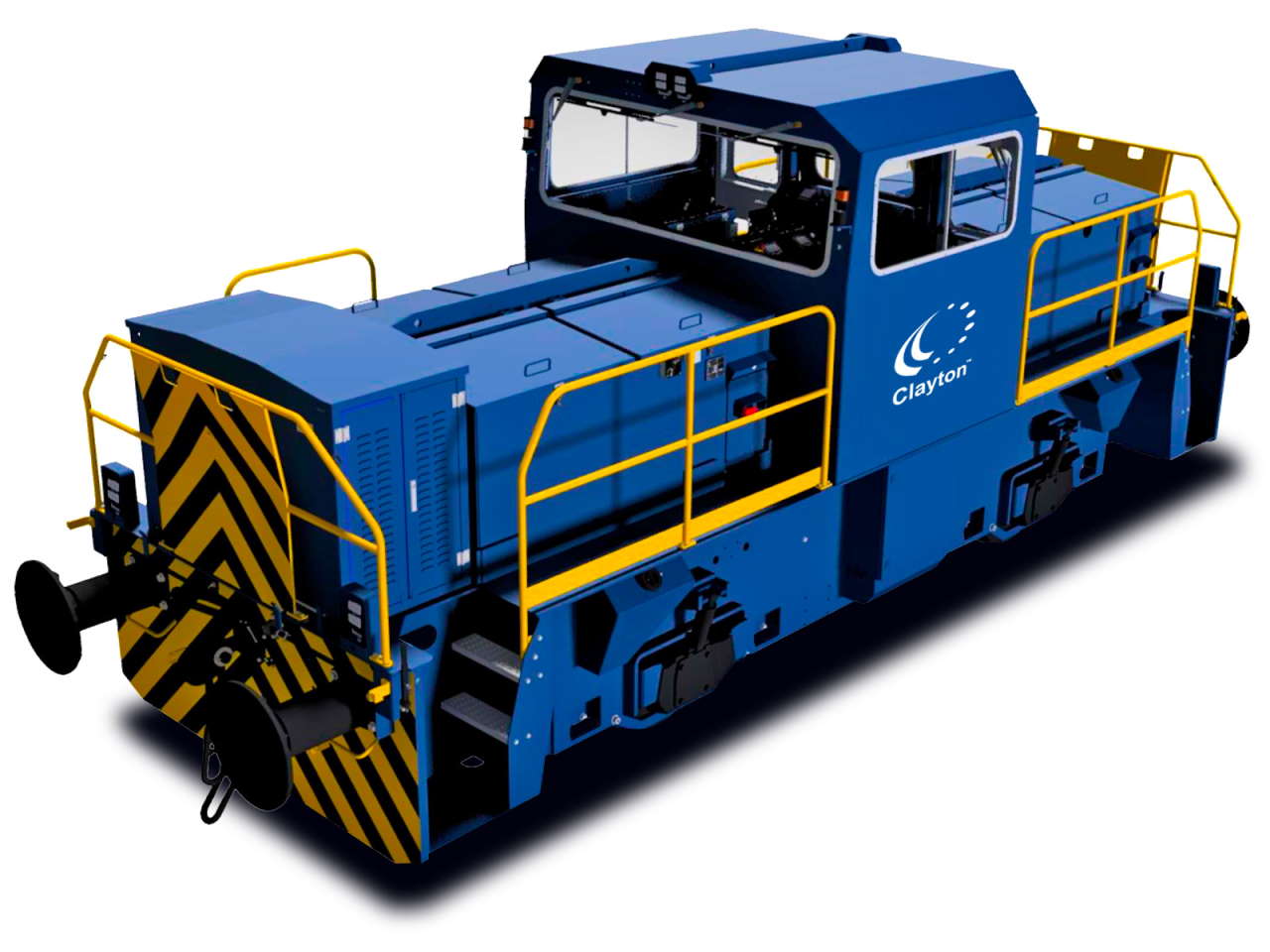
If it's any help in quantifying this, this article shows the capabiluty of the Clayton CB45 battery shunter.

The CB45 has onboard chargers where battery charging comes from a 3-phase supply and uses regenerative braking to return energy back to the battery. It is designed for long-range use without recharging, with a range of up to 450 km unladen, 16 km with a load of 1,200 tonnes, and a maximum haulage capacity of 3,000 tonnes that is limited by the rating of the coupler. Tractive Effort is up to 180 kN.

Even the battery on the Class 93 is probably big enough for shunting off the wires, without needing to fire up the diesel. The 80kWh battery stores the kinetic energy of a 1000T train at 55mph. Which is enough energy to accelerate that weight to 5.5mph one hundred times (assuming no other drains on the system, and no regenerative braking). That should be plenty to shunt the even the most complex intermodals on flat sidings.
 

Bald Rick

Veteran Member
Joined
28 Sep 2010
Messages
35,817
Even the battery on the Class 93 is probably big enough for shunting off the wires, without needing to fire up the diesel. The 80kWh battery stores the kinetic energy of a 1000T train at 55mph. Which is enough energy to accelerate that weight to 5.5mph one hundred times (assuming no other drains on the system, and no regenerative braking). That should be plenty to shunt the even the most complex intermodals on flat sidings.

two things about traction batteries:

1) overall capacity (kWh or MWh if big enough)
2) amount of power it can provide (kW or MW)

The 93 has 80kWh of battery, with 400kW of Power, which is half as much again as a Class 08 at full power. This will easily be able to provide enough power to shunt - given shunting is usually a minute or two at full power then a couple more at lower power, then braking (where a proportion of the energy used will be recovered), I’d expect there to be enough in the batteries for an hour or so of shunting.

The batteries will also provide enough power to accelerate a train up to a decent speed - someone better than me can do the maths but I reckon it can get to 20mph in a minute or so and stay there for a while.
 

Sad Sprinter

Established Member
Joined
5 Jun 2017
Messages
3,186
Location
Way on down South London town
Not at all. But we do need to retain some grasp of the concept of 'efficiency' of resource and capacity utilisation.

It may well be that short links to terminals are best addressed by multi-mode locomotives for the 'last mile' whilst there are considerable benefits (not just for freight) in wiring lines of route as @zwk500 has pointed out.

Why? Why not just electrify one mile on track?
 

Nottingham59

Established Member
Joined
10 Dec 2019
Messages
3,334
Location
Nottingham
The batteries will also provide enough power to accelerate a train up to a decent speed
theorectically 80kWh will get a 1000 tonne train to 55mph. A bit less in reality as there will always be some losses in the system. But plenty to get a 93 with a full intermodal out of a freight terminal on level ground. And there is always the diesel engine for back up if necessary
 

Meerkat

Established Member
Joined
14 Jul 2018
Messages
9,276
The 93 has 80kWh of battery, with 400kW of Power, which is half as much again as a Class 08 at full power. This will easily be able to provide enough power to shunt - given shunting is usually a minute or two at full power then a couple more at lower power, then braking (where a proportion of the energy used will be recovered), I’d expect there to be enough in the batteries for an hour or so of shunting.
The ears and noses of the neighbours would welcome that replacing a 66 idling for ages at the end of the garden, occasionally revving up to nudge the train along for the next few aggregate wagons to be unloaded!
 
Status
Not open for further replies.

Top