Our new ticketing site is now live! Using either this or the original site (both powered by TrainSplit) helps support the running of the forum with every ticket purchase! Find out more and ask any questions/give us feedback in this thread!
When Deutsche Bahn says a train has been replaced by an Ersatzzug, what do they mean?
In German it literally means "replacement train", but that suggests a service has been cancelled and a new one has been put in place which has a different route, goes at slightly different times or is a different standard of service to that expected (e.g. IC instead of ICE), but it is intended to be useful to the same passengers. This isn't always the case though. I've been on an Ersatzzug for an ICE, which was also an ICE and went from the same origin to the same destination stopping in the same places - why would that be?
It can be a relief or extra train for a service that was cancelled or delayed or diverted. Or for a private operator who has not got the new trains, ODEG had to rent DB trains for months after winning the RE3 contract 2012.
DB apparently has lots of spare stock in the strategic reserve at Mukran/Ruegen and elsewhere, this is dealt with by a department called "Stillstandsmanagement"/non-moving management.
..
Schienenersatzverkehr, rail replacement traffic, means: bus!
Usually an "Ersatzzug" is just wat the name says: a replacement train. It may be different rolling stock, but also a different unit of the same type of stock than originally planned.
For your example it might be that a previous ICE never reached it's destination (or, very likely at DB, had a significant delay) and thus was replaced by another ICE to allow the return service to run on time.
And indeed it might be also something like @LSWR Cavalier mentioned: a spare train composition. That's happening sometimes at Amsterdam - Berlin for example: a spare composition of older carriages is then used in Germany, which then usually terminates at Bad Bentheim as it isn't allowed across the border. Occasionally that would result in an other "ersatzzug" for the Dutch part, although we don't have a special name for that here.
There is a small number of standby sets (still L/H I think) dotted around, to cope with major disruption.
However, Ersatzzug can simply mean a different unit, with a different seating layout, running in the booked timings but with a different train number "to avoid confusion" - TBH I find it confusing!
Most often simply another set as planned. Which means the biggest efffect might be that the reserved seats are not there or in another order, but mostly not indicated as promised when done. You can get a voucher for its worth if you take the trouble to do that.
(as a side: DB promised me 10€ voucher if I used the ´comfort check in´ on my last trip, which I did not-all the hassle with apps. Still I got that voucher last week, but have to use i till 31/1 for MIN worth of 39€, more as I usually spend on a ticket-plus that I am far away in Asia now).
That suddenly a set comes from Rúgen (the island in the far north-east toward Poland, former DDR) would be extremely rare in sudden cases.
In Switzerland, it generally means a different unit to the one planned too - sometimes a loco-hauled spare set substituting for what's usually a multiple unit.
Apart from "it may look different to the train you're expecting and seat reservations might not be present", I think Ersatzzug also tells passengers that if they're say at B on an A - B - C train and an Ersatzzug is announced to C, then the train might not have come from A, so if you're waiting for someone supposed to arrive on that train you might be out of luck.
In Switzerland, it generally means a different unit to the one planned too - sometimes a loco-hauled spare set substituting for what's usually a multiple unit.
Apart from "it may look different to the train you're expecting and seat reservations might not be present", I think Ersatzzug also tells passengers that if they're say at B on an A - B - C train and an Ersatzzug is announced to C, then the train might not have come from A, so if you're waiting for someone supposed to arrive on that train you might be out of luck.
Before the new Bombardier carts appeared on SBB IR/IC services, there were sets of Re4/4II+EWI/EWII push-pull stock kept as standbys at strategic locations around the network (Zürich, Basel, Lausanne etc) for use as needed. A train being announced as "Ersatzzug" was always worth investigating as it might be one of the standby sets - I have seen them used for delays as little as 15mins. However, I do remember being at Basel when an EC from Germany was announced as being very late (some things don't change): SBB kicked out a full EuroCity set (including an - open - restaurant car) with an Re460 as an "Ersatzzug". Bit of luck, as the Re460 was one of my last few required of the class.
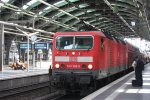
A slightly offbeat example from 2017 in Berlin featured extra regional trains running to cover for a temporarily closed S-Bahn line. In this case the Ersatzzug name was displayed on the screen of the locomotive.
When Deutsche Bahn says a train has been replaced by an Ersatzzug, what do they mean?
In German it literally means "replacement train", but that suggests a service has been cancelled and a new one has been put in place which has a different route, goes at slightly different times or is a different standard of service to that expected (e.g. IC instead of ICE), but it is intended to be useful to the same passengers. This isn't always the case though. I've been on an Ersatzzug for an ICE, which was also an ICE and went from the same origin to the same destination stopping in the same places - why would that be?
Before the new Bombardier carts appeared on SBB IR/IC services, there were sets of Re4/4II+EWI/EWII push-pull stock kept as standbys at strategic locations around the network (Zürich, Basel, Lausanne etc) for use as needed.
The disappearance of the old EW sets was not IMHO directly related to the arrival of new stock - just an economic decision (and there are various types of 'bombardier cart (sic) anyway). The sets in question were themselves known as 'alibizug'. Once deployed the service was an 'ersatzverkehr'
== Doublepost prevention - post automatically merged: ==
In Switzerland, it generally means a different unit to the one planned too - sometimes a loco-hauled spare set substituting for what's usually a multiple unit.
Apart from "it may look different to the train you're expecting and seat reservations might not be present", I think Ersatzzug also tells passengers that if they're say at B on an A - B - C train and an Ersatzzug is announced to C, then the train might not have come from A, so if you're waiting for someone supposed to arrive on that train you might be out of luck.
The most common 'ersatz' provision in Switzerland is to cover trains arriving from outside the country. For years and years the most regular place this happened was Brig and Chiasso, where a domestic trainset was provided to run in the path of a late running train from Italy. Nowadays, German and French trains are often just as late, so 'ersatz' has become more common on other Swiss borders.
I most often see ersatz at Zurich HB or Basel SBB. Very frequently Paris - Basel - Zurich TGVs and ICEs from Germany omit the Basel - Zurich section to make up time, necessitating 'ersatz' provision.
We are aware of an issue with emails from the Forum to Microsoft-based email accounts (hotmail/outlook/live.com email addresses). This is being looked into currently, thanks for your patience meanwhile.