• Our new ticketing site is now live! Using either this or the original site (both powered by TrainSplit) helps support the running of the forum with every ticket purchase! Find out more and ask any questions/give us feedback in this thread!

UK Rail Passenger Numbers Discussion

Status
Not open for further replies.
Sponsor Post - registered members do not see these adverts; click here to register, or click here to log in
R

RailUK Forums

Nicholas Lewis

Established Member
Joined
9 Aug 2019
Messages
8,009
Location
Surrey
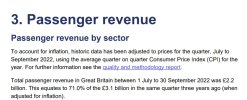
Not sure where you're getting 15-20% from. Passenger usage in the last quarter was 81% of pre-covid levels, compared to 71% for revenue (when adjusted for inflation)
The chart shows c 90% journeys but revenue by sector is down at 71% as per your quote hence my low range of 15-20%.

Bottom line is operators are absorbing 2B more than they were pre covid and as i say we should be thankful that DfT are only seeking a 10% reduction in the 23/24 business plans. What would be good to know is whether DFT are assuming a level of revenue growth which the operators should be asked to confirm is achievable based on service X but if DfT impose cost savings how much that's likely to impact revenue.
 

mrmartin

Established Member
Joined
17 Dec 2012
Messages
1,295
Not sure where you're getting 15-20% from. Passenger usage in the last quarter was 81% of pre-covid levels, compared to 71% for revenue (when adjusted for inflation)
I mean even if covid and strikes didn't happen revenue would surely be down significantly if you adjust for inflation (given fare rises have been significantly below inflation?)
 

modernrail

Established Member
Joined
26 Jul 2015
Messages
1,461
I mean even if covid and strikes didn't happen revenue would surely be down significantly if you adjust for inflation (given fare rises have been significantly below inflation?)
I suppose that depends on how ‘railway inflation’ is running compared to RPI/CPI. It wouldn’t surprise me if ‘railway inflation’ is running higher especially with the UK’s problematic railway maintenance costs compared with other European countries.
 

yorksrob

Veteran Member
Joined
6 Aug 2009
Messages
44,361
Location
Yorks
View attachment 126037
Looks like passenger numbers are still steadily rising even despite the recent disruption
Twitter post


The chart shows c 90% journeys but revenue by sector is down at 71% as per your quote hence my low range of 15-20%.

Bottom line is operators are absorbing 2B more than they were pre covid and as i say we should be thankful that DfT are only seeking a 10% reduction in the 23/24 business plans. What would be good to know is whether DFT are assuming a level of revenue growth which the operators should be asked to confirm is achievable based on service X but if DfT impose cost savings how much that's likely to impact revenue.

Nevertheless, if passenger numbers do continue that upward trend, it will make it more different for the DfT/Treasury/Government to trot out their excuses for cuts.
 

dk1

Veteran Member
Joined
2 Oct 2009
Messages
19,874
Location
East Anglia
Nevertheless, if passenger numbers do continue that upward trend, it will make it more different for the DfT/Treasury/Government to trot out their excuses for cuts.

And their strange stance on not engaging with the trade unions in a timely & constructive manner.
 

absolutelymilk

Established Member
Joined
18 Jul 2015
Messages
1,601
The chart shows c 90% journeys but revenue by sector is down at 71% as per your quote hence my low range of 15-20%.
That revenue figure is for the last quarter (July to September), so should be compared against the 81% of passenger journeys in that period
 

Bald Rick

Veteran Member
Joined
28 Sep 2010
Messages
35,824
Not sure where you're getting 15-20% from. Passenger usage in the last quarter was 81% of pre-covid levels, compared to 71% for revenue (when adjusted for inflation)

AIUI the revenue figures are not adjusted for inflation. (‘Inflation’ in this case being the increase in ticket prices)

Bottom line is operators are absorbing 2B more than they were pre covid and as i say we should be thankful that DfT are only seeking a 10% reduction in the 23/24 business plans.

Strictly speaking it’s not a 10% cut, but that the budgets are not being increased in line with inflation. The budget line for 23/4 is the same as when it was indicatively set this time last year. This means that TOCs have to absorb cost increases by making savings elsewhere, or by not having cost increases.


And their strange stance on not engaging with the trade unions in a timely & constructive manner.

Being cynical, the last part of my last sentence above may have something to do with it?
 
Last edited:

yorksrob

Veteran Member
Joined
6 Aug 2009
Messages
44,361
Location
Yorks
If we do get to the point that passenger numbers are back at 100%, I would suggest that from a political point of view, all talk of revenue lagging behind, support during the pandemic etc will be white noise compared to the "the passengers are back therefore you should not be cutting" argument. Great political capital can then be made from this by the Tories opponents.
 

Bald Rick

Veteran Member
Joined
28 Sep 2010
Messages
35,824
If we do get to the point that passenger numbers are back at 100%, I would suggest that from a political point of view, all talk of revenue lagging behind, support during the pandemic etc will be white noise compared to the "the passengers are back therefore you should not be cutting" argument.

If industry costs were at 100% of Pre Covid, you might have a point.
 

The Ham

Veteran Member
Joined
6 Jul 2012
Messages
12,036
That revenue figure is for the last quarter (July to September), so should be compared against the 81% of passenger journeys in that period

Indeed, on that basis (71/81=0.87654) revenue is ~13% behind passenger numbers.

If we project that forwards to the current 90% passenger numbers it's likely to be 79% of pre Covid levels.

However that's only half the story, as there's still quite a few TOC's running fewer train km's (XC, TPE and Avanti were at 60-65% in the last quarter and I doubt they've got a lot better).

As such the level of support is likely to be lower than the level of passengers indicates.

The chart shows c 90% journeys but revenue by sector is down at 71% as per your quote hence my low range of 15-20%.

Bottom line is operators are absorbing 2B more than they were pre covid and as i say we should be thankful that DfT are only seeking a 10% reduction in the 23/24 business plans. What would be good to know is whether DFT are assuming a level of revenue growth which the operators should be asked to confirm is achievable based on service X but if DfT impose cost savings how much that's likely to impact revenue.

£2bn more over what time period?

If it's over the last 12 months that's no surprise, as there were still significant levels of disruption due to Covid in December last year.

Even if it's a doubling of the income/costs from the last 6 months, the graph posted up thread shows there's still been improvements even though there's been ongoing disruption and so it may well provide a lower than actual figure.

The problem with requiring the 10% cuts is that some are going to be hard to reverse of passenger numbers carry on upwards.

For example GWR getting rid of their HST's and 769's may be difficult to back fill if their passenger numbers reach 100% and the class 80x's are needed back on the routes they were used on pre Covid or on over 100% on other suitable routes which require 80x's.
 

yorksrob

Veteran Member
Joined
6 Aug 2009
Messages
44,361
Location
Yorks
If industry costs were at 100% of Pre Covid, you might have a point.

From a political point of view, it depends which argument wins out in the minds of the voting public.

Bearing in mind, the DfT was only predicting rail travel getting to around 80% and have based their argument for cuts on this. Government will have serious egg mcmuffin on its face if we get to 100% and they're still cutting.
 

Bald Rick

Veteran Member
Joined
28 Sep 2010
Messages
35,824
Bearing in mind, the DfT was only predicting rail travel getting to around 80% and have based their argument for cuts on this.

That’s not correct.

From a political point of view, it depends which argument wins out in the minds of the voting public.

A significant majority of the voting public couldn’t give two hoots about it. Many never use the train, most of those that do use it infrequently and won’t be affected by the service changes, and most of those that are affecte by the service changes will just get in with it and be more worried about other things politically.
 

yorksrob

Veteran Member
Joined
6 Aug 2009
Messages
44,361
Location
Yorks
That’s not correct.


A significant majority of the voting public couldn’t give two hoots about it. Many never use the train, most of those that do use it infrequently and won’t be affected by the service changes, and most of those that are affecte by the service changes will just get in with it and be more worried about other things politically.

The cuts are already causing considerable unreliability. It's only a matter of time before the cull of rolling stock causes widespread overcrowding. It's that sort of thing that will become a running political sore, generating headlines and TV documentaries.
 

Bald Rick

Veteran Member
Joined
28 Sep 2010
Messages
35,824
The cuts are already causing considerable unreliability.

The ‘cuts’ are not doing that, at least not directly. When we had only 50% of the service running in 2020, it was the most reliable service ever!
 

yorksrob

Veteran Member
Joined
6 Aug 2009
Messages
44,361
Location
Yorks
The ‘cuts’ are not doing that, at least not directly. When we had only 50% of the service running in 2020, it was the most reliable service ever!

Yes, it's easy to run a reliable service when there are barely any passengers.
 

Ken H

Established Member
Joined
11 Nov 2018
Messages
6,718
Location
N Yorks
A business that has high fixed costs is very susceptible to fluctuations in demand. Volume car manufacture is high fixed cost (huge tooling costs for a new model) to a small reduction in sales can badly affect bottom line
A bar can cut costs. Can cut staff and order less beer. So is less vulnerable.
Railway is rich in capital. The infrastructure, trains. But high staff costs too. To get a 10% cut in costs would mean lots of staff cuts
OK you can cut spend on stuff like track maintenance and refurbing trains. But then quality starts to decline and thats hard to get back.
 

modernrail

Established Member
Joined
26 Jul 2015
Messages
1,461
Really good point - my company is encouraging people to book in advance and we always avoid 1st class when travelling for business.

I have heard a lot about empty peak time trains, with off peak services being rammed. The UK railways are not as bad as some for their focus on the '9-5 commuter', but certainly it was still an important demographic to them.

People are still travelling, but price sensitivity is higher, like you say and the trips have changed. What needs to happen is that Government, Industry and Unions figure out how they are going to make the railway more flexible and passenger driven. Maybe in the medium/long term we see the commuters come back in even bigger numbers than before, maybe we don't. Now more than ever we need to put evidence and long term strategy at the heart of everything we do :lol::lol::lol:

I do think the leisure boost has been due to the following reasons:
  • People with more flexible working spend less time travelling during the week, freeing time and money to do more discretionary travel on the weekends. (This seems very positive from a social point of view.)
  • We realise the value of seeing friends/family and visiting new places after the covid lockdowns.
  • Long term trends towards rail for leisure - especially as these trips tend to be longer distance and even if it isn't quite as fast, people value not having the stress of driving, especially if it is their downtime.

When I worked in Leeds we referred to the Anytime fares as the tax on the north. I was working in a regeneration team at the time and we all found it amusing that the Government thought one of the ways to close the north south divide was to charge companies in Liverpool, Manchester, Leeds and Newcastle significantly more to access London over 175 year old paid down infrastructure than it costs business in London to access Paris and Brussels on pretty new infrastructure including a rather large under sea tunnel.

Only in the UK could such ‘Government’ persist.

The pent up demand to access most train routes is massive and always will be when road congestion is too bad and we live in such a densely populated country.
 

43074

Established Member
Joined
10 Oct 2012
Messages
2,253
A significant majority of the voting public couldn’t give two hoots about it. Many never use the train, most of those that do use it infrequently and won’t be affected by the service changes, and most of those that are affecte by the service changes will just get in with it and be more worried about other things politically.
There aren't many service industries where the attitude towards a worse service being provided is essentially "tough, who cares?"
 

philosopher

Established Member
Joined
23 Sep 2015
Messages
1,513
A significant majority of the voting public couldn’t give two hoots about it. Many never use the train, most of those that do use it infrequently and won’t be affected by the service changes, and most of those that are affecte by the service changes will just get in with it and be more worried about other things politically.
But if the service becomes too bad, people will stop using the train, either they will WFH more or switch to car, coach / bus or air travel. If a passenger ends up standing half the time they take a long train journey of say more than an hour there is a fair chance they will switch to another form of transport for that journey. Then you get a vicious cycle of decline.

There aren't many service industries where the attitude towards a worse service being provided is essentially "tough, who cares?"
A business that had that kind of attitude would probably find themselves out of business
 

Starmill

Veteran Member
Joined
18 May 2012
Messages
27,284
Location
Bolton
There aren't many service industries where the attitude towards a worse service being provided is essentially "tough, who cares?"
Unfortunately, that's the attitude I'd accuse the government in England of taking towards nearly all publicly-funded services.
 

Bald Rick

Veteran Member
Joined
28 Sep 2010
Messages
35,824
There aren't many service industries where the attitude towards a worse service being provided is essentially "tough, who cares?"

But if the service becomes too bad, people will stop using the train, either they will WFH more or switch to car, coach / bus or air travel. If a passenger ends up standing half the time they take a long train journey of say more than an hour there is a fair chance they will switch to another form of transport for that journey. Then you get a vicious cycle of decline.


A business that had that kind of attitude would probably find themselves out of business

Sorry, it wasn’t my intention to display that attitude, apologies of that‘s how it came over.

What I mean is, that for the vast majority of the electorate, changes to the rail service will not affect them one bit. And for those for whom it does affect (like me, for example) - it is frankly a minor point compared to many of the other things going on in wider society that will cause me to consider who I vote for.

There will, of course, be some people who are badly affected, and that will cause them to ‘get political’. But it will be a very small fraction of the electorate.
 

E27007

Member
Joined
25 May 2018
Messages
1,042
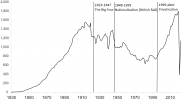
Please define what you mean by passenger numbers being down on a massive scale, by comparing them to past years?

Are we talking lower than the lowest point in the early 90's (<0.7bn passengers using the railways)?

Are we talking about that sort of level (circa 0.8bn passengers)

What about by the year 2000, when things had started to recover and things are on the up (circa 1bn)?

What about by the year 2010 when there has been a decade of growth and things were looking good (if very overcrowded at about 1.2bn)?

What about by the year 2014 (about 1.4bn)?

Clearly we're not at the pre Covid levels (1.8bn), however given we were at very very low levels during Covid how close do we have to get (whilst there's still ongoing growth) before significant cuts can be parked to see how things pan out (not no cuts, there could be some cuts, however these should be considered and measured and not just a knee jurk reaction)?
UK passenger numbers from 1829 to 2015
 

Attachments

  • GBR_rail_passengers_by_year_1830-2015.png
    GBR_rail_passengers_by_year_1830-2015.png
    50.2 KB · Views: 110

josh-j

Member
Joined
14 Sep 2013
Messages
323
Sorry, it wasn’t my intention to display that attitude, apologies of that‘s how it came over.

What I mean is, that for the vast majority of the electorate, changes to the rail service will not affect them one bit. And for those for whom it does affect (like me, for example) - it is frankly a minor point compared to many of the other things going on in wider society that will cause me to consider who I vote for.

There will, of course, be some people who are badly affected, and that will cause them to ‘get political’. But it will be a very small fraction of the electorate.
The continued persistence by the government in messing up rail travel and not aiming for a growth in rail travel and public transport use more generally, is that people are stuck in ever worsening traffic while more and more land is used for road building.

It may well be the case that lots of people don't think this affects them, but it very much does, and frankly the only sensible way forward is to properly fund and operate public transport. The argument is even stronger in dense urban areas but really affects everybody who travels in one way or another.
 

yorksrob

Veteran Member
Joined
6 Aug 2009
Messages
44,361
Location
Yorks
UK passenger numbers from 1829 to 2015

Interesting graph, which shows that passenger usage is now around that of the "golden age" of rail, i.e. the big four.

Yet the clueless half-wits in charge are still insisting on damaging and self-defeating cuts.
 

slowroad

Member
Joined
23 Jul 2021
Messages
371
Location
Wales
The continued persistence by the government in messing up rail travel and not aiming for a growth in rail travel and public transport use more generally, is that people are stuck in ever worsening traffic while more and more land is used for road building.

It may well be the case that lots of people don't think this affects them, but it very much does, and frankly the only sensible way forward is to properly fund and operate public transport. The argument is even stronger in dense urban areas but really affects everybody who travels in one way or another.
Trouble is, over most of the country public transport use is so low that even a proportionately large - and very expensive - increase would have minimal effect on road traffic volumes, which were growing at around one per cent a year (pre- Covid, admittedly).
 
Status
Not open for further replies.

Top