• Our new ticketing site is now live! Using either this or the original site (both powered by TrainSplit) helps support the running of the forum with every ticket purchase! Find out more and ask any questions/give us feedback in this thread!

Bus Manufacturer News & Discussion

Mikey C

Established Member
Joined
11 Feb 2013
Messages
8,285
As an aside, would Wrightbus have been better off just sticking to bodying Volvos (and other chassis), rather than going the integral route? They could have been Volvo's partner for the BZL in the UK.
 
Sponsor Post - registered members do not see these adverts; click here to register, or click here to log in
R

RailUK Forums

Goldfish62

Veteran Member
Joined
14 Feb 2010
Messages
13,235
As an aside, would Wrightbus have been better off just sticking to bodying Volvos (and other chassis), rather than going the integral route? They could have been Volvo's partner for the BZL in the UK.
MCV are Volvo's exclusive partner for the UK local bus market.

== Doublepost prevention - post automatically merged: ==

They seem to be doing alright with the amount of orders they have in hand.
When I was at the NEC last month I asked someone from Wright's why they didn't have a stand. He replied, "we don't need to. Our order books are full".
 

Tom Gallacher

Member
Joined
19 Mar 2021
Messages
276
Location
Glasgow
When I was at the NEC last month I asked someone from Wright's why they didn't have a stand. He replied, "we don't need to. Our order books are full".
With that kind of attitude they'll soon be going under again. Any business minded person will tell you that the best time to advertise is when you're doing well. Advertising is primarily about gaining future orders not resting on your laurels with what you currently have.
 

Mikey C

Established Member
Joined
11 Feb 2013
Messages
8,285
MCV are Volvo's exclusive partner for the UK local bus market.
But that's only since Wrights decided to start producing their own chassis. Once that happened (along with Optare giving up on the bodying other people's chassis) it was an open invitation for someone like MCV to come in.
 

Goldfish62

Veteran Member
Joined
14 Feb 2010
Messages
13,235
But that's only since Wrights decided to start producing their own chassis. Once that happened (along with Optare giving up on the bodying other people's chassis) it was an open invitation for someone like MCV to come in.
Yes, that right. So as I said MCV is the exclusive partner to Volvo. I wasn't referring to the past.
 

scosutsut

Established Member
Joined
1 Jan 2019
Messages
1,225
Location
scosutsut
So have they moved away from ADL? As in E400XLB no longer available?
I guess we'll find out if/when Lothian Buses order any B5TL or B8TL chassis. The last batches were Alexander built, but the last B8RLEs had MCV bodywork and appear to have impressed.
 

Mikey C

Established Member
Joined
11 Feb 2013
Messages
8,285
Yes, that right. So as I said MCV is the exclusive partner to Volvo. I wasn't referring to the past.
The point I was making though, was that if Wrights hadn't started making their own chassis, then Volvo wouldn't have made MCV an exclusive partner. Indeed MCV might never have got their foothold in the UK without the initial support of Volvo, who found themselves short of UK bodywork partners.
 

Snow1964

Established Member
Joined
7 Oct 2019
Messages
11,296
Location
West Wiltshire
Wrightbus have announced that the GB kite electric single deck has started production. It was launched few months back.

Wrightbus has announced that its GB Kite Electroliner electric bus is in production in Ballymena, Northern Ireland.

This model makes Wrightbus the only UK bus manufacturer to offer four zero-exhaust-emission vehicles, joining its double and single-decker Hydroliner buses and the double-decker Electroliner battery-electric bus.

 
Joined
31 Dec 2021
Messages
834
Location
Glasgow
I think Volvo diversifying it’s build partners is certainly a good thing especially seeing that Wrights orginally went bust.

ADL's 400XLB and MCV's Evora, EvoSeti & BZL keep Volvo comfortable. The ADL 400XLB is ment to be Alexander's UK equivalent of the Enviro 500 sold in other markets and its biggest problem is its lack of rear wheel steering as an option. ADL advertises it at 13.4m only, despite Volvo offering a range of chassis sizes for it, evident by the fact that in other markets the Volvo B8L chassis has been used in 12 & 12.8m tri-axles.

What’s odd is the fact that Volvos B11RLE chassis is basically the same layout, only with a larger engine and, importantly, rear wheel steering. If the Enviro 500 can have an active tag axle as an option it likely could be fitted to a B8L Chassis.

I believe when Wright went into liquidation they did have orders to complete for Volvo. Once completed they cut ties with Volvo, allowing more profit margin per build for Wright making their own integrals instead of Volvo obviously taking a cut for their chassis.

I guess we'll find out if/when Lothian Buses order any B5TL or B8TL chassis. The last batches were Alexander built, but the last B8RLEs had MCV bodywork and appear to have impressed.
The 400XLB has a B8L chassis, it uses a longitudinally mounted engine hence the lack of “T” in the chassis name.

MCV Evolution 2/Evora B8RLE chassis vehicles are particularly well refined, some of the best I’ve travelled on and driven.
 
Last edited by a moderator:

Snow1964

Established Member
Joined
7 Oct 2019
Messages
11,296
Location
West Wiltshire
MCV which is based in Egypt, is setting up in Bestwig, Germany

Called MCV, which stands for “Manufacturing Commercial Verhicles,” it is based in Cairo, Egypt, but is the new electric bus manufacturer that has landed on the German market, making its base in the city of Bestwig. Breaking the news is Urban Transport, which points out that the first vehicles by MCV Deutschland GmbH will be unveiled next spring. In MCV’s sights are alternative battery and hydrogen traction systems.

At the top of the new entity is Pierre Dellori, who came from Iveco-Bus, Jochen Grau, who also moved from Iveco-Bus to MCV, and Uwe Schneider, who with his STS Schneider Technik und Service GmbH will be in charge of the after-sales area of MCV’s buses. STS is an experienced partner in the field of bus service. It has worked for Iveco-Bus so far and will continue to do so in addition to its activities for MCV.

Its not clear if Volvo will continue to build chassis and send them to Egypt. The references of staff moving from Iveco-bus might suggest different combinations will be produced in due course.


Jordan Adam

Established Member
Joined
12 Sep 2017
Messages
5,656
Location
Aberdeen
ADL advertises it at 13.4m only, despite Volvo offering a range of chassis sizes for it, evident by the fact that in other markets the Volvo B8L chassis has been used in 12 & 12.8m tri-axles.
I'd imagine this comes down to capacity rather than vehicle length, a 12M Enviro400XLB would have around the same capacity as the long wheelbase 11.5M Enviro400MMC. ADL won't want two different products competing for what is a relatively small/niche market segment.
 
Last edited by a moderator:
Joined
31 Dec 2021
Messages
834
Location
Glasgow
I'd imagine this comes down to capacity rather than vehicle length, a 12M Enviro400XLB would have around the same capacity as the long wheelbase 11.5M Enviro400MMC. ADL won't want two different products competing for what is a relatively small/niche market segment.
A 12m tri-axle actually has less wheelbase space on the lower deck between the front and drive axle, compared to the 400MMC at 11.5m, as for turning circle, if a 12m tri-axle has rear wheel steering it’s turning circle would be notably better at the expense of extra tail swing.

A 12.8m variety of tri-axle with dual-doors closely has similar seated capacity to the 400MMC at 11.5m
 

Mikey C

Established Member
Joined
11 Feb 2013
Messages
8,285
I think Volvo diversifying it’s build partners is certainly a good thing especially seeing that Wrights orginally went bust.

ADL's 400XLB and MCV's Evora, EvoSeti & BZL keep Volvo comfortable. The ADL 400XLB is ment to be Alexander's UK equivalent of the Enviro 500 sold in other markets and its biggest problem is its lack of rear wheel steering as an option. ADL advertises it at 13.4m only, despite Volvo offering a range of chassis sizes for it, evident by the fact that in other markets the Volvo B8L chassis has been used in 12 & 12.8m tri-axles.
It's not that diverse, seeing that virtually all UK market Volvos are now bodied by MCV. The E400XLB is a niche product.
 
Joined
31 Dec 2021
Messages
834
Location
Glasgow
It's not that diverse, seeing that virtually all UK market Volvos are now bodied by MCV. The E400XLB is a niche product.
This is of course excluding Plaxton or Caetano coaches as well as a number of other coach builders. Once upon a time Wright was almost always the default builder for buses with Volvo chassis in the UK.

The outright diversity that I’m talking about is ensuring there are options for diesel, electric, singles and doubles including tri-axles however niche they may be.

Volvo may be limited to the number of body suppliers it can have if those bodywork builders aren’t willing to design bodywork around a Volvo chassis. I am almost certain that at an operator in Scotland had asked ADL to build on the B8RLE chassis but ADL simply said they would not design a bodywork for the Volvo B8RLE chassis but even at the time when Wright was building on Volvo chassis they would not create the longest B8L Tri-Axle for Lothian Buses.

I assume that the 400XLB from ADL was simply an easy solution given that the Enviro 500 and its body will not be greatly different from the Volvo chassis solution.
 

Cesarcollie

Member
Joined
5 Jun 2016
Messages
839
This is of course excluding Plaxton or Caetano coaches as well as a number of other coach builders. Once upon a time Wright was almost always the default builder for buses with Volvo chassis in the UK.

The outright diversity that I’m talking about is ensuring there are options for diesel, electric, singles and doubles including tri-axles however niche they may be.

Volvo may be limited to the number of body suppliers it can have if those bodywork builders aren’t willing to design bodywork around a Volvo chassis. I am almost certain that at an operator in Scotland had asked ADL to build on the B8RLE chassis but ADL simply said they would not design a bodywork for the Volvo B8RLE chassis but even at the time when Wright was building on Volvo chassis they would not create the longest B8L Tri-Axle for Lothian Buses.

I assume that the 400XLB from ADL was simply an easy solution given that the Enviro 500 and its body will not be greatly different from the Volvo chassis solution.

I suspect it all depends on the number you want to order. If any of the big groups came along and said we want 300 Volvo chassis with a body by (insert chosen bodybuilder here) both Volvo and the bodybuilder would work together to come up with a product!
 

CBlue

Member
Joined
30 Mar 2020
Messages
859
Location
East Angular
I suspect it all depends on the number you want to order. If any of the big groups came along and said we want 300 Volvo chassis with a body by (insert chosen bodybuilder here) both Volvo and the bodybuilder would work together to come up with a product!
Exactly.

Plaxton developed the interdeck and the original 15 metre long tri-axle Panther/Volvo B12B originally as bespoke orders for Stagecoach who wanted high capacity fleets for Megabus. I believe the Panther LE was borne out of a Stagecoach design spec too.

Likewise London orders caused ADL to modify their E400MMMC body to fit the Volvo B5LH, and before that producing some E400 bodied B9TLs for Dublin Bus. One curio was the unique E400 bodied B7TL SN56AWX which recently entered preservation.


It's not like the days of East Lancs who seemingly seemed happy to plonk their bodywork onto just about any chassis an operator wanted, creating a number of "one-off" vehicles through the 80s and 90s...
 
Last edited:

johnw

Member
Joined
22 May 2013
Messages
176
Alexander Dennis have always said that they would prefer half an order (bodywork) than no order, hence the 100s of Scania / Enviro400 with Stagecoach. I thought at the time it was Covid that stopped ADL developing an MMC body for the B8RLE for Lothian. They certainly adapted the MMC for the B5TL.

What is interesting is the amount of short heavyweight B8RLE / MCV are appearing around the UK.
 

ClydeCoaster

Member
Joined
31 Jul 2019
Messages
203
Spotted a bright yellow Mellor Sigma 8 in Kilwinning yesterday, MX72HKZ with 'Shuttle Buses' in the destination. I originally thought it was a demonstrator but the company has confirmed on their Facebook page they've taken the very first Mellor Sigma 8s to enter service, with a second due to arrive today.

It was out on driver familiarisation across their small route network. The social media post also seems to hint that the yellow is a base colour as we've to expect to see them in fleet livery in the new year.


We are happy to say that the first of our brand new electric buses has arrived at our depot today, with a second on the way tomorrow. These are the first Sigma 8s in operation in the UK!
We have been out trialling this first one on a couple of our routes so expect to see these out on the roads in our livery in the New Year!
 

Volvodart

Established Member
Joined
12 Jun 2010
Messages
2,958
Spotted a bright yellow Mellor Sigma 8 in Kilwinning yesterday, MX72HKZ with 'Shuttle Buses' in the destination. I originally thought it was a demonstrator but the company has confirmed on their Facebook page they've taken the very first Mellor Sigma 8s to enter service, with a second due to arrive today.

It was out on driver familiarisation across their small route network. The social media post also seems to hint that the yellow is a base colour as we've to expect to see them in fleet livery in the new year.

See:-


ClydeCoaster

Member
Joined
31 Jul 2019
Messages
203
Yes I'm well aware they had them on order, I'm simply pointing out they have the first production examples and they've been delivered.
 

scosutsut

Established Member
Joined
1 Jan 2019
Messages
1,225
Location
scosutsut
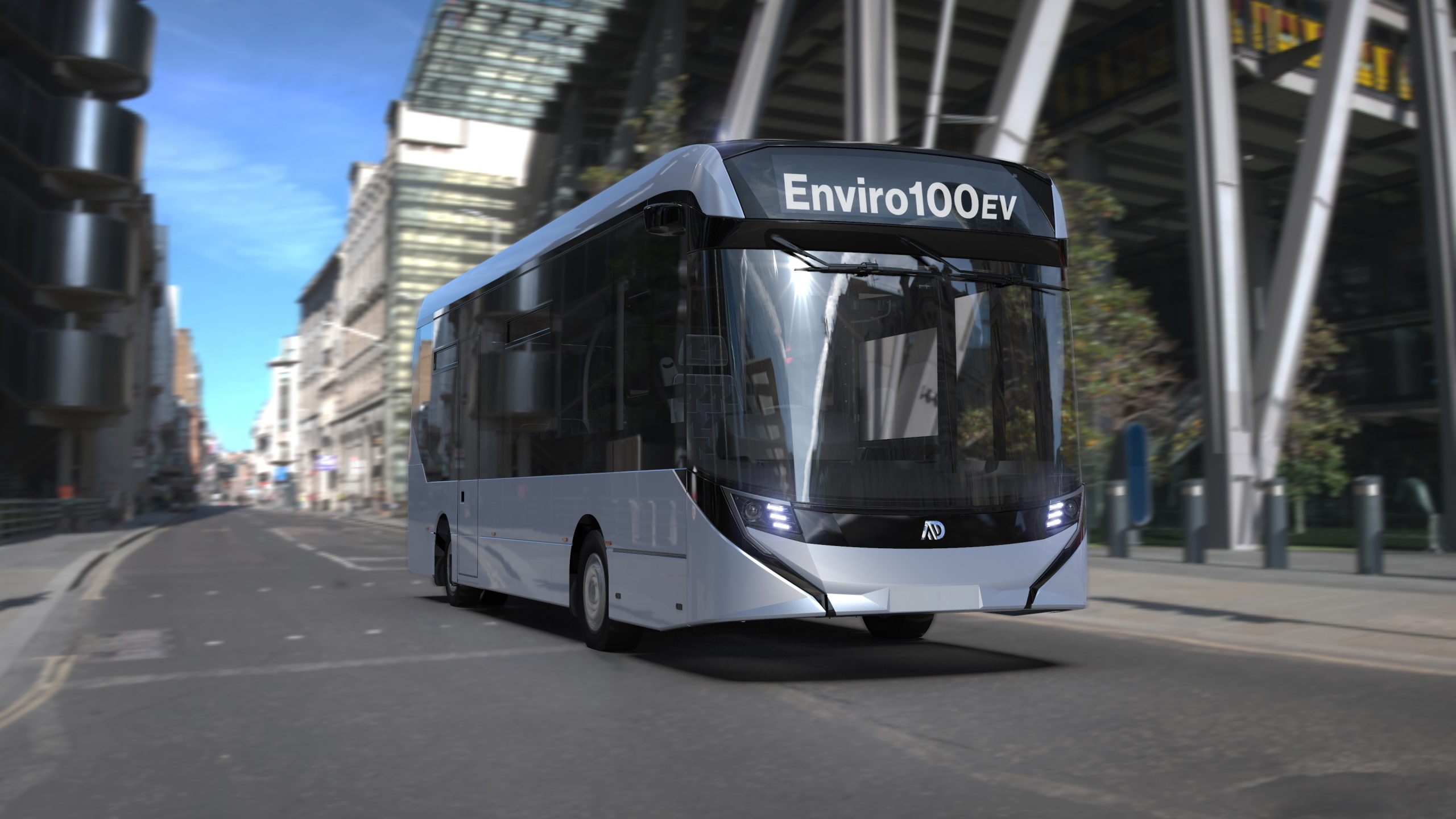
A detailed article on Route One focusing on the new Alexander Dennis Enviro 100 EV but it also has an image showing a 200 EV, and 500 EV alongside the announced 100 and 400 models.

Not a surprise, but first official recognition of the intentions far as I can tell?

Still trotting the BYD options remain available but suspect that will only be long enough for these to come on stream and gain traction / orders then it will be BYE not BYD!

Article link: https://www.route-one.net/news/alexander-dennis-enviro100ev-small-bus-redefined/

Article copy:
Alexander Dennis Enviro100EV: Small bus redefined?
By Tim Deakin -January 19, 2023

Alexander Dennis Enviro100EV
As the smallest member of the latest-generation Alexander Dennis battery-electric bus range, the Enviro100EV is what the manufacturer describes as “a white space product.” That is because it has effectively been designed on a clean sheet of paper.

The OEM believes that the Enviro100EV – at 8.5m long and 2.35m wide and with a door forward layout – will satisfy what Head of Concepts and Advanced Engineering Jamie Wilson believes is “a lot of pent-up demand” for such a product.

The Enviro100EV will be seen in the metal later this year. The first example will be a test and evaluation vehicle and the second a demonstrator. Although Alexander Dennis is coy on orders, it has confirmed that at least one deal has been completed. The first customer bus will thus also debut in 2023.

To begin with, Alexander Dennis is focusing the Enviro100EV on the domestic provincial market. But design provision has been made for a Transport for London-compliant version to follow – potentially in mid-2024 – and interest has already been received from both right- and left-hand drive export markets.

Enviro100EV is versatile bus for provincial market
Jamie points at two factors that he believes make the Enviro100EV ideally suited to provincial use cases. One is its size; a compact footprint will see it appeal to smaller, retail customers in addition to larger buyers. The other relates to increasing political awareness of the importance of first- and last mile transport in the decarbonisation space, an area that the OEM says the model will suit.
Meanwhile, provision of a maximum of 354kW/h of battery capacity combined with a gross vehicle weight of 11,600kg promises a range of up to 285 miles.

Average energy consumption projected by Alexander Dennis’s own modelling tool sits between 0.6-0.7kW/h per kilometre. That means the Enviro100EV will be capable of a full day’s work on higher-mileage rural services without recharging.

Jamie describes the Enviro100EV as “unique.” However, the concept of such a small bus has been on the NFI Group subsidiary’s radar for some time. Initially, it was expected to debut in diesel-powered form. Thoughts then turned to a diesel-electric hybrid, but a market rapidly shifting towards zero-emission realigned plans further.

“We looked at what we were doing with our own battery-electric range and how we could apply that to a small bus,” Jamie explains. “We quickly found that we could deliver a nice solution and leverage what we had already. There is a lot of family commonality, but the Enviro100EV has also been designed as a standalone product.”

DF layout key to Enviro100EV, Alexander Dennis believes​

Adoption of the door forward arrangement is something that Alexander Dennis says came from consultation with operators. Jamie notes that for a portion of the early development period, the OEM had expected the Enviro100EV to materialise in a wheel forward layout.

He explains that achieving the legally required ‘throat’ space by the cab and between the front wheels is challenging on a narrow, door forward bus, but that the work involved in doing so is outweighed by the benefits to the customer.

“It also gives standardisation with our other buses. We want operators to be able to put a driver in any Alexander Dennis product and for them to have a familiar environment.

“We explored a wheel forward arrangement; we would have been silly not to, but we reviewed it critically and concluded that it was not the best way.” He adds that manoeuvrability will be better with a set-back front axle.

Passenger environment a priority during design process​

The OEM splits what it views as the Enviro100EV’s positive design features into two camps: Those for the passenger, and those for the operator, although there is some crossover. 17.5in wheels were chosen to maximise cabin space. The rear axle is from Dana with drive taken via a single Voith motor, and the front unit is from Brist. Both are air suspended.

Jamie says that the 17.5in rims are “right sized” to the bus. Larger wheels would pose a challenge to the overall design; those specified allow the gangway to be as wide as possible, and they permit to be mounted above the front axle inward-facing seats that require no steps to access. Two of those are on the offside and one on the nearside out of an overall seated capacity of 25.

“We set out to make the Enviro100EV for the people that use it,” Jamie continues. He describes modern buses as effectively being “shrink wrapped” around the drivetrain, such is the complexity of accommodating all that is needed while maintaining an acceptable passenger environment.


routeone news


Home Bus

Alexander Dennis Enviro100EV: Small bus redefined?​

By
Tim Deakin
-
January 19, 2023
https://www.facebook.com/sharer.php...ander-dennis-enviro100ev-small-bus-redefined/
https://twitter.com/intent/tweet?te...o100ev-small-bus-redefined/&via=@routeoneteam

https://www.linkedin.com/shareArtic...nder+Dennis+Enviro100EV:+Small+bus+redefined?
Alexander Dennis Enviro100EV
As the smallest member of the latest-generation Alexander Dennis battery-electric bus range, the Enviro100EV is what the manufacturer describes as “a white space product.” That is because it has effectively been designed on a clean sheet of paper.
The OEM believes that the Enviro100EV – at 8.5m long and 2.35m wide and with a door forward layout – will satisfy what Head of Concepts and Advanced Engineering Jamie Wilson believes is “a lot of pent-up demand” for such a product.
The Enviro100EV will be seen in the metal later this year. The first example will be a test and evaluation vehicle and the second a demonstrator. Although Alexander Dennis is coy on orders, it has confirmed that at least one deal has been completed. The first customer bus will thus also debut in 2023.
To begin with, Alexander Dennis is focusing the Enviro100EV on the domestic provincial market. But design provision has been made for a Transport for London-compliant version to follow – potentially in mid-2024 – and interest has already been received from both right- and left-hand drive export markets.

Enviro100EV is versatile bus for provincial market​

Jamie points at two factors that he believes make the Enviro100EV ideally suited to provincial use cases. One is its size; a compact footprint will see it appeal to smaller, retail customers in addition to larger buyers. The other relates to increasing political awareness of the importance of first- and last mile transport in the decarbonisation space, an area that the OEM says the model will suit.
Indicative rendering of new bus interior
A rendering of an indicative interior layout shows that the Enviro100EV is set to have a lot in common with other Alexander Dennis bus models; that is deliberate, the manufacturer says
Meanwhile, provision of a maximum of 354kW/h of battery capacity combined with a gross vehicle weight of 11,600kg promises a range of up to 285 miles.
Average energy consumption projected by Alexander Dennis’s own modelling tool sits between 0.6-0.7kW/h per kilometre. That means the Enviro100EV will be capable of a full day’s work on higher-mileage rural services without recharging.
Jamie describes the Enviro100EV as “unique.” However, the concept of such a small bus has been on the NFI Group subsidiary’s radar for some time. Initially, it was expected to debut in diesel-powered form. Thoughts then turned to a diesel-electric hybrid, but a market rapidly shifting towards zero-emission realigned plans further.
“We looked at what we were doing with our own battery-electric range and how we could apply that to a small bus,” Jamie explains. “We quickly found that we could deliver a nice solution and leverage what we had already. There is a lot of family commonality, but the Enviro100EV has also been designed as a standalone product.”

DF layout key to Enviro100EV, Alexander Dennis believes​

Adoption of the door forward arrangement is something that Alexander Dennis says came from consultation with operators. Jamie notes that for a portion of the early development period, the OEM had expected the Enviro100EV to materialise in a wheel forward layout.
He explains that achieving the legally required ‘throat’ space by the cab and between the front wheels is challenging on a narrow, door forward bus, but that the work involved in doing so is outweighed by the benefits to the customer.
Alexander Dennis Enviro100EV rear view
Use of 17.5in wheels on the Enviro100EV is also deliberate; they maximise passenger capacity and space within the bus interior, and minimise the height of steps up to and within the rear section

“It also gives standardisation with our other buses. We want operators to be able to put a driver in any Alexander Dennis product and for them to have a familiar environment.

“We explored a wheel forward arrangement; we would have been silly not to, but we reviewed it critically and concluded that it was not the best way.” He adds that manoeuvrability will be better with a set-back front axle.

Passenger environment a priority during design process​

The OEM splits what it views as the Enviro100EV’s positive design features into two camps: Those for the passenger, and those for the operator, although there is some crossover. 17.5in wheels were chosen to maximise cabin space. The rear axle is from Dana with drive taken via a single Voith motor, and the front unit is from Brist. Both are air suspended.

Jamie says that the 17.5in rims are “right sized” to the bus. Larger wheels would pose a challenge to the overall design; those specified allow the gangway to be as wide as possible, and they permit to be mounted above the front axle inward-facing seats that require no steps to access. Two of those are on the offside and one on the nearside out of an overall seated capacity of 25.

“We set out to make the Enviro100EV for the people that use it,” Jamie continues. He describes modern buses as effectively being “shrink wrapped” around the drivetrain, such is the complexity of accommodating all that is needed while maintaining an acceptable passenger environment.
Alexander Dennis Enviro100EV in London red
Although the Enviro100EV will initially be positioned to meet demand in the provincial market, Alexander Dennis has design protected it to meet Transport for London and export requirements in the medium term

The first aisle step comes immediately ahead of the drive axle, with one more to reach the rear row of seats. Use of small wheels has been beneficial in enabling those steps to be kept shallow. Despite its narrow width, the Enviro100EV will be compatible with the Alexander Dennis SmartSeat.

Future-proofed battery arrangement caters for future shifts​

Important to both the passenger environment and operator-friendliness across the Alexander Dennis battery-electric family is the energy storage arrangement and its packaging. Batteries are from Polish company Impact Clean Power Technology. They utilise nickel manganese cobalt (NMC) chemistry and will be contained within boxes that are common across the vehicle range.

“We chose NMC as it is lightweight, compact and energy dense,” says Jamie. “Those qualities maximise the range, functional capability and passenger capacity of the vehicles.” In the Enviro100EV, batteries will be within the floor and on the roof. He adds that use of standardised containers and battery architecture and interface is one of the keys to the new bus range.

“NMC is static for now, but as we go forward, we could decide that we will offer other chemistries as an option,” he continues. The containers will permit that, and they will also simplify any mid-life battery replacement process. Additionally, if supply chain constraints mean that cell availability is challenged, that base product can be sourced from elsewhere and then packaged in the standard boxes.

Such versatility would also allow Alexander Dennis to utilise suitable domestically made batteries when appropriate products become available. Jamie is mindful that as the UK battery production and supply chain matures, commercial arguments or government incentives may come to favour it.

The new baby: On the road now the priority​

The Voith Electrical Drive System is used across Alexander Dennis’s range of latest-generation zero-emission buses. In the Enviro100EV it is the medium-duty variant; larger buses will use the more powerful heavy-duty iteration. Charging is via DC through a CCS2 connection.

Theoretical scope exists to adjust the length of the Enviro100EV, both upwards and downwards. For now, the OEM believes that 8.5m is the ‘sweet spot’. Potential for opportunity charging via inverted pantograph was part of the design brief, although Jamie believes that such rapid replenishment will only ever be called for on buses with the lower 236kW/h of battery capacity.

For now, the priority is to get the Enviro100EV into the market and in front of customers. Jamie is confident that it will deliver the same service life as heavier battery-electric buses. Achieving that was one of several high-level design objectives. “We believe we have met all of those, and we are now looking forward to seeing the bus in service.”

Enviro100EV to sit with other new Alexander Dennis models​

The Enviro100EV is the fourth new product in Alexander Dennis’s next-generation line-up of zero-emission buses. First was the hydrogen fuel cell-electric Enviro400FCEV. Next came the battery-electric tri-axle Enviro500EV for export markets. The first of those, destined for Hong Kong, is approaching completion.

Following closely on will be the Enviro400EV. The chassis for the first of those is currently being laid by the OEM at its Farnborough plant, and it has already shown a rear module. After that will come the Enviro100EV.

Alexander Dennis is keen to stress that the in-house battery-electric buses do not affect is successful relationship with BYD, which will continue. “We are trying to offer the best choice to the market,” says Jamie.

“It has been a mission of mine to keep as much commonality across our own zero-emission platform as possible,” he continues. In the battery-electrics, presence of the same driveline architecture and the same energy storage system and packaging aims to leverage that so ADL can offer “the keenest price to our customers.”

Design language for the battery-electric family has leaned on automotive engineers at Coventry University. That exercise took the temperature of what young people see as the future of transport. Alexander Dennis’s own industrial designers then took that forward into what the OEM sees as a cohesive range of products. “We did a lot of work around having a family look,” Jamie concludes.

 

Blindtraveler

Established Member
Joined
28 Feb 2011
Messages
10,543
Fantastic. Another cheap plastic bus that won't do anywhere near what it says on the the label in the harsh realities of service. Just what we always wanted and needed, said no one ever
 

Goldfish62

Veteran Member
Joined
14 Feb 2010
Messages
13,235
A detailed article on Route One focusing on the new Alexander Dennis Enviro 100 EV but it also has an image showing a 200 EV, and 500 EV alongside the announced 100 and 400 models.

Not a surprise, but first official recognition of the intentions far as I can tell?

Still trotting the BYD options remain available but suspect that will only be long enough for these to come on stream and gain traction / orders then it will be BYE not BYD!

Article link: https://www.route-one.net/news/alexander-dennis-enviro100ev-small-bus-redefined/

Article copy:
I was reading this article before you posted it.

Clearly the E100EV is a rival to the short Metrocity and apart from the claimed greater range has the advantages of not being Switch and being narrower. One thing about the design though is that rural operators tend to like generous ground clearance on the rear overhang for obvious reasons, but this doesn't appear to have a lot.

ADL have previously stated that the E200EV will continue to have the BYD chassis rather than developing an all-ADL model, but I note from the picture that it has revised frontal style in line with the new models. In fact it needs the raked front to comply with the 2024 TfL bus safety standard spec.

What isn't clear is whether the existing E400 hydrogen and BYD offers will have the revised styling or will continue to have the City bodywork, which is now around seven years old.
 

bunty0657

Member
Joined
18 Aug 2022
Messages
35
Location
UK
Fantastic. Another cheap plastic bus that won't do anywhere near what it says on the the label in the harsh realities of service. Just what we always wanted and needed, said no one ever
The first one hasn't even been built yet, but an armchair expert has already decided that it will be a failure. I recall similar being said about Chinese buses when they first came here.
 

Top