• Our new ticketing site is now live! Using either this or the original site (both powered by TrainSplit) helps support the running of the forum with every ticket purchase! Find out more and ask any questions/give us feedback in this thread!

Manchester-Cardiff in 1962

Status
Not open for further replies.

Oxfordblues

Member
Joined
22 Dec 2013
Messages
1,124
Please forgive a personal indulgence, but I have a query about a journey I made in 1962 which has puzzled me ever since. My mother put me on a Blackpool Central-Euston train at Lytham which I think was Class 40-hauled and I travelled alone. Alighting at Crewe I spent about an hour awaiting the Manchester-Cardiff which came in with an AL6 "lecky". I watched the engine-change and a "Royal Scot" took-over. I spent most of the journey leaning out of the window but by Pontypool Road became tired and rested in a compartment. When we finally arrived at Cardiff General where my grandmother was waiting the train-engine was a "Castle".

So my questions:
1. Why not steam-haul from Manchester to save a loco-change at Crewe?
2. Where was the Royal Scot replaced with a Castle: Shrewsbury, Hereford or Pontypool Road?
3. Were LMR locos barred from South Wales for some reason or was it traincrew knowledge that necessitated the loco-change?

Thank you in anticipation of helpful replies. I was only ten at the time!
 
Sponsor Post - registered members do not see these adverts; click here to register, or click here to log in
R

RailUK Forums

jfollows

Established Member
Joined
26 Feb 2011
Messages
10,105
Location
Wilmslow
In answer to Q1, as with 20 years later also, BR didn't believe in electrifying lines and then running diesel or steam locomotives on them if it didn't have to. I remember a morning departure from Wilmslow to Crewe with an AC electric which was changed to a class 33 diesel at Crewe in the early 1980s on a Manchester-Cardiff service, it was the usual method of operation of these trains. Even the York mail changed to an electric locomotive at Stockport for the journey to Crewe, followed by another change there back to diesel.
 

Gloster

Veteran Member
Joined
4 Sep 2020
Messages
12,980
Location
Up the creek
The locos probably changed at Shrewsbury and the reason was probably on the lines of, ‘That’s how we have always done it’. In addition to Shrewsbury having been a border between the LNWR/LMS and WR (even though the North & West was partly joint), until September 1963 the LMR/WR regional boundary was just north of Shrewsbury.
 

Magdalia

Established Member
Joined
1 Jan 2022
Messages
7,387
Location
The Fens
Timetable World has the September 1962 LMR public timetable which will allow you some further indulgence.

Table 140 shows the 8am Blackpool Central-Euston stopping at Lytham at 8.26am.
Table 50 shows the 8am Blackpool Central-Euston arriving Crewe at 9.51am.
Table 81 shows the 9.30am Manchester-Swansea calling at Crewe 10.14-10.25am.

The intermediate calls that you mention are Shrewsbury 11.20-11.28am, Hereford 12.42-12.48pm and Pontypool Road 1.36-1.40pm. Arrival at Cardiff is 2.26pm.

My knowledge of the steam era is limited but I would have thought that the loco change was unlikely to be Pontypool Road but could be either of Shrewsbury or Hereford.
 

Dr Hoo

Established Member
Joined
10 Nov 2015
Messages
5,648
Location
Hope Valley
Please forgive a personal indulgence, but I have a query about a journey I made in 1962 which has puzzled me ever since. My mother put me on a Blackpool Central-Euston train at Lytham which I think was Class 40-hauled and I travelled alone. Alighting at Crewe I spent about an hour awaiting the Manchester-Cardiff which came in with an AL6 "lecky". I watched the engine-change and a "Royal Scot" took-over. I spent most of the journey leaning out of the window but by Pontypool Road became tired and rested in a compartment. When we finally arrived at Cardiff General where my grandmother was waiting the train-engine was a "Castle".
Must have been one of the earlier electric locomotive types. AL6s/Class 86 didn't come along until 1965.

Great bit of history though. :D
 

Bevan Price

Established Member
Joined
22 Apr 2010
Messages
8,329
Timetable World has the September 1962 LMR public timetable which will allow you some further indulgence.

Table 140 shows the 8am Blackpool Central-Euston stopping at Lytham at 8.26am.
Table 50 shows the 8am Blackpool Central-Euston arriving Crewe at 9.51am.
Table 81 shows the 9.30am Manchester-Swansea calling at Crewe 10.14-10.25am.

The intermediate calls that you mention are Shrewsbury 11.20-11.28am, Hereford 12.42-12.48pm and Pontypool Road 1.36-1.40pm. Arrival at Cardiff is 2.26pm.

My knowledge of the steam era is limited but I would have thought that the loco change was unlikely to be Pontypool Road but could be either of Shrewsbury or Hereford.
Loco changes used to occur at Crewe, Shrewsbury, Hereford or Pontypool Road, but 4 minutes at Pontypool Road looks too short for a loco. change.
Traction knowledge was mostly irrelevant for steam - crews were expected to work whatever turned up.
 

Harvester

Established Member
Joined
9 Nov 2020
Messages
1,759
Location
Notts
In 1962 ”Warships” had taken over the principal express workings on the North-and-West route, to as far north as Crewe. It’s quite possible that the Royal Scot and Castle were substitutes for an unavailable diesel on the day of travel. Shrewsbury seems the most likely spot for the Castle to take over, one would be available as main line pilot, whereas Hereford and Pontypool Road would have had nothing larger than Halls at hand.
 

kermit

Member
Joined
2 May 2011
Messages
631
In answer to Q1, as with 20 years later also, BR didn't believe in electrifying lines and then running diesel or steam locomotives on them if it didn't have to.
I wonder just what the proportion of electric/diesel vs steam traction was at Manchester London Road (pre Piccadilly) in 1962? Sheffield and Glossop/Hadfield services were electric (1500v DC), the AM4 emus had arrived to pick up many local and intermediate services, and first generation dmus were displacing many steam hauled services (Buxton? Trans Pennine via Hope Valley?), and if as many longer distance loco hauled services as possible used electrics, and maybe even the station pilots were diesel shunters, how many steam services were left by then? Misty eyed romanticism aside (sorry - unintentional pun), in the smoggy world of the late 50s and early 60s, would the prospect of a cleaner, steam (smoke)-free station have been something really attractive? And therefore maybe worth the hassle of engine changes down the line?
 

Sir Felix Pole

Established Member
Joined
21 Oct 2012
Messages
2,171
Location
Wilmslow
The train-shed at Piccadilly was comprehensively cleaned and refurbished for the AC electrification, so the absence of steam would have been a bonus, but I think it was more a case of 'we've got this spanking new electric railway and we're jolly well going to use it'. It was only later that it was realised that changing locos sharply increased working expenses and diesel working under the wires for through services from non-electrified areas became the norm. Hope Valley services in 1962 generally only ran between Sheffield and Chinley, with the occasional through service to Manchester running to Central. The yet to be electrified North Staffs via Macclesfield was DMU worked by 1962, with no Euston expresses routed that way.
 

robert thomas

Member
Joined
2 Jun 2019
Messages
347
Location
Neath
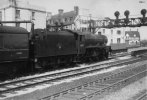
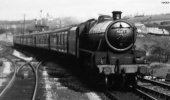
The Manchester-Swansea normally changed engines at Pontypool Road. LMS engines did sometimes work through to Cardiff. I photographed 45572 at Cardiff on the 4.40 p.m. to Liverpool on 1st June 1963 and 45577 at Pontypool Road on 16th March 1963 on the 09.30 Swansea-Manchester
 

Attachments

  • XM12.jpg
    XM12.jpg
    160.4 KB · Views: 24
  • XM08A.jpg
    XM08A.jpg
    44.4 KB · Views: 24

Oxfordblues

Member
Joined
22 Dec 2013
Messages
1,124
Thank you everyone for your very informative replies. Something that has puzzled me for sixty years has finally been answered!
 

LNW-GW Joint

Veteran Member
Joined
22 Feb 2011
Messages
21,916
Location
Mold, Clwyd
Table 81 shows the 9.30am Manchester-Swansea calling at Crewe 10.14-10.25am.
The intermediate calls that you mention are Shrewsbury 11.20-11.28am, Hereford 12.42-12.48pm and Pontypool Road 1.36-1.40pm. Arrival at Cardiff is 2.26pm.
That's 4 hours Crewe-Cardiff on an "express", on a supposedly 90mph main line.
Today's schedule on a 175 is just 2h30m, including more stops.
The only material change to the route is MU speeds of up to 90mph north of Craven Arms.
 

jfollows

Established Member
Joined
26 Feb 2011
Messages
10,105
Location
Wilmslow
I wonder just what the proportion of electric/diesel vs steam traction was at Manchester London Road (pre Piccadilly) in 1962?
Manchester London Road became Manchester Piccadilly in 1960.
I have some working timetables for the period, definitely 1963-64, so I will try and come up with a constructive answer if i can in a day or so.
 

Cheshire Scot

Established Member
Joined
24 Jul 2020
Messages
1,677
Location
North East Cheshire
That's 4 hours Crewe-Cardiff on an "express", on a supposedly 90mph main line.
Without access to a Sectional Appendix of the day I would very much doubt line speed would have been 90mph back then, perhaps at best 70/75 in some places and much less in others. Also, probably a fairly heavy train as many were back then meaning uphill speeds could be relatively unspectacular.
 

30907

Veteran Member
Joined
30 Sep 2012
Messages
21,950
Location
Airedale
Without access to a Sectional Appendix of the day I would very much doubt line speed would have been 90mph back then, perhaps at best 70/75 in some places and much less in others. Also, probably a fairly heavy train as many were back then meaning uphill speeds could be relatively
The WR wasn't exactly noted for speed, the odd express apart.
 

Taunton

Veteran Member
Joined
1 Aug 2013
Messages
12,273
2. Where was the Royal Scot replaced with a Castle: Shrewsbury, Hereford or Pontypool Road?
3. Were LMR locos barred from South Wales for some reason or was it traincrew knowledge that necessitated the loco-change?
That's the easy one. The Western Region followed the old GWR practice that on their main lines, fitted with GWR-pattern AWS ("ATC") since the 1920s, main line services were run only with locos so fitted. The line south of Shrewsbury was one such. North of Shrewsbury had been an LNWR/LMS line, so it wasn't, and thus Shrewsbury was a loco boundary. Things became a bit looser by around 1960, and some through runs started to come in, generally not scheduled though. Excursions from the LMR through Bristol to Weston, which had always changed locos at Bristol, started to allow the LMR loco to run through. The accident at Bridgwater in 1974, where an LMR Class 45 with no WR ATC ran through signals one night into the train ahead led to a ban again on such locos, for the remaining few years of ATC.

There was a longstanding tradition that the Southern and Western ran one train a day over each others' routes between Exeter and Plymouth, to maintain diversion route knowledge, but I believe the non-ATC Southern loco was not allowed on the Western route on days when low visibility was expected.
 

kermit

Member
Joined
2 May 2011
Messages
631
Manchester London Road became Manchester Piccadilly in 1960.
I have some working timetables for the period, definitely 1963-64, so I will try and come up with a constructive answer if i can in a day or so.
Whoops, sorry! And thank you.......
 

jfollows

Established Member
Joined
26 Feb 2011
Messages
10,105
Location
Wilmslow
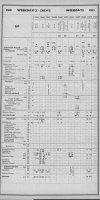
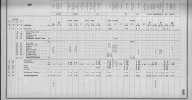
Here's 1V54, 09:30 Manchester Piccadilly-Cardiff in the following year's timetable, 9/9/63 to 14/6/64. The Crewe-Shrewsbury section says D350 but implies that this is only applicable on Saturdays. My working timetable only goes as far as Shrewsbury, because it's for the London Midland Region.
1A15 in the first timetable extract appears to be one of the few steam-hauled trains in that timetable (to London Euston via Styal, "The Mancunian" I think).
 

Attachments

  • 1V54.jpeg
    1V54.jpeg
    962.7 KB · Views: 22
  • 1V54a.jpeg
    1V54a.jpeg
    943.8 KB · Views: 22
Last edited:

hexagon789

Veteran Member
Joined
2 Sep 2016
Messages
18,304
Location
Glasgow
Can't help with the timings, but the LMR Summer 1963 Western Area Carriage Marshalling book has this entry:

9.30am Manchester (Picc.) - Swansea

2SK (FSO)
BSK
2SK
CK
SK
BG

Class Z stock
6/201 (FSX)
8/266 (FSO)

Class Z stock are BR Mk1 coaches

The 6/201 and 8/266 are the number of vehicles and the tare weight of the train in imperial tons.
 
Status
Not open for further replies.

Top