The 1967 Hither Green Rail Crash
Bonfire night was a Sunday in 1967, and, perhaps, a few fireworks were still going off in the streets between Grove Park and Hither Green marshalling yard as the twelve coach 19.43 from Hastings to Charing Cross passed the Hither Green signal box at 21.14 at about 70 mph with clear signals to pass through on the “Up Fast Line.”
The train was pretty much full, particularly at the front of the train as some of the intermediate stations had ‘short’ platforms. The train was busy enough for standing in the 1st class corridor on the fourth coach.

Close to the sidings north of Grove Park, the third carriage seems to have struck a ‘small wedge shaped piece of steel that had broken away from the end of a running rail and became derailed.’ It didn’t immediately come off the track but when the coach struck some points close to St Mildred’s Road bridge (next to where Bestway is now – see photographs above), the third coach, the one ahead of it, and all the coaches behind it became completely derailed, and the second to the fifth coaches to turn over onto their sides. The first coach ran on stopping just short of Hither Green station.
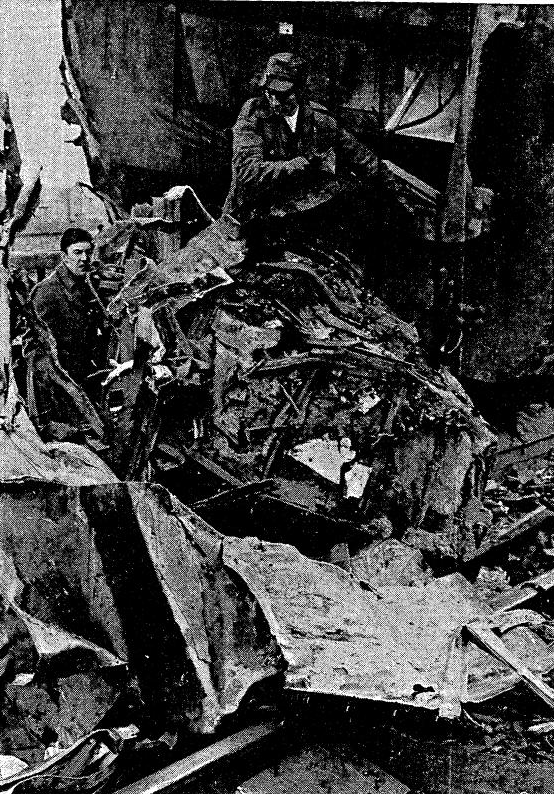
The coaches two to five had their sides torn off, this included the fourth coach where there were large numbers standing, there was other extensive damage to several coaches – notably coach two, whose roof was ripped off.
The emergency services arrived within minutes of the accident and must have witnessed utter devastation.. There were 49 fatalities and 78 people injured – the
sixth highest number of deaths in a single rail accident in Britain.
Amongst those
injured was a young Robin Gibb from the Bee Gees who was treated at
Hither Green Hospital. He had been in the first class seats in the fourth carriage but only suffered from bruising and minor cuts from broken glass – he had been lucky – many of the deaths were those standing in the corridor to his carriage.
Local emergency services reacted quickly- all six operating theatres at Lewisham Hospital were staffed up quickly to deal with the worst casualties, with the less severe injuries, like Robin Gibb, going to
Hither Green. Thirty fire brigade appliances from stations all over south London attended with cutting gear, with fire-fighters and ambulance staff coming into work on days off. Local people tried to help too – Lewisham Hospital was inundated with offers from south east Londoners of blood donations and offers to transport the walking wounded to Lewisham and Hither Green hospitals; local houses became first aid stations and blankets were provided from houses in the neighbouring streets (1).
Copious amounts of tea were provided to those involved with the rescue work – several residents of St Mildred’s Road spent much of the night scrambling up and down the embankment from the South Circular. These included Stan Hurrell, a newspaper seller, and his wife Jo, along with their near neighbours Lilian and Ron Humphrey (2). Their homes may well be pictured below in a photograph of the scene from the Illustrated London News (3).

In a Parliamentary debate the following lunchtime, t
he Minister of Transport, Barbara Castle, noted
…. Sir Stanley Raymond, the Chairman of the (British Railways) Board, was on the scene of the accident as quickly as he could be. He has informed me that the selflessness shown not only by members of the emergency services, but by ordinary members of the public, including a number of teenagers, was unparalleled in his experience since the days of the Blitz.
The picture the next day was of carnage, as the photographs from The Times show – the first (above) shows the extent of the damage to carriages (4); the second from close to the bridge on St Mildred’s Road shows carriages toppled down the embankment parallel Springbank Road (5).
There is also video footage from British Pathé News both from the immediate aftermath and the days after the crash.
An enquiry was opened soon after and the cause was quickly found, the driver and guard were exonerated, and the findings reported upon in the press before the end of the month, with the final detailed report being published in 1968.
The cause was found to be a fractured joint, the joint itself was new but the ballast underneath it had been had been inadequately built up when a wooden sleeper had replaced a concrete one in June 1967 –
the inquiry concluded
I have no doubt that the fracture was caused by the excessive “working” of the joint resulting from its unsatisfactory support condition (pictured below)

There is a
list at the end of the post of the names of the victims. There is a small brass memorial to one of the victims Dianne Williams high on the wall of the newspaper kiosk close to the ticket office.
Further down the ramp toward the exits to Staplehurst Road and Maythorne Cottages is one of the Hither Green history storyboards, unveiled on the 51st anniversary of the crash, listing the names of all the victims.
Unlike the
Lewisham crash a decade earlier, where the trains were commuter ones and included a fair number of local people, with the Hither Green crash all were passing through south east London en route from Sussex and Weald Kent. Mainy hailed from Kent and Sussex, a lot returning to London after having visited relatives or friends and a large proportion under 25. The next few paragraphs piece together a little about some of those who died in Hither Green.
The name on the brass plaque is that of Dianne Williams,
she was a teacher from Rye and was at the end of and eventful half term break – she’d married Bill the previous Saturday at Fulham Town Hall and was going to go back to work as Mrs. Reid. She was one of four from Rye Grammar School (now Rye College) who died –
the others were Ricky Spencer and sisters Gay and Judith Breeds.
Julia Hardwick was a civil servant, her sister Marion Hardwick was a hospital social worker – they seem to have been visiting their parents in Tunbridge Wells. Three of the victims originated from Wadhurst – Charles Haycraft was a medical researcher who lived in Hampstead; Catherine Yeo worked in a travel agents in Kensington – she was described as ‘full of life, keen on sailing and all kinds of sport. She was very happy in her work.’ Jennifer Bohane worked as a teacher in Ilford (7).
Howard Austin from Etchingham had been working as a bank clerk for two months after leaving school at 16; he and died with his girlfriend Jacqueline (Jackie) Branch who also worked in London (8) – they’d been to school together.
Hugh Roots was a final year Royal Veterinary College student who had spent the weekend with his parents in Rolvenden. Juliet McPherson Heard’s journey was the other way – she was a student nurse working at Pembury Hospital but coming from Mill Hill and going to see her mother for a couple of days. A patient at the hospital said that ‘nothing was too much trouble for her .. so genuine.’ (9)
There were a significant number of older victims too – Hugh Whittard was one of the
owners of Whittard’s coffee; he was living in South Kensington at the time of the crash. Kathleen Charlton and her brother Arthur White , were both in their 70s, they lived together in Bollo Lane, South Acton and died instantly together close to St Mildred’s Road (10).
Many of those involved in the emergency response were to suffer considerably in the aftermath at a time when post-trauma counselling was rare. Several stories of this have come up in response to the blog – such as an
engine driver based at Hither Green who helped with recovery work and had nightmares for years as a result of the horrors he encountered. He had to take early retirement from a job he loved because of his anxiety due to disturbed sleep. Other
staff at Hither Green station too were traumatised by the events.
The site today shows nothing of the disaster – neither on the railway itself nor on the bridge over St Mildred’s Road. But if you are travelling under the bridge or passing from Grove Park to Hither Green on the train, do reflect on those whose lives were cut short that night:
- Rose Margaret Ashlee (36) Crowborough
- Elizabeth Tamara Ashmore (20) Bordon
- Howard L. Austin (17) Etchingham
- Janet E. Bartlett (18) Hastings
- Jennifer Ann Bohane (26) Wadhurst
- Jacqueline Branch (16) Hurst Green
- Gay E. Breeds (17) Addington
- Judith M. Breeds (21) Addington
- Dorothy V. Cannon (57) Hampton
- Kathleen Charlton (73) Chiswick
- Veronica B. Chevallier (34) St John’s Wood
- Eric G. Coveney (64) South Tottenham
- Terence D. Cronk (19) Wateringbury
- Edith Olive May Dutch (65) Fulham
- Eric H. O. Fletton (64) Buckhurst Hill
- Rev. Harold Theodore Gibso Forster (51) Harrow
- Julia H. Hardwick (28) Tunbridge Wells
- Marion Gay Hardwick (23) Tunbridge Wells
- Charles Haycraft (23) Wadhurst
- Jacqueline A. Hazard (20) Nottingham
- Gillian Mary Heppenstall (29) Mark Cross, Sussex
- Ella Gladys Kemp (40) Cartsfield
- Bernard John Lavender (44) Wembley
- Irene E. Lavender (44) Wembley
- Mark Clifton Lavers (20) Burwash
- Betty Lewis (26) Hastings
- Ann E. Lingham (19) Streatham S.W.
- Juliet W. McPherson-Heard (20) Mill Hill
- George Alfred Meyers (26) Neasdon
- Dianne Sandra Reed (22) Enfield
- Susan Anne Ritson (21) Maidenhead
- Ruby Hazel H. Rolls (48) Tottenham
- Hugh P. Roots (21) Rolvenden, Kent
- Geoffrey Sellings (19) Hastings
- Michael Smith (2) Bloomsbury
- Wendy Smith (38) Bloomsbury
- Richard Spencer (21) Abbey Wood
- Rosemary Stewart (22) Upper Holloway
- William D. Thomson (28) Hastings
- Alison Winifred Treacher (23) Steyning
- Christopher Ian Turner (31) Cross-In-Hand
- James Gordon Melville Turner (60) Staplecross, Sussesx
- Lindsay Margaret Ward (19) Bexhill-On-Sea
- Joyce Watson (48) Putney
- Harold Arthur White (75) Chiswick
- Walter Hugh Whittard (64) South Kensington
- Dianne Williams (19) Rye
- Mabel Lillian Daisy Williams (69) Hampstead Aven
- Catherine Yeo (20) Wadhurst