I'm wondering if a new thread should be started for this?
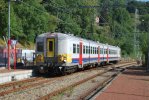
The remaining units are all from the series 601 to 782 built 1966 to 1980 (not 1979 as I wrote previously). 30 to 40 were renumbered in the 900 series and designated Cityrail with more standing space.
The current cab shape seems to have started in 1950. I can vaguely remember the AM50/AM53/AM54 series but they went for scrap in the early 1990s.
The AM56 numbered 129 to 150 had Budd stainless steel like the R32 subway cars in New York. I recall these units much better, they lasted until 1999.
The AM62-AM65 numbered 151 to 270 were basically identical to 601 to 782 except that none were refurbished. Aside from going from green to red livery, they essentially ran in as built condition for 50 years; the last run was in October 2013.
Over the years I've travelled on over 300 of them on almost every electric route on the network. The exceptions being a couple of branches and the recently wired routes.
You might add that :
- They were all compatible together, any of them could be MUed with any other;
- Braking systems varied a lot, so there were sometimes strong reactions between units in a varied consist;
- Up to 660, they were equipped with classical rheostat system for starting, as of 660 they switched to thyristors;
- Motor couplings were serial and serial/parallel on the rheostat ones, and serial/parallel only for the thyristor ones; the controller only had those two stable positions - on the thyristor ones, to maintain compatibility, the serial position was simulated;
- Max speed was 130 km/h for units below 600 and 140 km/h for 601 and above
- Maximum consist was 6 units, but this draws too much current so one of the six had to have its traction switched off, unless they were all thyristor units, because they draw less current;
- Only those which are not thyristor-equipped are cleared to run into Aachen;
- the current cab design started with unit 010 (AM50, built 1950).