For those interested, the 25":1 mile map can be seen at https://maps.nls.uk/view/104182256Comparing it to other photos and the 1898 25” map, I would have thought the train is an Up one.

-
Our new ticketing site is now live! Using either this or the original site (both powered by TrainSplit) helps support the running of the forum with every ticket purchase! Find out more and ask any questions/give us feedback in this thread!
You are using an out of date browser. It may not display this or other websites correctly.
You should upgrade or use an alternative browser.
You should upgrade or use an alternative browser.
Unknown station and 2-4-0
- Thread starter carlwebus
- Start date
- Status
- Not open for further replies.
Sponsor Post - registered members do not see these adverts; click here to register, or click here to log in
R
RailUK Forums
Gloster
Veteran Member
Probably a fair bit before The Great War as it doesn’t appear to have a centre lamp socket on the buffer beam: these were fitted from 1903. I haven’t been able to find anything definite about lamp codes, but I suspect it is carrying one for a stopping train.

Dr Hoo
Established Member
The relevant locomotive class had all been withdrawn by 1895 (according to Wikipedia).

Brilliant detection, but I think I have to disagree with this one detail.I hadn't realised that the Aylesbury branch had no physical connection with the Fast lines at Cheddington in those days. There were two diamond crossings that gave access to a small exchange facility with the Slow lines - a bit like the Wolverton layout today. So, you couldn't shunt, attach or detach on the Fast Lines at Cheddington.
Thus the vehicle in the background, 'behind' the train must be an unrelated shunt.
...
What is clearly happening is that the branch train has waited from 1122 until the southbound 1128 had arrived and then the locomotive has drawn forward across the Fast Line diamonds with a vehicle or two to be attached to other (Slow Line) services.
Looking at the photo again you can see the diamonds, but the vehicle isn't at the right angle to be using them, but would be about right for using a single slip. So I think it is an attachment to the 11.28 Up, very likely off the branch train but just possibly from the sidings on the branch.
Agreed, the OS map doesn't show any slip points, but that is not decisive, as they would be difficult to draw, and from a few random checks 1:25k maps rarely if ever show them.
Fortunately there is a signalling diagram online, and this shows 4 single slips, one to each of 4 diamonds: https://signalbox.org/~SBdiagram.php?id= 699
(It dates from 1957, but is an LNWR box with loads of spare levers - it is incredibly unlikely that the slips would have been added later.)
Hope this helps - but I can't find the driver's name...


What exactly is the middle track in between the fast and slow lines north of the station used for?For those interested, the 25":1 mile map can be seen at https://maps.nls.uk/view/104182256
The diagram by John Hinson, referred to by 30907 in post #35 above, calls this the 'Middle siding'. I assume it is to facilitate exchanges between the main lines, particularly the slow lines, and the Aylesbury branch.What exactly is the middle track in between the fast and slow lines north of the station used for?
gg1
Established Member
What exactly is the middle track in between the fast and slow lines north of the station used for?
Could it also be a holding siding for vans waiting to be coupled to/uncoupled from a stopping train, a process that looks to be in progress in the OP's photo?The diagram by John Hinson, referred to by 30907 in post #35 above, calls this the 'Middle siding'. I assume it is to facilitate exchanges between the main lines, particularly the slow lines, and the Aylesbury branch.
Yes. Any sort of vehicle exchange between the branch/goods yard and main line trains. I suspect that - purely on practical grounds - the branch goods would also have been responsible for shunting Cheddington goods sidings.Could it also be a holding siding for vans waiting to be coupled to/uncoupled from a stopping train, a process that looks to be in progress in the OP's photo?
Dr Hoo
Established Member
The signalling plan from 1957 is very helpful in terms of demonstrating that there were Fast Line slips at that time although I'm a bit surprised that there don't seem to be various shunt signals to optimise their regular use.
According to Railway Reminiscences by G P Neele (the L&NWR's Superintendent of the Line), the WCML through Cheddington gained an Up Goods in 1859, upgraded to Passenger in 1866. The Down fourth line came in 1876, in the wake of the second Watford Tunnel in 1874. So Cheddington would haver seen major re-modelling at that time.
In 1957 Cheddington had what would be described as a 'Type 4' signalbox, I think. (Not my specialist subject.) I thought that these only came in around 1875 and were build through to the early 1900s. So the later box might have dated from that time. Clearly there had been various developments. Track circuits came along, colour light distants and a completely new telegraph pole route to judge from later available photographs. Perhaps there was an intermediate design of signalbox. Does anybody know?
It has been helpful to learn that the Ordnance Survey didn't necessarily map slips on the '1:25' scale.
Aylesbury-Cheddington is sometimes described as the 'first branch line', dating back to the London & Birmingham Railway.
Great thread.
According to Railway Reminiscences by G P Neele (the L&NWR's Superintendent of the Line), the WCML through Cheddington gained an Up Goods in 1859, upgraded to Passenger in 1866. The Down fourth line came in 1876, in the wake of the second Watford Tunnel in 1874. So Cheddington would haver seen major re-modelling at that time.
In 1957 Cheddington had what would be described as a 'Type 4' signalbox, I think. (Not my specialist subject.) I thought that these only came in around 1875 and were build through to the early 1900s. So the later box might have dated from that time. Clearly there had been various developments. Track circuits came along, colour light distants and a completely new telegraph pole route to judge from later available photographs. Perhaps there was an intermediate design of signalbox. Does anybody know?
It has been helpful to learn that the Ordnance Survey didn't necessarily map slips on the '1:25' scale.
Aylesbury-Cheddington is sometimes described as the 'first branch line', dating back to the London & Birmingham Railway.
Great thread.
Gloster
Veteran Member
The first Type 4 boxes were erected around the beginning of 1876 and it was the standard design until about 1903. (Source: L.N.W.R Signalling, Foster, OPC, 1982.)
Dr Hoo
Established Member
Thanks for the confirmation.The first Type 4 boxes were erected around the beginning of 1876 and it was the standard design until about 1903. (Source: L.N.W.R Signalling, Foster, OPC, 1982.)
Do we know if Cheddington was the very first of this design? I don't think that the L&NWR opened any new routes around 1876 (besides a couple of oddities like Greenore to Newry, and North Wall in Dublin). Abersychan in 1879 was certainly a Type 4.
I had to look very carefully at the plan to see that signals 20-22 and 27-29 all read from or along the Middle Siding. Interestingly, there are no shunt signals from the Up Slow.The signalling plan from 1957 is very helpful in terms of demonstrating that there were Fast Line slips at that time although I'm a bit surprised that there don't seem to be various shunt signals to optimise their regular use.
Dr Hoo
Established Member
Quite, it's bizarre. Nothing on the Up Fast (to back a train into the Middle Siding or return after a detachment. Nothing on the Down Fast (to back a train onto the Aylesbury Branch/Yard.) Or am I missing something?I had to look very carefully at the plan to see that signals 20-22 and 27-29 all read from or along the Middle Siding. Interestingly, there are no shunt signals from the Up Slow.
Wonderful thread; such great historical investigation. I got as far as seeing that it was somethingdington, not Oddington but actauuly more similar than imagined. Four platform faces in a place with so little 'development', flat, the style of the chimneys and footbridge (and indeed the presence of such), ...
And how things have changed, and not!
https://maps.nls.uk/geo/explore/sid...1.85770&lon=-0.66297&layers=1&right=ESRIWorld
Many will recall Cheddington in relation to the so-called Great Train Robbery: https://en.wikipedia.org/wiki/Cheddington
And how things have changed, and not!
https://maps.nls.uk/geo/explore/sid...1.85770&lon=-0.66297&layers=1&right=ESRIWorld
Many will recall Cheddington in relation to the so-called Great Train Robbery: https://en.wikipedia.org/wiki/Cheddington
zwk500
Veteran Member
Possibly the diagram is incomplete, as there appears to be nothing on the Up Slow to allow access to the Up siding at all. Or moves have gradually been abolished but the track left in place, as some of the spare level numbers suggest close relation to the slips (although that could be coincidence not correlation).Quite, it's bizarre. Nothing on the Up Fast (to back a train into the Middle Siding or return after a detachment. Nothing on the Down Fast (to back a train onto the Aylesbury Branch/Yard.) Or am I missing something?
Horsebox I would imagine. The Rothschilds of adjoing Mentmore were 'big' in horse racing. The Rosebery Stakes etc. His horse Ladas won the Epsom Derby in 1894. Ladas an LNER A3; Blue Peter an A2. Ladas a Snowdon Railway loco.I would guess that the most likely answer is that a van or horsebox, or even a through carriage, is being attached or detached from the rear. If, as I think, it is an Up train attachment seems slightly more likely.
Photos of Cheddington Station now-ish:
Google Maps
Find local businesses, view maps and get driving directions in Google Maps.
 www.google.com
Cheddington to Aylesbury Line - Wikipedia
Found myself wondering WHY that photo was taken- looking somewhat 'posed'.
Was it common to build four platforms out in the sticks?- like Badminton out west, also somewhat horsey lordship
Last edited:
Levers 23,30,32 - the random spares in the middle of the frame - would fit that description. I suspect they were "passive provision" in case signals were deemed necessary, and the economy- minded LNWR deemed them unnecessary.Possibly the diagram is incomplete, as there appears to be nothing on the Up Slow to allow access to the Up siding at all. Or moves have gradually been abolished but the track left in place, as some of the spare level numbers suggest close relation to the slips (although that could be coincidence not correlation).
There was no general requirement to signal every shunt move, especially within a few yards of the box, and some railways didn't - I don't know about the LNW, but there were LSW boxes of similar vintage which had no shunt signals at all until the boxes themselves were replaced by BR(S).
zwk500
Veteran Member
Interesting, didn't know that!There was no general requirement to signal every shunt move, especially within a few yards of the box, and some railways didn't - I don't know about the LNW, but there were LSW boxes of similar vintage which had no shunt signals at all until the boxes themselves were replaced by BR(S).
Gloster
Veteran Member
Was it common to build four platforms out in the sticks?- like Badminton out west, also somewhat horsey lordship
Badminton only had side platforms on platform loops. The centre through roads didn’t have any platforms.
A picture of Tring station, next toward Euston- similar design footbridge. From https://tringlocalhistory.org.uk/Railway_local/index.htmWell spotted! There is a picture on Wikipedia taken some years later and a few steps further forward.

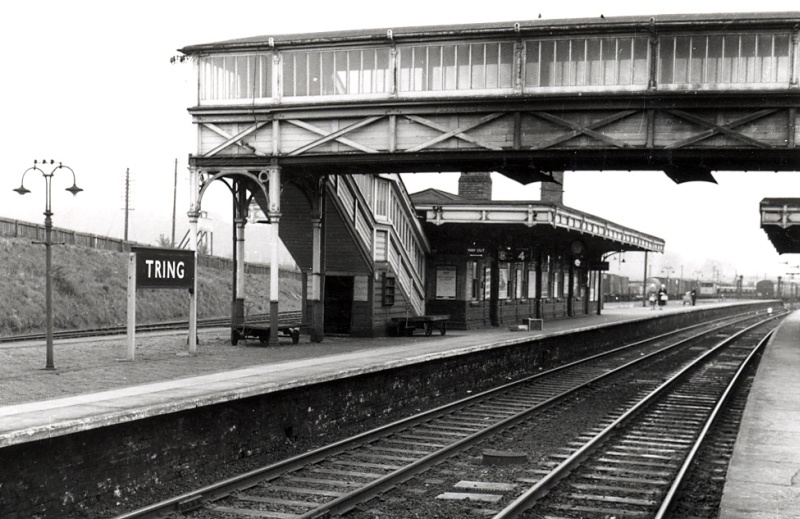
Tring Station, probably in the 1950s. Note the busy goods yard in the distance, now a car park.
== Doublepost prevention - post automatically merged: ==
Oh wel- memory huh!! Thank you. Question still applies though- four platforms usual?Badminton only had side platforms on platform loops. The centre through roads didn’t have any platforms.
Gloster
Veteran Member
I think that it would be affected by the type of service offered to a station: is it going to see nothing but a few locals or will there be semi-fasts? Whether the trains will be segregated so that all trains that stop will be on one pair of tracks or might they appear on all? The choice of whether they will be paired by direction (Up Slow, Up Fast, Down Fast, Down Slow) or use (Up Slow, Down Slow, Up Fast, Down Fast): in the latter situation you have already are going to have to build a platform in between the lines, so adding a second face to this middle platform and another platform on the far side is less disruptive than specially building one between the fast lines. How the line was quadrupled and where the old station was will have an effect.
There are plenty of factors here and each station would have been built to what best suited them and the company’s practices. I don’t think there was any fixed rule, probably not even within a single company. And you might have the situation of one Chief Civil Engineer having one preference, but it all changed when his successor had a different one.
There are plenty of factors here and each station would have been built to what best suited them and the company’s practices. I don’t think there was any fixed rule, probably not even within a single company. And you might have the situation of one Chief Civil Engineer having one preference, but it all changed when his successor had a different one.
Dr Hoo
Established Member
The L&NWR were quite early to quadrupling. Obviously the ‘pioneer’ branch line junction of Cheddington had two platforms on the original two tracks of the London & Birmingham. When the L&NWR decided to provide two more tracks for slow trains (both passenger and goods) on a ‘paired by use’ basis there wasn’t really an alternative to providing two new faces. I suppose that they could have demolished the original ones but there wouldn’t have been much point.
If a stopping train could be pathed on the Fast Lines it did give cross-platform interchange for Aylesbury in the Down direction.
If a stopping train could be pathed on the Fast Lines it did give cross-platform interchange for Aylesbury in the Down direction.
Horsebox I would imagine. The Rothschilds of adjoing Mentmore were 'big' in horse racing. The Rosebery Stakes etc. His horse Ladas won the Epsom Derby in 1894. Ladas an LNER A3; Blue Peter an A2. Ladas a Snowdon Railway loco.
Photos of Cheddington Station now-ish:

Google Maps
Find local businesses, view maps and get driving directions in Google Maps.
Cheddington to Aylesbury Line - Wikipedia
en.wikipedia.org
Found myself wondering WHY that photo was taken- looking somewhat 'posed'.
Was it common to build four platforms out in the sticks?- like Badminton out west, also somewhat horsey lordship
Thank you Gloster for correcting me re Badminton.Badminton only had side platforms on platform loops. The centre through roads didn’t have any platforms.
Back to Cheddington- Lord Rosebery's horse Ladas (of Mentmore Towers and Stud adj Cheddington Stn) won the Epsom Derby in 1894 and Rosebery was PM 1894-5. Good reason for a Photo!!
QED.After a bit of research I think that we can start to build a story.
The Webb Precursors were built 1874-1879 and withdrawn 1892-1895. Some only lasted 13 years. So photo must have been 1895 at the latest.
The shadow of the train is almost in line with it, the WCML runs S by SE at Cheddington, so photo must have been take at about 1130 (no 'summertime' clock change in those days).
The Middleton Press reprint of the December 1895 Bradshaw shows a southbound departure at 1128. Bingo! This was the 0905 from Nuneaton, via Blisworth (Northampton connection), arriving at Euston at 1225. This train followed the Up 'Birmingham Express' from Rugby and would be Slow Lined at Watford to allow the Up 'Belfast Boat Express' to precede it into Euston.
I hadn't realised that the Aylesbury branch had no physical connection with the Fast lines at Cheddington in those days. There were two diamond crossings that gave access to a small exchange facility with the Slow lines - a bit like the Wolverton layout today. So, you couldn't shunt, attach or detach on the Fast Lines at Cheddington.
Thus the vehicle in the background, 'behind' the train must be an unrelated shunt.
The Cheddington-Aylesbury line was a single track, worked on the 'One Engine in Steam' principle, at least in timetable terms. There was an 1105 Aylesbury-Cheddington, arriving at 1122. This provided a sharp connection (via the saggy footbridge) with the 1128.
What is clearly happening is that the branch train has waited from 1122 until the southbound 1128 had arrived and then the locomotive has drawn forward across the Fast Line diamonds with a vehicle or two to be attached to other (Slow Line) services.
I'm afraid that I can't give you the date.
Hope that helps.
- Status
- Not open for further replies.