
-
Our new ticketing site is now live! Using either this or the original site (both powered by TrainSplit) helps support the running of the forum with every ticket purchase! Find out more and ask any questions/give us feedback in this thread!
You are using an out of date browser. It may not display this or other websites correctly.
You should upgrade or use an alternative browser.
You should upgrade or use an alternative browser.
Unknown station and 2-4-0
- Thread starter carlwebus
- Start date
- Status
- Not open for further replies.
Sponsor Post - registered members do not see these adverts; click here to register, or click here to log in
R
RailUK Forums
Gloster
Veteran Member
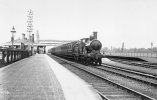
It looks like an LNWR loco, so I wonder if it is the line along the North Wales Coast.

Peter Mugridge
Veteran Member
Can't quite read the running in board, which is annoying as it's such a big one.
Looks like it begins with a C or a D, though. the second line in smaller letters suggests a "for..." line?
Looks like it begins with a C or a D, though. the second line in smaller letters suggests a "for..." line?
Gloster
Veteran Member
Could it be Cheddington, junction for Aylesbury, neither of which are in North Wales?

Almost certainly.Could it be Cheddington, junction for Aylesbury, neither of which are in North Wales?
The lines are paired by
Last edited:

WesternLancer
Veteran Member
- Joined
- 12 Apr 2019
- Messages
- 15,269
Wonderfully sharp image.
Style of carriages and attire of those glimpsed on platform suggests pre 1914 to me.
Style of carriages and attire of those glimpsed on platform suggests pre 1914 to me.

Iskra
Established Member
Can anyone explain what the train is doing? Has it slipped a coach, or is another engine separating the train from the rear?
Or is that simply a train departing from the left hand platform in the opposite direction?
Or is that simply a train departing from the left hand platform in the opposite direction?
Well spotted! There is a picture on Wikipedia taken some years later and a few steps further forward.Could it be Cheddington, junction for Aylesbury, neither of which are in North Wales?

The telegraph posts, with generally long and short arms alternating, indicate to me a Midland Railway location as this was typical MR practice.
But the loco is not an MR one.
EDIT: Ah! Stuving's post seems to identify the location, so not MR! The photo was taken by Ben Brooksbank on the 31st January 1953, the last day of passenger services on the Aylesbury branch, according to the posting he made on the Geograph website of the same picture.
But the loco is not an MR one.
EDIT: Ah! Stuving's post seems to identify the location, so not MR! The photo was taken by Ben Brooksbank on the 31st January 1953, the last day of passenger services on the Aylesbury branch, according to the posting he made on the Geograph website of the same picture.
Last edited:

Dr Hoo
Established Member
In the days before 1914 it was nothing unusual to take your horse and/or carriage by ordinary passenger train (by prior arrangement). Both Cheddington itself and Aylesbury L&NWR station offered this service (from the Railway Clearing House Handbook).Can anyone explain what the train is doing? Has it slipped a coach, or is another engine separating the train from the rear?
Or is that simply a train departing from the left hand platform in the opposite direction?
So attaching or detaching a van to/from a stopping train at Cheddington wouldn't have been particularly odd.
Last edited:
Gloster
Veteran Member
I would guess that the most likely answer is that a van or horsebox, or even a through carriage, is being attached or detached from the rear. If, as I think, it is an Up train attachment seems slightly more likely.
My eyesight (even in my 60s) must be better than I thought as I could pretty much read that as Cheddington !Can't quite read the running in board, which is annoying as it's such a big one.
Looks like it begins with a C or a D, though. the second line in smaller letters suggests a "for..." line?
Dr Hoo
Established Member
Deconstructing the picture from the perspective of an Edwardian photographer, it was an ideal situation. Because of the shunt move the train would be stationary for several minutes and the Down Fast blocked too.
Get your tripod and plate camera set up. Wait for ideal moment when sun came out from behind cloud and smoke or steam blowing in right direction.
Perhaps exposure of a couple of seconds with a small aperture for a nice sharp shot, I understand.
Get your tripod and plate camera set up. Wait for ideal moment when sun came out from behind cloud and smoke or steam blowing in right direction.
Perhaps exposure of a couple of seconds with a small aperture for a nice sharp shot, I understand.

Bevan Price
Established Member
- Joined
- 22 Apr 2010
- Messages
- 8,339
Yes. Comparing it with photos in Edward Talbot's book. "An Illustrated History of LNWR Engines", it closely resembles photos of Improved Precedent 2-4-0s.Locomotive looks to be one of the LNWR Improved Precedents, though I could be wrong.
Gloster
Veteran Member
Comparing it to other photos and the 1898 25” map, I would have thought the train is an Up one.
Peter Mugridge
Veteran Member
My eyesight (even in my 60s) must be better than I thought as I could pretty much read that as Cheddington !
This is as clear as it gets for me - I might have been able to enlarge it more had I been on my phone rather than a computer - for some reason it's not possible to do more than a minimal enlargement on a computer.

It is an Up train; see:Comparing it to other photos and the 1898 25” map, I would have thought the train is an Up one.
Up stopping train at Cheddington

© Copyright Ben Brooksbank and
licensed for reuse under this Creative Commons Licence.
(Click on photo to go to the original on the Geograph website)
This is as clear as it gets for me - I might have been able to enlarge it more had I been on my phone rather than a computer - for some reason it's not possible to do more than a minimal enlargement on a computer.
View attachment 120704
I pressed PrtScn then opened it in Paint and was able to use the Zoom In function to make it huge.
Peter Mugridge
Veteran Member
I don't have paint... would that trick work in Photoshop as well? Or would it pixelate out at high zoom?I pressed PrtScn then opened it in Paint and was able to use the Zoom In function to make it huge.
You'd have to actually uninstall it not to have it on a Windows machine ( surely there's some Mac equivalent? ). It works fine in Photoshop - copy image to clipboard, new image in Photoshop, it'll have the dimensions set properly already, and then paste. Right-click & save or copy image also works.I don't have paint... would that trick work in Photoshop as well? Or would it pixelate out at high zoom?
Peter Mugridge
Veteran Member
Thanks; I'll have to have a look to see where Paint is - never realised it was a standard feature...You'd have to actually uninstall it not to have it on a Windows machine ( surely there's some Mac equivalent? ). It works fine in Photoshop - copy image to clipboard, new image in Photoshop, it'll have the dimensions set properly already, and then paste. Right-click & save or copy image also works.
The loco appears to be carrying just one headlamp over one buffer. Does anyone speak LNWR headlamp code? If so this might reveal the class of train or even its destination.Comparing it to other photos and the 1898 25” map, I would have thought the train is an Up one.
Mr Whale put it on the "to do" list, but they've not quite got round to it. Maybe next year.Notable that the footbridge seems to still have the slight sag where the centre island platform supports are, 40 or more years after the original photo.

Dr Hoo
Established Member
After a bit of research I think that we can start to build a story.
The Webb Precursors were built 1874-1879 and withdrawn 1892-1895. Some only lasted 13 years. So photo must have been 1895 at the latest.
The shadow of the train is almost in line with it, the WCML runs S by SE at Cheddington, so photo must have been take at about 1130 (no 'summertime' clock change in those days).
The Middleton Press reprint of the December 1895 Bradshaw shows a southbound departure at 1128. Bingo! This was the 0905 from Nuneaton, via Blisworth (Northampton connection), arriving at Euston at 1225. This train followed the Up 'Birmingham Express' from Rugby and would be Slow Lined at Watford to allow the Up 'Belfast Boat Express' to precede it into Euston.
I hadn't realised that the Aylesbury branch had no physical connection with the Fast lines at Cheddington in those days. There were two diamond crossings that gave access to a small exchange facility with the Slow lines - a bit like the Wolverton layout today. So, you couldn't shunt, attach or detach on the Fast Lines at Cheddington.
Thus the vehicle in the background, 'behind' the train must be an unrelated shunt.
The Cheddington-Aylesbury line was a single track, worked on the 'One Engine in Steam' principle, at least in timetable terms. There was an 1105 Aylesbury-Cheddington, arriving at 1122. This provided a sharp connection (via the saggy footbridge) with the 1128.
What is clearly happening is that the branch train has waited from 1122 until the southbound 1128 had arrived and then the locomotive has drawn forward across the Fast Line diamonds with a vehicle or two to be attached to other (Slow Line) services.
I'm afraid that I can't give you the date.
Hope that helps.
The Webb Precursors were built 1874-1879 and withdrawn 1892-1895. Some only lasted 13 years. So photo must have been 1895 at the latest.
The shadow of the train is almost in line with it, the WCML runs S by SE at Cheddington, so photo must have been take at about 1130 (no 'summertime' clock change in those days).
The Middleton Press reprint of the December 1895 Bradshaw shows a southbound departure at 1128. Bingo! This was the 0905 from Nuneaton, via Blisworth (Northampton connection), arriving at Euston at 1225. This train followed the Up 'Birmingham Express' from Rugby and would be Slow Lined at Watford to allow the Up 'Belfast Boat Express' to precede it into Euston.
I hadn't realised that the Aylesbury branch had no physical connection with the Fast lines at Cheddington in those days. There were two diamond crossings that gave access to a small exchange facility with the Slow lines - a bit like the Wolverton layout today. So, you couldn't shunt, attach or detach on the Fast Lines at Cheddington.
Thus the vehicle in the background, 'behind' the train must be an unrelated shunt.
The Cheddington-Aylesbury line was a single track, worked on the 'One Engine in Steam' principle, at least in timetable terms. There was an 1105 Aylesbury-Cheddington, arriving at 1122. This provided a sharp connection (via the saggy footbridge) with the 1128.
What is clearly happening is that the branch train has waited from 1122 until the southbound 1128 had arrived and then the locomotive has drawn forward across the Fast Line diamonds with a vehicle or two to be attached to other (Slow Line) services.
I'm afraid that I can't give you the date.
Hope that helps.
Last edited:
WesternLancer
Veteran Member
- Joined
- 12 Apr 2019
- Messages
- 15,269
Excellent, a superb read.After a bit of research I think that we can start to build a story.
The Webb Precursors were built 1874-1879 and withdrawn 1892-1895. Some only lasted 13 years. So photo must have been 1895 at the latest.
The shadow of the train is almost in line with it, the WCML runs S by SE at Cheddington, so photo must have been take at about 1130 (no 'summertime' clock change in those days).
The Middleton Press reprint of the December 1895 Bradshaw shows a southbound departure at 1128. Bingo! This was the 0905 from Nuneaton, via Blisworth (Northampton connection), arriving at Euston at 1225. This train followed the Up 'Birmingham Express' from Rugby and would be Slow Lined at Watford to allow the Up 'Belfast Boat Express' to precede it into Euston.
I hadn't realised that the Aylesbury branch had no physical connection with the Fast lines at Cheddington in those days. There were two diamond crossings that gave access to a small exchange facility with the Slow lines - a bit like the Wolverton layout today. So, you couldn't shunt, attach or detach on the Fast Lines at Cheddington.
Thus the vehicle in the background, 'behind' the train must be an unrelated shunt.
The Cheddington-Aylesbury line was a single track, worked on the 'One Engine in Steam' principle, at least in timetable terms. There was an 1105 Aylesbury-Cheddington, arriving at 1122. This provided a sharp connection (via the saggy footbridge) with the 1128.
What is clearly happened is that the branch train has waited from 1122 until the southbound 1128 had arrived and then the locomotive has drawn forward across the Fast Line diamonds with a vehicle of two to be attached to other (Slow Line) services.
I'm afraid that I can't give you the date.
Hope that helps.
I'm afraid that I can't give you the date.
Isn't there a calendar pinned to the wall visible through one of the windows in the building on the left? Surely if one takes a closer look...

Bevan Price
Established Member
- Joined
- 22 Apr 2010
- Messages
- 8,339
Judging by the position of the loco's shadow, then according to the Suncalc website, the photo was most probably taken somewhere near midsummer at approximately 12:00 to 12:30
e.g. (ignore the year setting - the shadow position will be almost identical each year)
 suncalc.net
e.g. (ignore the year setting - the shadow position will be almost identical each year)
SunCalc - sun position, sunlight phases, sunrise, sunset, dusk and dawn times calculator
A little online application with interactive map that shows sun movement and sunlight phases during the given day at the given location.
WesternLancer
Veteran Member
- Joined
- 12 Apr 2019
- Messages
- 15,269
Incidentally - why no wires attached to any of those telegraph post pots? Would they have been removed from the pic somehow, or are they yet to be strung up?
Quite possibly just didn't show up in the photo - might have been moving a bit in the exposure, or touched out afterwards - there's no steam/smoke either.Incidentally - why no wires attached to any of those telegraph post pots? Would they have been removed from the pic somehow, or are they yet to be strung up?
- Status
- Not open for further replies.