Our new ticketing site is now live! Using either this or the original site (both powered by TrainSplit) helps support the running of the forum with every ticket purchase! Find out more and ask any questions/give us feedback in this thread!
NHS funding rose in real terms every year from 2007 to 2020. There were huge extra sums injected for 2020/2021, and things have now stabilised at a higher level than before.
If you are going to make arguments, at least make sure they are factual.
NHS funding rose in real terms every year from 2007 to 2020. There were huge extra sums injected for 2020/2021, and things have now stabilised at a higher level than before.
If you are going to make arguments, at least make sure they are factual.
That is why i said "real term", there was an "inflation plus" formula which was changed in 2010. so - in real terms - it's gone down compared to what it was.
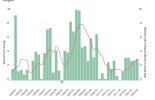
So why have people so worried about the health of the NHS coffers? Part of the reason is, while the budget has continued to get bigger, funding growth has slowed considerably.
In the first 70 years of the NHS, the average annual budget rise was 3.7%. However, between 2009/10 and 2018/19, the average funding growth each year was just 1.5%.
It's a bit late but I haven't had a drink. The chart does not show real term funding has "plunged" since 2010. It shows that the rate of increase has slowed compared to the previous decade, but the NHS funding has still increased.
The rate of increase dropped off but there wasn't a plunge or dramatic (or any) cuts to funding as was suggested. The graph exactly supports what I posted.
To be clear, saying you want increased funding is a legitimate argument, but saying x, y, or z was caused by cuts which didn't happen, is not correct.
It's a bit late but I haven't had a drink. The chart does not show real term funding has "plunged" since 2010. It shows that the rate of increase has slowed compared to the previous decade, but the NHS funding has still increased.
The rate of increase you could say "plunged" but there was still a real term increase almost every year of a not insignificant amount.
It's a bit like talking about the rate of acceleration reducing as you approach a top speed and then claiming that you are no longer accelerating, when you are!
The rate of increase you could say "plunged" but there was still a real term increase almost every year of a not insignificant amount.
It's a bit like talking about the rate of acceleration reducing as you approach a top speed and then claiming that you are no longer accelerating, when you are!
Yep, as you can see the rate of spending plunged compared to what it was - and it's an even bigger effective real term plunge when you consider that it came at a time of modernisation with increased costs.
So you're trying to do more with less that what you had before. politicians are not entirely stupid, so a lot was put in towards the end of the decade, but after a number of years of lesser funding that doesn't go that far.
So now we have "better care together" where some hospitals are losing their acute status and land being sold off. With the modified sites being listed as "new" hospitals. Even though some cities will actually have less acute hospitals.
The rate of increase dropped off but there wasn't a plunge or dramatic (or any) cuts to funding as was suggested. The graph exactly supports what I posted.
To be clear, saying you want increased funding is a legitimate argument, but saying x, y, or z was caused by cuts which didn't happen, is not correct.
Yes, the actual amount has gone up (at a reduced rate), but there was a lot of spending at the time with equipment modernisation and some sharp targets to hit. Equipment charges went up a lot in that time, and you can't skimp on that.
I guess they could have put the breaks on spending and not brought new equipment to match the reduced increase in spending, but that would lead to something even worse in the long run that we have now.
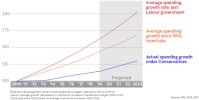
Since 2010, annual growth in the health budget has been significantly slower than it was under most of Labour’s time in office. The IFS says: “UK public health spending grew in real terms by an average of 1.3 per cent per year between 2009-10 and 2015-16.”
This doesn’t just put the Conservatives below Labour’s average spend – the IFS point out that this is “substantially below” the long-term trend growth between 1955 and 2016, when health budgets grew by 4.1 per cent a year on average.
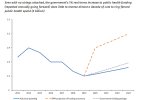
And a graph from an IFS study done at the time Teresa May was forced to inject larger sums of cash in 2018
The graph above shows how the healthcare budget has grown since 2010. It’s an indexed graph, which means that every measure begins at 100. It shows us relative growth rather than absolute numbers.
The blue line shows what’s happened in the real world since the Conservatives took office.
Figures from 2019-20 onwards show what the government’s most recent announcement will do for healthcare budgets. You can see it’s a definite acceleration in growth compared to previous years under the Coalition and Cameron/May administrations.
The orange line shows what would have happened if healthcare budgets had grown in line with the long-term average annual increase they’ve enjoyed since 1955 (about 4.1 per cent a year).
The red line shows what would have happened if growth in healthcare budgets had kept pace with the average annual increase they experienced under Labour (by our calculations, about 5.6 per cent a year).
While this week’s announcement is better than nothing for many healthcare providers and experts, it’s still a long way from undoing the years of austerity that the health service has faced.
"While this week’s announcement is better than nothing for many healthcare providers and experts, it’s still a long way from undoing the years of austerity that the health service has faced."
== Doublepost prevention - post automatically merged: ==
"While this week’s announcement is better than nothing for many healthcare providers and experts, it’s still a long way from undoing the years of austerity that the health service has faced."
Further, more recent research from the IPPR backs this up
The budget for public health services is now £850 million lower than in 2015/16 and by 2021 the budget will have been cut by 25% from its 2015/16 level in real-terms.
At the end of 2018 £1bn of cuts to public health services and the training of nurses and doctors over the following year were concealed within Government plans to boost the NHS budget by £20bn by 2023.
You can argue that the real term increase in funding wasn't enough if you want to, but I don't see the relevance to this thread; what's your point again? To justify the potential for more lockdowns or something? As I said before there are not going to be any more lockdowns because the general public would NOT accept it.
You can argue that the real term increase in funding wasn't enough if you want to, but I don't see the relevance to this thread; what's your point again? To justify the potential for more lockdowns or something? As I said before there are not going to be any more lockdowns because the general public would NOT accept it.
I'm just trying to point out that austerity has lead to a loss in capacity, the NHS is playing catch up after a decade of less than normal funding compared to what it's been used to.
With the metric on lockdowns being NHS capacity - and not the media asking questions to potential PM's - then i think it's time we stopped blaming the media (who have no impact at all on whether we lockdown or not) and going after the real reason why we might have lockdowns.
If we - god forbid - have to have a lockdown because of Covid (or a bad flu season or whatever), then it won't be because of the media, it'll because the health service can't cope.
As to the public not accepting further lockdowns, they'll have little choice really. We don't have the ultimate power at the end of the day to pick and choose, do we?
As to the public not accepting further lockdowns, they'll have little choice really. We don't have the ultimate power at the end of the day to pick and choose, do we?
I'm just trying to point out that austerity has lead to a loss in capacity, the NHS is playing catch up after a decade of less than normal funding compared to what it's been used to.
With the metric on lockdowns being NHS capacity - and not the media asking questions to potential PM's - then i think it's time we stopped blaming the media (who have no impact at all on whether we lockdown or not) and going after the real reason why we might have lockdowns.
If we - god forbid - have to have a lockdown because of Covid (or a bad flu season or whatever), then it won't be because of the media, it'll because the health service can't cope.
As to the public not accepting further lockdowns, they'll have little choice really. We don't have the ultimate power at the end of the day to pick and choose, do we?
The media are not the ones thar make the ultimate decision but their whole messaging implies that they want another lockdown and more restrictions. While the public can't do much about enforced business closures they can simply ignore things like not going out of their house. The health service has had 2 years ti sort themselves out, if they still can't cope why should the public suffer? The NHS works for us not the other way round.
The media are not the ones thar make the ultimate decision but their whole messaging implies that they want another lockdown and more restrictions. While the public can't do much about enforced business closures they can simply ignore things like not going out of their house. The health service has had 2 years ti sort themselves out, if they still can't cope why should the public suffer? The NHS works for us not the other way round.
I travelled 150 miles to spend Christmas 2020 with my dad. Spring 2021 I went to various places out of Liverpool Street whilst travel across the Welsh border was still banned. There was zero attempt at any enforcement on any trains that I went on. So yes they can shut the pubs but no way to stop people visiting friends or family at home.
In relation to face coverings, whilst I can see that the loose fitting ones do little to prevent infection, how can people deny their effectiveness against preventing serious illness or death before vaccines took on this role? It's pretty well established that viral load is a big factor in how ill people become following exposure and whilst the loose-fitting face masks clearly do little to prevent exposure and infection, they're still likely to reduce the amount of virus someone is exposed to - there's no evidence that they don't and logically you'd expect even a loose mask to prevent some particles from getting through. I don't believe we need to or should return to face coverings now that we have vaccines and increasing natural immunity, but I don't think it's correct to say that were ineffective in the second half of 2020 and first half of 2021, before everyone in the 'vulnerable' category at least had been offered full vaccination.
In relation to face coverings, whilst I can see that the loose fitting ones do little to prevent infection, how can people deny their effectiveness against preventing serious illness or death before vaccines took on this role?
In relation to face coverings, whilst I can see that the loose fitting ones do little to prevent infection, how can people deny their effectiveness against preventing serious illness or death before vaccines took on this role? It's pretty well established that viral load is a big factor in how ill people become following exposure and whilst the loose-fitting face masks clearly do little to prevent exposure and infection, they're still likely to reduce the amount of virus someone is exposed to - there's no evidence that they don't and logically you'd expect even a loose mask to prevent some particles from getting through. I don't believe we need to or should return to face coverings now that we have vaccines and increasing natural immunity, but I don't think it's correct to say that were ineffective in the second half of 2020 and first half of 2021, before everyone in the 'vulnerable' category at least had been offered full vaccination.
I don't think anyone on here denies that FFP3 standard masks IF worn and stored properly AND changed regularly can help to protect the wearer and delay infection, however if they aren't then I don't see how they can help. I would also say that if masks are so important why did infection rates rise after they were mandated and fall again after the mandate stopped? Also why did the health authorities initially say masks weren't necessary then change their minds after other places mandated them?
I don't think anyone on here denies that FFP3 standard masks IF worn and stored properly AND changed regularly can help to protect the wearer and delay infection, however if they aren't then I don't see how they can help. I would also say that if masks are so important why did infection rates rise after they were mandated and fall again after the mandate stopped?
As I said the question isn't about whether the loose-fitting ones prevent infection - we know they don't, it's whether they helped reduce severe disease or worse before we had widespread vaccination and the level of natural immunity we have now.
As I said the question isn't about whether the loose-fitting ones prevent infection - we know they don't, it's whether they helped reduce severe disease or worse before we had widespread vaccination and the level of natural immunity we have now.
I don't know if there is proven evidence, but sometimes you can think about it logically and any kind of covering over the nose and mouth is likely to at least reduce the number of viral particles (especially bigger particles) that transfer from one person to another through these.
I don't know if there is proven evidence, but sometimes you can think about it logically and any kind of covering over the nose and mouth is likely to at least reduce the number of viral particles (especially bigger particles) that transfer from one person to another through these.
There is lots of anecdotal evidence that flimsy face coverings don’t reduce transmission. The point made in other posts about mask mandates having on the face of it the opposite effect, is not the only evidence that they have negligible if any effect on reducing transmission. My wife and myself don’t wear masks as we are exempt in the terms of the original mandate and neither of us have caught covid as far as we are aware. My sister in law’s family wore masks and caught what we assume is Omicron earlier this year. The key point is despite many of us looking for evidence that surgical or similar masks reduce transmission, we have not been able to find any credible evidence that they are in any way effective. So the government and some experts have inflicted a mentally damaging restriction on the population without any scientific support simply to be seen to be doing something.
I don't know if there is proven evidence, but sometimes you can think about it logically and any kind of covering over the nose and mouth is likely to at least reduce the number of viral particles (especially bigger particles) that transfer from one person to another through these.
There is lots of anecdotal evidence that flimsy face coverings don’t reduce transmission. The point made in other posts about mask mandates having on the face of it the opposite effect, is not the only evidence that they have negligible if any effect on reducing transmission. My wife and myself don’t wear masks as we are exempt in the terms of the original mandate and neither of us have caught covid as far as we are aware. My sister in law’s family wore masks and caught what we assume is Omicron earlier this year. The key point is despite many of us looking for evidence that surgical or similar masks reduce transmission, we have not been able to find any credible evidence that they are in any way effective. So the government and some experts have inflicted a mentally damaging restriction on the population without any scientific support simply to be seen to be doing something.
I doubt churches for example would have implemented a face covering policy for as long as they did if it was obvious that they had no effect at the time. It wasn't about stopping transmission; the point is whether they helped reduce potential viral load and I don't see evidence that they weren't at least partially effective in this purpose.


 www.kingsfund.org.uk