Unfortunately the dft / govt and press wanted them gone, but nobody had a plan for this as ATW were leaving the franchise and KA were taking over the TFW franchise.Simple solution for the toilets is to lock them out of use, which is exactly what happened for their last five months in traffic. As regards maintenance, no matter how bad they were, they still turned out reliability figures five times better than their replacements and not much worse than 150s.

-
Our new ticketing site is now live! Using either this or the original site (both powered by TrainSplit) helps support the running of the forum with every ticket purchase! Find out more and ask any questions/give us feedback in this thread!
You are using an out of date browser. It may not display this or other websites correctly.
You should upgrade or use an alternative browser.
You should upgrade or use an alternative browser.
TfW DMU Availability
- Thread starter AgeoftheTrain7
- Start date
- Status
- Not open for further replies.
Sponsor Post - registered members do not see these adverts; click here to register, or click here to log in
R
RailUK Forums

AgeoftheTrain7
Member
That's quite a usual occurrence on the Crewe to Shrewsbury line - hope it isn't too bad.Another one coach Class 150(?) for the 17.20 from Crewe to Shrewsbury. The look of horror on everyone at the platform wondering how to get on. In fairness most get off at Nantwich but still.
Looks like it's this one car 153: https://www.realtimetrains.co.uk/service/gb-nr:Y92375/2022-06-08/detailed
So once again pre-booking would be expected. Why should disabled people be unable to do anything spontaneously?Or maybe provide travelling assistants to accompany disabled solo passengers? I suspect that would be cheaper than guarding all trains or staffing all stations.

TT-ONR-NRN
Veteran Member

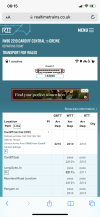
Another one coach Class 150(?) for the 17.20 from Crewe to Shrewsbury. The look of horror on everyone at the platform wondering how to get on. In fairness most get off at Nantwich but still.
Before Covid timetable the 1720 from Crewe used to run as a through service along the Heart of Wales Line then all the way to Cardiff. It was booked as a single 153 throughout. Now it looks like its just Crewe to Shrewsbury but I think the 153 then goes on to form the evening Heart of Wales which now goes to Carmarthen not Cardiff.
Last edited:
Interesting to know it's always been a single 153 unit then. I thought being peak time it wouldn't especially given the 6.08 from Nantwich to Crewe is usually a double unit and fairly empty.
There needs to be certainly half hourly services to Nantwich even if they skip the other stations because the amount of passengers using it is high and the connection times for heading south or to Stoke are terrible!
There needs to be certainly half hourly services to Nantwich even if they skip the other stations because the amount of passengers using it is high and the connection times for heading south or to Stoke are terrible!
craigybagel
Established Member
- Joined
- 25 Oct 2012
- Messages
- 5,826
For all bar the 7 minutes between Crewe and Nantwich on the 1720, a single 153 gives more than enough capacity on that diagram throughout the day.Interesting to know it's always been a single 153 unit then. I thought being peak time it wouldn't especially given the 6.08 from Nantwich to Crewe is usually a double unit and fairly empty.
There needs to be certainly half hourly services to Nantwich even if they skip the other stations because the amount of passengers using it is high and the connection times for heading south or to Stoke are terrible!
Meanwhile the unit that forms the 06:09 from Nantwich on its next trip passes through Birmingham in the morning rush hour, so whilst that first trip to Crewe is indeed very quiet, for the rest of the diagram it does indeed need to be a 2 car set.
Nantwich to Crewe is but a tiny piece of the jigsaw - and some of the unit allocations might seem a little strange until you consider the bigger picture.
The future service levels at Nantwich and Whitchurch are one of the big questions that we still don't publicly have an answer to. It will be interesting to see what solution is brought up with the new timetable.
The golden spanners data shows reliability to be, at most, only loosely corrolated with the age of rolling stock. Despite a big fall when Stagecoach lost the franchise, I think SWR's 30 year old 158s and 159s are still the most reliable DMUs in GB. Meanwhile, Northern's nearly-new Cavity units (class 195) are not much better than a 175; indeed the 175 might be the more reliable of the two I forget.It's unfortunately what happens with having such an old fleet of trains, most of tfws units were built in the 1980s and 1990s then newest units 175s are over 20yrs old now.
As a result reliability suffers
If I recall correctly, the golden spanners data showed TfW's 67 + mark 4 combos to be less reliable than the Sprinters. Hopefully that will improve as it's early days yet but it's worrying that the only true long-distance stock in TfW's fleet plan isn't looking very reliable at the moment.from experience tfw are struggling with unit reliability which always worsens in the warm weather. Tfw are trying to get more units until the 197s come into service, they are sourcing more Mk4s but it all takes time.
I'd need to check the figures to be sure, but I don't remember there being all that many diesel fleets that meet the 15,000 MTIN threshold for rolling stock reliability no longer being a significant factor in overall service reliability. On that basis, are we asking too much to expect a reliable service on a line that is not electrified?
Given the utterly stupid suituation that existed in the 2010s (a hard deadline for PRM compliance in 2020 and a no-growth ATW franchise until 2018) there didn't seem to be any other (indeed, without the benefit of hindsight we now enjoy, my opinion before the refranchising was that a large number of 769s should be ordered to replace the Pacers AND ATW's 150s). There was unlikely to be sufficient time to procure new DMUs (and that would have conflicted with ambitions for ValleyLines electrification (which absolutely could not possibily be delivered by the 2020 PRM deadline) anyway) and Porterbrook were claiming they could produce 769s in very little time - potentially allowing the Pacers to be replaced by 2020 with stock that would be able to benefit from electrification when it arrived. That seemed a really good idea to me at the time (the awful reliability of the 769s aside, it still does).In tfws defence there were some extra rolling stock planned such as the 230's & 769s but they have proven to be a terrible choice. One type in service but very temperamental the other type still sitting in some sidings after a 3yr delay.
It was posted in a Wales online article a few months ago, tfw have said this is the plan on the valleys network
No, that would have been madness (in the case of TfW anyway, who were the last operator of Pacers). Apart from 2 out of 3 Pembroke Dock diagrams in some summers, I can't recall ATW deploying Pacers outside the SE Wales Metro area on a regular basis. Given that the Metro will include electrification, spending alot of money upgrading diesel only units (or, worse, buying new diesels) doesn't make much sense to me. With hindsight regarding the 769 issues, I don't think there was alot TfW could have done other than keeping some 143s on under a PRM exemption and use them only for strengthening PRMed Sprinters)Somebody really did need to bite the bullet,and either get the 14x evolutions, or put in an order for a no-frills PRM compliant eco-pacer type unit,which could do a similar job,but with much reduced running costs.
Ian Walmsley's latest Modern Railways column makes the claim that Pacers were not actually the cost savers we thought they were. According to the article, if you look at it on a cost-per-metre-of-unit basis and factor in the cost of major works to replace doors and brakes (the latter because of frequent SPADs) they were no cheaper than Sprinters.Love them or hate them, but the pacers at their time were made the way they were to keep running costs down.We need a modern day upgraded version still, to fill that niche.
I think there is an issue even when a guard is provided when you have stock like the SWR/SWT class 707s or GA's huge Aventra fleet - units which run in pairs but aren't gangwayed so in effect one unit is either unstaffed or has only the driver who would be in no position to assist in good time if a call-for-aid alarm was activated.The treatment that disabled people get on DOO trains is atrocious and massively dubious in terms of equality legislation. It's not a good example to go by
Regarding toilets at all ValleyLines stations, I think in recent statements that has been downgraded to something which involves toilets at more valleys stations than in ATW days, but not all stations.
The logic that comes across regarding tfws DMUs reliability quoting golden spanner figures, of these are how tocs renew fleets no TOC will ever order new units.
Tfw should carry on with its ageing fleets of trains, just keep on patching them up. Ignoring the need for new more economical units that offer a far superior customer experience.
I know that tfw have gone down the Mk4s route as there's no alternative available for the longer distance routes, the HSTs were looked at but were not viable.
I've travelled on 195s as a passenger and have trained to drive 197s and they offer such a huge step forward compared to what tfw presently run now in so many ways.
Tfw should carry on with its ageing fleets of trains, just keep on patching them up. Ignoring the need for new more economical units that offer a far superior customer experience.
I know that tfw have gone down the Mk4s route as there's no alternative available for the longer distance routes, the HSTs were looked at but were not viable.
I've travelled on 195s as a passenger and have trained to drive 197s and they offer such a huge step forward compared to what tfw presently run now in so many ways.
Assuming the buffet car was a requirement, no alternatives were available as a cascade. However, they could have procured something new-build for the longer distance routes instead of the class 197s. Both CAF (Civity) and Bombardier (Aventra) have advertised bi-mode units (although in the case of CAF this is based on what it says on their website which wasn't clear whether this was available for UK loading guage) or there was the possibility of mark 5 stock from CAF. I guess that around 15 new five carriage trains could have handled the work of the 3tpd Holyhead-Cardiff LHCS and the full hourly Swansea-Manchester service (which I think is 9 or 10 diagrams or double that number of units if going on KeolisAmey's original plan to have everything be a pair of 197s on that route).I know that tfw have gone down the Mk4s route as there's no alternative available for the longer distance routes, the HSTs were looked at but were not viable.
Mk4s weren't in the plan the long distance services were going to be 197. It would be interesting to find out the details of the Mk4 for Class 170 swap. Were the Mk4s at scrap value? After 30 years being thrashed up and down the ECML the Mk4s aren't a long term solution.I know that tfw have gone down the Mk4s route as there's no alternative available for the longer distance routes, the HSTs were looked at but were not viable.
The dft wanted the 170s for other tocs & the Mk4s will be with tfw for some time as they are investing hugely in them.Mk4s weren't in the plan the long distance services were going to be 197. It would be interesting to find out the details of the Mk4 for Class 170 swap. Were the Mk4s at scrap value? After 30 years being thrashed up and down the ECML the Mk4s aren't a long term solution.
Buying Mk4s from GC & having ASDO fitted will be a big improvement for the usage of the Mk4s.
The achiles heal with the Mk4 sets seems to be the 67s as they are not very reliable, they are the 67s DB want to get rid of by the looks of things !
The three sets of 4 coaches (mark 4s) that TfW currently have were always in the plan, the change is that they will now be extended to 5 coaches and increased to 8 sets (if I recall correctly). As things stand, 8 mark 4 sets is still nowhere near enough to cover all long-distance services so still inferior 197s planned to be introduced on routes so long they shouldn't be allowed anywhere near.Mk4s weren't in the plan the long distance services were going to be 197. It would be interesting to find out the details of the Mk4 for Class 170 swap. Were the Mk4s at scrap value? After 30 years being thrashed up and down the ECML the Mk4s aren't a long term solution.
TT-ONR-NRN
Veteran Member
They were always in the plan for 3tpd Holyhead Cardiff, but you’re right for the Manchester services.Mk4s weren't in the plan the long distance services were going to be 197. It would be interesting to find out the details of the Mk4 for Class 170 swap. Were the Mk4s at scrap value? After 30 years being thrashed up and down the ECML the Mk4s aren't a long term solution.
I don’t understand why TfW published separate pictures of the interior of the ex LNER interior sets and branded them “Our Holyhead trains” and then of the ex Grand Central sets and branded them “Our Manchester trains” … the fact they’re doing that suggested they won’t touch the interiors which is obviously ridiculous.The dft wanted the 170s for other tocs & the Mk4s will be with tfw for some time as they are investing hugely in them.
Buying Mk4s from GC & having ASDO fitted will be a big improvement for the usage of the Mk4s.
The achiles heal with the Mk4 sets seems to be the 67s as they are not very reliable, they are the 67s DB want to get rid of by the looks of things !
Get ready folks, it’s happening again!The three sets of 4 coaches (mark 4s) that TfW currently have were always in the plan, the change is that they will now be extended to 5 coaches and increased to 8 sets (if I recall correctly). As things stand, 8 mark 4 sets is still nowhere near enough to cover all long-distance services so still inferior 197s planned to be introduced on routes so long they shouldn't be allowed anywhere near.
Nothing to do with the toilet not being PRM - it was because the use of toilets without retention tanks were banned.This demonstrates the lack of common sense; as long as a PRM compliant facility is available on the train, there really is no reason why an existing non-PRM one needs to be locked out. No different to having a 2/3/4/5 car unit with one PRM and one or more non-PRM facilities.
Ah yes, of course!Nothing to do with the toilet not being PRM - it was because the use of toilets without retention tanks were banned.
Fitting ASDO to them isn't investing hugely. GC already did a refurb and lots of their sister carriages have gone to the scrapman.The dft wanted the 170s for other tocs & the Mk4s will be with tfw for some time as they are investing hugely in them.
Buying Mk4s from GC & having ASDO fitted will be a big improvement for the usage of the Mk4s.
The achiles heal with the Mk4 sets seems to be the 67s as they are not very reliable, they are the 67s DB want to get rid of by the looks of things !
I'm not sure just the 67s will be the Achilles heel. The Mk4s are over 30 years old. They are the same age as the 158s.

markymark2000
On Moderation
TFW are investing in the MK4s? Half of the time, the CIS doesn't work and just shows BBC headlines and the seat reservations are still linked to LNER and some of the plugs already don't work. Where is this investment going as it can't be into the carriage equipment. Only good thing about the MK4 is the comfy seats and the luggage space but they already had all of that before TFW got them.The dft wanted the 170s for other tocs & the Mk4s will be with tfw for some time as they are investing hugely in them.
Buying Mk4s from GC & having ASDO fitted will be a big improvement for the usage of the Mk4s.
The achiles heal with the Mk4 sets seems to be the 67s as they are not very reliable, they are the 67s DB want to get rid of by the looks of things !
That said, the same can be said for most of TFW. More often than not, the CIS doesn't seem to work on 95% of the units.
The exGC sets are far better than the exLNER sets, the exLNER sets are getting refurnished but it's not a full refurb as tfw need them in traffic.TFW are investing in the MK4s? Half of the time, the CIS doesn't work and just shows BBC headlines and the seat reservations are still linked to LNER and some of the plugs already don't work. Where is this investment going as it can't be into the carriage equipment. Only good thing about the MK4 is the comfy seats and the luggage space but they already had all of that before TFW got them.
That said, the same can be said for most of TFW. More often than not, the CIS doesn't seem to work on 95% of the units.
The exGC sets are for the Cardiff to Manchester services and the exLNER are for the Cardiff to Holyhead route.
The TrainFX system on thr sprinters is awful & tfw know about it but the 197s will be replacing the sprinters soon. The 197s have a far more modern Cis system with big screens in the carriages with uo to date information.
The 197s will offer live passenger counts online & a far better customer experience.
craigybagel
Established Member
- Joined
- 25 Oct 2012
- Messages
- 5,826
Fitting ASDO to them isn't investing hugely. GC already did a refurb and lots of their sister carriages have gone to the scrapman.
I'm not sure just the 67s will be the Achilles heel. The Mk4s are over 30 years old. They are the same age as the 158s.
The training costs alone are massive. The original plans only required converting a small amount of staff from MKIII to MKIV. With the extra sets, it involves training over a hundred crew on loco and stock from scratch. On the drivers side, that's a 3 week course per driver.TFW are investing in the MK4s? Half of the time, the CIS doesn't work and just shows BBC headlines and the seat reservations are still linked to LNER and some of the plugs already don't work. Where is this investment going as it can't be into the carriage equipment. Only good thing about the MK4 is the comfy seats and the luggage space but they already had all of that before TFW got them.
That's before all of the other modifications - converting them to be compatible with 67s (as well as some bespoke modifications to the 67s themselves, the aforementioned ASDO, modifications to station infrastructure, the list goes on.
Also, I believe there is more work yet to come inside the coaches themselves.
I saw one at Newport this week, the tatty coaches didn't look great sandwiched between freshly painted loco and DVT!TFW are investing in the MK4s? Half of the time, the CIS doesn't work and just shows BBC headlines and the seat reservations are still linked to LNER and some of the plugs already don't work. Where is this investment going as it can't be into the carriage equipment. Only good thing about the MK4 is the comfy seats and the luggage space but they already had all of that before TFW got them.
That said, the same can be said for most of TFW. More often than not, the CIS doesn't seem to work on 95% of the units.
Wouldn't it have been an awful lot easier and cheaper just to have ordered a dozen or so more 197s. One standard stock for all non Valley Lines services.The training costs alone are massive. The original plans only required converting a small amount of staff from MKIII to MKIV. With the extra sets, it involves training over a hundred crew on loco and stock from scratch. On the drivers side, that's a 3 week course per driver.
That's before all of the other modifications - converting them to be compatible with 67s (as well as some bespoke modifications to the 67s themselves, the aforementioned ASDO, modifications to station infrastructure, the list goes on.
Also, I believe there is more work yet to come inside the coaches themselves.
I don’t understand why TfW published separate pictures of the interior of the ex LNER interior sets and branded them “Our Holyhead trains” and then of the ex Grand Central sets and branded them “Our Manchester trains” … the fact they’re doing that suggested they won’t touch the interiors which is obviously ridiculous.
The draft diagrams have sets inter-working between routes so there won't be Holyhead and Manchester sets so does seem a strange thing to publish!
craigybagel
Established Member
- Joined
- 25 Oct 2012
- Messages
- 5,826
Almost certainly. But TfW wanted stock that some people might consider to be more "Premium" for certain services. Given how certain posters are moaning about how awful the 197s are going to be (despite no fare paying passengers having actually used one yet) you'd think people would be grateful that TfW are offering an alternative for the longer and more business orientated routes.Wouldn't it have been an awful lot easier and cheaper just to have ordered a dozen or so more 197s. One standard stock for all non Valley Lines services.
Ah the boulevard of vanities that is the Welsh Government and their World Class Ken Skates MetroTfW wanted stock that some people might consider to be more "Premium" for certain services
irish_rail
On Moderation
I can't help but feel not putting toilets on new trains is a mistake. We pander so much now to the disability lobby to the extent the train at Paignton Zoo has had to be withdrawn because it cannot accommodate wheelchairs to the detriment of the thousands of families who previously enjoyed riding it. And yet, how many people in this country suffer from bladder or bowel issues that mean they cannot just "hold it". This will be further exacerbated on weekends with the party goers returning home. So how about instead of everyone getting their knickers in a twist about making everything DDA compliant why can we not focus on toilets on all trains?!The new tfw tram trains don't have toilets and will run along the valleys, tfw are planning to have toilet facilities at certain unmanned stations.
Maybe the toilet facilities could have been installed whilst the pacers were on the route & then they could have run until the tram trains come into service
Apparently because its a metro railway they don't have to have toilets fitted to the new rolling stock, if you look at merseyrail and other metro tocs they don't have toilet facilities on there rolling stock.I can't help but feel not putting toilets on new trains is a mistake. We pander so much now to the disability lobby to the extent the train at Paignton Zoo has had to be withdrawn because it cannot accommodate wheelchairs to the detriment of the thousands of families who previously enjoyed riding it. And yet, how many people in this country suffer from bladder or bowel issues that mean they cannot just "hold it". This will be further exacerbated on weekends with the party goers returning home. So how about instead of everyone getting their knickers in a twist about making everything DDA compliant why can we not focus on toilets on all trains?!
I don't agree with the situation but it looks like that's the future on the S Wales metro line, I use merseyrail & in thr last trains at weekends things do get messy I can assure u.
What a charming attitude towards the disabled.I can't help but feel not putting toilets on new trains is a mistake. We pander so much now to the disability lobby to the extent the train at Paignton Zoo has had to be withdrawn because it cannot accommodate wheelchairs to the detriment of the thousands of families who previously enjoyed riding it. And yet, how many people in this country suffer from bladder or bowel issues that mean they cannot just "hold it". This will be further exacerbated on weekends with the party goers returning home. So how about instead of everyone getting their knickers in a twist about making everything DDA compliant why can we not focus on toilets on all trains?!
- Status
- Not open for further replies.