py_megapixel
Established Member
Precisely how many passengers judge their experience on a train journey based on the cleanliness of the roof??

The capital M has been used in "M"erseyside for years though.You may be correct in your rebranding comment. I managed to lose my Merseytravel over 60s pass the other week. When a new one was sent out it had a M-Metro logo on it it. I hope that is not going to end up on the trains it hardly identifies or promotes the region - Metro is such a generic term. Merseyrail is a well established brand now dating back 50 years. It isn't broken - does not need fixing - though I would not mind a rebrand to "Mersey Railway(s)"
London buses did this perhaps 15 years ago, and came to the conclusion it made no difference other than making them harder to clean.I think the white colour is to reflect heat from sunlight where a black roof would warm up and stay toasty all day.
That's incorrect. White roofs are still specified for temperature reduction reasons. It works because it obeys the laws of physics. Light colours reflect heat, dark colours absorb heat.London buses did this perhaps 15 years ago, and came to the conclusion it made no difference other than making them harder to clean.
Electrostars with their white roofs look bad from above even if the sides are immaculately clean. Quite why you'd have a roof anything other than black is beyond me.
I think the white colour is to reflect heat from sunlight where a black roof would warm up and stay toasty all day.

With the 159s I can understand why it was changed from dark grey - the above mentioned issue of solar gain from the darker colour will make a particular difference for 158/159 fleets where the air conditioning system is absolutely on the limit.Just wait until the GWR 769s ever start running then, I really do wonder why they chose white for those - I can see the exhaust smears starting already!
In fact, GWR's roof colour choices always strike me as odd: Matt Black for the Turbos, Gloss Black for the 158s, White for EMUs but also for the Bi-Mode 769s. No taking into account for heat absorption, and a strange mix bag inn appearances. But the worst choice in roof colours has to go to SWR - Whose idea was it to change the roofs of the 159s from dark grey (SWT) to light grey / off white (SWR)?! It's no wonder why they look so filthy already!
Chiltern has white roofs on its 165s.Just wait until the GWR 769s ever start running then, I really do wonder why they chose white for those - I can see the exhaust smears starting already!
But the worst choice in roof colours has to go to SWR - Whose idea was it to change the roofs of the 159s from dark grey (SWT) to light grey / off white (SWR)?! It's no wonder why they look so filthy already!
I think the white colour is to reflect heat from sunlight where a black roof would warm up and stay toasty all day.

It still appears on bus flags, shelters, bus stations and rail station signage. No longer appears on any trains as far as I can tell.I'm quite a fan of TFW's T logo. Not so much West Yorkshire's M. Do they still use it?

It's not a regulation as such, but a livery choice by TfL.If the London Buses are mandated to have a white roof, why are trains not bound by the same regulation? Is it in anyway related to the free-flow of air on a fast-moving object compared to London buses stopping and starting in traffic combined with the hotter air of the urban heat island effect.
Ah, I see. That makes sense. My local bus operators are Arriva and Stagecoach, the former of which does not have white on top (as far as I know) and white is obviously part of the branding of the latter. Now it especially makes sense why it's unique to London.It's not a regulation as such, but a livery choice by TfL.
That is a very good point too actually. Perhaps somewhat ironically the air conditioning may be among these gubbins you speak of.Another point is that there's not much insulation between the roof and the bus interior (unless a single deck battery electric) so the heat essentially goes straight through the roof. On trains there's all sorts of gubbins in the ceiling shielding the interior to an extent.

Ah, I see. That makes sense. My local bus operators are Arriva and Stagecoach, the former of which does not have white on top (as far as I know) and white is obviously part of the branding of the latter. Now it especially makes sense why it's unique to London.
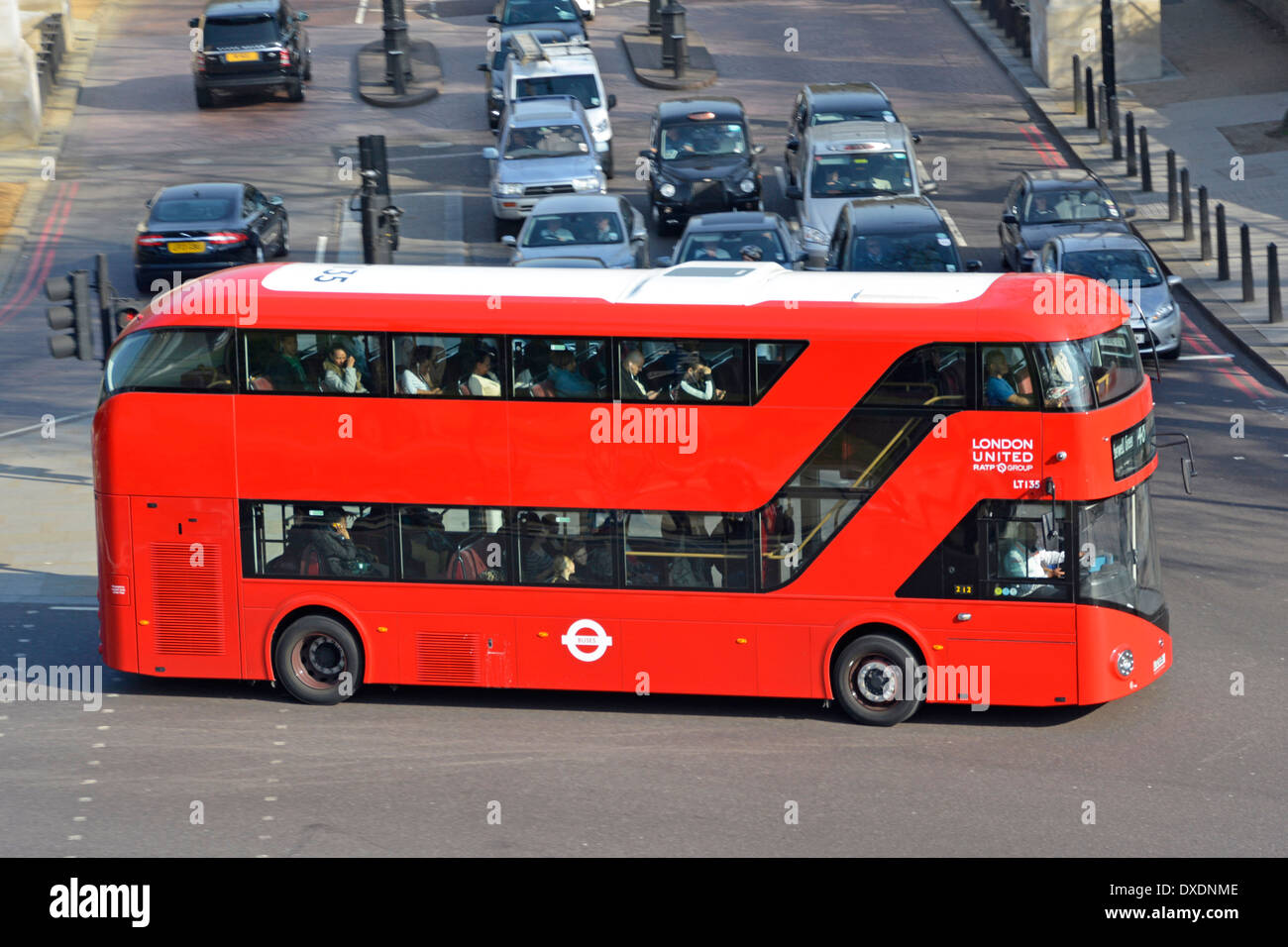
Do all London buses have the fleet number written on the roof? And can anyone explain what the purpose of doing that is?

It is different from the old M LogoThe capital M has been used in "M"erseyside for years though.
You are absolutely correct.That's incorrect. White roofs are still specified for temperature reduction reasons. It works because it obeys the laws of physics. Light colours reflect heat, dark colours absorb heat.
| "Kerry Constabile, who leads work on cities and regions for United Nations Secretary-General Ban Ki-moon’s climate-change team, says that London has “one of the most advanced climate-adaptation plans in the world,”. |
| Ten years ago, the Transport for London introduced a programme for the installation of white panels atop the capital’s trademark red buses in the framework of further climate-adaptation plans. More specifically, white panels reflect the rays of the summer sun, thus keeping the vehicles cooler. After 10 years, 98.5 percent of the fleet of 8,700 has white roofs, thus improving the overall conditions for passengers and drivers as well as reducing fuel consumption for air conditioning systems. Finally, Simon Hughes, deputy director for London at the Environment Agency claims that “Climate change is absolutely at the heart of what we do. We’ve got in place continual monitoring of key metrics of climate change to make sure we’re not sleepwalking into danger.”" |
Emergency service vehicles do too for the same reason.Yes. It is so overhead CCTV and the police helicopters can identify them.

So that bus tickers can identify buses while looking down at them from office windowsDo all London buses have the fleet number written on the roof? And can anyone explain what the purpose of doing that is?

In fact the entire Class 159, 165, 166 and 168 fleet were new with white roofs - it certainly helps to reduce solar gain inside the saloon whether or not it looks dirty.Chiltern has white roofs on its 165s.
I agree if you mean the original Inter City livery. It always went well when offset with red and yellow stripes for catering and first class respectively and of course looked damn good with a BR blue loco on the front but that's me being nostalgic possibly.Blue Grey.

thankfully, chiltern has now dropped it too, on most units that isRegarding Grand Central's branding - that suffers from one problem. Arriva.
It's branding wasn't too bad prior to the Arriva (by stealth) takeover, now everything has the somewhat irritatingly By Arriva tagline. So we are now left with Grand Central by Arriva, Chiltern Railways by Arriva etc. Thankfully XC seems to have dropped it

There was a time that "by DB" would have had a bit more gravitas than Arriva... looking at their (DB's) domestic services over the last few years, now I'm not so sure!Regarding Grand Central's branding - that suffers from one problem. Arriva.
It's branding wasn't too bad prior to the Arriva (by stealth) takeover, now everything has the somewhat irritatingly By Arriva tagline. So we are now left with Grand Central by Arriva, Chiltern Railways by Arriva etc. Thankfully XC seems to have dropped it, Northern by Arriva has finished and I think Wales disappeared before they started the somewhat clunky tagline. At least First's problem was the more simpler, and somewhat consistent, sticking First in front of most things, eg First Great Western, First Capital Connect, First Hull Trains, First Transpennine Express, First ScotRail.
Personally I’d rather see less stripes on the doors, and more Flag style indicators used instead. Something both GWR and SWR have at last got right with their recent liveries.One useful colour feature are the dark red vertical stripes either side of the doors on one carriage of a 4-carriage set on Southern's 377 fleet This signifies 'wheelchair and bicycle space + toilet' and you will see bike riders scanning an incoming train looking for the red stripe and scooting their bike up the platform to take advantage of the storage. Other fleets have a bicycle symbol adjacent to a door but these are less visible when scanning a train as it rolls into a platform. More red stripes, please!
I quite liked the dinosaur livery at the time, it was a bit different from all the corporate liveries on the mainland. It probably outstayed its welcome a bit, would have been better as a "one summer season" promotion.Ah, the tawdry dinosaur livery - so awful that I try my best not to remember it lol, it was like a misguided attempt to promote the Island Line like a "kiss me quick" Butlins holiday, it was a low for the 483s they deserved better than that.
SWT really should have given them the metro red or regional blue livery at the time.
The LT red livery pretty much did the 483s justice in their remaining time in service as it was their original livery before transferring to the Island Line.
Handy if Dennis Hopper plants a bomb on one, with Sandra Bullock and Keanu Reeves trying to save the day... 55 on a Borismaster would be a bit much though!Yes. It is so overhead CCTV and the police helicopters can identify them.
But the majority of people, ie those who have never used them, think that trains run on time in Germany...There was a time that "by DB" would have had a bit more gravitas than Arriva... looking at their (DB's) domestic services over the last few years, now I'm not so sure!
Yes, agreed, the TPE livery is a masterpiece. Do we know who did it?
It was implemented by Aura Brand Solutions, but trying to find/ identify the design agency is proving fruitless.
Don't forget the Tyne and Wear Metro either. It seems that yellow and silver/grey are a popular choice among local transit train operators.
Metrolink wanted a bright colour for on-street running and indeed settled on yellow, but a much softer tone than acidic hazard yellow.Indeed, so popular I recall seeing a photo about a year ago and for a brief second thinking “where near Manchester is that” before realising it was actually different rolling stock and in a different country, just with a very similar looking livery. I wonder if yellow has any safety benefits when on-street running is involved.
Yellow as a whole has the benefit of being relatively visible under low-light conditions compared to other colours which is why there used to be a law requiring British trains to have a certain degree of yellow on the front, so on-street running would definitely benefit from the same principle, especially when pedestrians are involved.Indeed, so popular I recall seeing a photo about a year ago and for a brief second thinking “where near Manchester is that” before realising it was actually different rolling stock and in a different country, just with a very similar looking livery. I wonder if yellow has any safety benefits when on-street running is involved.
Actually green is the most visible colour, not yellow.Yellow as a whole has the benefit of being relatively visible under low-light conditions compared to other colours which is why there used to be a law requiring British trains to have a certain degree of yellow on the front, so on-street running would definitely benefit from the same principle, especially when pedestrians are involved.
Yeah, lime green specifically if I'm not mistaken. That said for what reason did railway lawmakers opt for yellow instead of green?Actually green is the most visible colour, not yellow.