• Our new ticketing site is now live! Using either this or the original site (both powered by TrainSplit) helps support the running of the forum with every ticket purchase! Find out more and ask any questions/give us feedback in this thread!

When did metric start to be taught in British schools?

Status
Not open for further replies.

DynamicSpirit

Established Member
Joined
12 Apr 2012
Messages
9,218
Location
SE London
If I'm forced to buy food by the pound I will leave the UK.

Wow, as over-reactions to pretty trivial things go, that is quite something!

(And no-one is going to force you to buy food by the pound. The most that will happen is that it *might* become legal for any shops that choose to to sell food in imperial units only, and if that happens and any shops choose to do so and you really object, then all you'll have to do is buy your food in a different shop).
 
Sponsor Post - registered members do not see these adverts; click here to register, or click here to log in
R

RailUK Forums

najaB

Veteran Member
Joined
28 Aug 2011
Messages
33,743
Location
Scotland
The most that will happen is that it *might* become legal for any shops that choose to to sell food in imperial units only, and if that happens and any shops choose to do so and you really object, then all you'll have to do is buy your food in a different shop
And in the unlikely event that all shops sell in imperial units only?
 

DynamicSpirit

Established Member
Joined
12 Apr 2012
Messages
9,218
Location
SE London
And in the unlikely event that all shops sell in imperial units only?

As you say, unlikely, I would say, so unlikely that it can be discounted as a plausible possibility. There is no way that - say - Sainsburys or Tesco - are going to willingly choose to add to their own costs and simultaneously annoy a lot of their customers by swapping to imperial only. If any retail businesses go imperial-only, I would expect it would most likely be a few market traders and small independent retailers in less cosmopolitan parts of the country (red wall areas, perhaps) where their customers are mainly older people who would appreciate being able to buy in imperial, and who feel uncomfortable with metric. (And to be clear, in any areas where that's what people want, I don't see any issues with allowing it, because letting people do what they want as far as practical is, in principle, a good thing).
 

70014IronDuke

Established Member
Joined
13 Jun 2015
Messages
4,094
I remember learning to add up yards, feet and inches aged 7-8 in Ms Gwyn's class in 59-60.

In senior school, I'm sure we had switched to SI units from the time we started studying Physics, which would have been 2nd form, so 1964-65.
 

miklcct

Established Member
Joined
2 May 2021
Messages
5,017
Location
Cricklewood
No “normie” private individual here really uses fuel efficiency to calculate how much fuel they will need. Just “ah I see this is giving me 60mpg, that’s quite good”.
I used the figure, along with other factors, to decide if I drive (my motorcycle) or to take public transport. On some routes the fuel cost alone of my 150 cc motorcycle was already more than the express bus fare but on other routes a motorcycle would be the best tool for transportation.
 

McRhu

Member
Joined
14 Oct 2015
Messages
667
Location
Lanark
In Scotland we were taught only imperial when I was at primary school (1962 .. 1968) and I still think in feet, yards, stones, lbs, etc. 12 times table of course (12 pennies to a shilling). We learned Centigrade rather than Fahrenheit though. A very agreeable system, Imperial, whose units are relatable. As an aside I remember after Decimalisation Day, many shopkeepers still displaying prices in £sd. Maybe some still do?
 

Bayum

Established Member
Joined
21 Mar 2008
Messages
3,299
Location
Leeds
Imperial is still taught in primary schools. Y6 is taught to convert using graphs and Y3 still looks at different units in best fit scenarios such as ‘Which if these is best for xyz’
 

LUYMun

Established Member
Joined
15 Jul 2018
Messages
1,392
Location
Cancelled
All "Newspeak" metric throughout my education, but I grew up in the 21st century so it's hardly surprising.
 

Dai Corner

Established Member
Joined
20 Jul 2015
Messages
6,998
If I'm forced to buy food by the pound I will leave the UK. The use of imperial is one of the reasons I stay out of the USA (along with gun, car, tips, nonexistent annual leave, exceptionalism, etc.).

I buy pasta by the kg. I buy meat by the kg. I buy carrot by the kg. I buy rice by the kg. I buy juice by the L. I can't remember all the different fractions between the imperial units and can only memorise 1 lb = 454 g (1/2 lb = 227 g; 1/4 lb = 113 g) and 1 pint = 568 mL. I will need to use a calculator if different units are used.
I seem to recall that you are originally from Hong Kong, where according to Wikipedia Chinese, British Imperial and metric units are all permitted for trade.

In practice, is the metric system system dominant?
 

DelW

Established Member
Joined
15 Jan 2015
Messages
6,047
So how would reversing metrication affect industries such as science, medicine, engineering, construction etc etc? I suggest given a choice they’d all stay metric.

The BBC are reporting that ASDA thinks it’s stupid idea.
There is absolutely no chance of construction or engineering reverting to imperial. There's unlikely to be anyone still working who has done engineering calculations in imperial units*, bearing in mind that civil engineering was already fully metric when I started in 1973. Calculations that are straightforward in SI units are much more difficult in imperial, with numerous awkward conversion factors that would be simple factors of 10 in SI.
Strictly speaking, km/h is not truly metric. The correct metric unit for speed is m/s. I can't see that happening though.
Pedantically, I'd say it is fully metric, but it's not SI.

*Unless they've worked in the US, but of course their imperial units are different from ours anyway.
 

miklcct

Established Member
Joined
2 May 2021
Messages
5,017
Location
Cricklewood
I seem to recall that you are originally from Hong Kong, where according to Wikipedia Chinese, British Imperial and metric units are all permitted for trade.

In practice, is the metric system system dominant?
In practice all three systems are in commonplace for weight, with vegetable commonly sold in the Chinese system and fruit and meat commonly sold in the Imperial system in wet markets. A catty (Chinese system) in Hong Kong (not mainland China where the catty is metricated to 500 g) is exactly equal to 1 1/3 lb so these two systems (Chinese and Imperial) can be converted easily. However, meat in supermarket is commonly sold in metric system.

Another area where ads are still mainly in imperial is property (square feet), but the official documents are in metric instead.

Aviation altitude are still done in feet like the West, in contrast to mainland China.

Elsewhere it's basically metric, including horse racing, like other commonwealth countries. The legacy system is no longer taught. Rail and road are all metricated but some decades-old private dual-system signages still exist, and some old addresses based on Imperial milestones are still in use.

A funny thing is that, in colloquial speech we use the word 咪 (mai1) to denote the driving speed, which is a phonetic transcription of the word "mile" despite we are now driving in km/h. If we say "揸50咪" it means driving at 50 km/h in Hong Kong now (which meant 50 mph pre-metrication). So despite the unit has changed the colloquial word hasn't changed.

The Swedes have metricated their mile to be exactly 10 km. The Chinese have metricated their mile to be exactly 1/2 km, their feet to be exactly 1/3 m, and their catty to be exactly 1/2 kg. Why don't the Britons metricate the mile to be exactly 1.6 km?
 

al78

Established Member
Joined
7 Jan 2013
Messages
2,601
Strictly speaking, km/h is not truly metric. The correct metric unit for speed is m/s. I can't see that happening though.
It is metric, m/s is the international system of unit for speed or velocity but that doesn't mean it is the only measurement that is metric. Using kilo, heto, deca, milli, micro, nano, pico meters, grams, litres also counts as metric, it is all base 10.


== Doublepost prevention - post automatically merged: ==

The UK seems to be a mish-mash of imperial and metric. Fuel is sold in pence per litre but distances on road signs are displaed in miles, and pints of beer are served in pubs. People refer to their weight in stone and pounds, but with objects tend to state weight in kg. When I did home baking wih my mother as a child, she used pounds and ounces and fluid ounces to measure quantity, so I initially used that when baking, but have long since reverted to grams and milliliters. Americans use cups which I have never grasped.
 
Last edited:

Ediswan

Established Member
Joined
15 Nov 2012
Messages
3,459
Location
Stevenage
Pedantically, I'd say it is fully metric, but it's not SI.
Agreed.

It is metric, m/s is the international system of unit for speed or velocity but that doesn't mean it is the only measurement that is metric. Using kilo, heto, deca, milli, micro, nano, pico meters, grams, litres also counts as metric, it is all base 10.
km/h is not a base 10 multiple of m/s.
 

krus_aragon

Established Member
Joined
10 Jun 2009
Messages
6,107
Location
North Wales
I was in school from 1990-2002, never used either a log table or a slide rule. In fact I’m not sure what either of them are
A log table is (a book of) tables to let you find the logarithm of a number. You could also do this using a calculator, using the log() button.

The whole point of doing this (other than for things with logarithmic properties, like the growth of Covid cases back in 2020) is that adding the log of two numbers works like multiplying the numbers: log(x) + log(y) = log(x*y). This was one of the most straight-forward ways to quickly multiply numbers before calculators: look up the two numbers on a log table, add up the values, then look up the result in an inverse (antilog) table.

Slide rules took this to a turbo level: they were marked with a logarithmic scale (instead of the linear scale you get on a ruler), and had a sliding center portion. by lining up two numbers on the logarithmic scale you could multiply or divide them as quickly as you could slide it along and read the scale. Successive calculations could be chained, and there were also scales for doing things like square roots, cubing, and trigonometry on more advanced slide rules. These were the tools that engineers used to get men to the moon, before the days of pocket calculators.

I was in school at similar dates to you, and never encountered a log table at school. I first spotted a slide rule in an antique shop in the late 90s, but my Mum had to explain to me what it was.

(If you're curious, see http://www.sliderules.org/ for some online simulators, and how to use them.)

The one time I did encounter a book of tables at school was on an A-Level statistics course, where we used tables to look up probabilities for various values in poisson, normal, etc. distributions. We were still using decades-old books for this purpose, and some schools switched to photocopies of relevant pages in later years.

Good scientific calculators can look up these values from their memory these days, so the days of table booklets may have finally bitten the dust now.

 

AlterEgo

Verified Rep - Wingin' It! Paul Lucas
Joined
30 Dec 2008
Messages
29,686
Location
LBK
I used the figure, along with other factors, to decide if I drive (my motorcycle) or to take public transport. On some routes the fuel cost alone of my 150 cc motorcycle was already more than the express bus fare but on other routes a motorcycle would be the best tool for transportation.
That doesn’t really make a lot of sense. There’s not really a very accurate way of determining the cost of a particular car journey you’ve not done before, because each journey is different and your mpg will vary wildly depending on the road type and traffic.
 

GusB

Established Member
Joined
9 Jul 2016
Messages
8,193
Location
Elginshire
I'm struggling to see what all the fuss it about. You choose your favourite system and learn how to convert from one to the other. Almost everyone has a calculator in their pockets these days, after all.

I was taught metric at school, but had parents and grandparents who used imperial measurements. I learned how to use both systems, and it's really not difficult to switch.

If I'm asked how tall or heavy I am, it's feet and inches, and stones and pounds. If I need to find out what the metric equivalents are I shout "hey Google...".

I worked for Safeway when they switched from lbs/Oz at the deli counter. We were all given credit-card sized conversion guides which were handed out to customers. If I was asked for a quarter of smoked ham, or a pound of cheddar at the deli counter, I was capable of dispensing the metric equivalent. Even then, you were judging quantities by eye, so it was always going to be just under or just over the specified quantity.

Get a life!
 

DynamicSpirit

Established Member
Joined
12 Apr 2012
Messages
9,218
Location
SE London
A log table is (a book of) tables to let you find the logarithm of a number. You could also do this using a calculator, using the log() button.

Also worth pointing out that a log book would usually also contain tables of trigonometric functions - sin, cos, tan, and their inverses, and possibly other useful functions like square root. Before the age of the calculator, the standard way to do something like get the sine of an angle would be to look it up in a log book.

Good scientific calculators can look up these values from their memory these days, so the days of table booklets may have finally bitten the dust now.

Very pedantic point: Would they look up those values? It would take a lot of memory to store the values of functions for all the millions of possible numbers a person might input. Off the top of my head, I'd have expected a calculator to work out requested values of functions like log, sin, statistical functions, etc., on the fly using a suitable convergent series.

== Doublepost prevention - post automatically merged: ==

Why don't the Britons metricate the mile to be exactly 1.6 km?

Because it would cause huge confusion without solving any problem that particularly needs solving? There must be millions of existing references to 'miles' in existing UK documents, as well as road signs etc. If you redefined what 'mile' meant then it would mean that in many cases, people wouldn't know whether something was referring to the old mile or the new mile. It would be a complete disaster (which of course is why no-one is thinking of doing that).
 
Last edited:

miklcct

Established Member
Joined
2 May 2021
Messages
5,017
Location
Cricklewood
Because it would cause huge confusion without solving any problem that particularly needs solving? There must be millions of existing references to 'miles' in existing UK documents, as well as road signs etc. If you redefined what 'mile' meant then it would mean that in many cases, people wouldn't know whether something was referring to the old mile or the new mile. It would be a complete disaster (which of course is why no-one is thinking of doing that).

Why could the Chinese and the Swedes do that? (In Chinese medicine, all formulae were converted directly to metric units afterwards to prevent confusion)
 

jfollows

Established Member
Joined
26 Feb 2011
Messages
10,180
Location
Wilmslow
The Swedes have metricated their mile to be exactly 10 km. The Chinese have metricated their mile to be exactly 1/2 km, their feet to be exactly 1/3 m, and their catty to be exactly 1/2 kg. Why don't the Britons metricate the mile to be exactly 1.6 km?
Seems bonkers to me; 1 inch is exactly 2.54cm and everything else follows naturally from that.
So a mile is exactly 1.609344km, I don't have a problem with that! It was defined to be this value on 1 July 1959 according to https://en.wikipedia.org/wiki/Mile
 
Last edited:

krus_aragon

Established Member
Joined
10 Jun 2009
Messages
6,107
Location
North Wales
Very pedantic point: Would they look up those values? It would take a lot of memory to store the values of functions for all the millions of possible numbers a person might input. Off the top of my head, I'd have expected a calculator to work out requested values of functions like log, sin, statistical functions, etc., on the fly using a suitable convergent series.
They can be calculated, but it's typically quicker to use a lookup table that to calculate from scratch, and a few kilobytes for some lookup tables (or LUTs) is quite cheap nowadays.

Some iterative algorithms can get a speed boost by using a small lookup table to get a ballpark figure quickly, and then use the algorithm to nail down the exact answer. Others may use a lookup table for the last step instead.

Here's a short article and linked video discussing the use of lookup tables for such functions: https://hackaday.com/2020/01/10/using-lookup-tables-to-make-the-impossible-possible/
 

jfollows

Established Member
Joined
26 Feb 2011
Messages
10,180
Location
Wilmslow
They can be calculated, but it's typically quicker to use a lookup table that to calculate from scratch, and a few kilobytes for some lookup tables (or LUTs) is quite cheap nowadays.
I'm not disagreeing with you; speed isn't the issue here, but it reminds me of my time in "high performance computing" in which some sort of intermediate result was calculated, let's call it "c" calculated from some sort of floating point operation on "a" and "b". It often turned out, counter-intuitively, to be more efficient to recalculate "c" later on rather than saving its value after the first calculation, so slow is computer memory compared to computer clock cycles these days. The human programmer would probably think that saving something calculated for later re-use made more sense, but this could be wrong.
 

AlterEgo

Verified Rep - Wingin' It! Paul Lucas
Joined
30 Dec 2008
Messages
29,686
Location
LBK
Why could the Chinese and the Swedes do that? (In Chinese medicine, all formulae were converted directly to metric units afterwards to prevent confusion)
Because we all already know how far a mile is. I know I can walk a mile in about 15 minutes briskly. Why go through the process of converting every single road sign?

This is a conservative and unique country which is resistant to cultural change and long may it be so.
 

RuddA

Member
Joined
9 Feb 2020
Messages
242
Location
Norwich
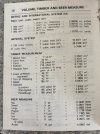
Have to start taking this book with me everywhere :D
Not sure how old it is as no date inside
 

Attachments

  • 0B2F5AA8-BB12-4B31-8530-C8680FFA3888.jpeg
    0B2F5AA8-BB12-4B31-8530-C8680FFA3888.jpeg
    236 KB · Views: 17
  • 9E0EEDEC-A1DA-4B3E-A72E-93B86C0DBB49.jpeg
    9E0EEDEC-A1DA-4B3E-A72E-93B86C0DBB49.jpeg
    165.8 KB · Views: 17

krus_aragon

Established Member
Joined
10 Jun 2009
Messages
6,107
Location
North Wales
I'm not disagreeing with you; speed isn't the issue here, but it reminds me of my time in "high performance computing" in which some sort of intermediate result was calculated, let's call it "c" calculated from some sort of floating point operation on "a" and "b". It often turned out, counter-intuitively, to be more efficient to recalculate "c" later on rather than saving its value after the first calculation, so slow is computer memory compared to computer clock cycles these days. The human programmer would probably think that saving something calculated for later re-use made more sense, but this could be wrong.
I can see how this could be appropriate, in scenarios where the time to calculate a value is shorter than the delay in retrieving it from a memory cache (or, heaven forbid, a cache miss meaning you have to get it from even slower memory!).

If you were building a custom processor to do dedicated high-speed calculations (e.g. on an FPGA), you'd typically use part of your chip for some lookup tables, which would be as fast as could be given that they're in the processor itself. Most general-purpose processors have some lookup element to them too (this was where the old Pentium FDIV bug arose).

Dragging things nearer the original topic, as the article I linked to mentions, times tables can be thought of as a simple lookup table.
 

Mcr Warrior

Veteran Member
Joined
8 Jan 2009
Messages
17,322
And for the imperial lengths, what I know is only that 1 mile = 1609 m (approximately 8/5 km for simple conversion); 1 yard = 91.44 m (approximately 10/11 m for simple conversion); and although not imperial, 1 nautical mile = 1852 m (approximately 50/27 km based on the original definition).
Centimetres, not metres! 8-)
 

===gricer===

Member
Joined
10 Feb 2021
Messages
46
Location
Devon
Rods links chains miles kilometres metres ... at least it is a linear scale !

Angstroms anybody ?

== Doublepost prevention - post automatically merged: ==

 
Status
Not open for further replies.

Top