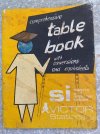
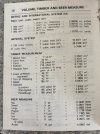
I was in school from 1990-2002, never used either a log table or a slide rule. In fact I’m not sure what either of them are
A log table is (a book of) tables to let you find the logarithm of a number. You could also do this using a calculator, using the log() button.
The whole point of doing this (other than for things with logarithmic properties, like the growth of Covid cases back in 2020) is that adding the log of two numbers works like
multiplying the numbers: log(x) + log(y) = log(x*y). This was one of the most straight-forward ways to quickly multiply numbers before calculators: look up the two numbers on a log table, add up the values, then look up the result in an inverse (antilog) table.
Slide rules took this to a turbo level: they were marked with a logarithmic scale (instead of the linear scale you get on a ruler), and had a sliding center portion. by lining up two numbers on the logarithmic scale you could multiply or divide them as quickly as you could slide it along and read the scale. Successive calculations could be chained, and there were also scales for doing things like square roots, cubing, and trigonometry on more advanced slide rules. These were the tools that engineers used to get men to the moon, before the days of pocket calculators.
I was in school at similar dates to you, and never encountered a log table at school. I first spotted a slide rule in an antique shop in the late 90s, but my Mum had to explain to me what it was.
(If you're curious, see
http://www.sliderules.org/ for some online simulators, and how to use them.)
The one time I did encounter a book of tables at school was on an A-Level statistics course, where we used tables to look up probabilities for various values in poisson, normal, etc. distributions. We were still using decades-old books for this purpose, and some schools switched to photocopies of relevant pages in later years.
Good scientific calculators can look up these values from their memory these days, so the days of table booklets may have finally bitten the dust now.