• Our new ticketing site is now live! Using either this or the original site (both powered by TrainSplit) helps support the running of the forum with every ticket purchase! Find out more and ask any questions/give us feedback in this thread!

Could there have been an electric version of the Pacer?

Status
Not open for further replies.

randyrippley

Established Member
Joined
21 Feb 2016
Messages
5,382
A mistake was made in not building an electric version
Dual voltage 700V DC / 25kV AC, both through lightweight overhead pickups, would allow cheap infill wiring all over the north.
Wire Wigan-Southport, Barrow, Cumbrian coast, Wales at 700V overhead, you'd only need a Hopkinson Bow as a pickup with cables strung from cheap (and environmentally green) telegraph poles. Nothing runs fast on those routes so the infrastructure costs would be cheap
 
Sponsor Post - registered members do not see these adverts; click here to register, or click here to log in
R

RailUK Forums

507020

Established Member
Joined
23 May 2021
Messages
1,983
Location
Southport
A mistake was made in not building an electric version
Dual voltage 700V DC / 25kV AC, both through lightweight overhead pickups, would allow cheap infill wiring all over the north.
Wire Wigan-Southport, Barrow, Cumbrian coast, Wales at 700V overhead, you'd only need a Hopkinson Bow as a pickup with cables strung from cheap (and environmentally green) telegraph poles. Nothing runs fast on those routes so the infrastructure costs would be cheap
The Wigan - Southport line is perfectly straight from Appley Bridge as far as Pool Hey level crossing, so >100mph running is more than optimal. Any upgrades to the line should allow this to improve journey times, rather than simply electrifying a 1980s 75mph service.

== Doublepost prevention - post automatically merged: ==

Of course what I haven’t mentioned is that a perfectly straight track such as Wigan - Southport is also perfectly suited to running non-bogie vehicles since there is no need for turning, but upon reaching Meols Cop the character of the line changes significantly and the sharp bend would spell the end of passable comfort for the electric Pacer
 
Last edited:

61653 HTAFC

Veteran Member
Joined
18 Dec 2012
Messages
19,375
Location
Yorkshire
I know the OP is talking overheads, but I'd be intrigued as to how you'd mount a shoe-beam to a Pacer-type vehicle if you wanted it to have 3rd-rail capability.
 

hexagon789

Veteran Member
Joined
2 Sep 2016
Messages
18,352
Location
Glasgow
You could have Pacer "accumulator" cars. The German railways had lightweight four-axle ones for many light branches, as well as diesel powered versions. Quite successful, some lasted into the mid-1990s, top speed was 100km/h and range was up to 400km.
 

Bletchleyite

Veteran Member
Joined
20 Oct 2014
Messages
113,935
Location
"Marston Vale mafia"
A mistake was made in not building an electric version
Dual voltage 700V DC / 25kV AC, both through lightweight overhead pickups, would allow cheap infill wiring all over the north.
Wire Wigan-Southport, Barrow, Cumbrian coast, Wales at 700V overhead, you'd only need a Hopkinson Bow as a pickup with cables strung from cheap (and environmentally green) telegraph poles. Nothing runs fast on those routes so the infrastructure costs would be cheap

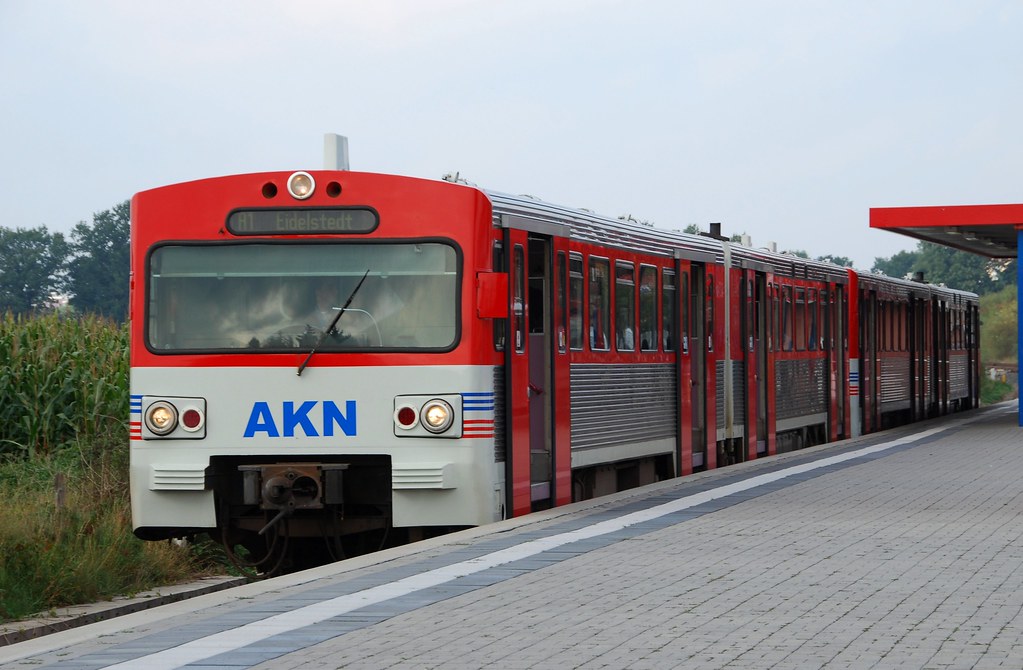
These:
...are remarkably close to what you might envisage a bi-mode Pacer to look like. They are derived from the Hamburg U-Bahn DT1/DT2 vehicles but scaled up, and can run on diesel or on 1200VDC side contact third rail, though I don't think they actually did for most of their lives I've been on one doing so.

They are bogied and articulated, though.

(Picture is of an AKN VT2E DEMU in the Hamburg area).

AKN is a curious little operation, sort of a rural metro. Its character is similar to most of the Swiss narrow gauge lines, with stations that look like scaled down Hamburg U-Bahn stations, but it's diesel operated and standard gauge.

Why wasn't it done? Because diesel wasn't seen to be an issue, and indeed at one (later) point it was seen as the clean future of internal combustion engines...how wrong we were!

== Doublepost prevention - post automatically merged: ==

As for wiring at 700VDC (basically tram electrification) isn't that more expensive than 25kV because of the number of substations required plus the rather heavier wiring for the higher current?
 
Last edited:

david1212

Established Member
Joined
9 Apr 2020
Messages
1,762
Location
Midlands
Going back to when introduced the 14x Pacers were for services on routes that had no electrification and either never expected to have or if subsequently electrified then operated by different trains even if hand-me-down rather than new.
Any running under 25kV would have been a short distance. Over the years both electrified routes expanded and the services to which Pacers were allocated changed.

I'm sure 25kV could have been done if continued operation on a route after electrification was planned. The biggest issue perhaps the weight of the transformer ?

Third rail would have difficult on a rigid chassis but did Pacers ever operate on lines with third rail ?
 

AM9

Veteran Member
Joined
13 May 2014
Messages
16,066
Location
St Albans
Going back to when introduced the 14x Pacers were for services on routes that had no electrification and either never expected to have or if subsequently electrified then operated by different trains even if hand-me-down rather than new.
Any running under 25kV would have been a short distance. Over the years both electrified routes expanded and the services to which Pacers were allocated changed.
That's just as true for DMUs but it didn't stop them.

I'm sure 25kV could have been done if continued operation on a route after electrification was planned. The biggest issue perhaps the weight of the transformer ?
Why would the transformer be a problem, it would be scaled to the power requirement. The class 399 has an 870kW system in a beefed-up tram chassis/body with a total weight of 66t, so a Pacer needing 2 x 84hp motors, transformer and electrics would probably weigh less than the 24t of a diesel one but have far better performance.

Third rail would have difficult on a rigid chassis but did Pacers ever operate on lines with third rail ?[/QUOTE] I'm sure that fitting shoes at the same centres as the axles could be done, but such a train would be constantly gapped on the main line.
 

py_megapixel

Established Member
Joined
5 Nov 2018
Messages
7,526
Location
Northern England
Any upgrades to the line should allow this to improve journey times, rather than simply electrifying a 1980s 75mph service.
I agree in principle, but isn't electrifying a 1980s 75mph service preferable to leaving it running diesel? You'd still get the noise and environmental benefits of EMUs, and the faster acceleration would allow the timings to be tightened a bit to shorten the journey time slightly.
 

randyrippley

Established Member
Joined
21 Feb 2016
Messages
5,382
The rolling stock isn't the expensive bit of electrification.
Depends on how you electrify
Look at the Manx Electric Railway, still using trolley poles and lightweight supports. You can't be suggesting a modern equivalent would be expensive.
 

507020

Established Member
Joined
23 May 2021
Messages
1,983
Location
Southport
I agree in principle, but isn't electrifying a 1980s 75mph service preferable to leaving it running diesel? You'd still get the noise and environmental benefits of EMUs, and the faster acceleration would allow the timings to be tightened a bit to shorten the journey time slightly.
In principle, a 1980s electric service would likely be marginally better to travel on than a 1980s Diesel service, but would not be preferable from the perspective of cost, to providing a modern 100mph electric service on the line. You wouldn’t just put wires up and retain life expired semaphore signals with excessively long block sections, which would likely need replacing anyway would you?
 

Energy

Established Member
Joined
29 Dec 2018
Messages
5,135
Depends on how you electrify
Look at the Manx Electric Railway, still using trolley poles and lightweight supports. You can't be suggesting a modern equivalent would be expensive.
The Manx Electric Railway is not a great place to start from, it doesn't go very fast and is very old. If you have a look at actual costs per km, even in the 1980s it was not cheap. See this for just the costs per single track km for the overhead lines, not including the power supply, bridge replacements, etc.
 

randyrippley

Established Member
Joined
21 Feb 2016
Messages
5,382
The Manx Electric Railway is not a great place to start from, it doesn't go very fast and is very old. If you have a look at actual costs per km, even in the 1980s it was not cheap. See this for just the costs per single track km for the overhead lines, not including the power supply, bridge replacements, etc.
But that's the point, the MER does it on the cheap using 100 year old infrastructure. Wiring a line to similar standards using modern equipment would be even cheaper. Most of the lines you'd want to wire up don't need speed, so don't need heavy duty equipment.
All you need is a trolleybus on rails, with lightweight overheads. If you're worried about bridge clearances just use a neutral section and fit the train with a Raworth-style booster set (or a Parry flywheel is there a difference??)
 
Last edited:

david1212

Established Member
Joined
9 Apr 2020
Messages
1,762
Location
Midlands
Why would the transformer be a problem, it would be scaled to the power requirement. The class 399 has an 870kW system in a beefed-up tram chassis/body with a total weight of 66t, so a Pacer needing 2 x 84hp motors, transformer and electrics would probably weigh less than the 24t of a diesel one but have far better performance.

Maybe it would not but I was thinking about the weight distribution rather than absolute weight if in one inner corner so both beyond the axle and mostly on one wheel. If underfloor together with the control system in place of the diesel engine and transmission then the weight would be more evenly distributed over 4 wheels.
 

AM9

Veteran Member
Joined
13 May 2014
Messages
16,066
Location
St Albans
Maybe it would not but I was thinking about the weight distribution rather than absolute weight if in one inner corner so both beyond the axle and mostly on one wheel. If underfloor together with the control system in place of the diesel engine and transmission then the weight would be more evenly distributed over 4 wheels.
With electric traction, train designers have far more flexibility in layout. For an electric Sprinter equivalent, the traction system would require about 150kW. I've no idea how large or heavy a minimal iron transformer would be, but I doubt it would be that difficult to locate in a 20 or 23m body. Modern traction electronics would be similarly compact, along with motors which would be totally accommodated within the bogie frames. It would be a routine design task to ensure the necessary weight distribution of such small components.
 

Energy

Established Member
Joined
29 Dec 2018
Messages
5,135
But that's the point, the MER does it on the cheap using 100 year old infrastructure. Wiring a line to similar standards using modern equipment would be even cheaper. Most of the lines you'd want to wire up don't need speed, so don't need heavy duty equipment.
All you need is a trolleybus on rails, with lightweight overheads. If you're worried about bridge clearances just use a neutral section and fit the train with a Raworth-style booster set (or a Parry flywheel is there a difference??)
The MER is a 12mph tram, the forces on the overhead lines are a lot less than on a train going at some actual speed.

Tunnels will still be a problem, for your idea you would need the pantograph to drop and raise at the right time regularly, have the flywheel have enough power for the train to not get stuck and still have onboards lights etc. While we are seeing discontinuous electrification now there is no chance BR would do it back then.

While BR often did stuff on the cheap they aren't this cheap.
 

david1212

Established Member
Joined
9 Apr 2020
Messages
1,762
Location
Midlands
With electric traction, train designers have far more flexibility in layout. For an electric Sprinter equivalent, the traction system would require about 150kW. I've no idea how large or heavy a minimal iron transformer would be, but I doubt it would be that difficult to locate in a 20 or 23m body. Modern traction electronics would be similarly compact, along with motors which would be totally accommodated within the bogie frames. It would be a routine design task to ensure the necessary weight distribution of such small components.

As I see sprinter was different as bogies and heavier weight construction.

While a step change from the systems fitted in 1950's / 60's EMU's the pacer was a late 1970's / early 1980's design so the electronics rather less refined and compact than recent EMU's. Regardless it is the transformer weight that I thought could have been a problem.
 

AM9

Veteran Member
Joined
13 May 2014
Messages
16,066
Location
St Albans
As I see sprinter was different as bogies and heavier weight construction.

While a step change from the systems fitted in 1950's / 60's EMU's the pacer was a late 1970's / early 1980's design so the electronics rather less refined and compact than recent EMU's. Regardless it is the transformer weight that I thought could have been a problem.
The transformers on the class 700 EMUs each have a rating of 2.5MW yet easily fit under the floor of the 20m cars (there isn't room for anything above the floor other than passenger space). 2.5MW is 10 times the amount of power that a two-car pacer would need.
 

dciuk

Member
Joined
1 May 2018
Messages
163
I know the OP is talking overheads, but I'd be intrigued as to how you'd mount a shoe-beam to a Pacer-type vehicle if you wanted it to have 3rd-rail capability.
As Diesel Pacers are banned from 3rd rail areas presumably a 3rd rail electric version would not be considered without needing other changes to overcome the reasons for this ban.
 

61653 HTAFC

Veteran Member
Joined
18 Dec 2012
Messages
19,375
Location
Yorkshire
As Diesel Pacers are banned from 3rd rail areas presumably a 3rd rail electric version would not be considered without needing other changes to overcome the reasons for this ban.
There isn't and never was a ban.
 

quantinghome

Established Member
Joined
1 Jun 2013
Messages
2,925
A mistake was made in not building an electric version
Dual voltage 700V DC / 25kV AC, both through lightweight overhead pickups, would allow cheap infill wiring all over the north.
Wire Wigan-Southport, Barrow, Cumbrian coast, Wales at 700V overhead, you'd only need a Hopkinson Bow as a pickup with cables strung from cheap (and environmentally green) telegraph poles. Nothing runs fast on those routes so the infrastructure costs would be cheap
Low voltage doesn't necessarily mean low cost. Low voltage = high current for the same Power demand (P = I x V). This in turn produces higher power losses in the overhead wires, especially when you're looking at long distances on rural lines. So a 700V overhead system would require either a much larger cross-section contact wire, or much more frequent feeders along the line, which would be difficult to achieve in rural areas.
 

AM9

Veteran Member
Joined
13 May 2014
Messages
16,066
Location
St Albans
Low voltage doesn't necessarily mean low cost. Low voltage = high current for the same Power demand (P = I x V). This in turn produces higher power losses in the overhead wires, especially when you're looking at long distances on rural lines. So a 700V overhead system would require either a much larger cross-section contact wire, or much more frequent feeders along the line, which would be difficult to achieve in rural areas.
Indeed, the whole of the Wigan to Southport branch could easily be fed from the WCML supplies, a significant economy compared with a grid to 33kV connection and several substations taking it down to 750V. I would think that NR would have had plenty of experience of the DC line to Weymouth to avoid another long thin 3rd rail schem, especially as there aren't many issues with getting OLE along that route.
 
Status
Not open for further replies.

Top