• Our new ticketing site is now live! Using either this or the original site (both powered by TrainSplit) helps support the running of the forum with every ticket purchase! Find out more and ask any questions/give us feedback in this thread!

Does a signaller know when a train has crossed a junction?

Status
Not open for further replies.

trainmania100

Established Member
Joined
8 Nov 2015
Messages
3,031
Location
Newhaven
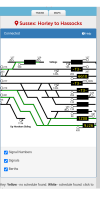
Often on traksy, ott etc, you might see a route be set for another train over a junction, whilst the opposite train is still in the signal berth.

Example attached. 1Z08 is using the line on 9J26s path, 9J26 has the route set to platform one before 1Z08 has passed signal 621.

An example might be southerham jn. A freight might have just passed the junction (but not cleared the following signal), and the route get set for another train crossing that trains path.

Does a signaller have more detailed information as to where a train is between two signals , for example with more detailed track circuit info?
 

Attachments

  • Screenshot_20220220-095410.png
    Screenshot_20220220-095410.png
    216.7 KB · Views: 127
Sponsor Post - registered members do not see these adverts; click here to register, or click here to log in
R

RailUK Forums

JN114

Established Member
Joined
28 Jun 2005
Messages
3,522
Often on traksy, ott etc, you might see a route be set for another train over a junction, whilst the opposite train is still in the signal berth.

Example attached. 1Z08 is using the line on 9J26s path, 9J26 has the route set to platform one before 1Z08 has passed signal 621.

An example might be southerham jn. A freight might have just passed the junction (but not cleared the following signal), and the route get set for another train crossing that trains path.

Does a signaller have more detailed information as to where a train is between two signals , for example with more detailed track circuit info?

Yes, signallers have considerably more information on exact train positions vs the likes of OTT, Traksy and so forth.

The likes of Traksy, OTT etc are not particularly reliable for signalling information. In the specific case you’ve shown there appears to be a crossover missing, that 1Z08 would actually be using to make its movement in parallel with 9J26 - here is a photo of the actual signalling display from 2007: https://photos.signalling.org/picture?/12164/category/1177-2007
 

zwk500

Veteran Member
Joined
20 Jan 2020
Messages
18,401
Location
Northampton
Yes, signallers have considerably more information on exact train positions vs the likes of OTT, Traksy and so forth.

The likes of Traksy, OTT etc are not particularly reliable for signalling information. In the specific case you’ve shown there appears to be a crossover missing, that 1Z08 would actually be using to make its movement in parallel with 9J26 - here is a photo of the actual signalling display from 2007: https://photos.signalling.org/picture?/12164/category/1177-2007
That photo also neatly illustrates the different track circuits.

It's also worth noting some panels can 'queue up' routes, so it may show the route line but the signal itself won't have cleared and the points won't have swung. OTT sometimes also shows wrong routes (Hither Green being a prime example right now). I don't know which panels have this facility and where OTT is accurate or not in every individual case.
 

edwin_m

Veteran Member
Joined
21 Apr 2013
Messages
28,589
Location
Nottingham
It's also worth noting some panels can 'queue up' routes, so it may show the route line but the signal itself won't have cleared and the points won't have swung.
Really? My detailed involvement with signalling is several decades old but I was always told such "preselection" by the interlocking was forbidden. Setting a route as soon as it is available means that if there is a short-duration wrong side track circuit failure, there is a risk that a conflicting route will be set with nobody noticing. Automatic Route Setting systems are allowed to do this, but they include extra checks on the sequence of track circuit occupation and clearing, and sound and alarm and de-activate themselves if they detect an unexpected clearing. ARS won't try to set a route, so the route lights won't appear, until it believes the route is available to be set.

There are some situations where a route may appear more than a few seconds before the relevant signal clears, but any points that are to be swung will always be called at the time of route setting, not when conditions are otherwise satisfied for the signal to clear:
  • Approach controlled signals.
  • Re-stroking the same route behind a train.
  • Signal in auto mode - the release of the route behind the train is inhibited.
  • Points don't get detection, or other aspect control conditions aren't satisfied.
Getting back to the OP's point, the conflict between routes is dealt with at a track circuit level (route sticks in relay interlockings or sub-routes in Solid State Interlocking) not at route level. So a conflicting route can be set for a second train as soon as the first train has passed beyond the track circuit(s) where the moves conflict.
 

zwk500

Veteran Member
Joined
20 Jan 2020
Messages
18,401
Location
Northampton
Really? My detailed involvement with signalling is several decades old but I was always told such "preselection" by the interlocking was forbidden. Setting a route as soon as it is available means that if there is a short-duration wrong side track circuit failure, there is a risk that a conflicting route will be set with nobody noticing. Automatic Route Setting systems are allowed to do this, but they include extra checks on the sequence of track circuit occupation and clearing, and sound and alarm and de-activate themselves if they detect an unexpected clearing. ARS won't try to set a route, so the route lights won't appear, until it believes the route is available to be set.
Fair enough, that was what I was told but my involvement with signalling is only tangential so I will defer to your experience. Probably then route lines are more to do with how OTT interprets the data from the feed than anything else.
 

MarkyT

Established Member
Joined
20 May 2012
Messages
7,549
Location
Torbay
Really? My detailed involvement with signalling is several decades old but I was always told such "preselection" by the interlocking was forbidden. Setting a route as soon as it is available means that if there is a short-duration wrong side track circuit failure, there is a risk that a conflicting route will be set with nobody noticing. Automatic Route Setting systems are allowed to do this, but they include extra checks on the sequence of track circuit occupation and clearing, and sound and alarm and de-activate themselves if they detect an unexpected clearing. ARS won't try to set a route, so the route lights won't appear, until it believes the route is available to be set.

There are some situations where a route may appear more than a few seconds before the relevant signal clears, but any points that are to be swung will always be called at the time of route setting, not when conditions are otherwise satisfied for the signal to clear:
  • Approach controlled signals.
  • Re-stroking the same route behind a train.
  • Signal in auto mode - the release of the route behind the train is inhibited.
  • Points don't get detection, or other aspect control conditions aren't satisfied.
Getting back to the OP's point, the conflict between routes is dealt with at a track circuit level (route sticks in relay interlockings or sub-routes in Solid State Interlocking) not at route level. So a conflicting route can be set for a second train as soon as the first train has passed beyond the track circuit(s) where the moves conflict.
Fully agree about preselection, in UK at least. I think some systems abroad allow it though, even though it might still be implemented as a separate 'layer' in which the route requests are 'stacked' and executed in order when free to set like a simplified manual entry ARS. In UK, where an ARS system is in use, the standard TORR (train operated route release) interlocking function must be enhanced with an extra sequential track circuit condition in order to automatically cancel a route after a train has passed the signal. Also, all sectional route locking (route sticks or subroutes) needs a small additional time delay on release built-in, to further safeguard against early route release following a momentary false track circuit clearance. These extra measures are very easy to add in a processor-based interlocking, but clearly need additional equipment in a wired relay interlocking.
 

trainmania100

Established Member
Joined
8 Nov 2015
Messages
3,031
Location
Newhaven
Thanks everyone, make sense. I thought something like queueing until a route had cleared might be one of the ways it's done too
 

edwin_m

Veteran Member
Joined
21 Apr 2013
Messages
28,589
Location
Nottingham
Fully agree about preselection, in UK at least. I think some systems abroad allow it though, even though it might still be implemented as a separate 'layer' in which the route requests are 'stacked' and executed in order when free to set like a simplified manual entry ARS. In UK, where an ARS system is in use, the standard TORR (train operated route release) interlocking function must be enhanced with an extra sequential track circuit condition in order to automatically cancel a route after a train has passed the signal. Also, all sectional route locking (route sticks or subroutes) needs a small additional time delay on release built-in, to further safeguard against early route release following a momentary false track circuit clearance. These extra measures are very easy to add in a processor-based interlocking, but clearly need additional equipment in a wired relay interlocking.
Thanks for confirming. I'd forgotten about the additional protections in the interlocking - if I remember rightly it would release immediately if the next track circuit on the route was occupied, otherwise it would report occupied for 15 seconds. But that could have been changed since I was involved with these systems in the early 1990s.
 

Horizon22

Established Member
Associate Staff
Jobs & Careers
Joined
8 Sep 2019
Messages
10,942
Location
London
Yes, signallers have considerably more information on exact train positions vs the likes of OTT, Traksy and so forth.

The likes of Traksy, OTT etc are not particularly reliable for signalling information. In the specific case you’ve shown there appears to be a crossover missing, that 1Z08 would actually be using to make its movement in parallel with 9J26 - here is a photo of the actual signalling display from 2007: https://photos.signalling.org/picture?/12164/category/1177-2007

In addition systems like OTT/Tracksy and even CCF are not 100% accurate - it is very possible that green line is a "phantom" and the route has already been taken by 1Z08 and it has not yet updated compared to what the signaller sees to allow 9J26 to move. In this case the map might be incorrect, but I've seen plenty of "conflicts" which is just that it is a 100% accurate representation of what is actually taking place on the ground unlike a signaller's panel with track circuits / axle counters.
 

Annetts key

Established Member
Joined
13 Feb 2021
Messages
3,788
Location
West is best
Please note that the following details are based on standard mainland U.K. signalling principals and on the
types of interlocking system that I am familiar with. There may be variations in different parts of the country, as not all the systems work exactly the same.

Some further points:

The signallers display is not always an 100% accurate and complete indication of the real state of the railway. There is a short time lag with some systems. The signaller is also only provided with a subset of the information from interlocking. But enough for them to do their job.

CCF, OTT, Traksy and similar systems, especially with relay based interlocking and older computer based (SSI - solid state interlocking) take their information from the Train Describer (TD) system. Which in turn is supplied with limited information from the interlocking system. The TD gets a subset of the information available to the signaller.

There is also a difference between the state of the route calling system and the route locking system. They do different things, but both are commonly referred to as “route”.

The route calling function is the function that operates when the signaller (or ARS) requests a route (operates the signal switch). It is this that requests the interlocking call all relevant points to the correct positions, and it’s this that requests that the interlocking clears the signal to show a proceed aspect. But note that there are many other controls in both the point control systems and the signal control systems.

The route locking system is a number of safety type functions that hold the path (or route) of the train locked so that at all times, the path is held correctly set for the train. It prevents points from being moved (on power) in front of the train, if a manually controlled level crossing is in the route, it prevents this from being opened to road traffic. If the line is bidirectional, it prevents the opposite direction signal from clearing. It’s normally arranged to match the track circuit or axle counter sections. So there may be many route locking functions between one signal and the next.

With a traditional control panel and traditional panel, that is no ARS or TORR systems, the route calling function (normally a relay) will continue to be set even after the train has gone past the signal. The route calling function is only cancelled when the signaller cancels the route. Then due to the design of the system, there will be a short delay before the route locking releases.

Further, because the route locking function is separate, as soon as the train has passed the signal, the signaller can cancel the route if they so wish. The route calling function will unset, but the route locking will continue to be effective under and ahead of the train. The route locking will automatically release as it detects the train clearing each track circuit or axle counter section, but with a short delay in case of bobbing track circuits. All this ensures that the train can safely proceed and still be fully protected by the signalling system.

As soon as the relevant route locking section releases, the points then become free. So the signaller can set a route from any signal that requires those points (either in a different position or in the same position).

With some systems, the next route can be set from the same signal even with a train in section, once the current train has gone past the signal. You can even call the same route again with a train still ‘in section’. However, the signal will not clear until it is safe to do so (the train ahead has completely cleared the section).

In a the type of interlocking system that I am familiar with, the TD is normally only supplied with the following information:
  • Which route calling function is set.
  • When a signal changes from a showing proceed aspect and returns to its most restrictive aspect (normally red) due to a train operating the track circuit or axle counter for the first section beyond the signal (or equivalent information).
  • In some systems, whether the signal is showing a proceed aspect or not.
This is often called stepping data, as it this which causes the TD to step the train description (headcode) forward to the next signal berth.

The CCF, OTT, Traksy and similar systems can therefore only use the limited information available to them. Hence why what they show does not alway make sense.

I hope this level of detail is not too much. But it’s needed in order to explain the why.

Also remember, that most of the time, the headcode is ahead of the train.

 
Last edited:
Status
Not open for further replies.

Top