We have a new reserved seat here, which has every chance of becoming the main version for night express trains . On it, I want to show how your feedback helped change the car. Since this prototype story is already long, you can clearly see both the dead-end branches, which were abandoned, and the successful solutions. Let's start with what we have now:
TMH showed the fourth, close to the final, second-class carriage in a diagonal layout. Let me remind you that at first we had a capsule hotel with a wardrobe instead of a table, then a whole carriage of sidewalls, and now there is the option that most resembles a Chinese diagonal reserved seat, only taking into account everything that experts and passengers have said before. For example, posts on Habré collected 548, 518 and 888 comments, a lot of feedback was from exhibitions, other publications and from those who went to the layouts (they were at Yaroslavsky, Paveletsky stations and at VDNKh).
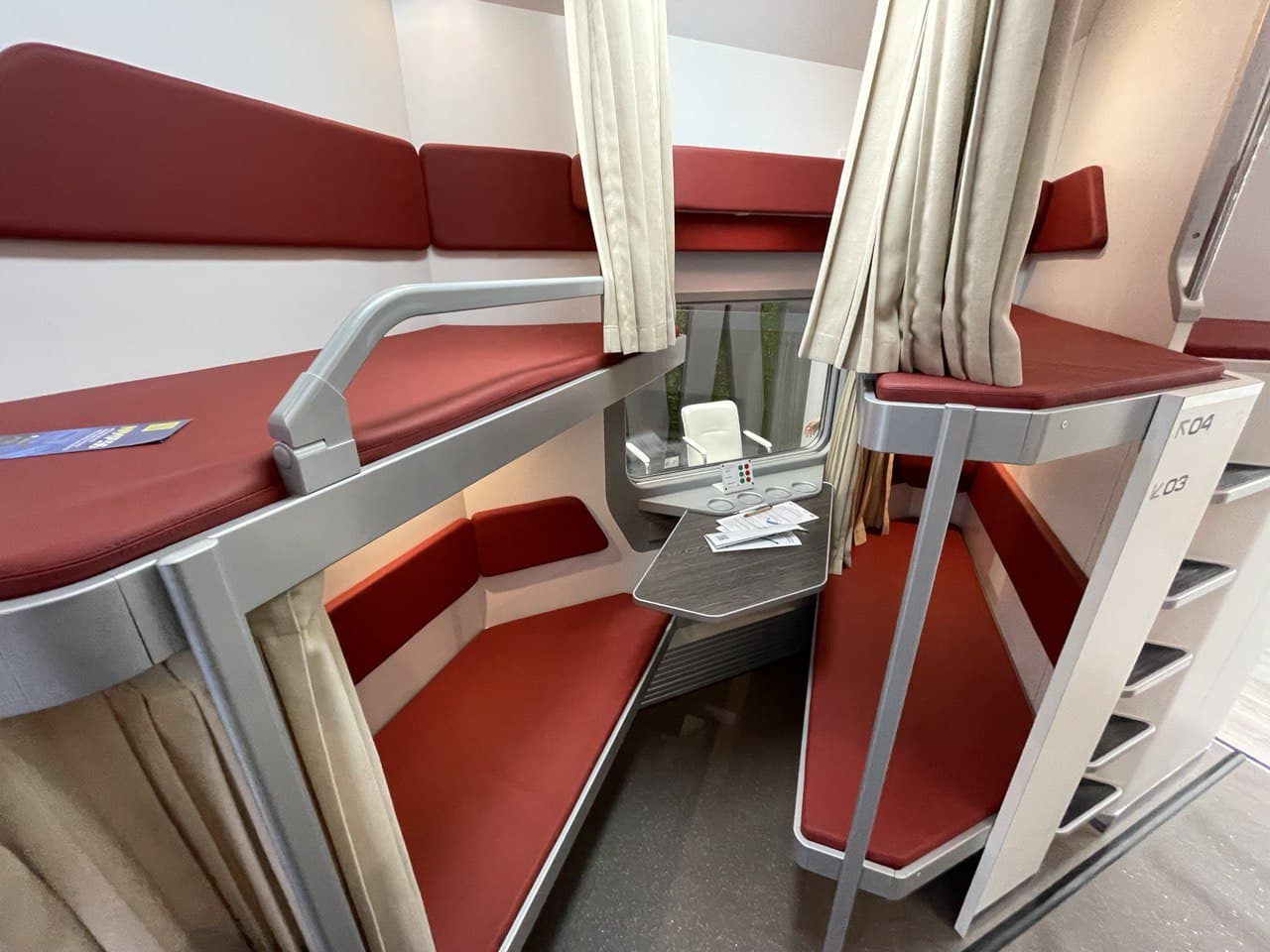
This means that the main thing: there will be "capsules" and the usual reserved seats with a table, your neighbor's legs will still remain in your nightstand. Luggage will no longer stick out into the aisle, but will lie securely between the shelf and the window, plus it will be possible to climb upward with bottles. Naturally, new light, sockets everywhere and a compromise with luggage racks in the aisle instead of third ones.
Let me remind you that the traditional reserved seat is good, but if the task is to lengthen the shelves and solve a bunch of things that have accumulated over the past 50 years, then a rearrangement is needed. This is what we see now.
What it is
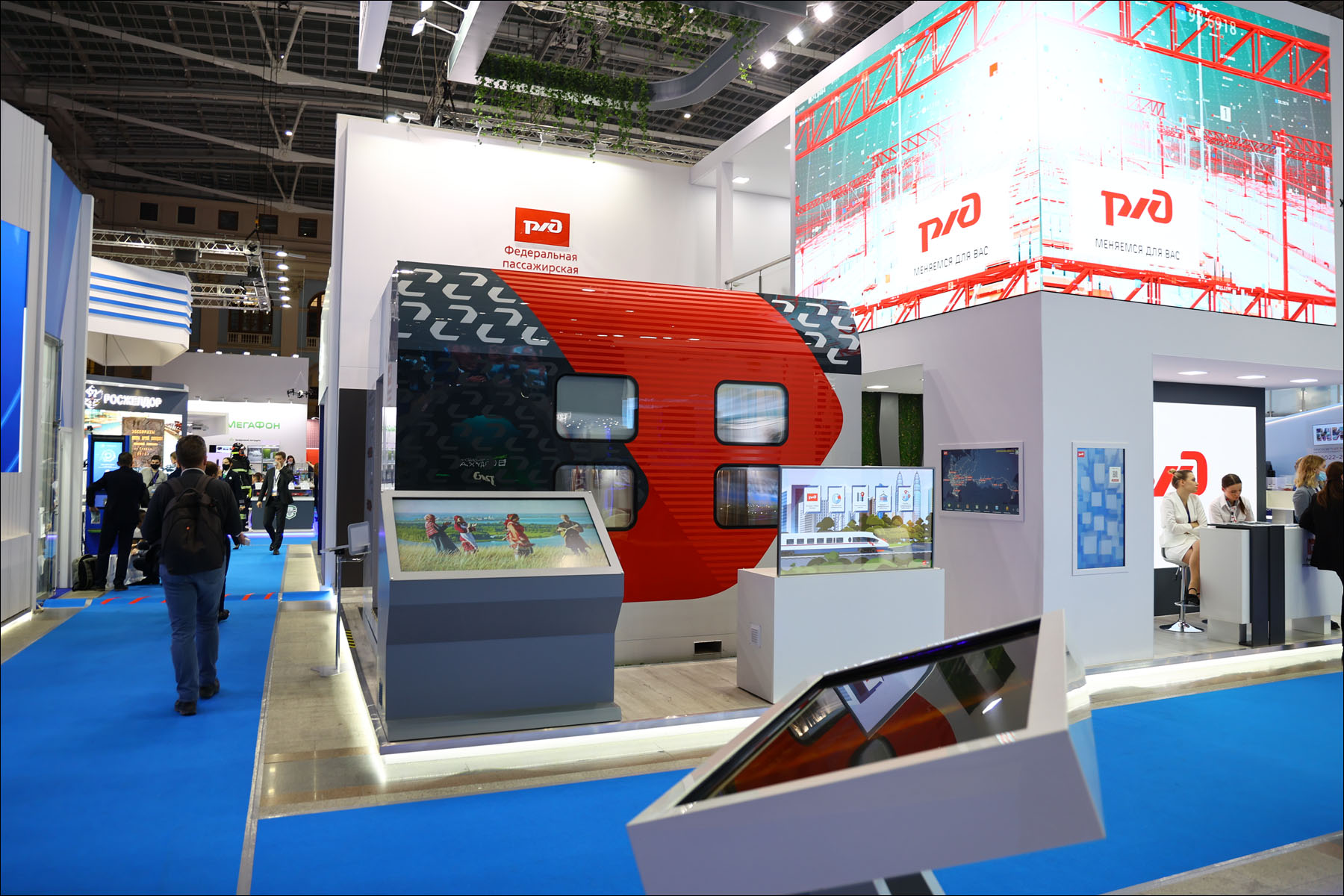
- This is a prototype from the Transport of Russia exhibition. This is not a finished carriage and not a final solution, but a demo model, something like a render of an interior. Its task is to show the final version of what will happen to reserved seats and to collect one more iteration of feedback. Now it seems that this is already a fairly good version of the car, and further development will be based on this type of interior, but it is not too late to make proposals. TMH (TVZ, designers and engineers) carefully read the comments.
- This is a night express carriage . Like all previous prototypes, it is not designed for a long ride. "Yolochka" will travel to the sections until 12 o'clock. For the Transsib, there are still traditional reserved seats and coupes.
- This is an economy class carriage . It should accommodate the same number of people as a regular reserved seat carriage, while having a shelf 15 centimeters longer and meeting cleaning, safety, and so on. It is assumed that its comfort should be higher than in a reserved seat carriage due to the departure from the inequality of the upper and lower shelves and sidewalls and "normal" ones. The population of this carriage is 56 people, that is, 2 people more than the typical one.
- This is a car of a new type for a two-car connection . That is, the train will have not one type of carriage, but clusters of two carriages. At the beginning of the car there is a slot - the so-called universal zone. In the master cars of the trailers, there will be a conductor's compartment and a vending machine with food, but in the slave cars of the traction, there will be a mini-cafe, a recreation area, a large luggage compartment for skis and bicycles, and so on under the route.
- This is the T dimension . This car is larger than the usual reserved seat in 1-VM dimensions (+73 centimeters in length and +28 centimeters in width). This is the size of modern electric trains (for example, Swallows). Now T-cars can go far from everywhere, but for many years now work has been underway to clear the dimensions of the approaching buildings, that is, to raise cable routes, all kinds of structures and expand old tunnels. Dimension T unties the hands of engineers very much.
- There is no finished carriage for this interior yet . The capsule layout means separate windows and a more complex air duct system, plus the engineer and the requirements for insolation-fire have not yet been fully calculated and so on. This means that the internal dimension can change within a couple of centimeters after detailing, plus a new car will generally have to be recalculated according to the stiffness of the walls (due to new windows). That is, until there is a final decision on how a reserved seat (more precisely, already non-compartment) car should look like from the inside, this option will not go into development.
- Furniture and fittings are for display only . Handles, doors, edging, rounding corners - all of this will change as it gets closer to being used. As usual, engineers will once again go over the entire carriage for head-banging places, places where a citizen's finger can get stuck, places where a child can stick his head, and by the first pre-serial cars they still recognize a couple of places that can treacherously attack a very drunk passenger.

Prototype history
- An ordinary reserved seat in the size of 1-VM is a railway default.
- The prototype 1-VM , which was demonstrated at the Paveletsky railway station and then traveled around the country - reserved seats turned into capsule hotels, a wardrobe appeared in the middle of each. Openable "windows" appeared between the upper and lower shelves of adjacent compartments. Long shelves.
- A prototype of the T dimension , where the same modular system was transferred to a new dimension. There are open reserved seats as before, but with a bunch of lighting modifications, etc. and closed with a wardrobe. There are a lot of corrections and improvements based on feedback. Long L-shaped shelves with an extension towards the upper body of the passenger.
- The prototype of the T dimension with a non-compartment capsule structure - "a whole car of sidewalls" on both sides. Lots of usability improvements in subsystems.
- T-herringbone, two structures made of compartment and capsules (you are here).
The most important thing that has changed
As with all prototypes, the shelf is now 188 centimeters long. This is 18 centimeters longer than the usual reserved seat shelf without an emphasis on the wall (where the socks stick out into the passage) and 15 centimeters longer than the side, which is 173 centimeters. In past times, there were questions why such a length. The answer is very simple: because it is the 95th percentile in the distribution of growth. That is, 95% of Russian earthlings fit on it without a trace. The remaining 5%, alas, can still ride, hunching a little or putting their socks in the aisle, there is nothing you can do about it. Long-bunk options for an additional fee are too difficult to implement and maintain, but can be implemented in compartment cars. Therefore, if it is critical for you to have a shelf of 195 centimeters, and not 188, alas, you are not in a reserved seat. As in all other reserved seats, there is no provision for the passage of disabled people in wheelchairs:for this there are special huge compartments and ramps in the staff carriages of trains, and there are also special huge toilets. In new
the option of
staff cars is planned, where there are two such compartments for a disabled person and an accompanying person.
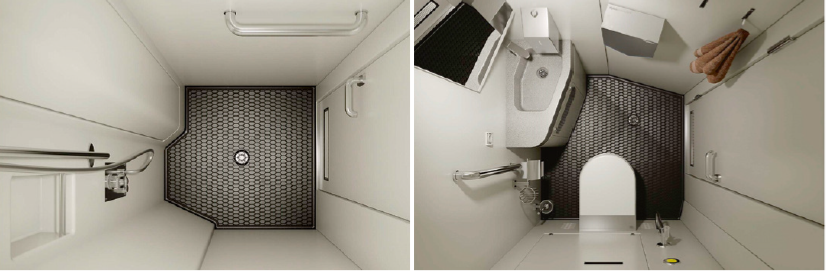
The prototype fully includes toilets and showers from v2.0 and v3.0. Here they were no longer even modeled. Let me remind you that in size T you can fit two toilets opposite each other plus one shower room at the non-brake end of the car. The shower room is very important, since one of the tasks of such a new reserved seat is to provide an opportunity to travel with at least some comfort without increasing the ticket price. That is, if the
SV "Grand Express"often replaces a hotel on the road (and there is a segment of people who purposefully travel by train instead of an airplane for the sake of this comfort), then there will be an attempt to make, if not a hotel, then at least a hostel or a capsule hotel. Yes, there might be a queue, but it's better than one shower room for the train in the headquarters car, as it is now. In the sense that before there was none, and if it bothers you, you can not use it, as in the good old days.
Both the toilets and the shower room have a built-in UV disinfection system from the ceiling panel between sessions. They are much easier to clean and generally free from the birth trauma of old toilets. Here, in general, I must say that there is nothing more reliable than a gravity-type toilet on the railway, but ****ting on the rails and closing the door at the stations is a so-so idea. In the twenty-first century, it is customary to torture people morally, not physically. Well, in the end, we first got tanks with negative pressure, which could be accidentally thrown back into the user in case of some malfunction, then solutions with a compressor (the whole car heard it from behind the track in the floor to the non-braking end), which also had a number of very rare bugs that have become good bikes from time to time. In general, now both toilets are at one end of the car,which means one compressor without a long run. The storage tank itself is stable at rest, the pressure is only in the pump and only at the right moment. The pump diaphragm should not cause a cascade of reactions when trying to feel it with a mop (but I still do not recommend experimenting). We have already seen toilets with plastic covers on the seats rolled over a button, but how exactly all this will be implemented and what will happen to the engineer (even though expensive grinders on the neck of the fecal tank, chewing on towels) - this is the choice of the carrier, which will be ordered and delivered. It is important for our history that the issue of toilets and showers has already been fundamentally resolved.The pump diaphragm should not cause a cascade of reactions when trying to feel it with a mop (but I still do not recommend experimenting). We have already seen toilets with plastic covers on the seats rolled over a button, but how exactly all this will be implemented and what will happen to the engineer (even though expensive grinders on the neck of the fecal tank, chewing on towels) - this is the choice of the carrier, which will be ordered and delivered. It is important for our history that the issue of toilets and showers has already been fundamentally resolved.The pump diaphragm should not cause a cascade of reactions when trying to feel it with a mop (but I still do not recommend experimenting). We have already seen toilets with plastic covers on the seats rolled over a button, but how exactly all this will be implemented and what will happen to the engineer (even though expensive grinders on the neck of the fecal tank, chewing on towels) - this is the choice of the carrier, which will be ordered and delivered. It is important for our history that the issue of toilets and showers has already been fundamentally resolved.It is important for our history that the issue of toilets and showers has already been fundamentally resolved.It is important for our history that the issue of toilets and showers has already been fundamentally resolved.

Similarly, at v3.0, the issue with the conductor compartment, the food zone and the universal zone was resolved . They will simply fit into the new interior in their previous form with minor modifications to the types of ski and bike mounts. I mean, large luggage can be left in a special compartment at the braking end of the car. Well, because the conductor's compartment may be located there, and the handbrake should be near it. Master cars in a link come with a conductor's compartment and a food area, driven in a link - for example, with a luggage area. Let me remind you that in this slot you can install any extension of the functionality of the car from a minibar or cafe to a cinema, if you wish. There are three typical ones now: a sofa cabin, a luggage area + vending machines, a luggage area + a conductor's compartment.
Most of the changes are in the interior, in fact, in the seats of the passengers.
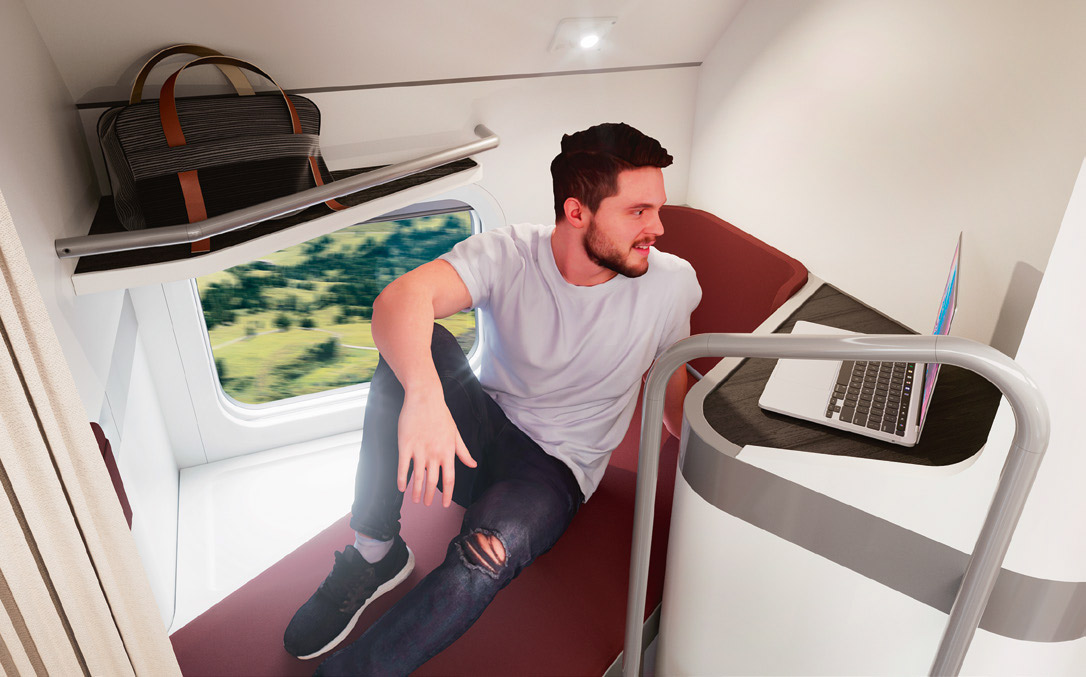
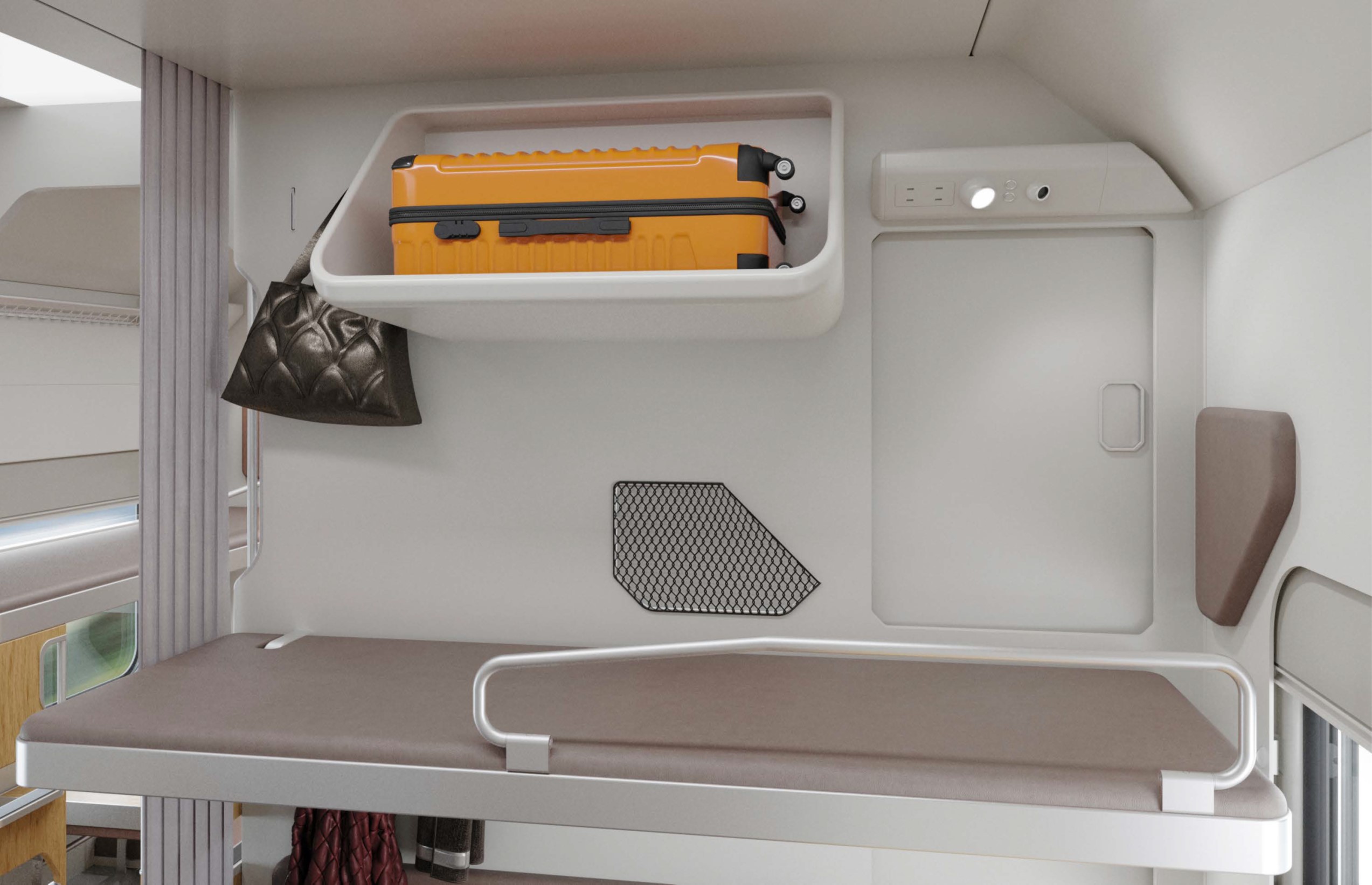
There were two different layouts: "capsules" and "open reserved seats" . Capsules are shelves where you are isolated as much as possible from other passengers. And not just your own curtains around the shelf perimeter, as it was in v1.0, but as much as possible with the structures of the car, that is, the walls. The passenger has his own space where he can pupate and not interact with the surrounding train at all. A similar approach was in the third prototype of the capsule car, but there was a difference, you even have a couple of seats.or not: some were closer to the aisle, others were snug in the back. There was also a problem with the fact that the luggage was right behind the curtain in the aisle for half of the seats, and in half it was safely hidden between the shelf and the window. So, the passengers really liked the second seats, and the first seemed unfair. Luggage should not be accessible from the aisle, but the shelf should not be a "side piece with a curtain", but fully its own personal space. Therefore, diagonals - so you can put at least a shelf in the aisle.
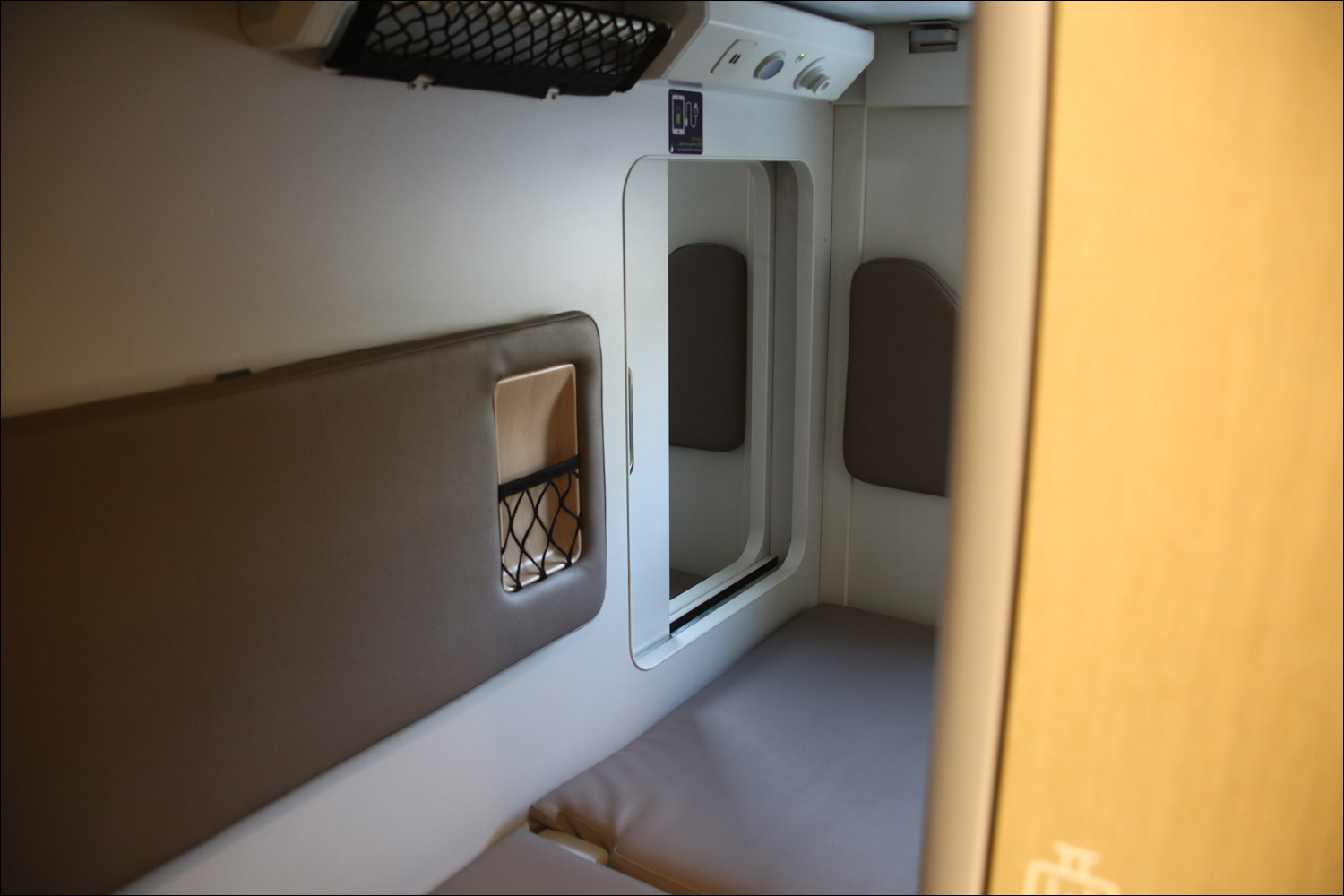
The capsules look like this:
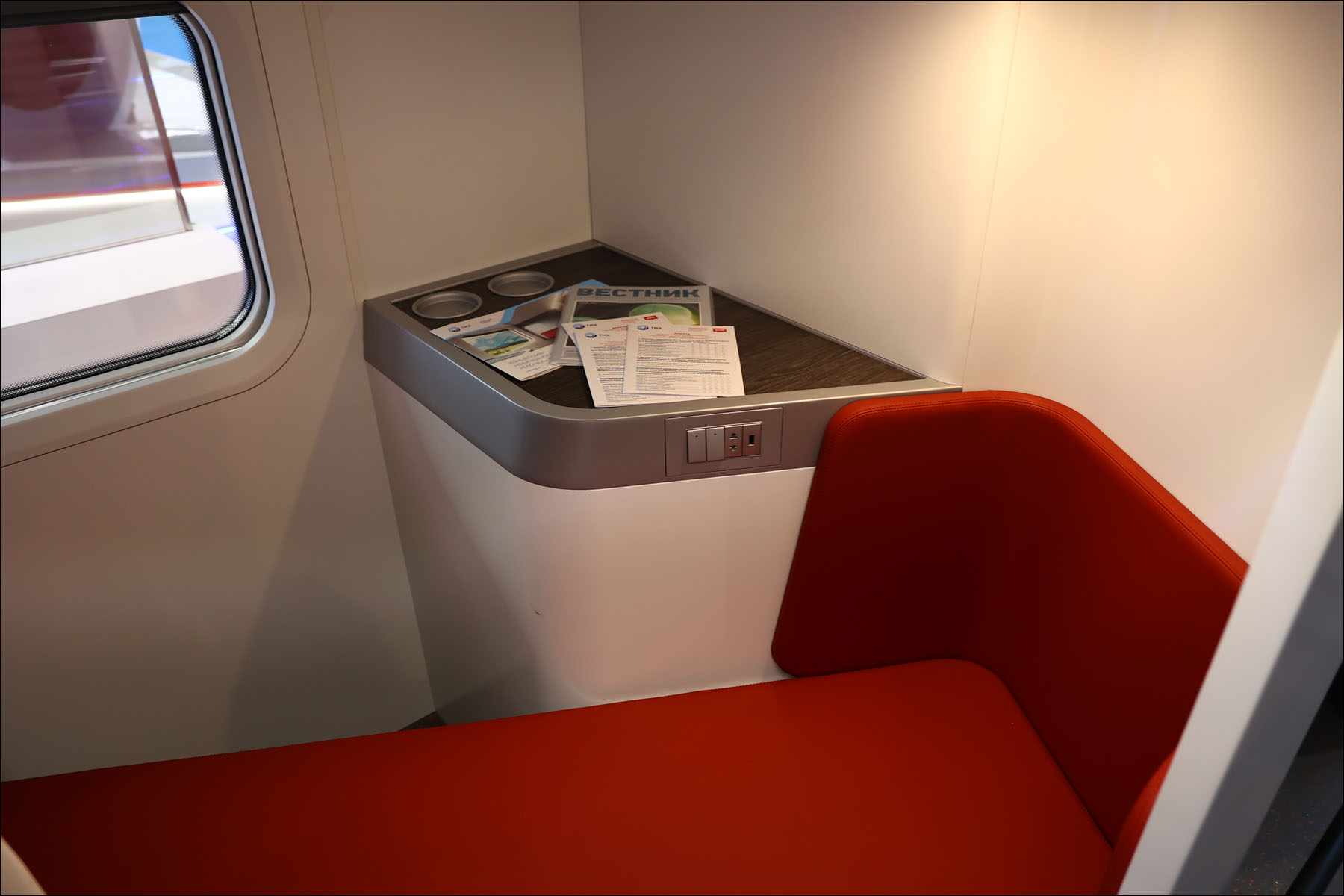
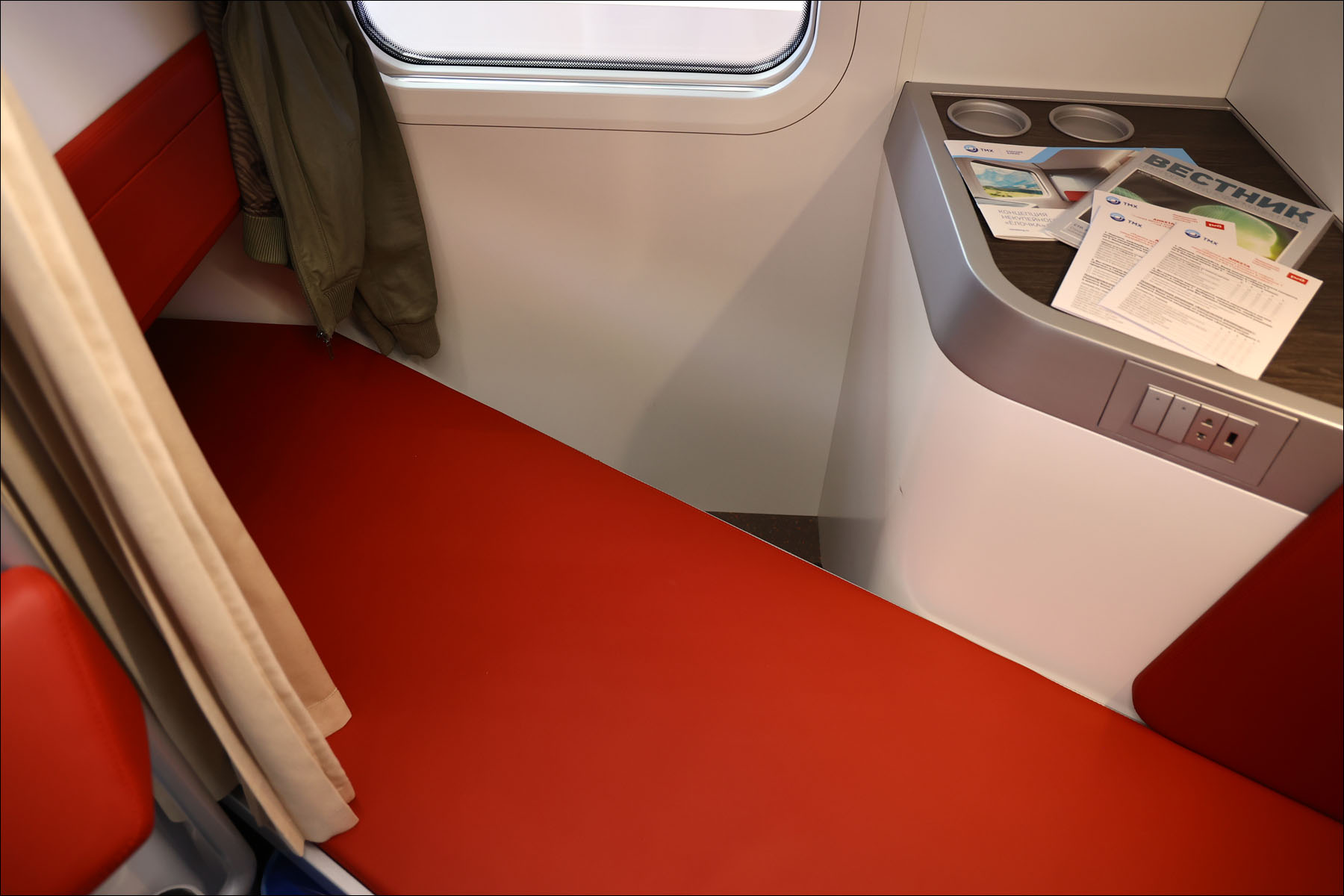
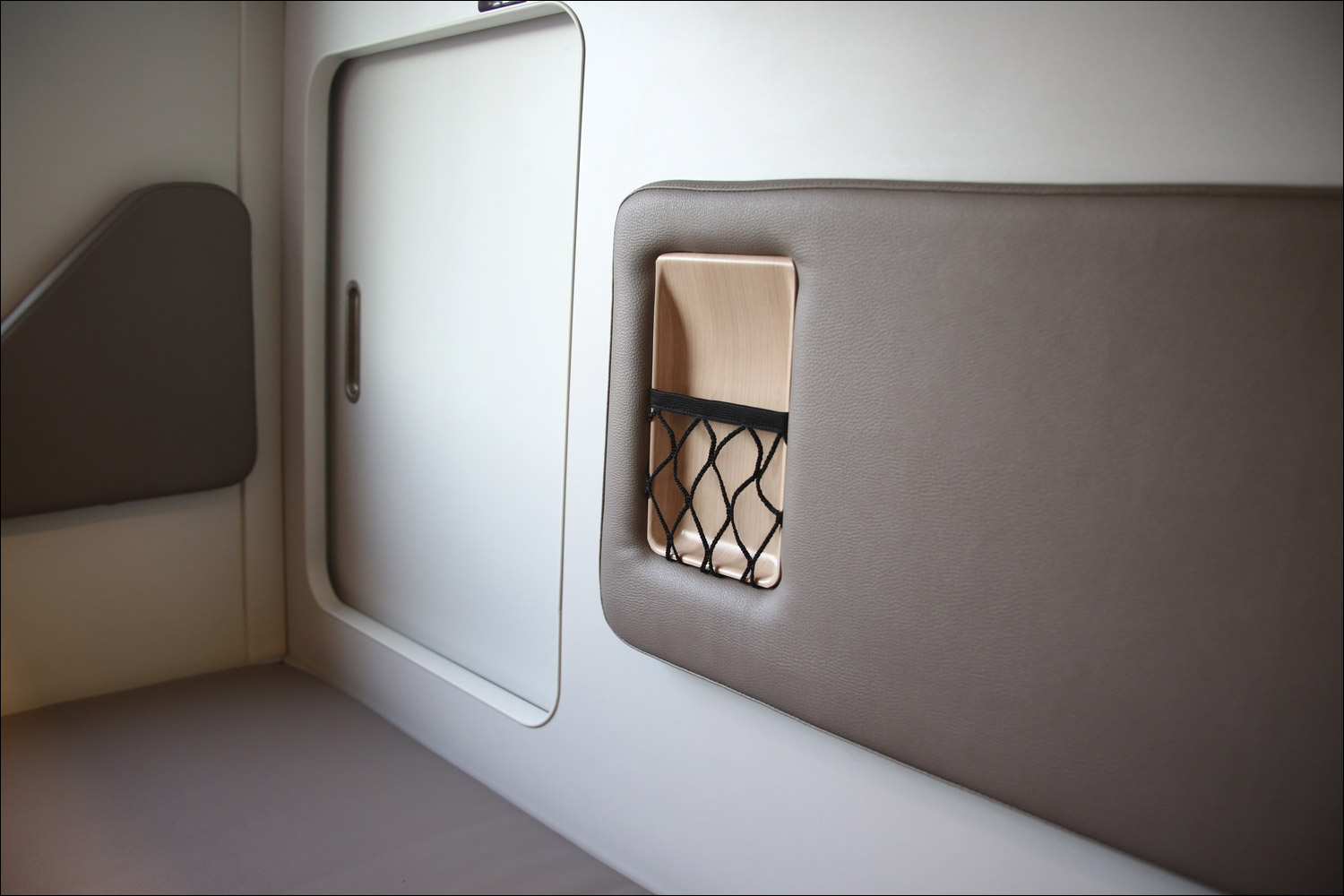
By the way, this very nightstand, in which the legs of the neighbor
Prototype photo with a sample of a person from the manufacturer of the sample car
Put your feet here (on the left in the photo):
Actually, all sockets, switches and the rest migrated here from past prototypes. There was an important story with the interface so that the user would intuitively understand which switch was from. Engineers have worked with prototypes, and now passengers do not get confused in experiments, but immediately figure out what and for what.
The switches are in the right places, the air flow control is affordable, that is, from the outward appearance it becomes clear what can be done with all this. At least that's what they say. The USB socket looks stronger, but it is still A, not C, let me remind you, there was an opinion that it would be immediately annoyed. In previous series, this element changed both in composition and in layout: in v1.0 it was behind the head, and long hair went there, in v2.0 it was so that it was easy to knock out the cable from the outlet by hand.
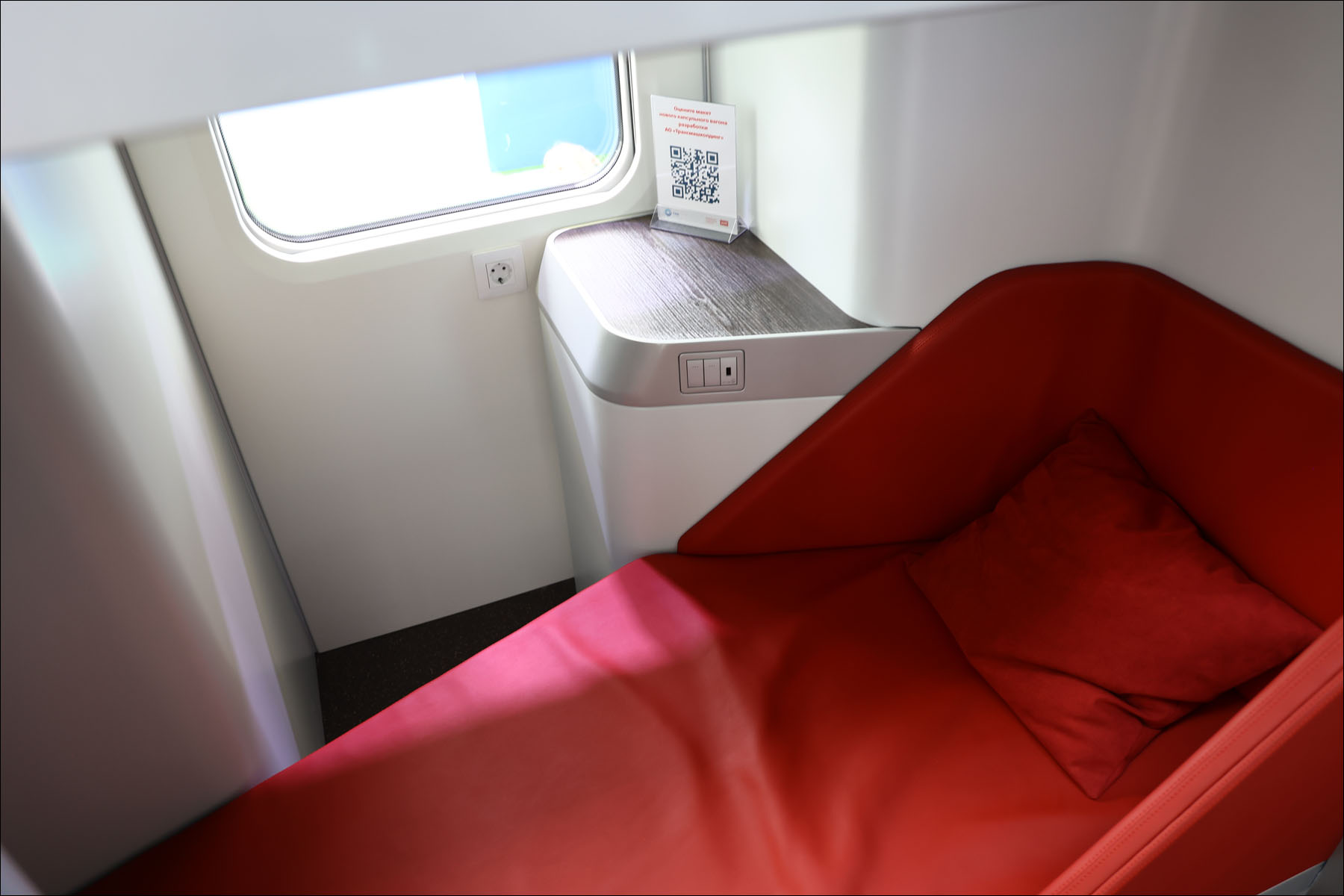
Passengers really wanted to equalize the functionality of the upper shelf and the lower... In previous prototypes, there were serious movements so that it was possible to work with a laptop at the top and so on, but there was not enough space, and half measures were obtained. More precisely, it is more convenient than in a regular reserved seat, but all the same, looking at the fourth version, it is already clear that these were intermediate forms. Of the important - it will be convenient here with a large laptop, there are slots for bottles and glasses (this is on the top shelf, where they usually did not even climb with this), and in general there is a lot of space. And yes, the steep staircase is back, positioning you right when you get to the top! True, now it looks strange:
This thing is
podzhescutcheon for standing. As a result of experiments, it turned out that passengers on the road for some reason want to stand. Perhaps they are talking to each other, perhaps thoughtfully looking into the distance. In general, now there is a thing to rely on. There is a similar one in Oriole, by the way.
The light has changed a little, now it is like this:
Two retractable clothes hooks instead of one:
This pocket with Velcro appeared in the legs:
Each passenger has his own window in the capsules, this is about ¼ of the large one, but they are made as separate holes in the carriage wall, and not dividing a large window into zones.
Pay attention, the window with the latch to the next shelf has disappeared.
Here is
It was needed in prototypes v1.0 and v2.0 for parents with children and couples to connect the top of the shelf into one space. It became clear that this was a fierce crutch, and instead of such a decision, they simply returned the open reserved seats, where four of us could ride without any capsules. So the second layout is a good old reserved seat (more precisely, an open compartment without side shelves), but only diagonal.
It looks like this again:
In one car, it seems, both layouts can be combined, as shown on the prototype.
That is, there is everything that was in the usual reserved seat of the modular car v2.0, but only in the style of capsules. The shelf does not expand towards the head as it did in the first prototypes.
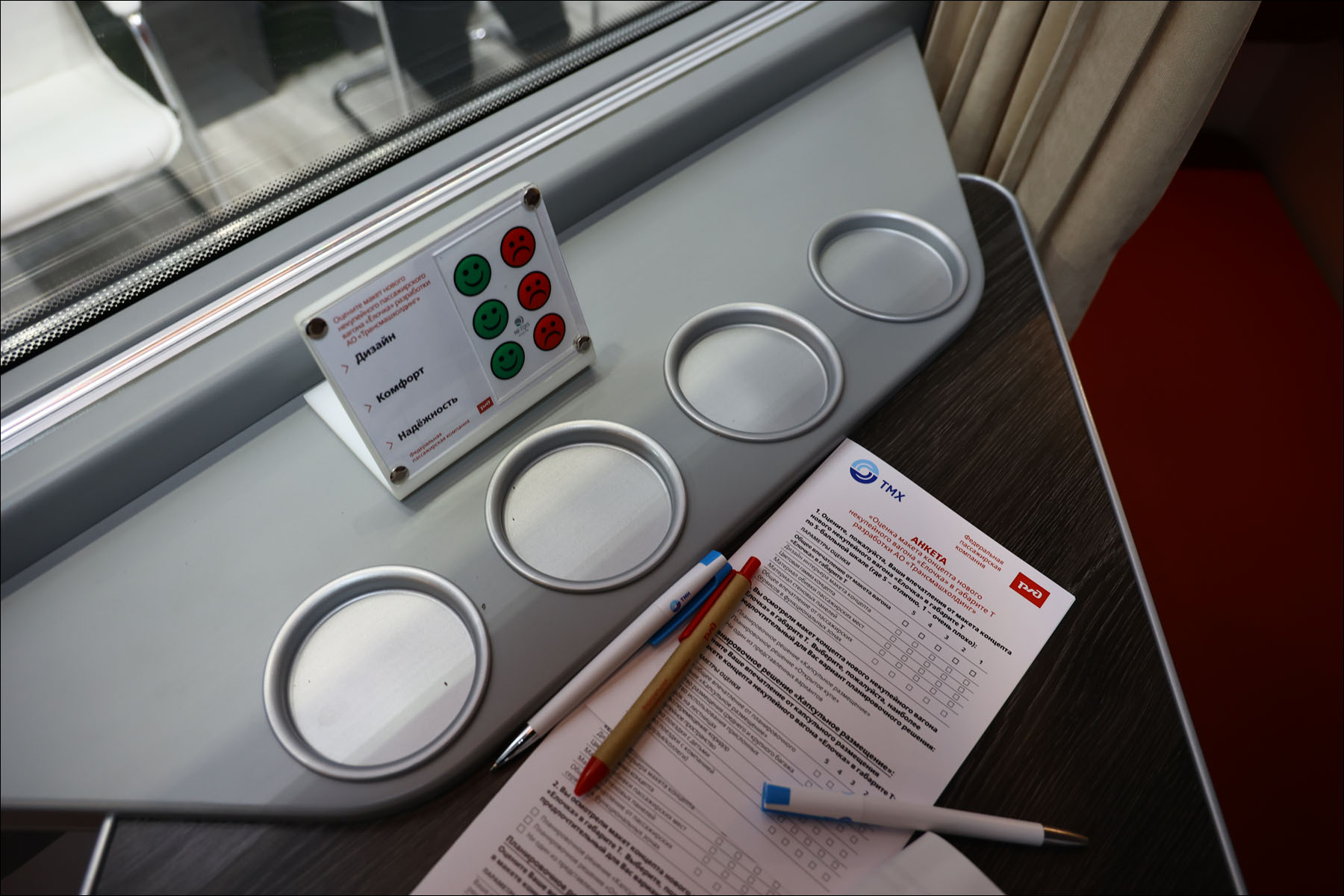
The table has changed slightly, overgrown with slots for bottles, but you can clearly see that you can still eat from it, and the carriage has not lost everything in its spaciousness.
There are cool holders on the second shelf:
Let me remind you that these wonderful wide reserved seats with curtains on the shelves, places for laptops and the ability to sit on the top shelf without curling up, there is only one big drawback - the third shelf is gone! In v1.0 and v2.0, this was handled by a huge cabinet in place of the desk. In v3.0 - slots next to the shelf.
This is how it was, let me remind you
Wardrobe
Space for luggage
Third shelf
In this prototype, there is a solution both next to the shelf and in the form of an upper fixture in the aisle. A similar solution is used in the coupe we are used to, if that. A suitcase of size M climbs there, that is, one that an ordinary person is still able to lift, and not just roll:
The ceiling in v3.0 was 2.1 meters, now under the shelves 1.9 meters. But on the other hand, they have additional LED lamps of scattered light, which makes the car much more visually illuminated with the same standard for flux density.

Now the luggage of passengers on the lower bins. Again, let me remind you that several years ago, according to the requirements of transport security for anti-terrorist purposes, they began to make the lower shelves without lockers. That is, at the bottom under the shelf there is just an empty space, not the walls. The passengers did not like this very much, but these are the requirements of the standard. As a result, they decided here: the default shelves are typical, as in ordinary modern reserved seats (that is, without walls). But there is an additional option to install metal roller shutters, such as garage doors, which will rise at the sight of the traffic police. It is more expensive, but it solves both problems. If the carrier chooses this, you can arrange the shelves with them.
Curtains everywhere:
The closet for linen, which was at the non-brake end of the carriage, disappeared, but two technical zones appeared at the beginning and at the end of the carriage due to the compensation of the diagonals:
They can store cleaning equipment and other things necessary for the train crew.
The open reserved seat
windows have become larger: the typical one is now 1020 millimeters wide, the new one will be 1200 millimeters.
Routers for Wi-Fi and scoreboards will be at the braking and non-braking ends of the car. They, like the bottle openers, were not modeled on the model.
So, we have a carriage without side shelves, with respect for personal space and common reserved seats to choose from, the entire engineer with sockets and other things, a good bright light that is controlled individually, more or less well-hidden luggage (not like last time on odd pairs of seats ), longer and wider shelves. The good blocks have been preserved, the upper shelf, as a result of three evolutionary transformations, has become similar to the working one. The design is ours 2050.LAB, the car will be produced at Tverskoy carriage building (this is where most of the passenger cars, Ivolga and double-deck cars are now made). The design speed is 160 kilometers per hour, the estimated turnaround time is 8 times more (25 thousand kilometers).
Initially, it seemed to me that this story is about “we have developed 3 new layouts, but we will show them one by one so that you are not shocked right away”, because the renders of the “Christmas tree” were actually still at the prototype stage of v1.0 1-VM. But if you look at what was then and what is now, you can see that this is really a path of iterative improvements.
TVZ plans to put all the prototypes together somewhere for everyone to see and collect feedback (as was the case at train stations and VDNKh) a little later, but now, due to the epidemic, it is not a fact that this will work. Just here again links to previous posts about this series of prototypes:
1 VM ,
neoclassical T ,
capsular T .
Well, in general, now it's time for me to thank Valeria Sharafutdinova from TMH for answering my questions and schemes. Well, if you have thoughts and comments about this car - write in the comments, TVZ (a plant as part of TMH) has a whole service that investigates passenger reviews, even before Kovid we did analytics on hundreds of thousands of reviews of our passengers especially for them in order to understand what is wrong or so with the cars.