
johnnychips
Established Member
Agreed. This is a pig. Kiveton Bridge station is on the border of Kiveton Park and Wales, while Kiveton Park station is next to a noticeable bridge over the canal, but not really in Kiveton Park.Kiveton Park Station.

Agreed. This is a pig. Kiveton Bridge station is on the border of Kiveton Park and Wales, while Kiveton Park station is next to a noticeable bridge over the canal, but not really in Kiveton Park.Kiveton Park Station.
It was near the village of Milton, now known as Old Milton.New Milton I believe was not really near anything when it first opened and was named after a nearby sub post office with the town of New Milton gradually building up around the station

Surely that area of Southwark in South London is effectively named after the mid-late 18th century coaching inn of the same name? (The railway station not being opened until a hundred years or so later).Elephant and Castle

Surely that area of Southwark in South London is effectively named after the mid-late 18th century coaching inn of the same name? (The railway station not being opened until a hundred years or so later).
Interesting, thanks.The bridge next to the station is called Great Western Bridge. The name Kelvinbridge only came about after the Subway (and Glasgow Central Railway) station located there.

Widdrington Station
Lots of separate settlements sprang up around former North-Eastern railway stations that were far removed from the towns and villages that they were meant to serve. Widdrington Station is a now a much bigger village than Widdrington. Stannington Station is heading the same way - if it isn't already.If closed stations allowed then Stannington Station.

So that explains why the single line tablets were Wooda Bay.Woody Bay, on the north Devon Coast, not quite a settlement, but worth mentioning I think.
When the Lynton & Barnstaple Railway opened in 1900, the cove was called Wooda Bay and the corresponding station was also named Wooda Bay (despite being 1.5 miles away and, in true L&B fashion, about 600ft higher up.) In 1901 the railway decided that ‘Woody Bay’ would be more marketable and therefore changed the name of the station, and correspondingly the landowner changed the name of the cove and nearby pier. However it was all to fail as the location never made any progress as the resort, the landowner ended up bankrupt and in debtors prison for 12 years and the L&B was closed in 1935.
The cove, however, is still now called Woody Bay.
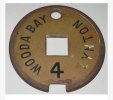 Photo from Bonhams
Was the area called that before the station though? I would've thought it was just the edges of the Newington/Lambeth/Walworth areas (maybe Borough too although I'm not sure if that one existed pre-railway either!)Surely that area of Southwark in South London is effectively named after the mid-late 18th century coaching inn of the same name? (The railway station not being opened until a hundred years or so later).

So that explains why the single line tablets were Wooda Bay.
View attachment 102800Photo from Bonhams
I think it has basically returned to nature. Didn’t almost the entire population work for the railway while it existed?Indeed yes!
I suppose you could say that anywhere that a settlement was entirely created for / dependent on a railway station is likely to qualify for this topic. For instance Riccarton Junction on the Waverley Route, which didn’t exist before the railway arrived, and unsurprisingly has since disappeared after its closure I think?
There is a well established, albeit small, village called Halwill with an old parish church about a mile away from the old station, around which a village has formed, called Halwill Junction.Micheldever Station
A former station, but Halwill Junction.
Interestingly, when I was a regular visitor to the Lynton area in the 70s, both spellings could still be seen on finger-post road signs.So that explains why the single line tablets were Wooda Bay.
View attachment 102800Photo from Bonhams

Quite possibly Newington. Might need to dig out a pre-1862 map from the NLS archives.Was the (Elephant and Castle) area called that before the station though?
There are also a few where a station with a double name has lead to one of the settlements losing its separate identity. Gidea Park was built in Squirrels Heath but named Gidea Park and Squirrels Heath as GP was a more upmarket area. Most people now would identify Gidea Park as the area around theh station rather than the original garden suburb half a mile away.
Except Chard Junction should actually be known as Perry Street. Everyone seems to forget that the village and the road share the same name. "Perry Street" is the name for that section of the Fosse WayThere are settlement named Seaton Junction and Chard Junction after the former stations, although both closed in the 1960s with their respective branch lines.

The area around Finchley Road station (the LU one and the previous Midland one) became known as Finchley Road after the station.Locations within most of London are referred to by the nearest Tube station. I admit some of those were named after pre-existing settlements, but a lot are named after other local features that wouldn't have been very useful for navigation until the Tube appeared.
Surely this area of Hampstead is effectively named after the turnpike roadway, Finchley Road (formerly known as Finchley New Road), built in the late 1820's and so which predates the somewhat later railway station.The area around Finchley Road station (the LU one and the previous Midland one) became known as Finchley Road after the station.
Was this particular station previously ever known as 'Falcon Bridge' before a subsequent makeover?Whilst in London ... a mention for Clapham Junction
The station was built in Battersea but the locals did not like the name Battersea Junction.
The station opened as Clapham Junction and retained its name throughout.Was this particular station previously ever known as 'Falcon Bridge' before a subsequent makeover?
It's a 4.5 mile road, you wouldn't choose to name an "area" after a road that long, unless a station had fixed the name to a specific location on the road.Surely this area of Hampstead is effectively named after the turnpike roadway, Finchley Road (formerly known as Finchley New Road), built in the late 1820's and so which predates the somewhat later railway station.

