• Our new ticketing site is now live! Using either this or the original site (both powered by TrainSplit) helps support the running of the forum with every ticket purchase! Find out more and ask any questions/give us feedback in this thread!

How would you divide up England by region?

Status
Not open for further replies.

MotCO

Established Member
Joined
25 Aug 2014
Messages
6,126
I used to work in the NHS. Over a number of different reorganisations, the number of regions the NHS was split into varied from 14, 13, 8, 7; in fact any succeeding reorganisation was almost 'any number but the last one'! It just goes to show that there are not any natural regions in England.

To take an example, one of the earlier options had a south-east region excluding London. Given the large movement of people between London and its commuter belt, would the population more readily relate to London or the south-east? Where would they pay their taxes? If income tax is based on where they work, rather than where they live, it would mean that a south-east resident they would have no representation in London, even though they pay taxes there. Anyone remember 'No taxation without Representation'?

No, I don't think regionalisation (even devolution) works. It will end up as a postcode lottery, and there are enough complaints about NHS postcode lottery - regionalisation would simplify multiply them.
 
Sponsor Post - registered members do not see these adverts; click here to register, or click here to log in
R

RailUK Forums

ChrisC

Established Member
Joined
7 Oct 2018
Messages
2,267
Location
Nottinghamshire
Wasn't Woodhead station in Derbyshire, the entrance to the tunnel in Cheshire? And Cheshire had a short but significant border with Yorkshire. This area could certainly never be called Midlands or East Midlands.
Woodhead station would have been in Derbyshire but the Cheshire boundary is nowhere near that area. A large section of the A628 Sheffield to Manchester Woodhead Pass road passes through Derbyshire and although moorland Derbyshire still extends even a few miles north of this. This part of Derbyshire is well north of Sheffield. On the either side of Sheffield, the north of Nottinghamshire extends up to within 10 miles of Doncaster at its boundary at Bawtry, which is surprisingly further north than Sheffield. Therefore I don’t think there is a definite boundary between the Midlands and the North but it happens gradually as you travel northwards through Nottinghamshire and Derbyshire. Certainly Mansfield, Worksop, Chesterfield and Buxton feel very much more northern than Nottingham and Derby.
 

Senex

Established Member
Joined
1 Apr 2014
Messages
2,957
Location
York
Woodhead station would have been in Derbyshire but the Cheshire boundary is nowhere near that area. A large section of the A628 Sheffield to Manchester Woodhead Pass road passes through Derbyshire and although moorland Derbyshire still extends even a few miles north of this.
I said "Wasn't", not "isn't". I think you'll find that until the changes of 1974 Longdendale was in Cheshire. See OS 25" sheets, Cheshire IV.8 (Charlesworth, Tintwistle).
 

Altrincham

Member
Joined
22 Aug 2011
Messages
276
Wasn't Woodhead station in Derbyshire, the entrance to the tunnel in Cheshire? And Cheshire had a short but significant border with Yorkshire. This area could certainly never be called Midlands or East Midlands.
That part of north east Cheshire had quite an unusual reach into the High Peak, and looking at this map it looks like the border was right up to Holme Moss transmitter. So yes, Cheshire had a border with Yorkshire, which is incredible to think of and highlights how much of Cheshire receded after the boundary changes.

== Doublepost prevention - post automatically merged: ==

Woodhead station would have been in Derbyshire but the Cheshire boundary is nowhere near that area.
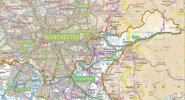
Prior to 1974, Cheshire extended well into the Longdendale valley. (The map attached shows just how far north east Cheshire stretched).
 

Attachments

  • 4B2B6F7D-9D96-412E-989B-94EBF2EF1DDA.jpeg
    4B2B6F7D-9D96-412E-989B-94EBF2EF1DDA.jpeg
    2.1 MB · Views: 30
Last edited:

ChrisC

Established Member
Joined
7 Oct 2018
Messages
2,267
Location
Nottinghamshire
I said "Wasn't", not "isn't". I think you'll find that until the changes of 1974 Longdendale was in Cheshire. See OS 25" sheets, Cheshire IV.8 (Charlesworth, Tintwistle).
Sorry my mistake. I was forgetting about the 1974 boundary changes.
 

Bevan Price

Established Member
Joined
22 Apr 2010
Messages
8,341
I suspect that few of us will agree about the definitions of regions or counties. My suggestions relate to traditional "counties", not the Mickey-Mouse "pretend" counties invented in 1974. I would also suggest that the "capital" of a region should NOT be the largest town or city; otherwise we risk repeating the case of London, where much of the economic activity & employment gravitates to one large location, with fringe areas liable to be neglected and under-funded. There are always bound to be anomalies near boundaries. So, maybe:

1. Northumbria (Northumberland & Durham), capital Hartlepool.
2. North West (Cumberland, Westmorland, Furness part of Lancashire), capital Whitehaven
3. Yorkshire, capital Barnsley or Keighley.
4. Lancastria (Lancashire & Cheshire), capital Burnley or Southport.
5. West Midlands (Staffordshire, Warwickshire, some northern parts of Worcestershire), capital West Bromwich or Walsall.
6. Mercia (Shropshire, remainder of Worcs., northern parts of Gloucestershire, Herefordshire) , capital Ludlow
7. East Midlands (Derbyshire, Notts., Leicestershire, Rutland), capital Alfreton or Belper.
8. South Midlands (Northants, Bedfordshire, Bucks., Oxfordshire), capital Northampton or Kettering.
9. Lincolnshire, capital Grimsby.
10. East Anglia (Norfolk, Suffolk, Cambs., northern parts of Essex), capital Bury St. Edmunds
11. Londinium (London, Middlesex, the most northern parts of Kent & Surrey), capital to be decided
12. Suburbia (Most of Hertfordshire, Southern Essex, Berkshire, parts of Kent & Surrey - roughly to Rochester / Maidstone / Guildford), capital Luton.
13. South East (parts of Kent, Surrey & Sussex, stretching roughly between a line joining Maidstone, Dover, Brighton, Worthing, Dorking and back to Maidstone.), capital Haywards Heath or Bexhill.
14. South Central (Hampshire, Dorset, Wiltshire)
15. Wessex. (Devon, Cornwall, southern parts of Gloucestershire, including Bristol), capital Taunton.

Apologies if I have omitted "your" county.
 

Altrincham

Member
Joined
22 Aug 2011
Messages
276
the north of Nottinghamshire extends up to within 10 miles of Doncaster at its boundary at Bawtry, which is surprisingly further north than Sheffield. Therefore I don’t think there is a definite boundary between the Midlands and the North but it happens gradually as you travel northwards through Nottinghamshire and Derbyshire. Certainly Mansfield, Worksop, Chesterfield and Buxton feel very much more northern than Nottingham and Derby.
I’ve often thought it unusual that Nottinghamshire’s border stretches so far north, in fact its border runs very close to Doncaster Sheffield airport. That far northern corner of Nottinghamshire certainly feels like Yorkshire than East Midlands, and feels a very long way from Nottingham.
 

GrimsbyPacer

Established Member
Joined
13 Oct 2014
Messages
2,254
Location
Grimsby
I suspect that few of us will agree about the definitions of regions or counties. My suggestions relate to traditional "counties", not the Mickey-Mouse "pretend" counties invented in 1974. I would also suggest that the "capital" of a region should NOT be the largest town or city; otherwise we risk repeating the case of London, where much of the economic activity & employment gravitates to one large location, with fringe areas liable to be neglected and under-funded. There are always bound to be anomalies near boundaries. So, maybe:

...
9. Lincolnshire, capital Grimsby.
...

Apologies if I have omitted "your" county.
The traditional counties have always continued to exist, even if administrative counties and non-metropolitan counties have come and gone in the mean time. Cheshire still includes Stockport etc. The area even feels like Cheshire (somehow) when on the train past Hazel Grove.

I agree that Grimsby is the capital of Lincolnshire, Lincoln is only a university town with touristy stuff, Grimsby is much more important with real work and food production and shipping etc.
 

Purple Orange

On Moderation
Joined
26 Dec 2019
Messages
3,459
Location
The North
The traditional counties have always continued to exist, even if administrative counties and non-metropolitan counties have come and gone in the mean time. Cheshire still includes Stockport etc. The area even feels like Cheshire (somehow) when on the train past Hazel Grove.

I agree that Grimsby is the capital of Lincolnshire, Lincoln is only a university town with touristy stuff, Grimsby is much more important with real work and food production and shipping etc.
As a resident of Cheshire, I can say Stockport left long ago. That there be Greater Manchester. It’s urban, loud, bold, looks like a city, smells like a city, call it what you wish but it ain’t Cheshire any more.
 

eMeS

Member
Joined
12 Jun 2011
Messages
954
Location
Milton Keynes, UK
As a resident of Cheshire, I can say Stockport left long ago. That there be Greater Manchester. It’s urban, loud, bold, looks like a city, smells like a city, call it what you wish but it ain’t Cheshire any more.
Surely, Stockport left when it got its railway viaduct. (Didn't this hold a world record for a period?)
 

busmanaams

Member
Joined
11 Jul 2021
Messages
20
Location
Rural southern Ayrshire
This point came up on the HS2 eastern leg thread so thought it might be an interesting discussion here.

Namely, how would you divide up England into regions? Would you use the same as the official Government regions, or something else?

I have an interest in geography so for me, that would play a part as well as considering what large town or city is the natural 'go to' location for a place.

So, starting in the southeast:

The South East - would be east of the government definition, covering Kent, East Sussex, Surrey and those parts of West Sussex which look to Brighton more than they do Portsmouth - so perhaps from the Arun Valley eastwards

The Central South - as someone who has lived in this area most of my life, I feel there is a Central South identity separate from the SE or SW. It's basically the area which would look to Southampton, Portsmouth or Reading as the local commercial centres, rather than London or Brighton. So Hampshire and the Isle of Wight for certain, as well as the extreme west of West Sussex (Chichester, Midhurst, Petworth), south-eastern Wiltshire (SE of the chalk escarpment above Westbury and including all of Salisbury Plain), and most of Dorset, except those parts northwest of Cranborne Chase - again the chalk escarpment of the north Dorset downs is a barrier in my mind. Also much of Berkshire except perhaps the Bracknell and Slough areas, which would be part of the southeast, and far southern Oxfordshire (Henley area).

The South West - looks variously to Bristol, Exeter or Plymouth. All of Cornwall, Devon and Somerset, as well as the former county of Avon. Those parts of Wiltshire and Dorset northwest of the chalk escarpment, and far-west Dorset also (Bridport area). Dominated by dairy farming with less arable land.

The Oxford-Cotswold region - essentially has Oxford as the main commercial/cultural centre. Notable for the golden-coloured stone of Cotswold buildings, so basically all of Gloucestershire east of the M5 (including Cheltenham even though that's beyond the escarpment) as well as much of Oxfordshire, southeast Worcestershire and southwest Warwickshire.

The Marches - essentially the Welsh border region, beyond the Cotswold escarpment and characterised by higher hills than is present further southeast. Shropshire, Herefordshire, south-western Worcestershire and the Forest of Dean area of Gloucestershire.

The West Midlands - basically the area which looks to Birmingham. Close in definition to the 'official' one but some of Worcs and Warwickshire lost to the Marches or Oxford-Cotswold.

The East Midlands - very similar to the official definition but with the Dark Peak in the North West instead, as to me it seems highly 'northern' in character

The North West - similar to the official definition but minus Cumbria which seems separate to me,remote from the large cities of the NW. So Cheshire, Lancashire, Gtr Manchester, Merseyside, and the Dark Peak area of Derbyshire.

The 'United Counties' or 'M1 country'. Struggling to find a good name for this so will borrow either the previously-dominant bus company of the area or the local motorway. Basically the 'in-between' area of Herts, Bucks, Beds and Northants which seems to be too far west for East Anglia, too far south for the Midlands, and too far east for Oxford-Cotswolds.

East Anglia - much as the standard definition minus the areas mentioned above.

The East - Lincolnshire and east Nottinghamshire.

Yorkshire - big enough to be a region in itself

The North East - Tyne and Wear, Durham and Northumberland (east of the Pennine watershed)

Cumbria, together with any parts of northwest Yorkshire or west Durham which are west of the Pennine watershed.

Anyway, plenty of flaws I'm sure, and I am more famiilar with some of these areas than others - but would be interesting to see what people's thoughts on this are...
Surely England can only be divided in one way : Yorkshire and not-Yorkshire?
 

gg1

Established Member
Joined
2 Jun 2011
Messages
2,499
Location
Birmingham
I used to work in the NHS. Over a number of different reorganisations, the number of regions the NHS was split into varied from 14, 13, 8, 7; in fact any succeeding reorganisation was almost 'any number but the last one'!

You missed 4 and 10.

7 is the current count, as you say it will no doubt change in the next few years.
 

RT4038

Established Member
Joined
22 Feb 2014
Messages
5,461
The traditional counties have always continued to exist, even if administrative counties and non-metropolitan counties have come and gone in the mean time. Cheshire still includes Stockport etc. The area even feels like Cheshire (somehow) when on the train past Hazel Grove.
I don't think that is quite right - some places feel like they are still in their traditional county, both others such as Birmingham (was once Warwickshire) or Stockport (was in Cheshire) don't. Coventry still feels (to me, but not necessarily the residents!) a bit in Warwickshire, but Birmingham definitely not.
 

NorthOxonian

Established Member
Associate Staff
Buses & Coaches
Joined
5 Jul 2018
Messages
1,670
Location
Oxford/Newcastle
I don't think that is quite right - some places feel like they are still in their traditional county, both others such as Birmingham (was once Warwickshire) or Stockport (was in Cheshire) don't. Coventry still feels (to me, but not necessarily the residents!) a bit in Warwickshire, but Birmingham definitely not.
Coventry doesn't really feel like it belongs to either county - not really Warwickshire but not really part of urban Birmingham either. Sunderland is very similar - my heart says it's Durham but objectively it doesn't really fit the rest of the county (and is also very distinct from the Tyne part of Tyne and Wear).
 

Purple Orange

On Moderation
Joined
26 Dec 2019
Messages
3,459
Location
The North
Coventry doesn't really feel like it belongs to either county - not really Warwickshire but not really part of urban Birmingham either. Sunderland is very similar - my heart says it's Durham but objectively it doesn't really fit the rest of the county (and is also very distinct from the Tyne part of Tyne and Wear).

To me Sunderland is Tyne & Wear. Durham is another county altogether. Afterall, it makes up the Wear part of Tyne & Wear.
 

davehsug

Member
Joined
8 Jul 2014
Messages
363
It's tricky near boundaries, especially where historic economic areas cross boundaries. The Norths Staffs/South Cheshire area is well esablished, encompassing Stoke/Newcastle-under-Lyme, The Staffs Moorlands area, Crewe, Sandach and Congleton areas of South Cheshire and into the Market Drayton and Whitchurch areas of North Shropshire. This crosses the divide of West Midlands/North West, which completely ignores the economic & often family ties across the area. I would argue that in recent years, the residents of Stoke have looked increasingly to Manchester when doing special shopping trips and nights out/concerts etc and Manchester airport is very much the local airport. Birmingham certainly feels much more "alien" than Manchester to most in the area.
The trump card of course, is that Stoke chip shops sell steak & kdney puddings and gravy! You only have to go to Stafford and they look at you very strangely if you ask for chips & gravy!
 

MotCO

Established Member
Joined
25 Aug 2014
Messages
6,126
The trump card of course, is that Stoke chip shops sell steak & kdney puddings and gravy! You only have to go to Stafford and they look at you very strangely if you ask for chips & gravy!

I think you have hit the nail on the head. It doesn't matter where administrators draw boundary lines - it is the cultural affinity one has with an area which determines the natural boundaries. Boundaries must pass the 'Chip and Gravy' test!
 

Purple Orange

On Moderation
Joined
26 Dec 2019
Messages
3,459
Location
The North
I think you have hit the nail on the head. It doesn't matter where administrators draw boundary lines - it is the cultural affinity one has with an area which determines the natural boundaries. Boundaries must pass the 'Chip and Gravy' test!

This only shows that you can’t ‘split up England’, but you can subdivide it for political administration. There are ten regions of the country, and I don’t see anyone saying “we’re not in the East Midlands, we’re in the West Midlands”.
 

MotCO

Established Member
Joined
25 Aug 2014
Messages
6,126
This only shows that you can’t ‘split up England’, but you can subdivide it for political administration. There are ten regions of the country, and I don’t see anyone saying “we’re not in the East Midlands, we’re in the West Midlands”.

But who do they have an affinity with? Where do they believe they belong? You can't expect people to fully believe in and support their 'region' if they don't feel they belong there. This will result in poor turnout at elections etc because people will not see any point in these unnatural regions.
 

Purple Orange

On Moderation
Joined
26 Dec 2019
Messages
3,459
Location
The North
But who do they have an affinity with? Where do they believe they belong? You can't expect people to fully believe in and support their 'region' if they don't feel they belong there. This will result in poor turnout at elections etc because people will not see any point in these unnatural regions.

What regions are unnatural? If it was an issue like you describe, constituencies would not exist. My constituency is Tatton, and it covers a huge area.
 

MotCO

Established Member
Joined
25 Aug 2014
Messages
6,126
What regions are unnatural? If it was an issue like you describe, constituencies would not exist. My constituency is Tatton, and it covers a huge area.

If your Region included Carlisle to the north, Liverpool in the west, etc, would you have any affinity for your Region, would you have anything in common with the rest of the Region or just affinity for Tatton? Constituencies would continue to exist, but Regions would overlay them.
 

Purple Orange

On Moderation
Joined
26 Dec 2019
Messages
3,459
Location
The North
If your Region included Carlisle to the north, Liverpool in the west, etc, would you have any affinity for your Region, would you have anything in common with the rest of the Region or just affinity for Tatton? Constituencies would continue to exist, but Regions would overlay them.

Yes, it’s the north. There is an affinity among northerners.
 

NorthOxonian

Established Member
Associate Staff
Buses & Coaches
Joined
5 Jul 2018
Messages
1,670
Location
Oxford/Newcastle
Yes, it’s the north. There is an affinity among northerners.
The north is a very wide term though - too wide for any kind of meaningful regional identity.

I grew up in the far north of County Durham. I feel a strong affinity with the people of Northumberland, County Durham and northern/eastern North Yorkshire (down to perhaps Richmond or Scarborough), and a fairly strong affinity with those from Cumbria and a lot of Yorkshire. But I feel no connection with Sheffield and its inhabitants, nor with the urban centres of the North West. The way the media go on you'd think the north was one conurbation, and perhaps that's how it feels to some northerners, but most people up here simply don't have ties to Manchester or Liverpool. If anything, I think most of us would say we had more in common with the south and east of Scotland than we do the M62 belt!

Fortunately the North East region is fairly narrowly defined (it's the smallest of the former European regions, and probably the most coherent). But the North West region is a bit of a monstrosity. What does Crewe have in common with Brampton? At the very least, a regional system should move Cumberland into a renamed North East (Westmorland and Furness look more to Lancaster and Preston so should stay in the North West).
 

johnnychips

Established Member
Joined
19 Nov 2011
Messages
3,826
Location
Leeds
Sorry my mistake. I was forgetting about the 1974 boundary changes.
That part of north east Cheshire had quite an unusual reach into the High Peak, and looking at this map it looks like the border was right up to Holme Moss transmitter. So yes, Cheshire had a border with Yorkshire, which is incredible to think of and highlights how much of Cheshire receded after the boundary changes.

== Doublepost prevention - post automatically merged: ==


Prior to 1974, Cheshire extended well into the Longdendale valley. (The map attached shows just how far north east Cheshire stretched).
This was called the ‘salt corridor’. Apparently, hundreds of years ago, you had to pay tax if you crossed a county boundary with salt. I have no idea how it was established, but the fact that Longdendale was in Cheshire meant you could move salt from the Cheshire salt mines to Yorkshire and just pay tax once.

Indeed, if you drive on the A628 Woodhead road from Sheffield to Manchester, soon after the summit, you will cross from the Metropolitan Borough of Barnsley into Derbyshire at Saltersbrook Bridge. Pre 1974 that would have been from Yorkshire into Cheshire.

DIFFERENT POINT:

I am always struck that places in the north of Derbyshire and Nottinghamshire and Lincolnshire feel much more northern than midlands-ish. Obvious examples are Glossop, Chesterfield and Scunthorpe; but I would also add places like Buxton, Worksop and Grimsby.
 
Last edited:

Purple Orange

On Moderation
Joined
26 Dec 2019
Messages
3,459
Location
The North
The north is a very wide term though - too wide for any kind of meaningful regional identity.

I grew up in the far north of County Durham. I feel a strong affinity with the people of Northumberland, County Durham and northern/eastern North Yorkshire (down to perhaps Richmond or Scarborough), and a fairly strong affinity with those from Cumbria and a lot of Yorkshire. But I feel no connection with Sheffield and its inhabitants, nor with the urban centres of the North West. The way the media go on you'd think the north was one conurbation, and perhaps that's how it feels to some northerners, but most people up here simply don't have ties to Manchester or Liverpool. If anything, I think most of us would say we had more in common with the south and east of Scotland than we do the M62 belt!

Fortunately the North East region is fairly narrowly defined (it's the smallest of the former European regions, and probably the most coherent). But the North West region is a bit of a monstrosity. What does Crewe have in common with Brampton? At the very least, a regional system should move Cumberland into a renamed North East (Westmorland and Furness look more to Lancaster and Preston so should stay in the North West).

I grew up in Newcastle and I have to say ‘the north’, ‘the north east’ and Tyne & Wear were strong concepts that have stayed with me, whereby I feel a lot in common with West Yorkshire, Greater Manchester and Merseyside all along that M62 belt. Having lived many years in both Tyne & Wear and in Greater Manchester, I can confidently say there is an awful lot the two areas share in common.

The question of ‘splitting up England’ isn’t the right question in the first instance, as England isn’t going to be split up. However if it is to do with devolving powers away from Westminster, then it could be done on a much more granular level than North West, East Midlands, South West etc etc. We already have started several different models for devolving powers in the UK, with the Scottish parliament, the Welsh Assembly and Northern Irish Assembly, but within England we have started a haphazard approach.

A case in point is that Greater London has an assembly, but Greater Manchester & the West Midlands do not. Greater Manchester has control over its NHS healthcare budget, whereas Greater London and the West Midlands do not. I would like us to take a leaf out of Italy’s book, which has 20 regional assemblies for a country with a similar population to England. All have varying sizes of population, with some as small as 300,000.

In short, we shouldn’t look for a uniform sized assembley, but set in place regional assemblies that do have consistent legislative powers and specifically powers from Westminster.
 

317 forever

Established Member
Joined
21 Aug 2010
Messages
3,286
Location
North West
Coventry doesn't really feel like it belongs to either county - not really Warwickshire but not really part of urban Birmingham either. Sunderland is very similar - my heart says it's Durham but objectively it doesn't really fit the rest of the county (and is also very distinct from the Tyne part of Tyne and Wear).
With more rural area between Coventry and the West Midlands, compared to between other West Midlands towns & cities, Coventry does feel detached from the West Midlands in general. Seeing more buses to Leamington & Nuneaton, and to a lesser extent Rugby & Warwick than to Birmingham & Solihull also makes it more like it is still in Warwickshire.
 

GrimsbyPacer

Established Member
Joined
13 Oct 2014
Messages
2,254
Location
Grimsby
Or why not
What does Crewe have in common with Brampton? At the very least, a regional system should move Cumberland into a renamed North East (Westmorland and Furness look more to Lancaster and Preston so should stay in the North West).
Just get rid of Cheshire and have Lancashire instead of a Northwest. It has the same population as Yorkshire.
People should be (geographically) loyal to their town, county, and nation, not compass directions
I grew up in Newcastle and I have to say ‘the north’, ‘the north east’ and Tyne & Wear were strong concepts that have stayed with me, whereby I feel a lot in common with West Yorkshire, Greater Manchester and Merseyside all along that M62 belt. Having lived many years in both Tyne & Wear and in Greater Manchester, I can confidently say there is an awful lot the two areas share in common.

The question of ‘splitting up England’ isn’t the right question in the first instance, as England isn’t going to be split up. However if it is to do with devolving powers away from Westminster, then it could be done on a much more granular level than North West, East Midlands, South West etc etc. We already have started several different models for devolving powers in the UK, with the Scottish parliament, the Welsh Assembly and Northern Irish Assembly, but within England we have started a haphazard approach.

A case in point is that Greater London has an assembly, but Greater Manchester & the West Midlands do not. Greater Manchester has control over its NHS healthcare budget, whereas Greater London and the West Midlands do not. I would like us to take a leaf out of Italy’s book, which has 20 regional assemblies for a country with a similar population to England. All have varying sizes of population, with some as small as 300,000.

In short, we shouldn’t look for a uniform sized assembley, but set in place regional assemblies that do have consistent legislative powers and specifically powers from Westminster.
What would be the harm is just using the 39 ("traditional") counties for England, all with equal powers then?
The extremes of past re-organisations of councils have often failed, Humberside, Leicestershire-with-Rutland, Hereford and Worcester, Greater Manchester, Merseyside, Tyne and Wear, all crossed county lines and all had to be split up again. Mass grouping on regional levels may work for crayon drawers in government, but in reality regional government doesn't work in England, and it can't until we get a proper national government first. Italy was unified, England is currently run by the UK is an un-equal system that favours the other nations, the first bit of devolution needed for England is for the whole nation to have it's own parliament like Scotland with the same status in funding arrangements. No one in Scotland is saying it should have it's 9 official regions with devolved governments afterall.
 
Status
Not open for further replies.

Top