Our new ticketing site is now live! Using either this or the original site (both powered by TrainSplit) helps support the running of the forum with every ticket purchase! Find out more and ask any questions/give us feedback in this thread!
I think there are people with fairly “extreme” views from both sides of the debate contributing to this thread. We have people who I suspect would quite happily see IC engined cars banned altogether (probably in the near future as well!) and others who don’t want an electric car and will find any (often tenuous) reason to claim they couldn’t live with one. I’ve said it a few times now but initial purchase cost is the main and often only hurdle to EV ownership for the majority of people at this stage.
I’m still hesitant to use one as my company car as I cover a lot of miles, often off the beaten track (relatively) and I worry about getting “caught out” either in terms of running out of charge (unlikely admittedly) or, more likely, having to wait longer than anticipated and then running late. How founded my concerns are in reality I’m not actually sure, and the chance of the latter will decrease as more chargers are installed.
My only other practical concern is charging whilst in meetings and having to move the car out of the charging bay half way through. I’m not sure there’s an easy answer to that although again it may become less of an issue when charging bays are more plentiful. I don’t think it’s an insurmountable problem but it is something I don’t need to worry about currently.
My hurdle is not having a place to "safely" plug in and charge, I cannot trail a cable out of my living room window, across the pavement to my car without causing a tripping hazard (although I wonder if some have tried). If I had a house with a driveway, believe me, it would be a serious consideration to have at least a Plug In Hybrid and if my mileage went down a Pure electric would be the next.
It is, yes. Going back to my example above of MK to the Lakes (230 miles), in most cases traffic means it would be impossible to do the journey without at least one 45 minute break.
Nonsense. Of all my friends with EVs, not one of them has ever had to wait for a charger in any circumstances. In the very unlikely event that all chargers are unavailable at your chosen location because they are occupied, then your car will simply direct you to another one nearby.
Put it in your terms. If there’s a long queue at petrol station (a), and you knew there was no queue at petrol station (b) up the road, would you wait or drive on?
The next charger on a motorway could be a fair distance away, and your fancy gizmo will tell you if they are being used now, not when you get there behind the other people who have had to skip the busy ones. I don’t think I have ever queued for petrol on the motorway.
even half an hour in a motorway service station is my idea of hell (especially on a Saturday morning) and not really a rest.
The next charger on a motorway could be a fair distance away, and your fancy gizmo will tell you if they are being used now, not when you get there behind the other people who have had to skip the busy ones. I don’t think I have ever queued for petrol on the motorway.
The nearest one might not be on a motorway, just like plenty of drivers now object to higher fuel prices at service areas and have favourite nearby garages to go to. Plus, as been said before, EV drivers don't drive until the charge is nearly zero and then panic any more than sensible IC drivers wait until the empty lamp has been on for 50 miles.
My hurdle is not having a place to "safely" plug in and charge, I cannot trail a cable out of my living room window, across the pavement to my car without causing a tripping hazard (although I wonder if some have tried). If I had a house with a driveway, believe me, it would be a serious consideration to have at least a Plug In Hybrid and if my mileage went down a Pure electric would be the next.
Then use your mobile phone to find a charger at a location more to your taste.
But you really must take a proper break when driving a long journey. If you are using motorway services being a bit bad as an excuse not to, you seriously need to rethink your approach to driving because you are putting others at risk.
I made sure I researched it, my house is on a street similar to Coronation Street, row of houses with small alley behind onto another row of houses, front door opens onto the pavement, no residents bays which means trying as hard as possible to get a space outside my door, no mean feat when the primary school across the road lets their staff park wherever. The local council are good at being green and have already started doing the work for renewable energy for all council owned buildings and one thing they were looking at was charging points in the streetlights, only issue is our streetlights in our street are attached to the houses and not at the edge of the pavement.
Yes, I may be 0.5% of the population that this affects, but I am not someone who does not want an electric car, if it was viable I would.
I made sure I researched it, my house is on a street similar to Coronation Street, row of houses with small alley behind onto another row of houses, front door opens onto the pavement, no residents bays which means trying as hard as possible to get a space outside my door, no mean feat when the primary school across the road lets their staff park wherever. The local council are good at being green and have already started doing the work for renewable energy for all council owned buildings and one thing they were looking at was charging points in the streetlights, only issue is our streetlights in our street are attached to the houses and not at the edge of the pavement.
Yes, I may be 0.5% of the population that this affects, but I am not someone who does not want an electric car, if it was viable I would.
Everybody will (eventually) be catered for as it is in everybody's interest that IC engines are removed from regular use. I envisage that in situations such as yours where there are no pavement mounted street light that some form of kerbside trapdoor outlet can be fitted, i.e similar to water stopcock/meter pockets or the plethora of utility access chambers. Given that some areas will need the power distribution network to be reinforced to enable electric heating to replace gas & other fossil fuel burning, there will be opportunities to install such access for street charging.
Expect the landscape of urban residential streets to change drastically (especially early Victorian examples). Hopefully the local environment will be better for it as a result.
I made sure I researched it, my house is on a street similar to Coronation Street, row of houses with small alley behind onto another row of houses, front door opens onto the pavement, no residents bays which means trying as hard as possible to get a space outside my door, no mean feat when the primary school across the road lets their staff park wherever. The local council are good at being green and have already started doing the work for renewable energy for all council owned buildings and one thing they were looking at was charging points in the streetlights, only issue is our streetlights in our street are attached to the houses and not at the edge of the pavement.
Yes, I may be 0.5% of the population that this affects, but I am not someone who does not want an electric car, if it was viable I would.
Someone in Belgium is selling charger poles that swing out from the wall at first floor level but I cannot find the manufacturers name. I think the swing was app controlled so you did not have to use your own pole but could use any compatible one and the app handled payment.
This is like old petrol stations in terraced streets which used to have fuel hoses on poles swing over the pavement. ICE adoption did not wait until enough modern service stations were built.
Everybody will (eventually) be catered for as it is in everybody's interest that IC engines are removed from regular use. I envisage that in situations such as yours where there are no pavement mounted street light that some form of kerbside trapdoor outlet can be fitted, i.e similar to water stopcock/meter pockets or the plethora of utility access chambers. Given that some areas will need the power distribution network to be reinforced to enable electric heating to replace gas & other fossil fuel burning, there will be opportunities to install such access for street charging.
Expect the landscape of urban residential streets to change drastically (especially early Victorian examples). Hopefully the local environment will be better for it as a result.
There are a few options in this case. Rejigging parking to "herringbone" style with a one way system would allow chargers to be put up one side. Or in cheaper towns it might be affordable to compulsory purchase a few end houses (or in some cases gardens) and create off-road parking areas with chargers. Either way this would come with the advantage of also solving the wheelchair and pram access issues that pavement parking causes in this sort of street.
My first smart phone was an HTC Desire in 2010 or 11. (My first mobile was a Nokia 5110 in 1999)
Not sure how that categorises me. As a person who adopts technology when it improves his life
At the moment spending tens of thousands of pounds on an EV wouldn't improve my life, might even degrade it
My first smart phone was an HTC Desire in 2010 or 11. (My first mobile was a Nokia 5110 in 1999)
Not sure how that categorises me. As a person who adopts technology when it improves his life
The Desire was my first one too, it was the first Android phone that wasn't a bit clunky to use, though the battery life was poor and so I had an upgraded battery in mine making it quite thick. It's interesting how HTC have basically disappeared despite having excellent phones right back at the start - the one I had after it was the One S and that was great too.
Before that the situation was maybe a bit Nissan-Leaf-esque, i.e. there were limited options with limited functionality.
Then use your mobile phone to find a charger at a location more to your taste.
But you really must take a proper break when driving a long journey. If you are using motorway services being a bit bad as an excuse not to, you seriously need to rethink your approach to driving because you are putting others at risk.
I do use the services, but don’t stop for long - I find little gain for staying longer than a brisk 5-10 minutes walk to the loos and back. Obviously if doing a Scotland run I will need a food stop but still prob only 20 mins.
Motorway services are only good for free toilets and certain food outlets like McDonald's where the prices are not inflated. There's no point using them for petrol unless it is an emergency. There are plenty of Tesco and Sainsbury's petrol stations near motorway junctions.
Motorway services are only good for free toilets and certain food outlets like McDonald's where the prices are not inflated. There's no point using them for petrol unless it is an emergency. There are plenty of Tesco and Sainsbury's petrol stations near motorway junctions.
Why is that? If an ICE card suits my situation now and that situation doesn't change why would the fact that other people are buying EVs change my needs.
The only thing that will force me to an EV will be if it becomes difficult to source fuel
Why is that? If an ICE card suits my situation now and that situation doesn't change why would the fact that other people are buying EVs change my needs.
The only thing that will force me to an EV will be if it becomes difficult to source fuel
I envisage though that there will be more fuel thefts, when you consider most Plant will still use diesel or even red diesel, Generators too, it will probably be easier to find the culprits if they are using it in their own vehicles but if they are selling it on to others, maybe not so much.
This may be one for the "small things which annoy" thread.
I took a look for EV charging points around Stevenage. I found this list: https://www.zap-map.com/locations/stevenage-charging-points/
The page is mostly what does not exist. Cut the clutter, just show the one useful line (my emphasis).
0 x 3kW 13/16A Unknown
0 x 3kW 13A 3-Square pin
0 x 3kW 13A Commando
0 x 3kW 16A Type 2 Mennekes
0 x 3kW 16A Type 1 Yazaki
0 x 7kW 32A Commando 2 x 7kW 32A Type 2 Mennekes
0 x 22kW 32A Commando
0 x 22kW 32A Type 2 Mennekes
0 x 7kW 32A Tesla Type 2
0 x 11kW 16A Tesla Type 2
0 x 22kW 32A Tesla Type 2
0 x 7kW 32A Type 1 Yazaki
0 x 43kW 63A Type 2 Mennekes
0 x 50kW 125A JEVS (CHAdeMO)
0 x 120kW (Tesla) Tesla Type 2
0 x N/A H35 or equiv
0 x N/A H70 or equiv
0 x 50kW 125A CCS (Combo)
Im not convinced that ultimately BEVs will be more than a temporary or partial solution. I reckon in another 10 years the future could well be FCEVs, unless there's an affordable and practical alternative to the current Lithium Ion batteries whose green credentials are to say the least dubious.
In my humble view, it's both cost of said EV vehicle and availability of said charger infrastructure both public and private including costs of providing electricity to charge up said vehicle.
Sort them out and widespread adoption of EVs will only continue but at a faster pace.
Im not convinced that ultimately BEVs will be more than a temporary or partial solution. I reckon in another 10 years the future could well be FCEVs, unless there's an affordable and practical alternative to the current Lithium Ion batteries whose green credentials are to say the least dubious.
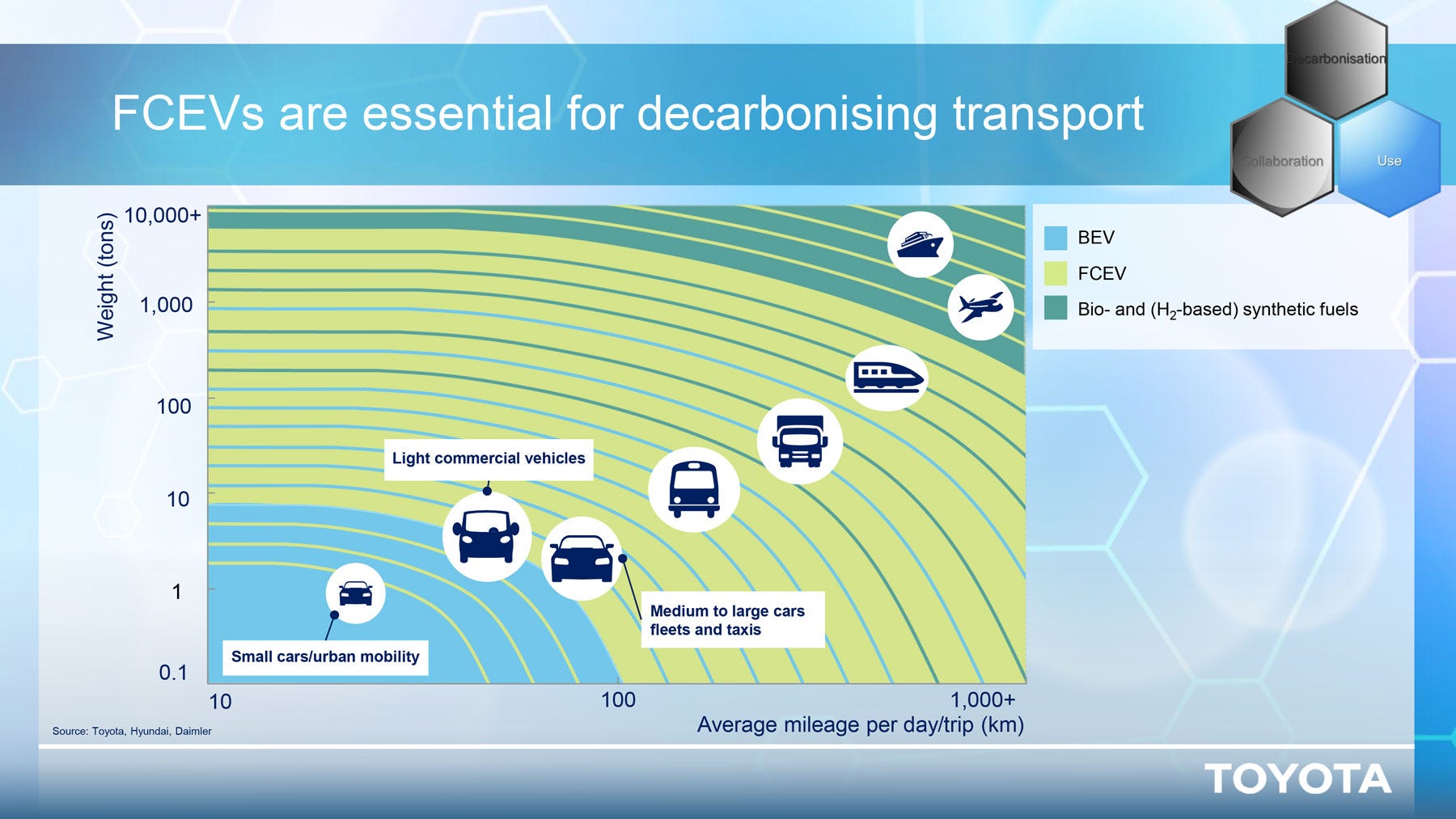
If anything replaces BEVs, it won't be FCEVs! They are just BEVs with reduced battery capacity and the hydrogen equipment (tanks & FCs) in their place. I highly doubt that they'll catch on in light vehicles outside of super-high mileage drivers for who the range/energy-addition-time is super important. This image shows a weight/distance diagram indicating likely energy sources* (developed by Toyota, Hyundai and Daimler, some of the largest proponents of FCEVs so expect it to be fairly heavily biased!):
Fuel cells start to win out as you get into the realms of daily trips of more than 100km or over 10t of weight. For the vast majority of people, BEV is entirely adequate. I would expect that we may see FCEVs dominate the "motorway muncher" market, with BEVs for everything else, along the lines of Diesel/Petrol (at least, pre VED nonsense), with FCEVs inevitably carrying a pretty big premium in terms of both purchase cost and fuel cost. Once beyond the realms of light vehicles it's another matter, but that's not the scope of this thread!
*damned if I can find the original source of this however!
Cost is, of course more than just the upfront purchase price. When you look at typical total costs on a monthly basis, EVs look very attractive. There’s a whole host of EVs you can lease for under £300/month, and a few in the £200/month bracket. Add in ‘fuel’ costs of 5p/mile or less if you have the right tariff, and minimal servicing requirements, and anyone buying a new car should serious consider it.
Charger infrastructure - as explained upthread it’s largely perception rather than reality. It’s not perfect and there are issues for some people - specifically those who routinely drive 300 mile so plus in one go and / or live where their parking space is not near their domestic power supply. However the charger situation is developing quickly. And as I said earlier, of all the people I know with EVs, none have ever had any charging ‘anxiety’ issues, and none would revert to ICE cars.
Interesting diagram, perhaps a little out of date. And... 1000 tonne airliners?
== Doublepost prevention - post automatically merged: ==
Cost is, of course more than just the upfront purchase price. When you look at typical total costs on a monthly basis, EVs look very attractive. There’s a whole host of EVs you can lease for under £300/month, and a few in the £200/month bracket. Add in ‘fuel’ costs of 5p/mile or less if you have the right tariff, and minimal servicing requirements, and anyone buying a new car should serious consider it.
Charger infrastructure - as explained upthread it’s largely perception rather than reality. It’s not perfect and there are issues for some people - specifically those who routinely drive 300 mile so plus in one go and / or live where their parking space is not near their domestic power supply. However the charger situation is developing quickly. And as I said earlier, of all the people I know with EVs, none have ever had any charging ‘anxiety’ issues, and none would revert to ICE cars.
The infrastructure may be developing quickly but until we get to a state that you can charge at any service station, it will still be hit and miss where charging points are for example, there is nowhere on my street that offers it nor is there any such points at work unless I drive to a council car park and walk 20 mins to work which defeats the object if I'm buying a car to commute to work, also leases can be expensive eg leases are more geared to business use then personal use eg one company offers a personal lease over 48 months at a rate of £257.00 a month for personal use however a business lease is only £214.00 so until the personal leases see lower costs, I have no interest in driving a EV.
Im not convinced that ultimately BEVs will be more than a temporary or partial solution. I reckon in another 10 years the future could well be FCEVs, unless there's an affordable and practical alternative to the current Lithium Ion batteries whose green credentials are to say the least dubious.
The battery manufacturer CATL recently announced they had developed a sodium ion battery, free from lithium, nickel and cobalt, which is expected to go into production in the next couple of years. At the moment the energy density isn't quite as good as lithium ion, but if the lack of expensive and rare metals means it's lower cost to produce, it might be a potential game changer.
If this makes it possible to produce large volumes of batteries at low cost, from readily available materials, the impact could be huge.
The development of a new sodium-ion battery by Chinese battery giant CATL is expected in the coming years to relieve pressure on lithium supplies, which are forecast to see shortages as early as 2022.
The battery manufacturer CATL recently announced they had developed a sodium ion battery, free from lithium, nickel and cobalt, which is expected to go into production in the next couple of years. At the moment the energy density isn't quite as good as lithium ion, but if the lack of expensive and rare metals means it's lower cost to produce, it might be a potential game changer.
If this makes it possible to produce large volumes of batteries at low cost, from readily available materials, the impact could be huge.
The development of a new sodium-ion battery by Chinese battery giant CATL is expected in the coming years to relieve pressure on lithium supplies, which are forecast to see shortages as early as 2022.
Indeed, it would certainly make it much cheaper for those second cars or cars which are almost all used fairly locally (and there's quite a few of them) which would almost never do more than 200 miles (and rarely do more than 50) and so could have a range of (say) 140 miles. As that would not only mean a cheaper battery but also not quite such a large one and so could put the upfront cost on a par with ICE cars.
With the other cost savings it would therefore change the economics significantly in the favour of BEV's (at least for those who mostly do shorter distance driving).
Quite possibly to the point where it would be no more expensive even if you had to use fairly costly public chargers (i.e. those with no charging capability at home or work).
Everybody will (eventually) be catered for as it is in everybody's interest that IC engines are removed from regular use. I envisage that in situations such as yours where there are no pavement mounted street light that some form of kerbside trapdoor outlet can be fitted, i.e similar to water stopcock/meter pockets or the plethora of utility access chambers. Given that some areas will need the power distribution network to be reinforced to enable electric heating to replace gas & other fossil fuel burning, there will be opportunities to install such access for street charging.
Expect the landscape of urban residential streets to change drastically (especially early Victorian examples). Hopefully the local environment will be better for it as a result.
Will that apply to small rural communities or caravan sites? I doubt it
and how are all these cars to be disposed of? If 2/3 of all ICE cars were taken off the road overnight, that's 20 million, with 100 miilion tyres to dispose of
Will that apply to small rural communities or caravan sites? I doubt it
and how are all these cars to be disposed of? If 2/3 of all ICE cars were taken off the road overnight, that's 20 million, with 100 miilion tyres to dispose of
We are aware of an issue with emails from the Forum to Microsoft-based email accounts (hotmail/outlook/live.com email addresses). This is being looked into currently, thanks for your patience meanwhile.




/cloudfront-us-east-2.images.arcpublishing.com/reuters/64MCSCSSBRKS3N5P3QAYJZGUCQ.jpg)

