Precisely, it's the motor industry deliberately blurring the differences with made-up names, the worst being Self Charging Hybrid, which uses fossil fuels to charge its battery. Even plug-in hybrids are misleading as their range is as little as can be got away with knowing that a user willl happily use fossil fuel without much consideration for the environment.No no no. The only fuel that goes into a (a non plug in) hybrid is fossil fuel. That fact that it uses electricity as part of its transmission system doesn't make it an EV. No more than a class 37 diesel-electric loco is an electric loco. Nor my '08 Yaris an EV because it has a battery which can be used to move the vehicle.

-
Our new ticketing site is now live! Using either this or the original site (both powered by TrainSplit) helps support the running of the forum with every ticket purchase! Find out more and ask any questions/give us feedback in this thread!
You are using an out of date browser. It may not display this or other websites correctly.
You should upgrade or use an alternative browser.
You should upgrade or use an alternative browser.
Have electric vehicles been "oversold" to the detriment of public transport, walking and cycling?
- Thread starter py_megapixel
- Start date
- Status
- Not open for further replies.
Sponsor Post - registered members do not see these adverts; click here to register, or click here to log in
R
RailUK Forums
Bletchleyite
Veteran Member
So is my Yaris an EV because I once moved it 20 yards on electric power?
Not any more so than a steam locomotive is an electric locomotive just because you tow it with one.
It's about how power reaches the road.
== Doublepost prevention - post automatically merged: ==
Precisely, it's the motor industry deliberately blurring the differences with made-up names, the worst being Self Charging Hybrid, which uses fossil fuels to charge its battery. Even plug-in hybrids are misleading as their range is as little as can be got away with knowing that a user willl happily use fossil fuel without much consideration for the environment.
Slightly missing the point there. All hybrids are of benefit because they can reduce particulate emission in built up areas. They don't reduce carbon emissions, but those are only part of the issue.
I think that there is a split in what the letters EV mean here, which isjust what the motor industry wants. A road vehicle should be considered a functional machine thatis fed energy in the form of a fuel o electrical energy. If the vehicle has an continuously accessible electricity supply, (e.g. like a trolleybus) then it is an EV. If it has periodic or geographically restricted access to an electricity (e.g. a charging point) and it has an energy storage facility (battery), then it is an EV. All other so-called (X,YorZ)EVs require a liquid or gaseous fuel are not 'Electric Vehicles' (in my view).Not any more so than a steam locomotive is an electric locomotive just because you tow it with one.
It's about how power reaches the road.
== Doublepost prevention - post automatically merged: ==
CO2 is the dominating reason why the move away from all carbon dioxide producing processes is being legislated. If particulates and noxious gases were such a major issue then the push would be for filtration, absorption and recycling, similar to the introduction of catalytic converters to control CO and unburnt hydrocarbons which were the largest pollution hazards before the introduction of 'Cats'.Not any more so than a steam locomotive is an electric locomotive just because you tow it with one.
It's about how power reaches the road.
== Doublepost prevention - post automatically merged: ==
Slightly missing the point there. All hybrids are of benefit because they can reduce particulate emission in built up areas. They don't reduce carbon emissions, but those are only part of the issue.
Last edited:
EssexGonzo
Member
- Joined
- 9 May 2012
- Messages
- 637
Precisely, it's the motor industry deliberately blurring the differences with made-up names, the worst being Self Charging Hybrid, which uses fossil fuels to charge its battery. Even plug-in hybrids are misleading as their range is as little as can be got away with knowing that a user willl happily use fossil fuel without much consideration for the environment.
And once your very small battery is empty and you’re on the motorway, you’re actually polluting more than an equivalent petrol or diesel model. A fact that is rarely brought up in marketing or magazine reviews.
Bletchleyite
Veteran Member
And once your very small battery is empty and you’re on the motorway, you’re actually polluting more than an equivalent petrol or diesel model. A fact that is rarely brought up in marketing or magazine reviews.
Still worth it to prevent the health issues caused by particulate emissions in urban areas.
We do need to get carbon emissions down pretty sharpish. But even more important is stopping people dying in cities from breathing in the filth, which is happening near-unreported all the time. That's why low emission zones are growing in popularity - this is nothing to do with carbon at all.
Last edited:
10% is a very significant shortfall. Would you be happy if your domestic electricity supply was only available 90% of the time. Or if your train only tuned up 90% of the time.
However that wasn't what was being said.
Over 90% of trips being suitable for use by BEV doesn't mean that 10% of (say) my journeys wouldn't be suitable.
Chances are for circa 80% people virtually 100% of their trips will be suitable for current BEV's and current EV charging capacity without any change in what they do.
That's because the average car does 8,000 miles a year. That's 36 miles each working day, so even an early generation BEV would be able to cope with that.
Even allowing for longer distance travel the average is 8 trips a year of over 50 miles. Again most of those would be achievable without a change in behaviour on an early generation BEV.
Yes there's going to be some journeys which aren't suitable for BEV's with no change, however many of those would be achievable without significant changes.
For the remaining sub 10% where is not suitable those are likely to be mostly focused on the same few percentage of people (for instance those who go hill walking in, say, Scotland at least once a month and live 4 hours away).
For those who have a few trips a year where there's a need for a significant change in what they do then chances are they are driving too far without suitable breaks (I'm yet to come across a valid reason which doesn't rely on this being the case, so if anyone has one then it'll be good to hear it).
Yes there's going to be those who love their petrol cars and will be sad to see the back of them when it comes to change to a BEV. However with many fewer things to go wrong with the power train, the ability to be nearly always fully charged for day to day use, the reduction in fuel costs and the many other benefits of changing then chances are that few will be too upset for very long and many will probably wish they had changed sooner.
The short of it is that there's many who dislike change, especially where they feel that it's being imposed on them. However the only way that BEV's will be imposed in the next 5 years will be because people will opt to have them because they are better.
Those that wish to are likely to be able to fairly easily obtain (although not new) petrol cars for the next 10 years, the numbers opting to do so are likely to drop significantly before then. Quite possibly the number of new petrol cars (possibly including hybrids) in 2024 could be fairly limited and almost certainly in the minority.
As an aside, we have been getting a spate in our area of thefts from pure electric cars, simply, their cables are being nicked, in a bit of searching I have found that a replacement is in some cases over £100, this is another factor which puts me off.
I live in a residential street with no rear parking and no front garden, so I would need to run my cable through my living room window if I wanted the luxury of charging my car outside my house. My wife works from home so there is no workplace charging to speak of... When I asked an EV specialist, how I would get round this, his answer, charge it at Tesco's while you are doing your weekly shop or go to your local charging station.
I can only assume that he means the local Tesco's where 2 of the chargers last week were out of order and the other 3 were in use or my local charging station where most of the council workers park their electric vehicles in all day.
Until the infrastructure gets better, then I have no chance of owning an EV and certainly will never have the luxury of being able to charge it outside my own house.
Yes they are being oversold, I know a few disabled people who have had issues with certain pure electric models and when you also figure in maybe fitting an electric winch for a wheelchair, how much charge are you going to get when you add in all that weight, but yet dealers will still try and push people onto them.
Hybrids may still have to be the norm for a few years yet, either self charging of generating hybrids like the new Qashqai
I live in a residential street with no rear parking and no front garden, so I would need to run my cable through my living room window if I wanted the luxury of charging my car outside my house. My wife works from home so there is no workplace charging to speak of... When I asked an EV specialist, how I would get round this, his answer, charge it at Tesco's while you are doing your weekly shop or go to your local charging station.
I can only assume that he means the local Tesco's where 2 of the chargers last week were out of order and the other 3 were in use or my local charging station where most of the council workers park their electric vehicles in all day.
Until the infrastructure gets better, then I have no chance of owning an EV and certainly will never have the luxury of being able to charge it outside my own house.
Yes they are being oversold, I know a few disabled people who have had issues with certain pure electric models and when you also figure in maybe fitting an electric winch for a wheelchair, how much charge are you going to get when you add in all that weight, but yet dealers will still try and push people onto them.
Hybrids may still have to be the norm for a few years yet, either self charging of generating hybrids like the new Qashqai
And once your very small battery is empty and you’re on the motorway, you’re actually polluting more than an equivalent petrol or diesel model. A fact that is rarely brought up in marketing or magazine reviews.
That's not always correct, firstly some manufacturer's Hybrids and Plug-in hybrids use a slightly different petrol engine cycle, the Atkinson cycle rather than the Otto cycle, which provides higher thermal efficiency than regular petrol engines. The hybrid functionality optimises the efficiency of the engine when its running and only runs it when needed, rather than continuously. Also many hybrid cars are designed with efficiency in mind so tend to have better aerodynamic performance.
If I monitor the energy flows on my car while driving along the motorway in hybrid mode, typically the engine starts up for gradients and when accelerating, driving the wheels and topping up the battery, but on level stretches and downhills it's often dropping out automatically and leaving it to the electric drive, and it gets MPG easily better than a regular petrol and diesels of comparable size.
EssexGonzo
Member
- Joined
- 9 May 2012
- Messages
- 637
Infrastructure is definitely the biggest challenge right now, I agree. Even for those who charge at home but have long distance journey patterns.As an aside, we have been getting a spate in our area of thefts from pure electric cars, simply, their cables are being nicked, in a bit of searching I have found that a replacement is in some cases over £100, this is another factor which puts me off.
I live in a residential street with no rear parking and no front garden, so I would need to run my cable through my living room window if I wanted the luxury of charging my car outside my house. My wife works from home so there is no workplace charging to speak of... When I asked an EV specialist, how I would get round this, his answer, charge it at Tesco's while you are doing your weekly shop or go to your local charging station.
I can only assume that he means the local Tesco's where 2 of the chargers last week were out of order and the other 3 were in use or my local charging station where most of the council workers park their electric vehicles in all day.
Until the infrastructure gets better, then I have no chance of owning an EV and certainly will never have the luxury of being able to charge it outside my own house.
Yes they are being oversold, I know a few disabled people who have had issues with certain pure electric models and when you also figure in maybe fitting an electric winch for a wheelchair, how much charge are you going to get when you add in all that weight, but yet dealers will still try and push people onto them.
Hybrids may still have to be the norm for a few years yet, either self charging of generating hybrids like the new Qashqai
And the varying use cases for different users get lost in the blunt force arguments.
Electric is great for the urban jungle. PHEV is great for majority urban journeys with the odd longer one thrown in if you can accept the inefficiency compromise. Diesel is great for the longer distances but not the school run or the city commute.
But in the dumbed down media or divergent social media camps, electric is good and everything else is bad.
Which is clearly ignores the facts.
== Doublepost prevention - post automatically merged: ==
Good points.That's not always correct, firstly some manufacturer's Hybrids and Plug-in hybrids use a slightly different petrol engine cycle, the Atkinson cycle rather than the Otto cycle, which provides higher thermal efficiency than regular petrol engines. The hybrid functionality optimises the efficiency of the engine when its running and only runs it when needed, rather than continuously. Also many hybrid cars are designed with efficiency in mind so tend to have better aerodynamic performance.
If I monitor the energy flows on my car while driving along the motorway in hybrid mode, typically the engine starts up for gradients and when accelerating, driving the wheels and topping up the battery, but on level stretches and downhills it's often dropping out automatically and leaving it to the electric drive, and it gets MPG easily better than a regular petrol and diesels of comparable size.
But we have a modern hybrid (not PHEV). It is rubbish at mpg on the motorway compared to a diesel equivalent. It’s pulling around some batteries and two motors that play less of a part in a higher speed cruise. Yes, you can see them working so is the system more efficient than a petrol only equivalent? Possibly.
But it does not beat a diesel for economy or emissions on a longer journey.
But we have a modern hybrid (not PHEV). It is rubbish at mpg on the motorway compared to a diesel equivalent. It’s pulling around some batteries and two motors that play less of a part in a higher speed cruise. Yes, you can see them working so is the system more efficient than a petrol only equivalent? Possibly.
But it does not beat a diesel for economy or emissions on a longer journey.
Any discussion is heavily dependent on which manufacturers and cars you are comparing because hybrid performance varies a lot and is affected by vehicle weight, size, shape etc.
Personally I don't find the efficiency an issue, I got around 60 mpg from a previous diesel, I can get better than that just running the PHEV in hybrid mode, if plug it in and include the EV contribution it's considerably better. Plus the other factor is carbon intensity, diesel emits ~2.68kg of CO2 per litre, petrol is around 2.31kg CO2 per litre, so 16% more per litre, which negates some of the MPG benefit.
apk55
Member
I have always thought the point of a hybrid is to get the best of both electric and petrol engines. Petrol engines are very inefficient at low power outputs and use considerable quantities of fuel when idling. In contrast an electric drive is very good at low outputs such as urban congestion. and can also high power outputs for short periods such as acceleration.
Put the two together and you can have a much smaller petrol engine that just meet the motorway cruising at 70MPH power requirements (and optimized for high efficiency at that point - probably an Atkins cycle engine). Good acceleration would be achieved by using electric assistance. Would probably be best suited to a serial hybrid design with a small generator charging the battery of an electric car.
Put the two together and you can have a much smaller petrol engine that just meet the motorway cruising at 70MPH power requirements (and optimized for high efficiency at that point - probably an Atkins cycle engine). Good acceleration would be achieved by using electric assistance. Would probably be best suited to a serial hybrid design with a small generator charging the battery of an electric car.

You can't base suitability on averages.Chances are for circa 80% people virtually 100% of their trips will be suitable for current BEV's and current EV charging capacity without any change in what they do.
That's because the average car does 8,000 miles a year. That's 36 miles each working day, so even an early generation BEV would be able to cope with that.
Even allowing for longer distance travel the average is 8 trips a year of over 50 miles. Again most of those would be achievable without a change in behaviour on an early generation BEV.
Just because someone averages 1 bottle week doesn't mean he doesn't get ratted from time to time
My average mileage is 100 miles per week. But I may go several weeks without taking the car out of the garage and then do a five hundred mile joutney
Strange as it may seem, adding weight does little to change the range of an EV. The slightly higher draw when accelerating is mainly paid back when slowing down (unless regularly stamping on the brake enough to bring in the mechanical brakes). Something like an electric winch is within the profile of the vehicle s o it doesn't affect the air resistance. And using the winch would be the equivalent of a few tens of meters range per lift cycle.Yes they are being oversold, I know a few disabled people who have had issues with certain pure electric models and when you also figure in maybe fitting an electric winch for a wheelchair, how much charge are you going to get when you add in all that weight, but yet dealers will still try and push people onto them.
== Doublepost prevention - post automatically merged: ==
As has been said many times here, longer journeys should be broken up with breaks for the driver, - about once per two hours driving is the recommended interval. That would require a minor change to driving habits, but it would be in the direction of greater safety for all.You can't base suitability on averages.
Just because someone averages 1 bottle week doesn't mean he doesn't get ratted from time to time
My average mileage is 100 miles per week. But I may go several weeks without taking the car out of the garage and then do a five hundred mile joutney
Indeed - petrol hybrids replace high mileage diesel motorway munchers that often also get used in the city quite effectively.Still worth it to prevent the health issues caused by particulate emissions in urban areas.
We do need to get carbon emissions down pretty sharpish. But even more important is stopping people dying in cities from breathing in the filth, which is happening near-unreported all the time. That's why low emission zones are growing in popularity - this is nothing to do with carbon at all.
Hybrids are an interim solution during the transition. They have been tentatively targeted for withdrawn from sale in 2035. With the way every attendee to COP26 will be under pressure to make genuine progress towards net zero carbon, that day may firm up or even be tightened. Once a significant reduction in global sales of IC engined vehicles takes place, their prices will rise and their demise will hasten.Indeed - petrol hybrids replace high mileage diesel motorway munchers that often also get used in the city quite effectively.
You can't base suitability on averages.
Just because someone averages 1 bottle week doesn't mean he doesn't get ratted from time to time
My average mileage is 100 miles per week. But I may go several weeks without taking the car out of the garage and then do a five hundred mile joutney
Which is very atypical behaviour, the vast majority of people use their cars at least weekly. As such you would fall into the group where BEV's would require a change in your behaviour.
500 miles at an average of 60mph would be 8 hours of driving, are you saying that you do not stop at all during that time?
Very few trips by the vast majority of people are that long, and so where there are several cars with ranges of 250 miles plus the majority of people would be fine with an BEV.

LSWR Cavalier
Established Member
Of course many drivers keep going when tired, so being forced to stop to charge the vehicle could be a very very good thing, it might prevent wrecks caused by falling asleep when driving.
Instead of promoting new vehicles and scrapping perfectly usable ones a few years old, people should try to travel less. I managed to live near work for many years so I could walk or cycle. Not having to drive is great for financial and mental health reasons too.
Plenty of people could not do without a car, but plenty could.
As for the original question, the answer is yes. People walking and cycling need space that can be got by reducing space for motors.
Instead of promoting new vehicles and scrapping perfectly usable ones a few years old, people should try to travel less. I managed to live near work for many years so I could walk or cycle. Not having to drive is great for financial and mental health reasons too.
Plenty of people could not do without a car, but plenty could.
As for the original question, the answer is yes. People walking and cycling need space that can be got by reducing space for motors.
DustyBin
Established Member
Which is very atypical behaviour, the vast majority of people use their cars at least weekly. As such you would fall into the group where BEV's would require a change in your behaviour.
500 miles at an average of 60mph would be 8 hours of driving, are you saying that you do not stop at all during that time?
Very few trips by the vast majority of people are that long, and so where there are several cars with ranges of 250 miles plus the majority of people would be fine with an BEV.
For the majority of people the initial purchase cost is the only really hurdle at this stage.
For me, I’ve said it before but range per say isn’t the problem, lack of infrastructure is. My petrol car will only manage 250 or so miles on a full tank but I can refill it in a couple of minutes, and I never struggle to find a filling station (even though I run it on 99 RON which a lot don’t sell). We’re getting there but my next “daily driver” car (if I don’t just keep this one) will most likely be petrol or (less likely) hybrid. Incidentally, I agree with those who think the latter are a bit of a con, there are tax benefits to them for sure, but that’s not really the point! I’ve considered a 330/530e on more than one occasion, however I’d spend the majority of the time driving it as a 2 litre turbo petrol so I don’t see much environmental benefit….
That is a completely separate issue. If it were important it would already have been addressed by restricting the sale of petrol to 20 litres every four hours.As has been said many times here, longer journeys should be broken up with breaks for the driver, - about once per two hours driving is the recommended interval. That would require a minor change to driving habits, but it would be in the direction of greater safety for all.
Bletchleyite
Veteran Member
That is a completely separate issue. If it were important it would already have been addressed by restricting the sale of petrol to 20 litres every four hours.
I hope you aren't saying you drive 500 miles without at least half an hour of breaks (on which you could fast charge)?
500 miles is a long way - say London to Scotland.
We’re getting there but my next “daily driver” car (if I don’t just keep this one) will most likely be petrol or (less likely) hybrid. Incidentally, I agree with those who think the latter are a bit of a con, there are tax benefits to them for sure, but that’s not really the point! I’ve considered a 330/530e on more than one occasion, however I’d spend the majority of the time driving it as a 2 litre turbo petrol so I don’t see much environmental benefit….
Picking a couple of Hybrid models which are generally rated as being at the inefficient end of the scale, doesn't mean all hybrids are a con. Japanese and Korean hybrids are well rated for efficiency. Like anything, the buyers needs to do their research, not all hybrids are equal.
For example, Autocar long term review of a Toyota PHEV, averaged 96mpg over 10,000 miles, reviewer reckons 70mpg easily achievable just in hybrid mode on a flat battery.
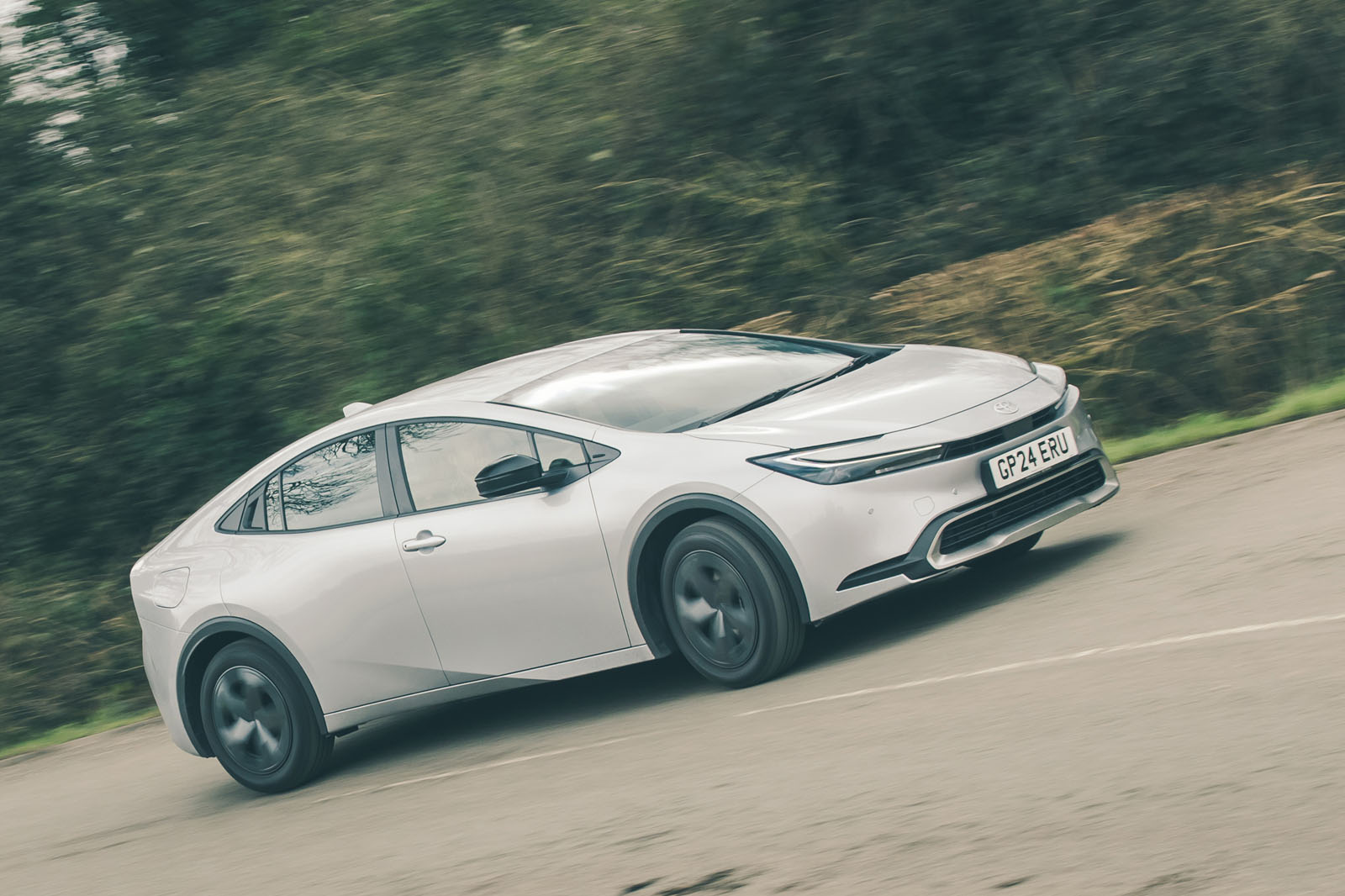
Prius shock! Once forbidden hybrid is fun to drive | Autocar
The Prius we were told we couldn't have goes on UK sale after all – and it's good
 www.autocar.co.uk
Last edited:
DustyBin
Established Member
Picking a couple of Hybrid models which are generally rated as being at the inefficient end of the scale, doesn't mean all hybrids are a con. Japanese and Korean hybrids are well rated for efficiency. Like anything, the buyers needs to do their research, not all hybrids are equal.
For example, Autocar long term review of a Toyota PHEV, averaged 96mpg over 10,000 miles, reviewer reckons 70mpg easily achievable just in hybrid mode on a flat battery.
Prius shock! Once forbidden hybrid is fun to drive | Autocar
The Prius we were told we couldn't have goes on UK sale after all – and it's good
That’s fair enough, I should really have said “some hybrids”. Cars like the Prius have absolutely no appeal to me (the aforementioned BMWs wouldn’t be my first choice either in truth!) but clearly they are highly efficient so will make sense for some people.
Thing is, take a larger vehicle, Mitsubishi (although they are pulling out of the UK) have their Outlander PHEV, 2.4l petrol engine and the electric motor. I know a guy who has one of these and has filled the tank in the last year (so he says) once!, yes it costs him in electricity, but he is with EDF who do a special tariff so in the long run it does if all true come out really cheap. Volvo do an XC90 Diesel Plug-in, even if you do a decent amount of miles, it must be great, if you have somewhere both ends to plug in and charge.
When the electric hybrid first came out, it was all Honda Insight or IMA, lets make our car look futuristic and aerodynamic to save an extra few miles, now BMW have trick solutions like the radiator grille being able to open and shut for airflow and there is a few that utilise solar for charging ancillaries, now the majority just look like normal cars.
I have wondered, in 20 or 30 years time, maybe sooner, whether there will be some kind of channel in the middle of the road (motorways or non pedestrian roads) when your car is half charged, it kind of induction charges as you go (it would use your satnav to work out how long your journey was going to be etc...), we are seeing similar systems being trialled at bus termini with overhead induction charging, with technology, it might be possible although probably very quickly open to abuse.
When the electric hybrid first came out, it was all Honda Insight or IMA, lets make our car look futuristic and aerodynamic to save an extra few miles, now BMW have trick solutions like the radiator grille being able to open and shut for airflow and there is a few that utilise solar for charging ancillaries, now the majority just look like normal cars.
I have wondered, in 20 or 30 years time, maybe sooner, whether there will be some kind of channel in the middle of the road (motorways or non pedestrian roads) when your car is half charged, it kind of induction charges as you go (it would use your satnav to work out how long your journey was going to be etc...), we are seeing similar systems being trialled at bus termini with overhead induction charging, with technology, it might be possible although probably very quickly open to abuse.
Bletchleyite
Veteran Member
Induction charging is certainly a thing, it was trialled on a bus project in MK for a few years and largely worked. I suspect induction charging at parking spaces is more likely the thing, though. People should simply not be making 500 mile journeys with no break, and if EVs ensure they do as a by-product of how they work, good.
See National Grid are bringing back mothballed coal power stations so all these "zero emission" evs can be charged https://www.bbc.co.uk/news/business-58469238
My father before he passed was really into battery technology innovation, he followed the evolution of computer processors and chip die too, about 2 years ago, he said that some of the battery technology that was due out in the next 5 years would make fast charging very possible and the holding of charge (without any major discharge) a reality. some of the materials of conduction and storage would change too and our reliance on some battery materials would be obsolete, one of the Korean makers were talking about a fast charge from 0 to 90% charge of a mobile phone battery in a matter of 90 seconds with minimal thermal discharge i.e the battery not getting extremely hot in the charging process.Induction charging is certainly a thing, it was trialled on a bus project in MK for a few years and largely worked. I suspect induction charging at parking spaces is more likely the thing, though. People should simply not be making 500 mile journeys with no break, and if EVs ensure they do as a by-product of how they work, good.
A car battery is maybe 200x that size, but if you can pull into a petrol station or services and charge up your car to 50% charge in the time it takes to go into the station, buy a coffee and pay for it, then it would certainly make things a lot easier, something like an VW id4 will do around 150-200 miles off a rapid 30 minute charge at present, get that down to 5 minutes and then you are making the electric car ownership a lot more viable to petrolheads.
Also if you translate that technology to buses, then that means that if you have 8 electric buses on a route and a couple of them are used as hot spares while others have to come back and charge, put rapid induction charging at the terminus and those "hot spares" are no longer needed for that purpose and can be deployed on other routes.
Bletchleyite
Veteran Member
Also if you translate that technology to buses, then that means that if you have 8 electric buses on a route and a couple of them are used as hot spares while others have to come back and charge, put rapid induction charging at the terminus and those "hot spares" are no longer needed for that purpose and can be deployed on other routes.
The MK scheme did exactly that - charging grids at each end. They did require one more vehicle than for the same route diesel operated due to the layover not being able to be used to catch up on delays.
Now just think that through, what chance would the government have in trying to restrict the amount of fuel (outside some national shortage like when union action disrupted the supply from the distribution depots)? There are many drivers who regularly exceed 20l of fuel per day, e.g. taxis and delivery vans to name two. And can you think of any ways to sidestep such a restriction, - I can and I don't have any motive to attempt such a careless practice.That is a completely separate issue. If it were important it would already have been addressed by restricting the sale of petrol to 20 litres every four hours.
It has always been a recommendation to take regular breaks during long journeys for safety reasons. Unfortunately, quite a few people are no longer on this earth thanks to the few irresponsible drivers who boast that they are safer drivers and drive 500 miles (or whatever their car is capable of) non-stop. Maybe road charging may address that in the future but other than prosecuting those that do put others at risk through their own selfishness, (often too late), there has never been any campaign to legally restrict the volume of fuel that can be bought per visit.
Your post is an absolute red herring in any discussion about EVs, their range and en-route charging opportunities.
== Doublepost prevention - post automatically merged: ==
That is good news because it means that the transition can go ahead as fast as possible with no need to pander to range anxiety (which is just used by climate deniers as another argument for delaying the mandating of the removal of IC vehicles from the market).... A car battery is maybe 200x that size, but if you can pull into a petrol station or services and charge up your car to 50% charge in the time it takes to go into the station, buy a coffee and pay for it, then it would certainly make things a lot easier, something like an VW id4 will do around 150-200 miles off a rapid 30 minute charge at present, get that down to 5 minutes and then you are making the electric car ownership a lot more viable to petrolheads. ...
Last edited:
The number of people knowingly using range anxiety to further their own agendas is small. The number of people who have been convinced, one way or another, that a range drop from 600 miles to 155 miles is a cause for anxiety is much higher. A 300 mile range and 200mph fast charging ought to set most minds at ease after some bickering.That is good news because it means that the transition can go ahead as fast as possible with no need to pander to range anxiety (which is just used by climate deniers as another argument for delaying the mandating of the removal of IC vehicles from the market).
Human beings are notoriously bad at self reporting, and don't like to be told that they actually use a car for journeys of borderline inappropriate length 90% of the time. No cultural shift ever happened without some pushback.
Bletchleyite
Veteran Member
The number of people knowingly using range anxiety to further their own agendas is small. The number of people who have been convinced, one way or another, that a range drop from 600 miles to 155 miles is a cause for anxiety is much higher. A 300 mile range and 200mph fast charging ought to set most minds at ease after some bickering.
I think a range of 200-300 miles is a sweet spot. 150 or fewer does limit some use-cases (e.g. the hillwalking trips some speak of with limited local charging on campsites) but 200+ has very few limits if the driver is taking sufficient breaks away from the vehicle.
- Status
- Not open for further replies.