Our new ticketing site is now live! Using either this or the original site (both powered by TrainSplit) helps support the running of the forum with every ticket purchase! Find out more and ask any questions/give us feedback in this thread!
The RAIB report into the crossing accident near Sudbury a few years ago made this exact point, that the lorry driver was qualified by virtue of their Lithuanian driving licence, but the railway had assumed that all such drivers had been through UK HGV training.
Would it be unreasonable to suggest that anyone given the responsibility of driving large, heavy and potentially lethal vehicles within the UK should be trained to UK standards ?
Would it be unreasonable to suggest that anyone given the responsibility of driving large, heavy and potentially lethal vehicles within the UK should be trained to UK standards ?
Would it be unreasonable to suggest that anyone given the responsibility of driving large, heavy and potentially lethal vehicles within the UK should be trained to UK standards ?
And be familiar with the highway code having past a test.
Here goes with the signage using standard highway / highway code colours.
Bearing in mind that there are many crossings that are farm track crossings therefore not necessarily part of the highway but private to the landowner.
Children – driving or operating farm machinery
The law says that no child under 13 may drive or ride on tractors and other self-propelled machines used in agriculture.
Before allowing children over 13 to operate a tractor, certain conditions must be met. We describe these in full in HSE's free leaflet Preventing accidents to children on farms.
Children under 16 must not drive, operate, or help to operate, any of the following:
towed or self-propelled harvesters and processing machines;
trailers or feed equipment with conveying, loading, unloading or spreading mechanisms;
power-driven machines with cutting, splitting, or crushing mechanisms or power-operated soil-engaging parts;
chemical applicators such as mounted, trailed or knapsack sprayers;
handling equipment such as lift trucks, skid steer loaders or all-terrain vehicles.
Do farm children understand farm risks? Every year children are killed during agricultural work. Most children who die are family members.
www.hse.gov.uk
Children – driving or operating farm machinery
The law says that no child under 13 may drive or ride on tractors and other self-propelled machines used in agriculture.
Before allowing children over 13 to operate a tractor, certain conditions must be met. We describe these in full in HSE's free leaflet Preventing accidents to children on farms.
Children under 16 must not drive, operate, or help to operate, any of the following:
towed or self-propelled harvesters and processing machines;
trailers or feed equipment with conveying, loading, unloading or spreading mechanisms;
power-driven machines with cutting, splitting, or crushing mechanisms or power-operated soil-engaging parts;
chemical applicators such as mounted, trailed or knapsack sprayers;
handling equipment such as lift trucks, skid steer loaders or all-terrain vehicles.
== Doublepost prevention - post automatically merged: ==
So at 13 you can driver a tractor and tow a simple trailer with bails of hay on it, on a private accommodation track and come to a level crossing and not be familiar with the highway code at all and any colour schemes of the signage.
It is, of course, the responsibility of the “Authorised User” of private crossings (such as this one) to ensure that anyone using the crossing understands how it is operated.
In the case of the accident at Sudbury - 11 years ago - the Lithuanian lorry driver knew exactly how to use the crossing correctly, evidenced by the voice recordings of his many, many, previous uses of it. Which is why he received a 5 year prison sentence.
And I think this was very similar, based on the buildings on the other side of the track. I still get surprised, annoyed maybe that everyone points the finger at NR every time, having seen pictures of the crossing, the instructions are simple, if you don't understand them, then do not drive !
If he was a 'seasonal' worker, then the owner should have ensured he knew how to use the crossing before allowing him to work, that is very simple.
in fact I have know private UWC owners call in and say, I have a new starter, I am showing him how to cross, there will be a couple of calls from us soon.
Like everyone, the only person that knows exactly what happened here is the tractor driver, but having seen some pictures, it looks like he thought he could make it over before the train got there, People (not only on the railway) have got more impatient as the years have gone by, they know what to do, but just ignore it, as it takes too long.
All of this talk about signage and driver competence in highly diverting*, but it does rather miss the point. No matter what the situation, no driver of any sort of vehicle, but particularly a large slow-moving one, should be driving across the front of what should be a clearly visible train approaching at any sort of speed.
* I will just say the following on the matter, though. Firstly, we don’t yet know whether or not the tractor was being driven by a seasonal worker, agency staff or a regular farm worker, nor their age, nor their command of the English language. So maybe we ought to park this for the time being until such matters become clear.
Secondly, familiarity breeds contempt. At a crossing like Kisbeys where the sight-lines are excellent it is likely that they feel confident that the crossing can be (mis)used safely because they can see trains approaching and have experience to know roughly how long it might take for a certain type of train to cover the distance to the crossing. Something that I hope they are now reassessing in the light of recent events.
I must admit I find myself puzzled that members of an industry that, rightly, prides itself on it's safety record are so keen to simply blame the driver of the tractor rather than consider whether the railway could do something better to ensure that future incident are even less likely. By all means if you read all the instructions the correct way to use the crossing is clear. But by having a numbered list, which does not include the most important instruction to phone the signaller, would appear to be opening up the signs to misunderstanding. Indeed the RAIB in the Frognal Farm report went to great lengths on this subject:
92 The signage was not clear, contained conflicting information and did not convey the most important action required to the crossing user.
93 The Private Crossings (Signs and Barriers) Regulations 19966 prescribe the signs to be used at a user worked crossing with and without telephones. POGO equipment had not been invented when these regulations were made, and so the sign that should be used at a crossing with telephones, shown at diagram 103 in the regulations (figure 6) does not explain how to use a POGO crossing. There are currently no appropriate signs in the regulations for crossings with new technology such as POGO equipment, and the signs used at Frognal Farm and other POGO crossings were designed by Network Rail for use in conjunction with other, legally specified, signs.
94 When devising a sign giving instructions on how to use POGO crossings, Network Rail chose to modify the diagram 103 sign to keep it as close as possible in appearance and wording to the sign mandated by the regulations.
95 The most important piece of information to convey to the unfamiliar user at a user worked crossing where it is not possible to see if trains are coming in sufficient time to make an informed decision as to whether it is safe to cross, is that the user must phone the signaller to ask for permission to cross the line.
96 The instructions are not concise and they do not capture the reader’s attention. The most important instruction on the sign, to contact the signaller for permission to cross, is not a numbered instruction, and it is therefore easy to overlook. In addition it is difficult to pick out in the white text on the red background.
97 Neither this sign, nor any of the others at the crossing, makes it clear to the user that it is not safe to cross the railway without permission from the signaller, nor do they explain that pressing the button will open the gates regardless of whether or not there is a train coming.
1 The intent of this recommendation is to enable crossing users who may be unfamiliar with user worked crossings to safely operate and traverse such crossings, in view of the increasing number of reasons that people may need to use user worked crossings without necessarily having been briefed on their use.
Network Rail, with Office of Rail and Road and Department for Transport support, should review and revise the information offered to users of private level crossings, including consideration of signage wording and diagrams, the conspicuity and placement of signage, and the actions that the user needs to take, including operation of the gates or barriers, and communication with the signaller. The review should also consider, alongside the presentation of information, practicality and feasibility of the current arrangements by which authorised users are expected to brief and inform other potential users of the crossing, in view of the increased dependence of occupiers on delivered goods and services from a plethora of sources, and other factors which may increase the number of crossing users (paragraphs 129a.i, 129a.iii, 129a.iv).
Now in this case it may very well be that the tractor driver was intimately familiar with how the crossing is supposed to be used and didn't use it properly. But clearly it has been identified in previous incidents that the crossing signs are not as clear as they could be. Not having item one on the numbered list as "Call the signaller to check it is clear to cross" seems like a huge oversight to me. So rather than simply dismiss this incident as being a case of a driver being impatient or to stupid to be allowed on the road surely we should be thinking to ourselves that even if those are true actually it has shown up a problem with the signage which could be corrected so that the chance of an accident is further reduced?
Question - If there is a circuit between the phone at the crossing and the signaller, then there is probably a similar circuit in reverse.
Couldn't the 'gates open' button be dependant on the phone being off hook (call being made) - or better - since the signaller has now been 'disturbed' - couldn't he/she release the green button remotely.
i don't buy (in this day and age) that this can't be done reasonably effectively and at modest cost - may not be 'belt and braces 'ideal' - but means that the green button can't be pressed without the telephone being used.
If the rule is that the green button mustn't be used before the telephone has been - then interlock them so that it can't be?
Have you been in a busy Signalbox, where there maybe upwards of 10, some may have many more crossings to deal with, plus AHB's / CCTV's also dealing with Line Blocks, Station Staff ringing in, and running trains too
add that with umpteen more buttons on the panel etc, in addition to SPT's / AHB's / UWC/ GSM-R / Ordinary dial phone / Station Phones...........
== Doublepost prevention - post automatically merged: ==
I must admit I find myself puzzled that members of an industry that, rightly, prides itself on it's safety record are so keen to simply blame the driver of the tractor rather than consider whether the railway could do something better to ensure that future incident are even less likely. By all means if you read all the instructions the correct way to use the crossing is clear. But by having a numbered list, which does not include the most important instruction to phone the signaller, would appear to be opening up the signs to misunderstanding. Indeed the RAIB in the Frognal Farm report went to great lengths on this subject:
Before going onto recommend:
Now in this case it may very well be that the tractor driver was intimately familiar with how the crossing is supposed to be used and didn't use it properly. But clearly it has been identified in previous incidents that the crossing signs are not as clear as they could be. Not having item one on the numbered list as "Call the signaller to check it is clear to cross" seems like a huge oversight to me. So rather than simply dismiss this incident as being a case of a driver being impatient or to stupid to be allowed on the road surely we should be thinking to ourselves that even if those are true actually it has shown up a problem with the signage which could be corrected so that the chance of an accident is further reduced?
I must admit I find myself puzzled that member of an industry that, rightly, prides itself on it's safety record are so keen to simply blame the driver of the tractor rather than consider whether the railway could do something better to ensure that future incident are even less likely.
Until such time as an accident investigation report is published, the possibility that this was a simple case of crossing misuse gone wrong must remain on the table. Given the extent to which abuse has been found to be a causal factor in past incidents, I see no reason to be getting so hung up on the precise wording of crossing instructions at locations other than Kisbeys UWC. Once we know that this was a problem then we can think about what needs to be done about it.
But I stand by my point. Clarity of instructions notwithstanding, familiarity with crossings aside, the train was clearly visible to the tractor driver. No signaller would have given permission to cross at that time, so the tractor driver acted on his/her own judgment.
== Doublepost prevention - post automatically merged: ==
I would also like to amplify what @Bald Rick said about UWCs up-thread.
It is, of course, the responsibility of the “Authorised User” of private crossings (such as this one) to ensure that anyone using the crossing understands how it is operated.
Given the proximity of the crossing to the farm buildings, it shouldn’t have taken the farmer, who will be very aware of how the crossing works, more than a couple of minutes to brief any new staff on how to use it in the event that they are unfamiliar. Given that they are risking his/her machinery, it would seem to me to be an important safeguard.
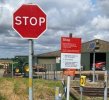
I'd have thought the same until I realised what I'd done when I first saw the sign in question - read "Stop", then went straight to the numbered list of instructions, having assumed the remainder of the red-background text was the boilerplate warning I've already seen on red-backgrounded signs all over the network.
Thus I'm inclined to agree with the RAIB in saying that it's a weakness, regardless of the extent to which it was or wasn't involved in this incident.
@LAX54 Where was that picture taken? Someone else will surely be able to answer, but I’m not sure that STOP signs are normally provided at UWCs by Nitwit Rail. Could it be that someone else has put that up thereby causing confusion with the official signage?
Looking at it as a whole, I find that I see the large "STOP" message, and then my attention is drawn to the numbered list. I'm looking for instructions, and we're accustomed to seeing instructions in ordered lists. If you've ever used a recipe (especially online) there's a title, a blurb that waffles at great length, and then an ordered list. It's what we're used to.
What we aren't used to is the main important thing being item 0 in the list of things to do.
Until such time as an accident investigation report is published, the possibility that this was a simple case of crossing misuse gone wrong must remain on the table. Given the extent to which abuse has been found to be a causal factor in past incidents, I see no reason to be getting so hung up on the precise wording of crossing instructions at locations other than Kisbeys UWC. Once we know that this was a problem then we can think about what needs to be done about it.
But I stand by my point. Clarity of instructions notwithstanding, familiarity with crossings aside, the train was clearly visible to the tractor driver. No signaller would have given permission to cross at that time, so the tractor driver acted on his/her own judgment.
== Doublepost prevention - post automatically merged: ==
I would also like to amplify what @Bald Rick said about UWCs up-thread.
Given the proximity of the crossing to the farm buildings, it shouldn’t have taken the farmer, who will be very aware of how the crossing works, more than a couple of minutes to brief any new staff on how to use it in the event that they are unfamiliar. Given that they are risking his/her machinery, it would seem to me to be an important safeguard.
Indeed and I did not intend to suggest that this might be anything other than crossing misuse (indeed one would suggest that at the moment that seems the most likely outcome). But, again, I find it bizarre that members of an industry which is quite rightly proud of its safety record seem to be so averse to making even the simplest of changes to the crossing instructions such as making item one on the list "Call the signaller and check it is clear to cross" (and we now have two members on this forum who have confessed that their eyes were drawn straight to the numbered list after seeing the STOP instruction). Perhaps in this incident it may have made no difference if the tractor driver was as belligerent as has been suggested. But we know what sign was provided at the crossing thanks to the RailCam article and indeed it is as potentially flawed as that found at Frognal Farm.
Even if, for some reason, people aren't keen to change the wording to improve safety by helping to remove any ambiguity surely the wording should be changed to ensure that the next person that misuses this or any other crossing cannot use "well the wording wasn't totally clear" as an excuse for their behaviour? I am just puzzled that there seems to be such opposition to something which would improve safety.
There was a thread here a few months ago about what if somebody was deaf and wanted to use one of these crossings what would happen? Food for thought..
Everybody in here has an interest in the railway so you’re looking at crossings from a different viewpoint. The average person doesn’t have these same viewpoints and I think people here forge that.
But it’s presumably in-hand. The RAIB recommended that the DfT and ORR look into crossing signage, and either they are and changes are in the pipeline or they’re content with how things are.
There was a thread here a few months ago about what if somebody was deaf and wanted to use one of these crossings what would happen? Food for thought..
I’m glad that this forum takes disability seriously, but sometimes it gets overblown and used solely as a rod with which to beat the railway. I would imagine that a deaf crossing user would, given their awareness of their physical limitations, use the crossing differently, take greater care to look and cross more quickly.
But it’s presumably in-hand. The RAIB recommended that the DfT and ORR look into crossing signage, and either they are and changes are in the pipeline or they’re content with how things are.
It's perhaps just my general dislike of the DfT and general sense that the ORR about as much use as a chocolate fireguard but I have doubts that they've even started looking into it...
Have you been in a busy Signalbox, where there maybe upwards of 10, some may have many more crossings to deal with, plus AHB's / CCTV's also dealing with Line Blocks, Station Staff ringing in, and running trains too
add that with umpteen more buttons on the panel etc, in addition to SPT's / AHB's / UWC/ GSM-R / Ordinary dial phone / Station Phones...........
No I haven't that is why I said it was a question.
But - again from a point of not knowing I would ask:-
1) Should pedestrian access be via a separate small gate from the one with the green button for the cattle/vehicular access?
2) If the signaller is being telephoned regarding opening the main gates he already has to have his attention on the matter, otherwise what's the point in ringing him.
If he thinks the way is clear he could press a release button with a 30 second timer that allows the green button to open the gates.
3) Relying on the local idiot to a) read and b) use a telephone before crossing is not good enough - obviously - it risks endangering the driver and passengers, never mind the idiot.
It's perhaps just my general dislike of the DfT and general sense that the ORR about as much use as a chocolate fireguard but I have doubts that they've even started looking into it...
I'd like to think that the RAIB had the power to chase-up it's recommendations to ensure that they have been acted upon, but ultimately I suppose it's not their position to do so. These are all independent agencies after all.
I do not think I missed it: why is the gate control not locked by the signalling? Does it at least warn someone somewhere that the line is obstructed?
Based on what I have seen locally (and this crossing is not far from me), it is probably misuse but those signs are still poor. I was told years ago not to use small areas of white on red text next to black on white because many people find it difficult to read (but equally many do not) and that was only an advertising/information leafket not a safety critical sign. How can the railway not know this?
I'd like to think that the RAIB had the power to chase-up it's recommendations to ensure that they have been acted upon, but ultimately I suppose it's not their position to do so. These are all independent agencies after all.
The status of all recommendations made between 2016 and 2020 is as follows:
57% are either implemented, or their implementation is ongoing
for 21% of recommendations the safety authority has yet to be satisfied that an appropriate plan, with timescales, is in place for implementation (that is, the response is still ‘progressing’)
for 21% of recommendations a sufficient response has still to be reported to the safety authority (these are mainly recommendations made during 2020)
less than 1% of recommendations have been reported as not being implemented
I must admit I find myself puzzled that members of an industry that, rightly, prides itself on it's safety record are so keen to simply blame the driver of the tractor rather than consider whether the railway could do something better to ensure that future incident are even less likely.
Whereas I am equally puzzled that people seem so keen to find any possible avenue to blame the railway. Whatever the outcome of the investigation there is no doubt in my mind that the employer of the tractor driver should have ensured that they were fully aware of the crossing and its method of operation before allowing them out, given that this is a private road and not a public highway. Surely the crossing has been used on countless occasions in the past without an accident occurring ?
Whereas I am equally puzzled that people seem so keen to find any possible avenue to blame the railway. Whatever the outcome of the investigation there is no doubt in my mind that the employer of the tractor driver should have ensured that they were fully aware of the crossing and its method of operation before allowing them out, given that this is a private road and not a public highway. Surely the crossing has been used on countless occasions in the past without an accident occurring ?
There are a number of posts here saying that the LC signage is not clear enough, or that the signalling arrangements and interlocking are insufficient. Is that not in effect blaming the railway, at least partly ?
There are a number of posts here saying that the LC signage is not clear enough, or that the signalling arrangements and interlocking are insufficient. Is that not in effect blaming the railway, at least partly ?
I think those are trying to remove reasons for other people to blame the railway and perhaps make it that a fool in a hurry (or whatever the phease in English law is) is less likely to miss an important instruction.
There are a number of posts here saying that the LC signage is not clear enough, or that the signalling arrangements and interlocking are insufficient. Is that not in effect blaming the railway, at least partly ?
There is a difference between assigning blame and coming up with potential options to reduce the likelihood of a similar incident regardless of who is actually to "blame".
Even if the tractor driver is to "blame", if there are options that the railway could easily implement that would reduce the chance of something like this happening again, isn't it a generally good idea to try to see if any of those options could be taken up?
Blame is pointless. It doesn't matter (I guess it does in terms of who pays who, but that is basically it). What matters is reducing the chance of incidents happening. Both sides of an incident can do that, regardless of which side is actually to "blame".
In my job, we often see issues that you can very much assign "blame" to a particular person or group if you wanted to. But we don't, because it is pointless. What we do is look to see what could be changed so such an incident is less likely to reoccur. Quite often that involves actions on both sides of the fence as with most incidents there isn't just one cause. Thankfully in my job we are just talking about software that powers websites, nothing safety critical. But the point still stands for the railways and other safety critical industries. Hell it is one of the first things you learn when you do learn about safety critical systems - that if something goes wrong enough for an incident to occur, then it is likely multiple things have gone wrong and you can't just pin the blame on one of those things.
We’ve had a lot more freight heading up and down the GEML vice across the fens due to this incident these past few days, so guessing freight are working around this incident well.
Freight is lucky there is space to accommodate them, due to Covid 19, a Saturday service level rather than an SX service level has been operation on weekdays for many months on this route.
Freight is lucky there is space to accommodate them, due to Covid 19, a Saturday service level rather than an SX service level has been operation on weekdays for many months on this route.
We are aware of an issue with emails from the Forum to Microsoft-based email accounts (hotmail/outlook/live.com email addresses). This is being looked into currently, thanks for your patience meanwhile.