Our new ticketing site is now live! Using either this or the original site (both powered by TrainSplit) helps support the running of the forum with every ticket purchase! Find out more and ask any questions/give us feedback in this thread!
The topic for WoE rolling stock has been brought up on the Okehampton Service thread and seeing as it’s a bit off topic, I thought that it was worth of its own thread within the speculative ideas thread.
About what rolling stock will replace the 159’s and the future services.
The topic for WoE rolling stock has been brought up on the Okehampton Service thread and seeing as it’s a bit off topic, I thought that it was worth of its own thread within the speculative ideas thread.
About what rolling stock will replace the 159’s and the future services.
The recent CMPS release stated that they expect the rolling stock to be tendered for replacement around the time of the next franchise, which is around 2023.
The recent CMPS release stated that they expect the rolling stock to be tendered for replacement around the time of the next franchise, which is around 2023.
Given the likely post-Covid financial situation, it would not surprise me if there is little or no new stock in the next 5-10 years. After that, any new pure dmus may look rather like Class 172 or 195, but with updated engines, etc. They may consider some bi-mode versions if there is no progress with electrification west of Basingstoke or Salisbury.
Given the likely post-Covid financial situation, it would not surprise me if there is little or no new stock in the next 5-10 years. After that, any new pure dmus may look rather like Class 172 or 195, but with updated engines, etc. They may consider some bi-mode versions if there is no progress with electrification west of Basingstoke or Salisbury.
Third rail 755’s are an option, although they don’t have end doors and also don’t have vestibules meaning that the weather always come in.
68’s and mk5’s would of course be the best option from a passengers point of view. Before they lost the franchise Stagecoaches was thinking of buying LHCS for the route. What a shame they didn’t.
== Doublepost prevention - post automatically merged: ==
Another thing, whatever replaces the 159’s needs to be 750V DC Third Rail capable, as well as being able to run on 25kV OHLE. The units/loco will obviously need a fair bit of power for the stop start nature of the route, as well as to carry what would be a heavy train should it ever be built. Not to mention the gradients like Honiton bank which can be a real slog even in the relatively powerful 159’s.
68’s and mk5’s would of course be the best option from a passengers point of view. Before they lost the franchise Stagecoaches was thinking of buying LHCS for the route. What a shame they didn’t.
Really? because the impression I've got so far is they're awful. Also, you can't split the formation.
I'd like to see a new version of the 158 concept as an electric with modular power source. Unless it suddenly turns into a primary main line again ( we've been struggling to make it a half decent main line for years already so something major has to happen for *that* sort of change ) the stock it has is ideal. Fortunately they have 10 years left in them, so there's no rush.
Really? because the impression I've got so far is they're awful. Also, you can't split the formation.
I'd like to see a new version of the 158 concept as an electric with modular power source. Unless it suddenly turns into a primary main line again ( we've been struggling to make it a half decent main line for years already so something major has to happen for *that* sort of change ) the stock it has is ideal. Fortunately they have 10 years left in them, so there's no rush.
Why split it? 5 or 6 cars is plenty. LHCS is of course the best option for any railway, especially a long regional one like this.
== Doublepost prevention - post automatically merged: ==
If not LHCS then Stadler 755’s are the way forward.
The only important thing is that the train is comfortable for passengers. The only way to do that is to have LHCS or a separate power module like the Stadler 755’s.
It all depends on the future shape of the WoE mainline. I would like to to see total route modernisation with double track throughout from Salisbury to Exeter and electrification at 25kv AC from Exeter to the existing DC electrification. If we're serious about decarbonising transport, then electrification of secondary mainlines will have to be a thing in the late 2020s - early 2030s.
On this basis, stock replacement would have to fit around this - it's worth extending the 159s and then replacing them with dual-voltage units when the electrification is complete. Something like the Anglia FLIRTs could do well, or more 80x IETs, but realistically it's at least 10-15 years away.
== Doublepost prevention - post automatically merged: ==
If LHCS was the way forward why is everything bar TPE's Mk 5s a MU? And even TPE's Mk 5s aren't classic LHCS in the sense that they run in fixed sets with a locomotive at one end - I can't see that they're going to be adding an dropping extra carriages to meet demand from a pile of spares in a carriage siding somewhere.
Passenger comfort is of course important, but safety and affordability generally get a look in, too. There's no reason why DfT couldn't decide to replace every MU in the country with a massive Mk 5 build that would be the largest carriage order since the Mk 1s in the 1950s and 1960s.... except that it's a terrible idea because there are much cheaper ways of providing the same service, and there isn't an unlimited amount of public funding to pay for all of this.
Third rail 755’s are an option, although they don’t have end doors and also don’t have vestibules meaning that the weather always come in.
68’s and mk5’s would of course be the best option from a passengers point of view. Before they lost the franchise Stagecoaches was thinking of buying LHCS for the route. What a shame they didn’t.
== Doublepost prevention - post automatically merged: ==
Another thing, whatever replaces the 159’s needs to be 750V DC Third Rail capable, as well as being able to run on 25kV OHLE. The units/loco will obviously need a fair bit of power for the stop start nature of the route, as well as to carry what would be a heavy train should it ever be built. Not to mention the gradients like Honiton bank which can be a real slog even in the relatively powerful 159’s.
I can’t see loco hauled being an option, as it’s a waste of space at Waterloo.
WOE is a difficult one as it requires a relatively high-capacity train for the Waterloo end, which is still sufficiently comfortable for a long journey. A Voyager type design would waste too much space. Likewise speed capability over 100 mph isn’t required.
In an ideal world something as close as possible to the 159 is what’s needed. For me the only issue with the 159s is that the seating is a little cramped when the train is heavily loaded. Apart from that they’re ideally suited to the route.
Ultimately electrification is probably the solution, perhaps using the 350/2s if they can be made dual voltage, and fitted with a less high density interior.
I can’t see loco hauled being an option, as it’s a waste of space at Waterloo.
WOE is a difficult one as it requires a relatively high-capacity train for the Waterloo end, which is still sufficiently comfortable for a long journey. A Voyager type design would waste too much space. Likewise speed capability over 100 mph isn’t required.
In an ideal world something as close as possible to the 159 is what’s needed. For me the only issue with the 159s is that the seating is a little cramped when the train is heavily loaded. Apart from that they’re ideally suited to the route.
Ultimately electrification is probably the solution, perhaps using the 350/2s if they can be made dual voltage, and fitted with a less high density interior.
Needs a slightly longer train perhaps? how long can Waterloo take? I thought I saw 10 car being the maximum ( which in 158/9 terms is rather awkwardly 3+3+2+2 ), so either slightly longer carriages ( if they can be gauge cleared ) to make 9 cars at max out of some combo of 3s, or perhaps a mix of 3 and 4 car units would seem to suit all the things units on this route are expected to do.
We had a look ( well, something of an argument ) at 185s a while back & found their layout didn't offer anything like as many seats as a 159, so I don't know if a 350 is going to be any better.
Excuse me but I regularly travelled from Woking to Yeovil Junction until recently and on certain peak time 9-car trains would be lucky to get a seat before Andover... 5 or 6 cars is certainly NOT plenty.
A lot of talk here about OHLE,is there really any serious NR proposals to wire up Waterloo-Exeter? No. There's been talk elsewhere on the forum of electrifying Basingstoke-Salisbury but what's the point in doing just this small bit? Fright seemed to be the answer given by some members but how is that small bit going to benefit a whole line passenger service? Is it really worth investing in a replacement fleet with OHLE capability without any commitment to wire up the whole route?
A lot of talk here about OHLE,is there really any serious NR proposals to wire up Waterloo-Exeter? No. There's been talk elsewhere on the forum of electrifying Basingstoke-Salisbury but what's the point in doing just this small bit? Fright seemed to be the answer given by some members but how is that small bit going to benefit a whole line passenger service? Is it really worth investing in a replacement fleet with OHLE capability without any commitment to wire up the whole route?
Listen to this article The feature in our March issue that considered the electrification required for a zero-carbon railway attracted a great deal of interest. This included a map showing that between 4,300 and 6,300 route kilometres of electrification was likely to be required from an analysis...
A lot of talk here about OHLE,is there really any serious NR proposals to wire up Waterloo-Exeter? No. There's been talk elsewhere on the forum of electrifying Basingstoke-Salisbury but what's the point in doing just this small bit? Fright seemed to be the answer given by some members but how is that small bit going to benefit a whole line passenger service? Is it really worth investing in a replacement fleet with OHLE capability without any commitment to wire up the whole route?
If the stock lasts 40 years, then by the time it arrives you're looking at it still being in service in about 2070. Modern 3rd rail EMUs have been OHLE ready for ages - a DEMU just has an extra source of juice ( or two sources for hybrid ) on top.
I recall reading that the 3rd rail infrastructure east of Basingstoke can't cope with any more trains anyway, but leaving that aside a bi-mode 444 style train would seem to be ideal
Needs a slightly longer train perhaps? how long can Waterloo take? I thought I saw 10 car being the maximum ( which in 158/9 terms is rather awkwardly 3+3+2+2 ), so either slightly longer carriages ( if they can be gauge cleared ) to make 9 cars at max out of some combo of 3s, or perhaps a mix of 3 and 4 car units would seem to suit all the things units on this route are expected to do.
We had a look ( well, something of an argument ) at 185s a while back & found their layout didn't offer anything like as many seats as a 159, so I don't know if a 350 is going to be any better.
Most Waterloo platform lengths, (including the former international platforms), are 240m max, which allows for either 12 x 20m or 10 x 23m. A few platforms are shorter, mostly 200m, and on the main suburban side, ie P1-6.
10 car 158/159 formations (3+3+2+2) have run for quite a few years, so that’s the capacity you need to replicate.
However many cars are involved (depending on individual car length in a particular design), any new rolling stock in maximum formation should clearly fill up the available platform length at Waterloo. The ability to split trains en route is important as full length to Exeter is wasteful, and that favours a unit end gangway configuration to minimise crewing, which also fits with the <100mph operation speed. Electric transmission and batteries to support hybrid multi-power source operation is likely, certainly being able to pick up from existing 3rd rail DC (with static charging opportunities at depots/termini elsewhere), and possibly from OHLE as well if the provision of such is considered likely on the route west of Basingstoke. I wonder if Stadler could bolt a different end gangway fitted cab on their FLIRT design.
However many cars are involved (depending on individual car length in a particular design), any new rolling stock in maximum formation should clearly fill up the available platform length at Waterloo. The ability to split trains en route is important as full length to Exeter is wasteful, and that favours a unit end gangway configuration to minimise crewing, which also fits with the <100mph operation speed. Electric transmission and batteries to support hybrid multi-power source operation is likely, certainly being able to pick up from existing 3rd rail DC (with static charging opportunities at depots/termini elsewhere), and possibly from OHLE as well if the provision of such is considered likely on the route west of Basingstoke. I wonder if Stadler could bolt a different end gangway fitted cab on their FLIRT design.
I don't see why they couldn't, although really the Stadler 755's for SWR would have to be 5 cars instead of 3 or 4 cars. 4 cars is awkward and 3 is too low as to make 9 that requires 3 sets.
A 4 car class 755 is 80m long, so a 6 car one would be around 111m long as the intermediate car are only 15.5m long instead of 20 like the driving cars. So a 12 car 755 (2 x 6 car units) would be 222m, meaing that it would fit in Waterloo and could still be split in half at Salisbury or Yeovil. Before anyone says about splitting down to 3 cars for Exeter, that's pointless as they shouldn't be running 3 to Exeter anyway as the over crowding is to much.
The current powerpacks are plenty powerful enough for a 6 car unit as they have 2570hp which is more than a 6 car 159 with the 400hp engines installed.
== Doublepost prevention - post automatically merged: ==
Also, as a side note, LHCS for the route can't be that bad of an idea if Stagecoach themselves were seriously considering it before they lost the franchise. I wonder if they could ever make a comeback seeing as First has made a poor job of it.
It was well know that SWT's 159's were some of the best of their kind, however, now FirstGroup have taken over it's take a bit of a nose dive, hence a £132m loss.
755s with only 1 set of doors would not be suitable on the busy end of the route. Two doors per coach would be required.
as others have stated LHCS is also a non starter due to the waste of space of having a loco on it. As far as I’m aware Stagecoach never floated the idea and any talk of it is just enthusiast wibble, happy to be proven wrong with a link to an article but I certainly don’t recall the idea being floated.
In an ideal world the replacements would be 3rd rail + DEMU with end gangways. End doors lots of airline seats and a handful of tables dotted throughout. I think they should be 5x22m coaches with a power pack in the same design as the Swiss designed units. That would allow for a power pack of 10m per unit if required.
755s with only 1 set of doors would not be suitable on the busy end of the route. Two doors per coach would be required.
as others have stated LHCS is also a non starter due to the waste of space of having a loco on it. As far as I’m aware Stagecoach never floated the idea and any talk of it is just enthusiast wibble, happy to be proven wrong with a link to an article but I certainly don’t recall the idea being floated.
In an ideal world the replacements would be 3rd rail + DEMU with end gangways. End doors lots of airline seats and a handful of tables dotted throughout. I think they should be 5x22m coaches with a power pack in the same design as the Swiss designed units. That would allow for a power pack of 10m per unit if required.
While I respectfully disagree with you on the LHCS front, as in my option it’s far superior to any unit, regardless of power source, I do agree that should it be units that are ordered they should have a desperate power pack. That is without a doubt. They offer almost as much comfort as LHCS, but without the shunting bit.
However many cars are involved (depending on individual car length in a particular design), any new rolling stock in maximum formation should clearly fill up the available platform length at Waterloo. The ability to split trains en route is important as full length to Exeter is wasteful, and that favours a unit end gangway configuration to minimise crewing, which also fits with the <100mph operation speed. Electric transmission and batteries to support hybrid multi-power source operation is likely, certainly being able to pick up from existing 3rd rail DC (with static charging opportunities at depots/termini elsewhere), and possibly from OHLE as well if the provision of such is considered likely on the route west of Basingstoke. I wonder if Stadler could bolt a different end gangway fitted cab on their FLIRT design.
3+4+3 might work out nicely for flexibility - I'm not a planner but I can see the attracton in leaving Waterloo like that, dropping a unit off at Salisbury or Yeovil which can then run a service back or to Bristol, and then you can even split off a unit at Exeter to carry on to Okehampton ( or other parts of Devon ) if you wanted & send the the remaining one to Axminster/Plymouth/depot for a service & back to pick the other unit up again to head back east. All entirely off the top of my head as an illustration rather than a practical plan, but the route does seem to like doing this sort of thing.
10x23m can also be 9x26m, if they'll fit everywhere else.
Class 93 tri mode with Mark 5a coaches for the win....no....um OK.... then I agree with a design based upon the Class 755, with 3rd rail shoes, a pantograph and a diesel centre car and intercity door layouts
Class 93 tri mode with Mark 5a coaches for the win....no....um OK.... then I agree with a design based upon the Class 755, with 3rd rail shoes, a pantograph and a diesel centre car and intercity door layouts
Class 80X, could they be designed with 3rd rail. Would need extra equipment to covert DC to AC traction motors though. Diesal engine would help during icing periods etc on 3rd rail territory too.
3+4+3 might work out nicely for flexibility - I'm not a planner but I can see the attracton in leaving Waterloo like that, dropping a unit off at Salisbury or Yeovil which can then run a service back or to Bristol, and then you can even split off a unit at Exeter to carry on to Okehampton ( or other parts of Devon ) if you wanted & send the the remaining one to Axminster/Plymouth/depot for a service & back to pick the other unit up again to head back east. All entirely off the top of my head as an illustration rather than a practical plan, but the route does seem to like doing this sort of thing.
10x23m can also be 9x26m, if they'll fit everywhere else.
Both ends are busy, it's the middle bit that kinda thins out but there's still long-distance passengers. Interesting thing to try and balance.
Should that ever happen, would SWR require a depot in Exeter? They would have a lot of stock down here and some of it may require work? There is space at Exeter (riverside yard) for a small single road shed and a few stabling sidings.
== Doublepost prevention - post automatically merged: ==
Class 80X, could they be designed with 3rd rail. Would need extra equipment to covert DC to AC traction motors though. Diesal engine would help during icing periods etc on 3rd rail territory too.
Should that ever happen, would SWR require a depot in Exeter? They would have a lot of stock down here and some of it may require work? There is space at Exeter (riverside yard) for a small single road shed and a few stabling sidings.
== Doublepost prevention - post automatically merged: ==
Why does everyone want 80x’s? They’re so overrated and totally unsuitable for the route.
80X other than moans about the seats and certain internal layouts seem to be settling into quite a boring train. I.e. they seem to be getting on with the task and not making headlines. They are assembled in the UK providing. Employment too. There will be plenty of spare parts and expertise to maintain them given their widespread use and can no doubt be re-used else where on the network.
No reason I guess to a 3/4 door configuration either.
80X other than moans about the seats and certain internal layouts seem to be settling into quite a boring train. I.e. they seem to be getting on with the task and not making headlines. They are assembled in the UK providing. Employment too. There will be plenty of spare parts and expertise to maintain them given their widespread use and can no doubt be re-used else where on the network.
No reason I guess to a 3/4 door configuration either.
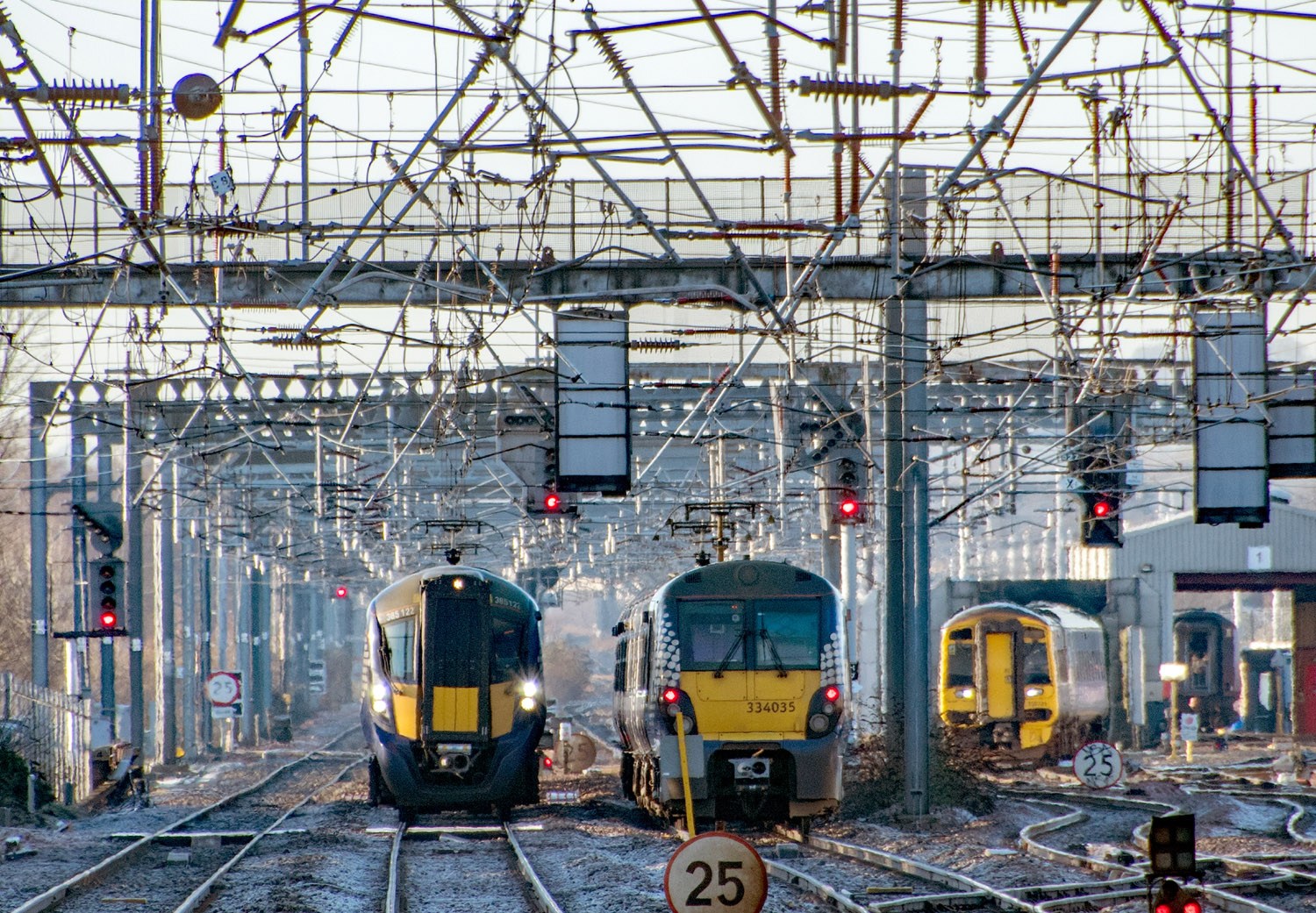
More to the point, 8xxs are over-spec, being designed predominantly for 125+mph Intercity service with limited stops. If you wanted to buy from Hitachi, a bimode/battery 100mph product similar to the Scotrail EMUs would be far more appropriate, with adjusted seating and door layouts as desired.
More to the point, 8xxs are over-spec, being designed predominantly for 125+mph Intercity service with limited stops. If you wanted to buy from Hitachi, a bimode/battery 100mph product similar to the Scotrail EMUs would be far more appropriate, with adjusted seating and door layouts as desired.
Stadler 755's Flirt's are without doubt the best bi-mode MU's around these days. They're quiet (depending on where it is you sit), they're fast and more importantly the engines aren't under the floor which is so much better. Being in GWR's 150's isn't a fun thing to do. Even SWR 159's have a constant drone that cannot be escaped.
We are aware of an issue with emails from the Forum to Microsoft-based email accounts (hotmail/outlook/live.com email addresses). This is being looked into currently, thanks for your patience meanwhile.