That massively overstates the demand that could ever exist on the Chiltern lines, even if we hadn't had the events of 2020.Make some 4 car Electrostar with battery and OHLE. Run them predomantsy as 8 car sets up to Aylesbury and 4/8 to Ruislip (peak only) and Banbury. Put Gerrards Cross and High Wycombe terminators on Crossrail. Have 6tph Intercity fasts every hour (3 Oxford, 2 Birmingham & 1 Stratford). Either have all 6 going to Marylebone or have 4 to Marylebone and 2 to OOC. 2 would, in any case, have a connection on/off a XR at High Wycombe. I’d run the IC services with 5/7 coaches, probably an IET variety. I’d also look to send East West Rail to MYB, though this has been labelled as a no in the past by EWR. They’d stop at only a couple of places en route via Amersham (long loops?), or they could take advantage of extra capacity on the Wycombe route (as it’d be 4 tracked up to Ashendon in my plan), though this would mean double tracking the Monks Risborough route.

-
Our new ticketing site is now live! Using either this or the original site (both powered by TrainSplit) helps support the running of the forum with every ticket purchase! Find out more and ask any questions/give us feedback in this thread!
You are using an out of date browser. It may not display this or other websites correctly.
You should upgrade or use an alternative browser.
You should upgrade or use an alternative browser.
How could London Marylebone capacity be increased?
- Thread starter BrianW
- Start date
- Status
- Not open for further replies.
Sponsor Post - registered members do not see these adverts; click here to register, or click here to log in
R
RailUK Forums
The Planner
Veteran Member
- Joined
- 15 Apr 2008
- Messages
- 19,722
So to clarify, how many are turning off to the Met at Neasden? Just the two?Make some 4 car Electrostar with battery and OHLE. Run them predomantsy as 8 car sets up to Aylesbury and 4/8 to Ruislip (peak only) and Banbury. Put Gerrards Cross and High Wycombe terminators on Crossrail. Have 6tph Intercity fasts every hour (3 Oxford, 2 Birmingham & 1 Stratford). Either have all 6 going to Marylebone or have 4 to Marylebone and 2 to OOC. 2 would, in any case, have a connection on/off a XR at High Wycombe. I’d run the IC services with 5/7 coaches, probably an IET variety. I’d also look to send East West Rail to MYB, though this has been labelled as a no in the past by EWR. They’d stop at only a couple of places en route via Amersham (long loops?), or they could take advantage of extra capacity on the Wycombe route (as it’d be 4 tracked up to Ashendon in my plan), though this would mean double tracking the Monks Risborough route.
Marylebone would end up with:
- 4-6tph Intercity
- 2-4tph Aylesbury Slow
- 0-2tph Ruislip Slow (Peak only)
- 2-2tph Banbury Semi then Slow
- 2-2tph East West Rail
10tph total in the off peak but 16tph in total in the peaks. Probably possible with conventional signalling, though ERTMS would be good if possible, at least out to Wycombe and Amersham - or just to where the Amersham route goes off.

For better or worse, the "get it done" attitude of the 60s is long gone, certainly when it comes to railways. You have to have several stages of consultation, submit a Transport and Works Act Order application, then wait until the Minister decides to take it off their "to do" pile (the TWAO for Manchester Picc platforms 15-16 has been sitting on that pile for years)...Many urban 'road-widening' and 'redevelopment' schemes of the 1960s 'sacrificed' lots of houses, and presumably that was thought worth it for the gain?
In short, no chance.
The Victoria line manages to operate 36tph using 2 platforms at either end of the line, without so much as a grade separated crossover.How many platforms at a terminus station are needed to service a double-track line running at peak capacity?
The problem is the turnaround time, which is linked to the diversity of routes served. It's only possible to achieve that sort of frequency when all trains do the same route, so you can do your turnaround in 1-2 mins because you don't need to worry about waiting for your departure "path".
So, the answer is that "it depends" - on how many different routes and calling patterns you want to serve, amongst other things. I think it would be safe to say that Marylebone's 6 platforms are not overly generous, but needn't be unworkable.
In short, no. Not unless it were a deep-level bored tunnel. Just as one example, MCC raised a stink about the fact that Network Rail wouldn't let them build an extension on top of the existing cut and cover tunnel that runs along the edge of their grounds.I mentioned about the possibility of an additional tunenel to the west of existing- is that a possibility?
You would have to compulsorily purchase thousands of properties... It's just not happening.
Operationally that would make some degree of sense. The difficulty is that TfL are highly unlikely to want to take on the liability of an additional loss-making stretch of line, that stretches far beyond Greater London.And if the Aylesbury services were 'incorporated' somehow with the Met? I recognise the 'territorial' issues related to TFL and how that has played out in relation to eg Watford, the Croxley link, Bakerloo 'truncations' at Queens Park or Harrow & Wealdstone and 'traction
I think a deal could be made, but it would involve the government having to pay TfL a lot of money, not least for whichever electrification option is chosen north of Amersham.
Why would you extend all services to Birmingham? It simply doesn't make any sense, even if it were possible (and that's not a given - take a look at the graph north of Aynho Junction).Could there then be focus on more-or-less a straightforward up-and-down Marylebone- Birmingham catering for a pattern of regular express/ semifast and stoppers, interleaving with Oxford- Birmingham and Birmingham services as London trains fall off north of Banbury. Sorry if I'm not putting that clearly- I'm not a 'professional'!
It seems very unlikely that Marylebone will ever see a "low level" set of platforms. If anything big happens to the services on the Chiltern lines, I would expect it to be for a limited number of trains to be diverted into Old Oak Common once that part of HS2 is completed.Good point- thinking of how Thameslink transformed Blackfriars- Holborn Viaduct/ Farringdon- Kings Cross suburban etc -where might Chiltern trains head to through and beyond central London?
In the distant future, I suppose there's potential for some of the Crossrail Paddington LL/OOC terminators to be extended to join up with Chiltern OOC services. But that would require a hefty amount of grade separation at OOC and South Ruislip to be feasible, not to mention electrification from OOC to High Wycombe/Gerrards Cross or thereabouts.

4 off peak and 6 peak? If EWR fasts go via High Wycombe, there should be space.So to clarify, how many are turning off to the Met at Neasden? Just the two?
The Planner
Veteran Member
- Joined
- 15 Apr 2008
- Messages
- 19,722
OK, a crossing moving effectively takes 1½ paths as you need 4½ minutes clear between up trains to do it. I don't think the peak could work as you need to find 27 minutes to do 6 crossing moves.4 off peak and 6 peak? If EWR fasts go via High Wycombe, there should be space.
The other bit people are forgetting about Marylebone is using the platforms permissively. If you have 7 cars or more in a platform already you cannot do it and you also need an extra minute for coming in on the back of a train anyway. That adds up and you start having problems flighting, certainly in the peaks.
In theory, you could improve the throat - have it four wide further north. I'm only thinking of extending this to north of the canal but if you had a lot of money Lords might let you dig up their western side (of the site not the main pitch) so NR could use the other tunnel.How many platforms at a terminus station are needed to service a double-track line running at peak capacity?
Passing loops out of London, especially Gerrads Cross to Princes Risborough, would help Marylebone. You can read about that in past threads on this site.
ChiefPlanner
Established Member
What came first? The GCR lines or the four tracking of the Met? The modern day Chiltern is parallel to the Met/Jubilee from Neasden to Finchley Road, but is at some points a little removed.
The Met was 4 tracked to Harrow North Junction (where the busy Uxbridge line peels off) by 1925 or so - and further 4 tracked before 1960 Harrow North to just north of Moor Park before 1960. There had been complex 4 tracking south of Harrow before that with increasing business and the Stanmore line coming in. Well covered in particular by Alan A Jackson who did a superb history of the line.
The 4 tracking for the Great Central was really Harrow South Junction to Marylebone in the Edwardian years , easy enough to Neasden South (as what became Metroland stage 1 had really not developed and there were empty fields until the Wembley Park Estate and major building kicked in around 1920 or so) , the tricky bit from Neasden South towards Finchley Road and was faced with already developed suburbs like Willesden Green and Kilburn where the new route was literally shoehorned in , taking a few back gardens out in the process ! - and forced to expensively tunnel into the terminus.
It's while since I was close to Marylebone (having moved house and with Covid constraints), but this (found by Googling on Marylebone images) suggests there was at that time quite a width of 'throat'
and I'm sure I recall what look like bricked up tunnel mouths to the west side at Lodge Rd/ Lords Place/ St Johns Wood Rd and at Finchley Road ...
AND a photograph on the north wall in the exit from Marylebone Station to Harewood Avenue.
Please humour me with my speculations and (false?) memories ...
I'm learning quite a lot here, whether or not increasing capacity is thought worthwhile. Thank you all.
and I'm sure I recall what look like bricked up tunnel mouths to the west side at Lodge Rd/ Lords Place/ St Johns Wood Rd and at Finchley Road ...
AND a photograph on the north wall in the exit from Marylebone Station to Harewood Avenue.
Please humour me with my speculations and (false?) memories ...
I'm learning quite a lot here, whether or not increasing capacity is thought worthwhile. Thank you all.
Originally there were a series of shorter tunnels, these were gradually linked into the current arrangement. You can see the maximum extent of the 7 tracks here:
You can clearly see there the two eastern tracks are long headshunts for the goods yard, and the westernmost is a long headshunt for the facilities on the western side of the station. Interestingly, it appears four tracks continue, but I know only a single tunnel was bored for this section, although the second portal was constructed at Canfield Place and a metre or two of tunnel, for reasons I'm not too sure of?
You can see here that the original bridge over the WCML at South Hampstead was also clearly laid out for the other lines to later be built on the right:
 www.railwayarchive.org.uk
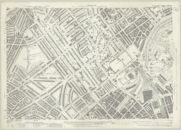

You can clearly see there the two eastern tracks are long headshunts for the goods yard, and the westernmost is a long headshunt for the facilities on the western side of the station. Interestingly, it appears four tracks continue, but I know only a single tunnel was bored for this section, although the second portal was constructed at Canfield Place and a metre or two of tunnel, for reasons I'm not too sure of?
You can see here that the original bridge over the WCML at South Hampstead was also clearly laid out for the other lines to later be built on the right:
Listing
philthetube
Established Member
- Joined
- 5 Jan 2016
- Messages
- 4,189
You need something to cope with shorter platforms, particularly at Rickmansworth, possibly others. Difficult to extend, ams possibly not allowed because of sharp curves.Agreed, if/when Chiltern gets electrified it would make sense to get a fleet of 7/9 car EMUs like the 345s but with a doors at thirds layout.
I don't think it would matter whose land, as both locations would not affect LUL services or require posessions of trak used by the underground.The first question is *how* Chiltern's going to get electrified. Relatively speaking the Wycombe route is fairly easy in as much as it's not shared. The bigger question is what about Harrow - Amersham ? Yes you could provide dual-voltage EMUs with changeovers in the vicinity of Harrow and Amersham (presumably the change would need to happen within the NR estate not TFL) but is the TFL power supply up to handling Chiltern running EMUs over that stretch ?
The Victoria line manages to operate 36tph using 2 platforms at either end of the line, without so much as a grade separated crossover.
The problem is the turnaround time, which is linked to the diversity of routes served. It's only possible to achieve that sort of frequency when all trains do the same route, so you can do your turnaround in 1-2 mins because you don't need to worry about waiting for your departure "path".
more important than routes is having stock, which can serve any route, then you have to work out staffing as on the Victoria line you can send any driver on the next train as they are all going to the same place.
Thank you mr-jrt especially. Excellent material.Originally there were a series of shorter tunnels, these were gradually linked into the current arrangement. You can see the maximum extent of the 7 tracks here:
You can clearly see there the two eastern tracks are long headshunts for the goods yard, and the westernmost is a long headshunt for the facilities on the western side of the station. Interestingly, it appears four tracks continue, but I know only a single tunnel was bored for this section, although the second portal was constructed at Canfield Place and a metre or two of tunnel, for reasons I'm not too sure of?
You can see here that the original bridge over the WCML at South Hampstead was also clearly laid out for the other lines to later be built on the right:
Listing
looking at this photo https://www.railwayarchive.org.uk/getobject?rnum=L1637&os=1
suggests three two-track tunnels, being four tracks GC and two for Met, the Bakerloo (now Jubilee) being below.
The 1915 map shows clearly 4 tracks below the Nursery End at Lords (with the Met being further over to the east through the then Lords above ground station) with the two tracks on the west side ending south of the land titled as Nursery.
That looks like a lot of work done for two sidings. I imagine agreement with MCC would have been time-consuming and expensive (for two headshunts!), and wonder whether the date of the map says something. Might there have been intent for four through GC tracks, as the South Hampstead photo also tends to suggest, with work curtailed by the war and subsequently rethought and scaled back?
Or (more speculatively) tunnels built and sealed off, like Northern Line or Down Street for government/ storage/ whatever? Also bearing in mind telephone stuff at Dollis Hill too, and RAF 'facilities' at Stanmore and Uxbridge? Appealing to the 'conspiracy theorists' ...
The 'plot' thickens.
I don't believe it was the war, I think it was the same reason Marylebone only got 4 platforms - they simply ran out of money, so did the bare minimum they could to get the service running, with any small contingency going on a bit of passive provision under Lords as that would never be able to be dug up again. As demand picked up and they had a chance to build up their reserves I suspect the second bores would have been dug, but the London Extension was never a big success, and then the grouping happened in 1923, and the GC was never going to get substantial sums spent on it when the LNER's focus was always going to be the ECML, the GCML was always a strange fit for the LNER, given it ran largely through the LMS's territory.
I don't believe it was the war, I think it was the same reason Marylebone only got 4 platforms - they simply ran out of money, so did the bare minimum they could to get the service running, with any small contingency going on a bit of passive provision under Lords as that would never be able to be dug up again. As demand picked up and they had a chance to build up their reserves I suspect the second bores would have been dug, but the London Extension was never a big success, and then the grouping happened in 1923, and the GC was never going to get substantial sums spent on it when the LNER's focus was always going to be the ECML, the GCML was always a strange fit for the LNER, given it ran largely through the LMS's territory.
Whilst the London Extension did run through Midland territory it's worth remembering that Nottingham Victoria was a GN / GC joint station - in that sense the GC enabled the GNR access into Midland territory. And much of the GC's northern territory did overlap with the GNR.
I wonder if it was also about 'balancing' the mileage of the Big 4 - as formed the LMS had about 6800 miles, the LNER 6500 - whereas if the MSLR had been put with the LMS that would have increased the LMS by about 500 miles.
Either way, the destruction of the GCR happened once BR moved the responsibility of the GCR from Eastern to Midland region and the old LMS men took no time in running down their 'old enemy' - ironically it wasn't until BR reallocated the remains from Marylebone to the Western Region did things start to look up for what is now the Chiltern line. BR Midland had utterly neglected it.

It was perhaps an attempt to avoid certain cities in the Midlands becoming complete LMS monopolies, and once you get to Yorkshire where most of the freight was the grouping made great sense.Whilst the London Extension did run through Midland territory it's worth remembering that Nottingham Victoria was a GN / GC joint station - in that sense the GC enabled the GNR access into Midland territory. And much of the GC's northern territory did overlap with the GNR.
I wonder if it was also about 'balancing' the mileage of the Big 4 - as formed the LMS had about 6800 miles, the LNER 6500 - whereas if the MSLR had been put with the LMS that would have increased the LMS by about 500 miles.
Either way, the destruction of the GCR happened once BR moved the responsibility of the GCR from Eastern to Midland region and the old LMS men took no time in running down their 'old enemy' - ironically it wasn't until BR reallocated the remains from Marylebone to the Western Region did things start to look up for what is now the Chiltern line. BR Midland had utterly neglected it.
The signalling between Marylebone and Neasden was the oldest mainline multi-aspect colour light installation in the UK, planned and started by the GCR, but commissioned by the newly formed LNER in time for the Wembley exhibition in 1924. When the WR took the line over from the LMR (about 1990?) the new Regional Signalling & Telecommunications Engineer made a complete inspection and found much of the original equipment still in situ and in an appalling, seemingly unmaintained, condition. There were cabinets in the tunnels rusted away to almost nothing, rampant cable degradation, and even some old glass 'fishtank' relays actually full of water! This was perhaps not all that surprising as up until that point the route had been living under a constant shadow of impending closure throughout the first decade of the Thatcher administration, including the absurd coach terminal conversion proposals. The incoming Engineer condemned the entire installation as unsafe immediately on his taking responsibility and ordered temporary Absolute Block working while an emergency job was implemented to quickly renew the equipment in advance of the upcoming resignalling.
It was perhaps an attempt to avoid certain cities in the Midlands becoming complete LMS monopolies, and once you get to Yorkshire where most of the freight was the grouping made great sense.
The signalling between Marylebone and Neasden was the oldest mainline multi-aspect colour light installation in the UK, planned and started by the GCR, but commissioned by the newly formed LNER in time for the Wembley exhibition in 1924. When the WR took the line over from the LMR (about 1990?) the new Regional Signalling & Telecommunications Engineer made a complete inspection and found much of the original equipment still in situ and in an appalling, seemingly unmaintained, condition. There were cabinets in the tunnels rusted away to almost nothing, rampant cable degradation, and even some old glass 'fishtank' relays actually full of water! This was perhaps not all that surprising as up until that point the route had been living under a constant shadow of impending closure throughout the first decade of the Thatcher administration, including the absurd coach terminal conversion proposals. The incoming Engineer condemned the entire installation as unsafe immediately on his taking responsibility and ordered temporary Absolute Block working while an emergency job was implemented to quickly renew the equipment in advance of the upcoming resignalling.
The closure threats had little to do with the Thatcher government - it was entirely a BR lead initiative that. As indeed was the closure from Calvert to Nottingham & Sheffield - that wasn't a Beeching proposal.
BR London Midland, packed full of ex Midland / LMS men *hated* the GC and saw it as the old competition.
By 1983 their efforts to run it down had been so successful that modernisation or closure were the options and it was Peter Parker who initiated the consultation on closure, it wasn't at the government's behest. Arguably it's inexcusable that they hadn't maintained the signaling systems as you set out - that's basic maintenance. It shows the sheer disregard BR LM had for the route.
It's worth remembering that it was a couple of Tory MPs who were among the most vociferous opponents of closure.
And it would be similar today? A lot of Conservative seats served by the now Chiltern Line, and what is now beyond in terms of former Great Central and 'Red Wall' seats; and opposition to HS2 (south of Nottingham!). What chance no influence/ interference/ involvement of 'local' MPs?It's worth remembering that it was a couple of Tory MPs who were among the most vociferous opponents of closure.
== Doublepost prevention - post automatically merged: ==
Remembering, it's 'speculative', but in the light of 'something to be done to 'lose' diesels' in the fullness of time/ or soon?For better or worse, the "get it done" attitude of the 60s is long gone, certainly when it comes to railways. You have to have several stages of consultation, submit a Transport and Works Act Order application, then wait until the Minister decides to take it off their "to do" pile (the TWAO for Manchester Picc platforms 15-16 has been sitting on that pile for years)...
In short, no chance.
The Victoria line manages to operate 36tph using 2 platforms at either end of the line, without so much as a grade separated crossover.
The problem is the turnaround time, which is linked to the diversity of routes served. It's only possible to achieve that sort of frequency when all trains do the same route, so you can do your turnaround in 1-2 mins because you don't need to worry about waiting for your departure "path".
So, the answer is that "it depends" - on how many different routes and calling patterns you want to serve, amongst other things. I think it would be safe to say that Marylebone's 6 platforms are not overly generous, but needn't be unworkable.
In short, no. Not unless it were a deep-level bored tunnel. Just as one example, MCC raised a stink about the fact that Network Rail wouldn't let them build an extension on top of the existing cut and cover tunnel that runs along the edge of their grounds.
You would have to compulsorily purchase thousands of properties... It's just not happening.
Operationally that would make some degree of sense. The difficulty is that TfL are highly unlikely to want to take on the liability of an additional loss-making stretch of line, that stretches far beyond Greater London.
I think a deal could be made, but it would involve the government having to pay TfL a lot of money, not least for whichever electrification option is chosen north of Amersham.
Why would you extend all services to Birmingham? It simply doesn't make any sense, even if it were possible (and that's not a given - take a look at the graph north of Aynho Junction).
It seems very unlikely that Marylebone will ever see a "low level" set of platforms. If anything big happens to the services on the Chiltern lines, I would expect it to be for a limited number of trains to be diverted into Old Oak Common once that part of HS2 is completed.
In the distant future, I suppose there's potential for some of the Crossrail Paddington LL/OOC terminators to be extended to join up with Chiltern OOC services. But that would require a hefty amount of grade separation at OOC and South Ruislip to be feasible, not to mention electrification from OOC to High Wycombe/Gerrards Cross or thereabouts.
Also a reminder, re Lords, that we want to stop others doing what they want, while not wanting them to stop us!!
Thank you for your helpful comments.
Thank you for this extensive response. I wasn't meaning to suggest everything should go all the way to Birmingham, only in that direction (ie not Aylesbury), with an appropriate pattern with I would imagine a lot of terminators at Banbury and of course also to Oxford.
Last edited:
The Marylebone coach station proposals were formulated at the nadir of the industry in the period of the Serpell Report under a Government with an anti-rail stance whose leader had expressed the opinion that anyone over 30 years of age who used public transport was a failure. Would such a scheme have ever got as far as it did under any other possible administration, whoever had actually proposed it initially? Thankfully, BR changed direction markedly in the late 80s with the formation of the sectors, and NSE, under Chris Green, selected the reprieved line for 'total route modernisation' instead, the first step of which was transfer to the WR which allowed the Reading Signalling Projects organisation to manage the resignalling, and operations to be combined with Thames Valley suburban using a standard new fleet of diesel units.The closure threats had little to do with the Thatcher government - it was entirely a BR lead initiative that. As indeed was the closure from Calvert to Nottingham & Sheffield - that wasn't a Beeching proposal.
BR London Midland, packed full of ex Midland / LMS men *hated* the GC and saw it as the old competition.
By 1983 their efforts to run it down had been so successful that modernisation or closure were the options and it was Peter Parker who initiated the consultation on closure, it wasn't at the government's behest. Arguably it's inexcusable that they hadn't maintained the signaling systems as you set out - that's basic maintenance. It shows the sheer disregard BR LM had for the route.
It's worth remembering that it was a couple of Tory MPs who were among the most vociferous opponents of closure.
A London Reconnections article covers the Marylebone story in context of broader rail to road conversion proposal over the years:

Almost Terminal: Marylebone's Brush With Destruction - London Reconnections
The leading source for independent news and analysis about transport in London and beyond. Award-winning coverage of transport infrastructure and politics alongside stories about the history of the Capital's transport networks.
 www.londonreconnections.com
SETTING THE SCENE
Proposals for converting railways into roads dated back several decades. Probably the most detailed argument in favour of the idea was put forward by Brigadier Thomas Ifan Lloyd, CBE, DSO, MC, in his 1957 booklet superbly titled Twilight of the Railways – What Roads They’ll Make! This set out, over some 80 pages, his argument that the line-by-line closure not just in London, but of the entire British railway system and its conversion into roads would lead to a far more efficient transport system for the country. Two years earlier Lloyd had addressed the Institute of Civil Engineers on the same topic, and the booklet is a development of this address. It is worth looking briefly at some of his points.
It was perhaps an attempt to avoid certain cities in the Midlands becoming complete LMS monopolies, and once you get to Yorkshire where most of the freight was the grouping made great sense.
The signalling between Marylebone and Neasden was the oldest mainline multi-aspect colour light installation in the UK, planned and started by the GCR, but commissioned by the newly formed LNER in time for the Wembley exhibition in 1924. When the WR took the line over from the LMR (about 1990?) the new Regional Signalling & Telecommunications Engineer made a complete inspection and found much of the original equipment still in situ and in an appalling, seemingly unmaintained, condition. There were cabinets in the tunnels rusted away to almost nothing, rampant cable degradation, and even some old glass 'fishtank' relays actually full of water! This was perhaps not all that surprising as up until that point the route had been living under a constant shadow of impending closure throughout the first decade of the Thatcher administration, including the absurd coach terminal conversion proposals. The incoming Engineer condemned the entire installation as unsafe immediately on his taking responsibility and ordered temporary Absolute Block working while an emergency job was implemented to quickly renew the equipment in advance of the upcoming resignalling.
What happened to the outgoing LM Area Signalling Engineer? I hope there was a no tea, no biscuits conversation!
whose leader had expressed the opinion that anyone over 30 years of age who used public transport was a failure. .
whose leader had expressed the opinion that anyone over 30 years of age who used public transport was a failure.
Care to provide evidence for that quote ?
== Doublepost prevention - post automatically merged: ==
What happened to the outgoing LM Area Signalling Engineer? I hope there was a no tea, no biscuits conversation!
Or, more likely, the NUR pleaded his case saying he'd given 'x' years loyal service to the railways, had been suffering from stress having seen a hedgehog get run over and he was allowed to take early retirement on a full pension......
Last edited:
I don't know but I suspect you may be correct! It's the only instance I've ever known of a complete section of mainline signalling being condemned en masse like that. I was not directly involved with the job, but as usual as a drawing office junior, I went out assisting on the commissioning weekend for the replacement colour light signalling hurriedly designed and installed using relay technology and initially controlled from the existing Marylebone and Neasden signalboxes. I believe that, being almost new, that section remained relay-based at least for a while, when the remainder of the route was SSI equipped a few years later as part of the route modernisation.What happened to the outgoing LM Area Signalling Engineer? I hope there was a no tea, no biscuits conversation!
Or, more likely, the NUR pleaded his case saying he'd given 'x' years loyal service to the railways, had been suffering from stress having seen a hedgehog get run over and he was allowed to take early retirement on a full pension......
I doubt the NUR would have been involved - AS&TE was strictly a management position!
It's the only instance I've ever known of a complete section of mainline signalling being condemned en masse like that.
Fenchurch St box very, very nearly came to it in the mid 90s. Apparently the relevant signalling engineer went into print to advise that he would condemn the lot if the relevant investment panel and Treasury didn’t authorise the LTS resignalling with urgency. It was being delayed in the transition from BR to Railtrack. Rather concentrated the minds of those on the panel, I should imagine.
swt_passenger
Veteran Member
- Joined
- 7 Apr 2010
- Messages
- 34,307
The ‘run coaches instead’ proposal was still being kept on the back burner for many years, especially by that “transport consultant” Paul Withrington when he was objecting to the Evergreen 3 (Chiltern to Oxford) TWAO...The Marylebone coach station proposals were formulated at the nadir of the industry in the period of the Serpell Report under a Government with an anti-rail stance whose leader had expressed the opinion that anyone over 30 years of age who used public transport was a failure. Would such a scheme have ever got as far as it did under any other possible administration, whoever had actually proposed it initially? Thankfully, BR changed direction markedly in the late 80s with the formation of the sectors, and NSE, under Chris Green, selected the reprieved line for 'total route modernisation' instead, the first step of which was transfer to the WR which allowed the Reading Signalling Projects organisation to manage the resignalling, and operations to be combined with Thames Valley suburban using a standard new fleet of diesel units.
A London Reconnections article covers the Marylebone story in context of broader rail to road conversion proposal over the years:
Almost Terminal: Marylebone's Brush With Destruction - London Reconnections
The leading source for independent news and analysis about transport in London and beyond. Award-winning coverage of transport infrastructure and politics alongside stories about the history of the Capital's transport networks.
The ‘run coaches instead’ proposal was still being kept on the back burner for many years, especially by that “transport consultant” Paul Withrington when he was objecting to the Evergreen 3 (Chiltern to Oxford) TWAO...
It was also proposed for the LTS at one point - less seriously though.
It appears I have been misled for years about that that widely used misquote. To be clear, there is no evidence she ever made such a remark in the public domain.Care to provide evidence for that quote ?
== Doublepost prevention - post automatically merged: ==
Something the concept's proponents have never adequately demonstrated is the peak crewing and other logistical requirements for matching the capacity of London commuter services using many individual road coaches instead of 12 car trains. Imagine if every train had to be replaced by say 16 individual coaches, each with a driver. I'm not saying there aren't some prodigious feats of capacity delivery by road vehicles in parts of world, but are they actually efficient in operation?It was also proposed for the LTS at one point - less seriously though.
Last edited:
Something the concept's proponents have never adequately demonstrated is the peak crewing and other logistical requirements for matching the capacity of London commuter services using many individual road coaches instead of 12 car trains. Imagine if every train had to be replaced by say 16 individual coaches, each with a driver. I'm not saying there aren't some prodigious feats of capacity delivery by road vehicles in parts of world, but are they actually efficient in operation?
Well, yes, but at the time of the proposal I suspect the peak service into Marylebone was at most 60 (rail) coaches an hour, and I doubt they were full.
Fair point. The early 80s were the route's and the rail industry's nadir more generally. The recovery, only a few years later, was very dramatic.Well, yes, but at the time of the proposal I suspect the peak service into Marylebone was at most 60 (rail) coaches an hour, and I doubt they were full.

Dr Hoo
Established Member
Quite!Well, yes, but at the time of the proposal I suspect the peak service into Marylebone was at most 60 (rail) coaches an hour, and I doubt they were full.
I was working at BRB HQ (at Marylebone, for younger readers) at the time when the coach way idea was being touted. This was while I was living in Kent. It was very sobering to see how coach companies such as The King's Ferry (amongst several others) quickly built up operations from the Medway Towns to Central London via the M2, even without the benefit of a dedicated corridor for the last few miles. These involved dozens of new vehicles and were quite popular. Depending on where you lived in areas like Walderslade and Rainham the coach could be a comfortable 'doorstep' alternative to relatively slow and uncomfortable slam-door EMUs from inconveniently-located stations. The fares were cheaper too. And the coaches didn't seem to have strikes.
Many of the coaches were used on tourist work in and around Central London between the peaks so it was a remarkably 'efficient' operation whilst idle peak railway rolling stock was worked back empty to Slade Green or even Gillingham to stable before another empty run back at around 1600.


A lot of residential property to buy up for what look like short platforms.I Guess this is the Most Obvious Option
View attachment 88886
- Status
- Not open for further replies.