• Our new ticketing site is now live! Using either this or the original site (both powered by TrainSplit) helps support the running of the forum with every ticket purchase! Find out more and ask any questions/give us feedback in this thread!

Weirdest Rail Rolling Stock and Infrastructure

Status
Not open for further replies.

Jozhua

Established Member
Joined
6 Jan 2019
Messages
1,891
Been as I'm looking for examples from around the world, I thought this would be the most appropriate sub forum. If not, I'm happy for it to be moved.

Send over the wierdest looking rolling stock, trains that are powered in unusual ways, or interiors that defy the standard 2+2 seating!

Seen infrastructure in wierd places, or climbing strangely steep gradients? Any rail guages that are really wide or narrow?

Send it all, I'm genuinely intrigued.

My favourite has to be the train ferrys, of which there are an Italian and Swedish example in Europe. The sleeper trains get loaded onto a boat for part of their journey.

 
Sponsor Post - registered members do not see these adverts; click here to register, or click here to log in
R

RailUK Forums

lxfe_mxtterz

Member
Joined
3 Mar 2018
Messages
1,072
Location
Sarahdale (West of Emmerdale)
Japan has a whole range of weird and interesting trains and railway infrastructure. Two examples of interesting stations are...

Doai

"In Gunma Prefecture a few hours north of Tokyo lies Doai Station, the deepest train station in Japan. With its platform located 70 meters underground from the entrance, Doai station has been a hot spot for many travelers looking for a spooky experience unlike anything else!

Functioning as part of the Joetsu Line that connects Niigata Prefecture area to Tokyo as it runs all the way to Ueno Station, Doai Station opened in December of 1936 with two platforms servicing the few trains that operate every day. In a recent census, it was discovered that the station still attracts about 22 passengers a day as of 2011.

One of the platforms is above ground in a very unassuming area just behind the main entrance. The other platform lies inside the Shimizu Tunnel that connects Niigata Prefecture to Gunma Prefecture.

In order to get to the Shimizu Tunnel, though, you will have to go down a total of 486 steps to reach the train platform.

As the station itself is in an area that is rather remote, it remains unmanned by staff, and visitors are free to enter the premises to explore to their heart’s content. However, please be aware that you will still need to pay to get on the train if you decide to jump aboard."

- JAPAN Forward

EACB37B4-DBD5-4471-89D7-2AE5A60B61D2.jpeg

Photo by JAPAN Forward.

0A90FE10-9BC8-4714-877A-0AEB4EE3CC07.jpeg

Photo by Makoto Saito.

Tappi-Kaitei & Yoshioka-Kaitei

These two stations are located in the Seikan Tunnel which connects the main Japanese island of Honshu with the northern island of Hokkaido, but what I find really interesting is how narrow the platforms of both these stations are! Sadly, both stations are now closed, but here is a photo of one of the stations which put Wapping to shame! :D

FAA4F1EB-0C96-4112-8914-466822226432.jpeg

Photo by someone on TripAdvisor; I couldn't find who, unfortunately.
 

eastwestdivide

Established Member
Joined
17 Aug 2009
Messages
3,411
Location
S Yorks, usually
In 2012, I passed an electrified turntable outside Leipzig.
There's another at Mürzzuschlag on the Semmering line.

For infrastructure, the Rendsburg bridge in N Germany is overdue a visit - a high level rail bridge, reached by a spiral track, with a transporter bridge underneath.

In Switzerland, Aareschlucht Ost, a request stop station in a tunnel where the driver has to stop to open the door to the station, which is a door in the side of the tunnel giving onto the gorge after which it's named. You can't wait on the platform.
 

Shimbleshanks

Established Member
Joined
2 Jan 2012
Messages
1,283
Location
Purley
For strange ideas, I can recommend the two books by Adrian S Garner, Monorails of the 19th Century and Monorails of the Early 20th Century.

Just to quote a few examples:
The Larmanjat system that used a mixture of guided flanged wheels and road wheels (and the later and rather similar Ewing system that saw some use in India);
The Bradford & Foster Brook Railway in Pennsylvania which had a standard Baldwin 4-4-0 but balanced on single wheels and raiuls (it toppled over);
Lartigue's monorails which had doubled-boilered locomotives straddling a trestle-type rail (a system operated relatively successfully between Listowel and Ballybunion in Irelanmd for quite a number of years) and there was also a line between Feurs and Panissieres in France, a very rare example of a line that was completed, but never went into commercial operation;
Behr's demonstration monorail in Brussels in the late 1890s that reached speeds of nearly 100mph;
And the Boynton Bicycle Railway on Long Island in the US which used very narrow cars of about 4ft width, each using one rail of a convential railway as a monorail.
 

dazzler

Member
Joined
6 Apr 2018
Messages
260
Location
York
For strange ideas, I can recommend the two books by Adrian S Garner, Monorails of the 19th Century and Monorails of the Early 20th Century.

Just to quote a few examples:
The Larmanjat system that used a mixture of guided flanged wheels and road wheels (and the later and rather similar Ewing system that saw some use in India);
The Bradford & Foster Brook Railway in Pennsylvania which had a standard Baldwin 4-4-0 but balanced on single wheels and raiuls (it toppled over);
Lartigue's monorails which had doubled-boilered locomotives straddling a trestle-type rail (a system operated relatively successfully between Listowel and Ballybunion in Irelanmd for quite a number of years) and there was also a line between Feurs and Panissieres in France, a very rare example of a line that was completed, but never went into commercial operation;
Behr's demonstration monorail in Brussels in the late 1890s that reached speeds of nearly 100mph;
And the Boynton Bicycle Railway on Long Island in the US which used very narrow cars of about 4ft width, each using one rail of a convential railway as a monorail.

All of those, bar the Behr monorail in Brussels are mentioned on Douglas Self's excellent website Loco Locomotives, along with many other weird and wonderful locos.
 

Ianno87

Veteran Member
Joined
3 May 2015
Messages
15,214
Wuppertal Schwebebahn seems pretty much unique.

There is a much more modern Schwebwebahn at Düsseldorf Airport.

== Doublepost prevention - post automatically merged: ==

I also nominate the section of line along Wexford Quay, Ireland.
 

2HAP

Member
Joined
12 Apr 2016
Messages
473
Location
Hadlow
There's a set of points at Snaefell station, Snaefell Mountain Railway, Isle of Man that has a single blade.
 

JonasB

Member
Joined
27 Dec 2016
Messages
1,123
Location
Sweden
My favourite has to be the train ferrys, of which there are an Italian and Swedish example in Europe. The sleeper trains get loaded onto a boat for part of their journey.

There will probably not be any train ferries for passengers anymore in Sweden, the nights trains to Germany are planned to run via Denmark next year. So the train ferries are now for freight only.

But one that might be a bit weird, and at least has been talked about in Sweden is the three gauge point that existed in Växjö. Claimed to be the only one in the world, but to be honest I'm not sure I believe that. And it was only a point for two of the gauges.JvmKBAA05766 (kopia).jpg
 

GRALISTAIR

Established Member
Joined
11 Apr 2012
Messages
10,503
Location
Preston Lancs
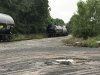
I choose this from Dalton GA in the USA. I post because we own the sidings and I watch the trains shunting the chemical tankers into place.
 

Attachments

  • E36B8137-708E-4E6B-B300-F41DA6B18D1B.jpeg
    E36B8137-708E-4E6B-B300-F41DA6B18D1B.jpeg
    3.2 MB · Views: 105

JonasB

Member
Joined
27 Dec 2016
Messages
1,123
Location
Sweden
When the Öresund bridge was built the Swedish and Danish railways had to work together seamless. Apart from different voltages and signal system, in Denmark trains drive on the right, in Sweden they drive on the left. To solve that a crossing was built just north of Malmö where the northbound tracks go in a tunnel under the southbound tracks. It is visible in this cabride (from around 5:00 in case the time stamp doesn't work):

Someone mentioned an electric turntable, in Storlien there is an indoor turntable: https://www.google.se/maps/@63.3155663,12.100579,259m/data=!3m1!1e3

In Hudiksvall the rail line runs through a hotel: https://goo.gl/maps/DQscJemifpzRaZAC7 (The plan is to double track the line, but this part has proven to be a bit of a headache.

Örnsköldsvik, where the rail line runs over a ski jumping slope: https://goo.gl/maps/DQscJemifpzRaZAC7

Rottneros, a park with a rail line through it: https://goo.gl/maps/TdxeFVbHjtJVc6tg7 Not the biggest rail line, but it sees around 30 passenger trains a normal weekday and there are freight trains as well.

Combined road and rail bridges, there are a couple of them in Sweden, here is one in Sveg: https://goo.gl/maps/mWy2owfroczxFNfW7
 
Joined
21 Sep 2010
Messages
266
Nove Udoli in the Czech Republic.

Overgrown and out of action in 2006 but apparently operating in 2019.


26.jpg
 

61653 HTAFC

Veteran Member
Joined
18 Dec 2012
Messages
19,352
Location
Yorkshire
Pont Gisclard on the Cerdagne line in the South of France. Not just a rare railway suspension bridge, but one that's electrified with DC 3rd rail.

At one end of that line is Latour de Carol/Enveitg. One of two (?) stations in Europe served by three different gauges: metre gauge on the aforementioned Cerdagne line; standard gauge to Toulouse; Iberian gauge to Barcelona. The other triple gauge station I'm aware of is Montreux in Switzerland, but there may be others.

As for unusual trains, the line is operated with both modern Stadler GTW units, and vintage EMU sets dating back to the original opening in the 1900s- which during the summer include open-air carriages.

Another rather odd-looking train is the DB 670, no longer in service in Germany but some were sold to other railways from what I could tell.
https://commons.wikimedia.org/wiki/File:Doppelstockschienenbus_der_DWE_Baureihe_670(Elfriede).jpg
 

etr221

Established Member
Joined
10 Mar 2018
Messages
1,597
There this unusual rail crossing in OZ, A drawbridge instead of a diamond crossing
My understanding is there are several of these, where the sugar cane estate ng railways (I think 2' gauge) cross the QR 3' 6" gauge 'main line' - it was felt preferable to having, and maintaining, flat, square, crossings.

Not previously mentioned is the Patiala State Monorail Tramway in India, sample preserved at the Railway Museum in Delhi.

There are (or were) a couple of triple gauge (with triple gauge track) stations in South Australia - I forget the details (and they changed when the Trans-Australian standard gauge project was implemented).

Several loco builders had really mutigauge test tracks (by which I mean 5 or 6 gauges)

The Norwegians have a couple of underground turntables - one is in Oslo Sentral loco depot, whose track layout is that of a roundhouse, but all dug into a mountain. And another off the long (and relatively new) tunnel on the Oslo-Bergen mainline.

Some of the locally built locos ('critters') for forestry railways in New Zealand were pretty weird.

Something that Douglas Self missed for his loco loco pages were the Geoghegan locomotives - and the (Irish) standard gauge haulage wagons that they powered - used at the Guiness Brewery in Dublin.

The Panama Canal tug locomotive railways, to assist ships through the locks.

The funicular assisted Trieste-Opicina tramway in Italy.

Proposed in various places, but never I think actually built or completed were ship-carrying railways (in place of canals).
 

biko

Member
Joined
8 Mar 2020
Messages
512
Location
Overijssel, the Netherlands
Not extremely weird maybe, but in the Netherlands we have freight trains on metro tracks between Schiedam and Vlaardingen. I don’t think this happens anywhere else, but correct me if I’m wrong.
 

Midnight Sun

Member
Joined
16 Sep 2018
Messages
310
Not extremely weird maybe, but in the Netherlands we have freight trains on metro tracks between Schiedam and Vlaardingen. I don’t think this happens anywhere else, but correct me if I’m wrong.
Freight wagons carry steel that were hauled along short sections of the old Glasgow tramway network before it was closed by small electric locomotives to the shipyards from the nearest mainline freight yards.

freight1.jpg
 

biko

Member
Joined
8 Mar 2020
Messages
512
Location
Overijssel, the Netherlands
Freight wagons carry steel that were hauled along short sections of the old Glasgow tramway network before it was closed by small electric locomotives to the shipyards from the nearest mainline freight yards.

View attachment 82502
On tramways used to happen here as well, the Netherlands used to have extensive regional tramways with freight transport to railway stations. But are there any examples on metro tracks? I don't think LU has any freight on its tracks, although of course there are mainline trains on LU.
 

DanielB

Established Member
Joined
27 Feb 2020
Messages
1,451
Location
Amersfoort, NL
When the Öresund bridge was built the Swedish and Danish railways had to work together seamless. Apart from different voltages and signal system, in Denmark trains drive on the right, in Sweden they drive on the left. To solve that a crossing was built just north of Malmö where the northbound tracks go in a tunnel under the southbound tracks.
The border between The Netherlands and Belgium has a similar situation, with trains in The Netherlands which are driving on the right while in Belgium they drive on the left. When the high speed line between Amsterdam and Antwerpen was built however, the crossover was built nowhere near the border: just south of Rotterdam Lombardijen station trains from the south towards Rotterdam pass over a huge fly-over to get from the left (northbound) high-speed tracks to the right domestic track towards Rotterdam Central crossing seven other tracks.
As a result, both international and domestic trains run on the left track when using the high speed line south of Rotterdam.

More unique are the Intercity-tracks between Utrecht Central and Blauwkapel junction however, which are the only place in The Netherlands where non-high speed trains are driving on the left by design. This situation arose when fly-overs where built to increase capacity at Utrecht Central: Intercity to/trains from Rotterdam/The Hague arrive/depart driving on the right and using the fly-overs. At Utrecht Central, these trains have to reverse to continue to Amersfoort Central. When departing from Utrecht these trains are then driving on the left until Blauwkapel junction just outside the city boundaries where more space was available to build a crossover.

A weird situation on the Dutch network in the past was the initial connection to Houten Castellum station. As construction of houses near the proposed location of this new station started years before the Utrecht - Houten line could be doubled (needed to have sufficient capacity for an additional stop) it was decided to build a temporary third track next to the existing line and to rent two TW6000 trams from HTM in The Hague (which had bought a fleet of those trams second hand from Hannover). They were painted NS yellow and equipped with a downchopper to convert the 1500V on the overhead lines to the 600V on which the trams operated.
These trams were running an half-hourly service from January 2001 till December 2008 at a maximum speed of 40 km/h. A journey from Houten to Houten Castellum took only three minutes.
 

Bald Rick

Veteran Member
Joined
28 Sep 2010
Messages
35,817
I’m not going to describe this, but leave it for the viewer’s delectation.

Check out the pantograph, and the points operating equipment.


Ianno87

Veteran Member
Joined
3 May 2015
Messages
15,214
Not extremely weird maybe, but in the Netherlands we have freight trains on metro tracks between Schiedam and Vlaardingen. I don’t think this happens anywhere else, but correct me if I’m wrong.
On tramways used to happen here as well, the Netherlands used to have extensive regional tramways with freight transport to railway stations. But are there any examples on metro tracks? I don't think LU has any freight on its tracks, although of course there are mainline trains on LU.

I think it used to happen on the Tyne and Wear metro when the present-day Airport line only went to Bank Foot? Freight access was still possible via Metro tracks to the former freight terminal at Callerton.
 

Jozhua

Established Member
Joined
6 Jan 2019
Messages
1,891
When the Öresund bridge was built the Swedish and Danish railways had to work together seamless. Apart from different voltages and signal system, in Denmark trains drive on the right, in Sweden they drive on the left. To solve that a crossing was built just north of Malmö where the northbound tracks go in a tunnel under the southbound tracks. It is visible in this cabride (from around 5:00 in case the time stamp doesn't work):
Oh yeah, always wondered how that works!
Another rather odd-looking train is the DB 670, no longer in service in Germany but some were sold to other railways from what I could tell.
https://commons.wikimedia.org/wiki/File:Doppelstockschienenbus_der_DWE_Baureihe_670(Elfriede).jpg
I love it! Where can I buy one?
There this unusual rail crossing in OZ, A drawbridge instead of a diamond crossing

Oh yeah, seen that around before. Seems a bit over engineered, but hey, an interesting watch.
I’m not going to describe this, but leave it for the viewer’s delectation.

Check out the pantograph, and the points operating equipment.

Doesn't seem far off the quality of trains in the Northwest. The pantograph system is interesting, but the electrification is probably more reliable than that around Manchester.
Really, people just need to tighten their bootstraps and hook a metal rod to the cables!
 

etr221

Established Member
Joined
10 Mar 2018
Messages
1,597
I don't think LU has any freight on its tracks, although of course there are mainline trains on LU.
While no freight these days on LU, there used to be: the Metropolitan Railway always thought of itself as a 'mainline' company, with significant goods traffic on the Extension, also depots in the City (some served by the Met., others accessed by GWR, Midland and GNR via running powers). Most was handed over to the LNER in the 1930s; but I believe the Uxbridge line freight traffic remained (at least nominally) an LT operation until much later. The District provided access to goods depots at Kensington; and the LNER/BR continued to provide freight services over the 'New Works' extensions of the Northern and Central lines. Special disk distant signals were provided for freight trains! And the East London Line used to be a Met/MDR/LNER/SR joint line, with significant freight usage into the 1950s/60s. ISTR some at the north connection with the GER came down down by lift, rather then being worked via Liverpool Street

On which thought, not to forget the Post Office Railway, carrying mail under London in unmanned trains from the 1920s - I hesitate to say automatic: the technology was basically that of model railways - switch the current on or off to go or stop.

And the Chicago Tunnel Company, which provided freight service under Chicago - again, narrow gauge and electric. It's last traffic was carrying ash away from office central heating furnaces: the last trains never ran, they laden and that was it: as far as the office was concerned, they were rid of the ash, and were happy.

And the other surprising underground railway is the Jungfraubahn to Jungfraujoch - a rack line to the highest station in Switzerland, but underground.

Noting the freight operation over the Glasgow tramway illustrated up thread: the tramway gauge was slightly less than standard, the sg freight wagons ran on tiptoe, as it were, with the tips of the wheel flanges in the tram rail grooves.

A book I remember reading many years ago: Unusual Railways, by Wilson B.G. & Day J.R., published by Frederick Muller Ltd 1957.
 

JKF

Established Member
Joined
29 May 2019
Messages
1,299
Not extremely weird maybe, but in the Netherlands we have freight trains on metro tracks between Schiedam and Vlaardingen. I don’t think this happens anywhere else, but correct me if I’m wrong.

in the early 20th Century coal was transported via the Leeds Tramway network, from Busk Pit near Gipton to Wortley Fireclay Works. There were reasonably long freight-only branches at each end, plus other connections to Elland Rd, Kirkstall maintenance depot/yard and other pits.. Rolling stock was tram ‘tippler’ cars usually used for maintenance.

== Doublepost prevention - post automatically merged: ==

Another rather odd-looking train is the DB 670, no longer in service in Germany but some were sold to other railways from what I could tell.
https://commons.wikimedia.org/wiki/File:Doppelstockschienenbus_der_DWE_Baureihe_670(Elfriede).jpg

Looks similar in profile to the buses that used to run into Beverley, which were shaped this way to pass through an ancient arched gateway.

 
Status
Not open for further replies.

Top